Famine: Zimbabwe’s chickens are coming home to roost

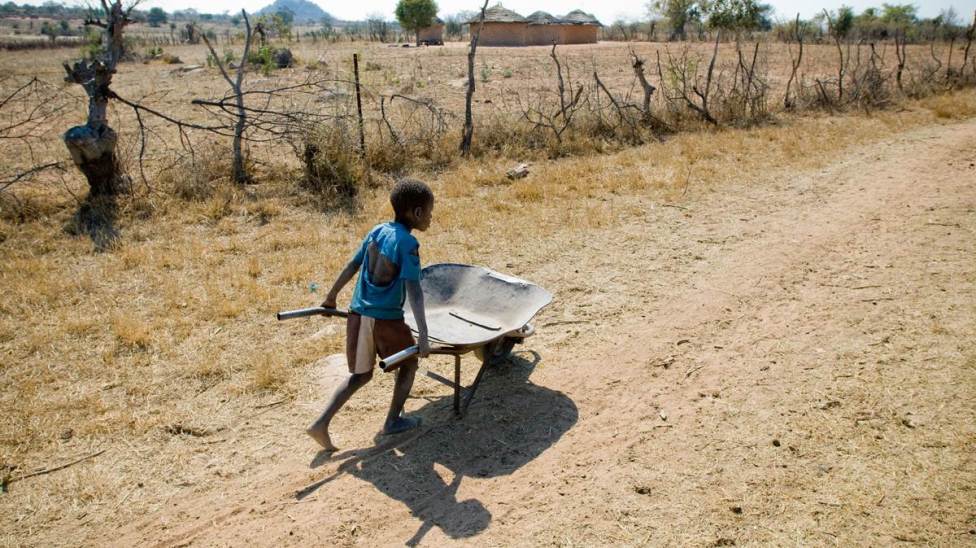
Zimbabwe, which has been ruled by the radical Afro-Marxist party ZANU PF for the last 39 years and long a darling of the global left, is finally hitting an economic brick wall with a possible famine in the offing, at least according to the United Nations World Food Programme.

The economic mismanagement of the country has been complemented by what is being called “the worst drought in almost four decades, cyclone-induced floods and an economic collapse have left Zimbabwe on the verge of its worst-ever famine”.

The southern African nation will probably run out of maize — its staple food — by January and about three out of five Zimbabweans won’t have enough to eat, according to the United Nations World Food Programme.

The government has already declared a state of disaster because of the drought, which has decimated harvests. One of the strongest-ever cyclones in the southern hemisphere also destroyed crops in March and a deepening economic crisis has limited the government’s ability to address the looming shortfalls.

Since a parity peg to the U.S. dollar was dropped in February, the local currency has slumped to 13.85 to the dollar, making it the world’s worst performer. That’s slashed spending power in a country where most goods are imported. Zimbabwe is already struggling to find sufficient foreign exchange to fund imports of fuel and wheat.

While Zimbabwe has experienced intermittent food shortages for the last two decades, the problem has mostly been limited to rural areas. This time, 3 million of the 8.5 million people at risk of food insecurity are in cities, said Eddie Rowe, the WFP’s country director in Zimbabwe.

“You will have a lot more people hungry in Zimbabwe than ever before,” he said. In the past, “in urban areas the alarm bells were not ringing.”

“The drought has just exacerbated the situation,” said Jee-A van der Linde, an economist at NKC African Economics in Paarl, South Africa. It will “deteriorate to a point where they need foreign aid.”

The country’s maize crop is expected to plummet 54% this year and Agriculture Secretary Ringson Chitsiko warned in March it only had seven months of grain stockpiles, including corn. Parts of north-western Zimbabwe had their lowest rainfall since 1981, according to the Southern African Development Community.

Zimbabwe has made attempts to replenish its maize stocks, but an international tender for at least 750,000 tons of corn failed because the government and bidders couldn’t agree on financial terms, two people familiar with the situation said.

The country has now agreed to buy 150,000 tons of maize from South Africa, the people said. However, analysts estimate Zimbabwe could need as much as 1 million tons of maize imports.

Sibusiso Moyo, the country’s foreign minister and head of its grain importation committee, didn’t respond to messages sent to his office seeking comment.

Zimbabwe’s crisis has been compounded by smaller harvests in neighboring countries, such as Zambia, which often have surpluses

The white maize preferred by Zimbabweans also limits the pool of potential suppliers, as the yellow variety is more common in other parts of the world. In southern Africa, white maize is mainly reserved for human consumption and yellow is fed to animals.

Zim intensifies war against white farmers

Zimbabwe has intensified its war against white farmers. The land grab has already sparked severe food shortages and has contributed to massive inflation.

The country’s lands and resettlement minister Douglas Mombeshora wants at least 163 white commercial farmers in Mashonaland East evicted with no compensation.

This follows after President Robert Mugabe recent vows to expel the country’s last remaining white farmers from their land.

“We don’t need a white man to continue to guide us. No. We are now equipped with skills,” Mugabe was quoted as saying during a party to celebrate his 91st birthday in Victoria Falls last Saturday.

The land grabs were set to continue despite Mugabe publicly admitting earlier that ill-equipped black “war veterans”, have laid to waste vast tracts of farmland seized from whites under his controversial land reforms.

But Mugabe nevertheless continues to reward his party cronies and political allies with farms confiscated from whites.

According to New Zimbabwe.com, more than 160 white commercial farmers in Mashonaland East province will soon be removed from their properties as the government says they are occupying the land “illegally”.

Meanwhile, News Day reported on Thursday that the European Union had warned Mugabe over his threat for more land grabs saying the move could ruin business re-engagement efforts between Zimbabwe and the EU block.

The EU recently lifted restrictions on most government officials, but retained Mugabe and his wife Grace on the sanctions list.

“Whites will never own land in Zimbabwe”

Mugabe and his ruling Zanu-PF party launched the land reforms in 2000, taking over white-owned farms to resettle only black Shona peasants belonging to his own tribe, to “correct colonial land ownership imbalances”.

At least 4 000 white commercial farmers were evicted from their farms, together with black Ndebele peasants. Mugabe launched an ethnic cleansing campaign after independence in which 20 000 black Ndebeles were massacred by his ruling tribe.

The land seizures have often been violent, claiming the lives of several white farmers, but despite losing ownership, many have survived unlike their white South African counterparts.

Some “war veterans” from Zimbabwe’s 1970s liberation struggle claiming land, are teenagers or in their twenties, adding to the sad farce.

How Britain plundered the globe for 300 years

by George Monbiot of The Guardian

Opium, famine and banks all played their part in Britain’s plundering of the globe.

Why now? It’s not as if this is the first time Britain’s representatives have been caught out. The history of governments in all countries is the history of scandal, as those who rise to the top are generally the most ambitious, ruthless and unscrupulous people politics can produce. Pushing their own interests to the limit, they teeter perennially on the brink of disgrace, except when they fly clean over the edge. So why does the current ballyhoo threaten to destroy not only the government but also our antediluvian political system?

The past 15 years have produced the cash-for-questions racket, the Hinduja and Ecclestone affairs, the lies and fabrications that led to the invasion of Iraq, the forced abandonment of the BAE corruption probe, the cash-for-honours caper and the cash-for-amendments scandal. By comparison to the outright subversion of the functions of government in some of these cases, the is small beer. Any one of them should have prompted the sweeping political reforms we are now debating. But they didn’t.

For the past 300 years, the revolutions and reforms experienced by almost all other developed countries have been averted in Britain by foreign remittances.

The social unrest that might have transformed our politics was instead outsourced to our colonies and unwilling trading partners. The rebellions in Ireland, India, China, the Caribbean, Egypt, South Africa, Malaya, Kenya, Iran and other places we subjugated were the price of political peace in Britain. After decolonisation, our plunder of other nations was sustained by the banks. Now, for the first time in three centuries, they can no longer deliver, and we must at last confront our problems.

There will probably never be a full account of the robbery this country organised, but there are a few snapshots. In his book Capitalism and Colonial Production, Hamza Alavi estimates that the resource flow from India to Britain between 1793 and 1803 was in the order of £2m a year, the equivalent of many billions today. The economic drain from India, he notes, “has not only been a major factor in India’s impoverishment … it has also been a very significant factor in the industrial revolution in Britain”. As Ralph Davis observes in The Industrial Revolution and British Overseas Trade, from the 1760s onwards India’s wealth “bought the national debt back from the Dutch and others … leaving Britain nearly free from overseas indebtedness when it came to face the great French wars from 1793”.

In France by contrast, as Eric Hobsbawm notes in The Age of Revolution, “the financial troubles of the monarchy brought matters to a head”. In 1788 half of France’s national expenditure was used to service its debt: the “American War and its debt broke the back of the monarchy”.

Even as the French were overthrowing the ancien regime, Britain’s landed classes were able to strengthen their economic power, seizing common property from the country’s poor by means of enclosure. Partly as a result of remittances from India and the Caribbean, the economy was booming and the state had the funds to ride out political crises. Later, after smashing India’s own industrial capacity, Britain forced that country to become a major export market for our manufactured goods, sustaining industrial employment here (and avoiding social unrest) long after our products and processes became uncompetitive.

Colonial plunder permitted the British state to balance its resource deficits as well. For some 200 years a river of food flowed into this country from such places as Ireland, India and the Caribbean. In The Blood Never Dried, John Newsinger reveals that in 1748 Jamaica alone sent 17,400 tons of sugar to Britain; by 1815 this had risen to 73,800. It was all produced by stolen labour.

Just as grain was sucked out of Ireland at the height of its great famine, so Britain continued to drain India of food during its catastrophic hungers. In Late Victorian Holocausts, Mike Davis shows that between 1876 and 1877 wheat exports to the UK from India doubled as subsistence there collapsed, and several million died of starvation. In the North-Western provinces famine was wholly engineered by British policy, as good harvests were exported to offset poor English production in 1876 and 1877.

Britain, in other words, outsourced famine as well as social unrest. There was terrible poverty in this country in the second half of the 19th century, but not mass starvation. The bad harvest of 1788 helped precipitate the French revolution, but the British state avoided such hazards. Others died on our behalf.

In the late 19th century, Davis shows, Britain’s vast deficits with the United States, Germany and its white dominions were balanced by huge annual surpluses with India and (as a result of the opium trade) China. For a generation “the starving Indian and Chinese peasantries … braced the entire system of international settlements, allowing England’s continued financial supremacy to temporarily co-exist with its relative industrial decline”. Britain’s trade surpluses with India allowed the City to become the world’s financial capital.

Its role in British colonisation was not a passive one. The bankruptcy, and subsequent British takeover, of Egypt in 1882 was hastened by a loan from Roths­child’s bank whose execution, Newsinger records, amounted to “fraud on a massive scale”. ­Jardine Matheson, once the biggest narco-trafficking outfit in history (it dominated the Chinese opium trade), later formed a major investment bank, Jardine Fleming. It was taken over by JP Morgan Chase in 2000.

We lost our colonies, but the plunder has continued by other means. As Joseph Stiglitz shows in Globalisation and its Discontents, the capital liberalisation forced on Asian economies by the IMF permitted northern traders to loot hundreds of billions of dollars, precipitating the Asian financial crisis of 1997-98. Poorer nations have also been strong-armed into a series of amazingly one-sided treaties and commitments, such as trade-related investment measures, bilateral investment agreements and the EU’s economic partnership agreements. If you have ever wondered how a small, densely populated country which produces very little supports itself, I would urge you to study these asymmetric arrangements.

But now, as John Lanchester demonstrates in a fascinating essay in the London Review of Books, the City could be fatally wounded. The nation that relied on financial services may take generations to recover from their collapse. The great British adventure – three centuries spent pillaging the labour, wealth and resources of other countries – is over. We cannot accept this, and seek gleeful revenge on a government that can no longer insulate us from reality.

Read the original article here.


Starvation looms in Zimbabwe

The New York Times recently carried an article stating that Zimbabwe’s “land reform”, confiscating the land of white farmers, was a “success”. Now this report from the United Nations World Food Programme shows the true picture: a country where one in five people receives food hand-outs.

Famine has raised its head in Zimbabwe again, as the numbers of people depending on aid to avoid starvation soared by 60 percent from last year to 1.6 million, according to the United Nations World Food Programme (WFP).

The agency said that one in five of the country’s rural people were in need of famine relief. Grain production in the last year was 1 million tonnes, the worst since 2009, which at 800,000 tonnes was the worst year on record.

Zimbabwe had a reputation as “Africa’s breadbasket” until 2000 when President Robert Mugabe launched his violent seizures of white-owned farms, forcing 1,500 white farmers of their land and displacing a million farm workers and their families.

The International Monetary Fund and the World Bank have said that year marked the beginning of the collapse of one of Africa’s most successful economies.

The latest figures were released after a lengthy study by UN agencies, the Zimbabwe government and non-governmental organisations involved in agriculture.

Already, the report said, rural residents of the country were feeling the effects of the food shortages, a pattern marked by empty domestic granaries and farmers selling their cattle to raise money to buy food.

The report blamed erratic rainfall, low supplies of seed and fertilizer, and bad farming practices.

At the height of the last rainy season, farmers unions slammed a supply arrangement set-up by government officials. Political figures in Mugabe’s ZANU(PF) party snapped up cheap fertilizer and seed and sold large quantities of it at inflated prices while peasant farmers waited helplessly.

During the current winter wheat season, promises of cheap supplies from the government also came to nothing, resulting in the lowest wheat crop forecast yet of 5,000 tonnes.

The WFP said it would rely on “regionally procured cereals” to make up the country’s current shortfall.

Commentators have pointed out that the biggest regional producer is Zambia, where scores of white farmers moved and became large-scale producers again after being driven off their land in Zimbabwe in the last decade. – Sapa-DPA