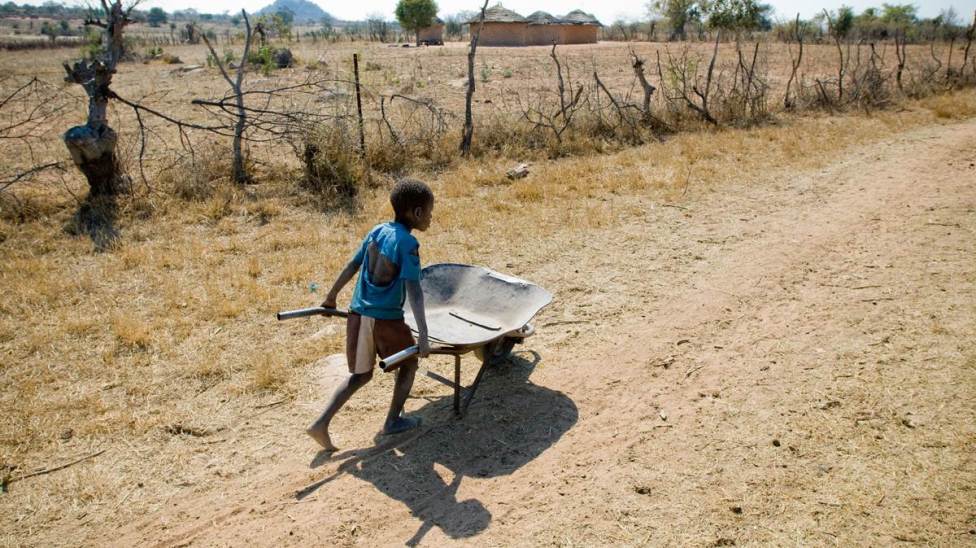
Famine: Zimbabwe’s chickens are coming home to roost

Zimbabwe, which has been ruled by the radical Afro-Marxist party ZANU PF for the last 39 years and long a darling of the global left, is finally hitting an economic brick wall with a possible famine in the offing, at least according to the United Nations World Food Programme.

The economic mismanagement of the country has been complemented by what is being called “the worst drought in almost four decades, cyclone-induced floods and an economic collapse have left Zimbabwe on the verge of its worst-ever famine”.

The southern African nation will probably run out of maize — its staple food — by January and about three out of five Zimbabweans won’t have enough to eat, according to the United Nations World Food Programme.

The government has already declared a state of disaster because of the drought, which has decimated harvests. One of the strongest-ever cyclones in the southern hemisphere also destroyed crops in March and a deepening economic crisis has limited the government’s ability to address the looming shortfalls.

Since a parity peg to the U.S. dollar was dropped in February, the local currency has slumped to 13.85 to the dollar, making it the world’s worst performer. That’s slashed spending power in a country where most goods are imported. Zimbabwe is already struggling to find sufficient foreign exchange to fund imports of fuel and wheat.

While Zimbabwe has experienced intermittent food shortages for the last two decades, the problem has mostly been limited to rural areas. This time, 3 million of the 8.5 million people at risk of food insecurity are in cities, said Eddie Rowe, the WFP’s country director in Zimbabwe.

“You will have a lot more people hungry in Zimbabwe than ever before,” he said. In the past, “in urban areas the alarm bells were not ringing.”

“The drought has just exacerbated the situation,” said Jee-A van der Linde, an economist at NKC African Economics in Paarl, South Africa. It will “deteriorate to a point where they need foreign aid.”

The country’s maize crop is expected to plummet 54% this year and Agriculture Secretary Ringson Chitsiko warned in March it only had seven months of grain stockpiles, including corn. Parts of north-western Zimbabwe had their lowest rainfall since 1981, according to the Southern African Development Community.

Zimbabwe has made attempts to replenish its maize stocks, but an international tender for at least 750,000 tons of corn failed because the government and bidders couldn’t agree on financial terms, two people familiar with the situation said.

The country has now agreed to buy 150,000 tons of maize from South Africa, the people said. However, analysts estimate Zimbabwe could need as much as 1 million tons of maize imports.

Sibusiso Moyo, the country’s foreign minister and head of its grain importation committee, didn’t respond to messages sent to his office seeking comment.

Zimbabwe’s crisis has been compounded by smaller harvests in neighboring countries, such as Zambia, which often have surpluses

The white maize preferred by Zimbabweans also limits the pool of potential suppliers, as the yellow variety is more common in other parts of the world. In southern Africa, white maize is mainly reserved for human consumption and yellow is fed to animals.

New York Times and UN at loggerheads over state of Zimbabwean agriculture

Rural Zimbabweans in need of UN food relief after Mugabe's 'successful land reform' Photo: WFP

Whereas the New York Times sang the praises of Zimbabwean “land reform” only a few weeks ago, the UN food agency has just said that hunger was worsening in Zimbabwe after erratic rains, shortages of seeds and fertiliser and “poor agricultural practices” in the troubled economy.

This, the UN said, had led to a reduction in fields planted with the main staple foods. The World Food Programme said cereal harvests in the current season were down by an estimated one-third compared with last year. It said about 1.1million rural people would need food aid up to December, rising to 1.6million in the traditionally “lean months” to March.

The agency’s latest bulletin yesterday said $119-million was needed for upcoming food assistance. It said food shortfalls were becoming especially critical in arid southern Zimbabwe where Matabeles live. The Zimbabwean leader has previously been accused of genocide in Matabeleland where 20 000 people were killed in the early 1990s, with a large proportion of the inhabitants fleeing to South Africa.

Irregular rains, poor agricultural practices and ongoing economic challenges have pushed Zimbabwe into an increasingly critical food security situation, the United Nations food relief agency warned.

Lydia Polgreen of The New York Times Photo: Twitter

However, the New York Times’s correspondent in Johannesburg, Lydia Pogreen, differs from the WFP assessment and sees a “golden lining” amid any dark clouds over Zimbabwean agriculture. On 20 July 2012 the New York-based liberal paper wrote:

“The success of these small-scale farmers has led some experts to reassess the legacy of Zimbabwe’s forced land redistribution, even as they condemn its violence and destruction. “

The paper also stressed that the illegal confiscation of white-owned land does not necessarily lead to greater farming productivity but creates greater equality. It quoted a Zimbabwean pro-Mugabe researcher as saying: “But does it share wealth more equitably? Does it give people a sense of dignity and ownership? Those things have value, too.”

According to the World Food Programme (WFP), the past several weeks have provided signs of growing distress across the African country with high food prices, empty silos and granaries, and a reduced cereal harvest, aggravating the country’s food security outlook.

“Late and erratic rains, poor agricultural practices, constrained access to inputs, and a reduction in planted area have all contributed to reducing the national cereal harvest by 33 per cent this year,” WFP said in a news release on its Zimbabwe Vulnerability Assessment (ZimVAC). It further noted that a lack of diversified livelihoods and the rising cost of living were combining to create a perfect storm of income and food insecurity.

WFP, in fact, pointed out that according to the ZimVAC, over 1.6 million Zimbabweans will be in need of food assistance during the peak hunger period spanning January to March 2013.

ZimVAC is an annual study conducted by the Government of Zimbabwe in collaboration with UN agencies and non-governmental organisations in order to estimate national food insecurity levels.

In response to the deteriorating food situation, the UN agency announced it was scaling up operations in conjunction with the Government and other stakeholders to provide a combination of food distribution and cash transfers to those in need.

The WFP further noted that it would require approximately $119 million to complete its operations in Zimbabwe until the end of March 2013, though it said that almost three-quarters of the funding has not yet been accounted for.

Starvation looms in Zimbabwe

The New York Times recently carried an article stating that Zimbabwe’s “land reform”, confiscating the land of white farmers, was a “success”. Now this report from the United Nations World Food Programme shows the true picture: a country where one in five people receives food hand-outs.

Famine has raised its head in Zimbabwe again, as the numbers of people depending on aid to avoid starvation soared by 60 percent from last year to 1.6 million, according to the United Nations World Food Programme (WFP).

The agency said that one in five of the country’s rural people were in need of famine relief. Grain production in the last year was 1 million tonnes, the worst since 2009, which at 800,000 tonnes was the worst year on record.

Zimbabwe had a reputation as “Africa’s breadbasket” until 2000 when President Robert Mugabe launched his violent seizures of white-owned farms, forcing 1,500 white farmers of their land and displacing a million farm workers and their families.

The International Monetary Fund and the World Bank have said that year marked the beginning of the collapse of one of Africa’s most successful economies.

The latest figures were released after a lengthy study by UN agencies, the Zimbabwe government and non-governmental organisations involved in agriculture.

Already, the report said, rural residents of the country were feeling the effects of the food shortages, a pattern marked by empty domestic granaries and farmers selling their cattle to raise money to buy food.

The report blamed erratic rainfall, low supplies of seed and fertilizer, and bad farming practices.

At the height of the last rainy season, farmers unions slammed a supply arrangement set-up by government officials. Political figures in Mugabe’s ZANU(PF) party snapped up cheap fertilizer and seed and sold large quantities of it at inflated prices while peasant farmers waited helplessly.

During the current winter wheat season, promises of cheap supplies from the government also came to nothing, resulting in the lowest wheat crop forecast yet of 5,000 tonnes.

The WFP said it would rely on “regionally procured cereals” to make up the country’s current shortfall.

Commentators have pointed out that the biggest regional producer is Zambia, where scores of white farmers moved and became large-scale producers again after being driven off their land in Zimbabwe in the last decade. – Sapa-DPA