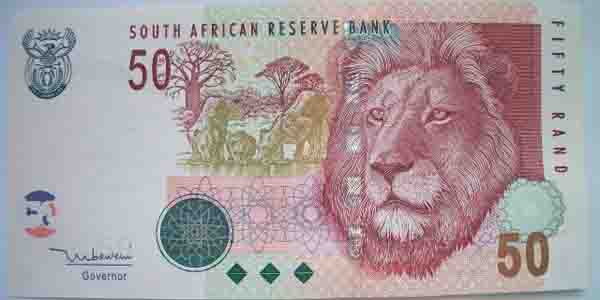
Repo left unchanged but rand sinks

The rand was a touch softer against the dollar on Thursday, coming off the session’s highs after the central bank left rates unchanged despite a hawkish policy statement that had fuelled last minute expectations for a hike.

Governor Lesetja Kganyago said the bank’s monetary policy committee voted 4:2 in favour of keeping the benchmark repo at 5.75% but warned the deteriorating inflation outlook meant the stance could not be “maintained indefinitely”.

The rand touched a session high of 11.7350/dollar after Kganyago warned that inflation expectations remained uncomfortably close to the upper end of the 3-6% target range over the longer term.

It had retreated to 11.8400 by 1531 GMT, little changed from Wednesday’s closing level of 11.8355.

“The sell-off in the rand post the MPC meeting … tells us that the market wants the Reserve Bank to start hiking interest rates,” said Jana van Deventer, a market analyst at ETM.

“There’s no doubt that the statement was hawkish, and that could provide support for the rand at the margins in coming months if they actually start hiking interest rates but it might be too little too late.”

Government bonds were weaker after the rate call, with the yield on the benchmark government bond maturing in 2026 ending the session at 7.985%, up 2.5 basis points from the previous day.

SA suffering a ‘crisis of confidence’

Peter Armitage
Peter Armitage

Since 1994, the South African currency’s value has correlated with the emerging market index, the result of its status the currency of reference across emerging markets.

“It seems now like the market is starting to think that South Africa’s internal challenges are compromising the rand’s role as the ‘dollar of emerging markets’,” says Peter Armitage, CEO of Anchor Capital. Armitage was updating members of the Institute of Directors in Southern Africa (IoDSA) on the country’s economic outlook. “South Africa is suffering a crisis of confidence.”

Adding weight to that analysis is the cover story of the 20 October edition of The Economist: “Cry, the beloved country: South Africa’s sad decline”.

Armitage’s analysis of South Africa’s position in the global economy is troubling but not wholly negative. The country in fact does have many strengths-some of them unexpected-but it needs to use them to solve internal challenges that are in danger of becoming systemic.

Many of South Africa’s indicators look good. The country is ranked 29 on the International Monetary Fund’s 2011 gross domestic product index and, in terms of gross domestic product per person, is ahead of fellow BRICS countries China and India. Things also look rosy in the private sector, where the Johannesburg Stock Exchange (JSE) has delivered an average return of 15% per year since 1995.

“But that’s because 35% of JSE earnings comes from foreign investments, and 40% from resources,” says Armitage. “The resources boom is essentially driven by Chinese demand and is not the result of anything we are doing right-in fact, our export volumes have been declining. It’s only the fact that resources prices have risen so much that we are in positive territory.”

In short, then, South Africa’s strength is actually based on external factors with its weaknesses, sadly, internal. We are running a near-record trade and current account deficits, and are reliant on increasing amounts of foreign capital inflows. We are facing demands for huge wage increases by a work force that is relatively unskilled which are not accompanied by increased productivity. And most poisonous of all, while there is a relatively large amount of money in the country, it is not distributed evenly-hence our high GINI coefficient-and unemployment remains frighteningly high.

These problems have to be solved.

On the plus side, says Armitage, government spending and rising wages are driving consumer spending, and our financial sector is healthy. South African companies are waking up to the potential offered by the rest of Africa.

“Government spending is, however, going to drive growth internally, but we need to make sure that money gets where it should-there’s too much leakage at present,” he says.

A final important point is that the weakening rand actually acts as a buffer that protects the economy from some of the impact of higher wages, by increasing the rand value of what is exported.

South African strikes hurt currency, bonds

South Africa’s rand sank this week to within sight of three-year lows against the dollar as a wave of strikes spread beyond the mining sector, threatening the biggest industrial crisis since the end of apartheid.

After two months of violent labor unrest in the platinum and gold mines, Japanese car giant Toyota said on Thursday its Durban plant had fallen victim to the wildcat strikes that are shaking Africa’s biggest economy only three months before an ANC leadership election.

President Jacob Zuma is favorite to win re-election as head of the ruling party, although a widening of the strikes and sell-offs of the rand and domestic bonds threaten to expose his lack of economic expertise.

So far, a wave of foreign flows into the bond market related to South Africa’s October 1 inclusion in the influential Citi World Government Bond Index (WGBI) on October 1 have helped underpinned domestic asset prices.

But signs are emerging that the WGBI effect is waning, and concerns about the strikes’ impact on growth is rising.

The rand has lost nearly 1.3 percent this week, recording its fourth daily loss in five days on Wednesday as strikes, a yawning current account gap and a Moody’s ratings downgrade took their toll.

“These events have had a marked impact on the currency, not-withstanding the evidence of substantial purchases of South African bonds by foreign investors on the back of the WGBI inclusion,” said Bruce Donald, a strategist at Standard Bank

“The strikes are certainly one of the factors impacting investor sentiment towards South Africa in terms of the political uncertainty it might create. It also has negative consequences for growth and for the current account through its impact on mining exports.”

In July, before the wave of strikes started with a wildcat walkout at Lonmin’s Marikana platinum mine, exports of minerals, precious stones and metals accounted for half of all South Africa’s trade receipts.

Moody’s last week cut South Africa’s sovereign credit rating to Baa1 from A3 amid a souring of investor sentiment over the protests that have hit production in the world’s top platinum producer and No. 4 gold producer.

All that has put pressure on Zuma’s government, which was criticized for its handling of the unrest at Marikana, where more than 40 people were killed in August, the majority shot dead by police.

This week, Reserve Bank Governor Gill Marcus noted the rand remained vulnerable to “changing risk perceptions in global financial markets and domestic issues, such as the tragic events at Marikana”.

Joining the club

The rand has been lifted by about 84 billion rand ($10 billion) of portfolio flows since the start of 2012 as foreign accounts that track the WGBI stocked up on local debt ahead of the October 1 inclusion, Marcus said.

But the governor cautioned these levels were not sustainable.

Despite its recent strong run, the rand is still among the weakest performers against the dollar so far this year in a basket of 20 emerging market currencies, shedding more than four percent since January.

By contrast, units such as the Hungarian forint, Polish zloty and Turkish lira have rallied 9 percent, 8 percent and 4 percent respectively.

The rand hit 8.4524 earlier on Thursday, within sight of Wednesday’s month low of 8.4590. A sustained hold below the 8.45 area could push it to 8.55/dollar, then all the way towards the three-year low of 8.71 it hit in early June amid intense concerns about Europe’s debt crisis.

Waning WGBI flows make the currency more vulnerable to swings in global risk appetite as investors eye the unabating credit crunch in the single currency area.

“We expect the WGBI flows could start to ease up now after the actual inclusion date and perhaps thin out over the next week or two and then normality could kick back into effect,” said Sean McCalgan, a market analyst at ETM.

“That leaves the rand in a rather vulnerable position,” he added. “WGBI is one of the only positive drivers working in favor of the rand at the moment.”

($1 = 8.4415 South African rand) – Reuters