America usurped: China becomes world’s largest economy

Last week the International Monetary Fund updated its data on the world economy. For the first time it ranks China’s economy as the world’s biggest in purchasing-power-parity terms.

Historians, though, point out that China is merely regaining a title that it has held for much of recorded history.

In 1820 it probably produced one-third of global economic output. The brief interlude in which America overshadowed it is now over.

The White House seemed oblivious on Wednesday, crowing that “the economic policies that this president put in place are the envy of the world”.

They seemed caught flat-footed by the news.

The latest IMF figures show the Chinese economy is worth $17.61 trillion compared with $17.4 trillion for the U.S.

The figure is controversial as it requires the comparison of a huge amount of goods and services, and is therefore a vast statistical undertaking that can only be conducted infrequently with estimates used during intervening periods. The methods used to collect the data have also led to controversy in the past.

When it comes the raw GDP data base on exchange rates, China will eventually also overtake the US if it carries on growing as it has, but that is still likely to take some years.


Central banks’ investment in yuan puts currency near reserve status

Investment by dozens of central banks comes despite currency not being fully convertible

At least 40 central banks have invested in the yuan and several others are preparing to do so, putting the mainland currency on the path to reserve status even before full convertibility, Standard Chartered said.

Twenty-three countries have publicly declared their holdings in yuan, in either the onshore or offshore markets, yet the real number of participating central banks could be far more than that, said Jukka Pihlman, Standard Chartered’s Singapore-based global head of central banks and sovereign wealth funds.

Pihlman, who formerly worked at the International Monetary Fund advising central banks on asset-management issues, said at least 17 central banks had invested in yuan assets without declaring they had done so.

The US dollar is still the world’s most widely held reserve currency, accounting for nearly 61 per cent of global allocated reserves at the end of last year, according to IMF data. The ratio has been on a declining trend since 2001, when 71 per cent of the world’s reserves were denominated in US dollars.

The IMF does not disclose the percentage of reserves held in yuan, but the emerging market countries’ share of reserves in “other currencies” has increased by almost 400 per cent since 2003, while that of developed nations grew 200 per cent, according to IMF data.

Pihlman said “a great number of central banks are in the process of adding [yuan] to their portfolios”.

“The [yuan] has effectively already become a de facto reserve currency because so many central banks have already invested in it,” he said. “The [yuan] may become a de facto reserve currency before it is fully convertible.”

The central banks more likely to add yuan holdings in the future were the ones with “strong trade linkages to China” and those which had relatively large levels of reserves which could consider diversifying more for return-related reasons, he said.

“The [yuan’s] convertibility may be already there for central banks in a way that has got them comfortable to start investing in the currency,” Pihlman said.

The rising popularity of the yuan among central bankers is probably mainly due to Beijing’s extremely favourable treatment of them as it has sought to encourage investment in the yuan.

For example, central banks enjoy preferential treatment in the qualified foreign institutional investor category, both on the size of the quota and the length of the lock-up period. The quotas to the interbank bond markets given to central banks are not publicly known, but some of those announced by investing central banks are up to 10 times larger than others in the programme and, most importantly, free of any capital controls.

“Central banks and sovereign funds have special treatment,” Pihlman said. “They have the ability to invest in a way that any other investor does not. When it comes to convertibility, there is nothing kind of formally out there, but the feed back from central banks is that it is fully convertible.”

Among the 23 central banks known to have yuan holdings, 11 are from Asian markets with close trade links with mainland China: Australia, Hong Kong, Indonesia, Japan, South Korea, Macau, Malaysia, Nepal, Pakistan, Singapore and Thailand, according to public records from either central banks’ own statements or central bankers’ interviews with the press.

The rest are five from Europe – Austria, Belarus, Norway, France and Lithuania – and seven from South America or Africa – Bolivia, Chile, Ghana, Kenya, Nigeria, South Africa and Tanzania.

Source: South China Morning Post


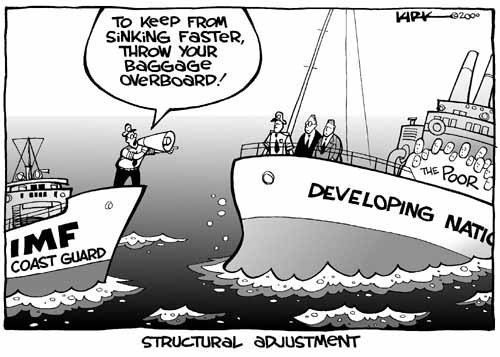
IMF wants trade unions reined in, labour brokers rewarded

imfTrade unions need to be reined in. That is the advice given in an International Monetary Fund report on South Africa released on Tuesday .

The report strangely recommends the use of labour brokers. Labour broking has been called “human trafficking and a modern form of slavery” as it treats workers as profit-making commodities.

Brokers are generally viewed as parasites because they make labour more expensive in a country where unemployment is rife.

It urges the government to move more quickly in implementing its National Development Plan and massive infrastructure spending proposals. It also supported lower wage demands.

Noting that South Africa’s economic growth is lower than that of other emerging countries, and is too low to cut unemployment, the IMF suggests “a social bargain” that would pull together trade unions, business, government and labour brokers.

It urges “commitments to wage restraint” by trade unions. Increases of as much as 100% were demanded this year in the gold mining sector.

As the report was released, workers in the automotive components industry were past the three-week mark in their strike for higher wages. They are demanding an increase of more than 10% and have paralysed vehicle manufacturing.

Production at the world’s biggest platinum mining company, Anglo Platinum, has been disrupted. Members of the Association for Mineworkers and Construction Union have been on strike since Friday.

At South African Breweries, workers downed tools on Monday. The Food and Allied Workers’ Union is demanding a 9.5% increase.

The IMF report flags “escalating labour tensions” as “a key domestic risk”, the Times reported.

The IMF says that more jobs would be created if economic growth were stronger and the labour market “more flexible”.

“Unemployment remains stubbornly above 20%, or more than 30% when including those who have given up looking for a job. Youth unemployment is even higher at more than 50%,” says the report.

The IMF points to recent reforms in Mexico and suggests that South Africa should do something similar to loosen the hold of trade unions on the labour market. This hold, it said, has “produced an insider-outsider system that creates too few jobs and stifles growth”.

Compared to its peers, South Africa has been falling behind.

“Since 2009, South Africa’s growth has averaged 3% compared with 5% for emerging markets and 4% for commodity exporters,” says the report.

The IMF expects South Africa’s growth to slow to 2%.

It urges the government to “resist” a proposal to restrict the use of labour brokers , noting that temporary employment was responsible for a large share of employment growth in recent years.

Trade union federation Cosatu has been vocal in its campaign to get labour brokers banned.

The Treasury yesterday skirted around responding to calls for comprehensive reform of the labour market. It claimed that the issues raised by the IMF were already part of government policies and programmes.

“At its lekgotla in August, the cabinet agreed on a number of measures aimed at reigniting economic growth.

“These measures are in part informed by the recognition that the economy can no longer rely heavily on the global economy to reignite growth and create jobs for the millions of unemployed South Africans,” said the Treasury.

It said “actions are being taken to improve labour relations in key sectors”.

The IMF sees South Africa as more susceptible to shocks.

“In recent years, South Africa’s vulnerabilities [to adverse economic conditions] have increased considerably.”