DRC bans Belgian film on rape

The Democratic Republic of Congo on Wednesday banned a documentary film about a doctor who treats war rape victims, leading the filmmakers to say the government was trying to silence debate about sexual violence.

Media Minister Lambert Mende gave no reason for the decision to ban The Man who Mends Women (L’Homme Qui Repare Les Femmes), which is about Congolese gynecologist Denis Mukwege, the founder of Panzi Hospital in the eastern city of Bukavu.

Sexual violence by militias and the army is a defining atrocity of a conflict in eastern Congo that has lasted two decades, and the hospital has treated thousands of rape victims.

Several high-level perpetrators have recently been convicted.

Human rights groups have accused the army of using rape as a weapon, but military leaders objected to the film as slanderous, said Thierry Michel, the film’s Belgian co-producer.

“The banning of the scheduled screening of this film is a way of gagging (Mukwege) … and (the voice) of the victims of these wars and tragedies that the country has lived through for 20 years,” Michel said in the statement.

The film, co-financed by Belgium’s foreign affairs ministry and the International Organisation of La Francophonie, was scheduled to be screened in the capital, Kinshasa, next week and Bukavu the following week.

Mukwege won the Sakharov Prize, Europe’s top human rights award, last October and was tipped for last year’s Nobel Peace Prize.

Source: AFP

French scrabble champ speaks no French

The Francophone world crowned a new Scrabble champion on Monday – a man from New Zealand who barely speaks a word of French.

Nigel Richards, considered one of the world’s greatest players of the word-based board game, beat opponents from France, Canada, Belgium and Francophone Africa on his way to claiming the title at the 44th World Championships of French Scrabble in the Belgian town of Louvain.

But unlike his competitors who all grew up speaking French as their mother tongue, Richards cannot even string a sentence together in the language.

He claims to have memorised the entire French dictionary in just nine weeks before the tournament began, without learning how to pronounce the words or their meanings.

“Nigel can say ‘bonjour’ – with an accent – he can tell you the scores in French … But that’s all,” Yves Brenez of the Belgian Federation of Scrabble told Francetv info.

“He learnt the French vocabulary in just nine weeks. For him, words are just a combination of letters. I exaggerate a bit, but he knows [words] that others have taken ten years to learn.”

If Richards’ victory injured the Gallic pride of the players or audience in Belgium, they didn’t show it, instead giving the New Zealander a standing ovation.

Richards, who lives in Malaysia, is already something of a legend in the world of Scrabble, with one English-language world championship to his name and five US national championship titles.

Source: France24

Belgium to revoke passports of ISIS fighters

The Belgian government proposed a law on Friday which will invalidate passports and identity cards of people authorities believe plan to go and fight for militant Islamist organisations in the Middle East.

The measure, which has to be approved by parliament, is a response to Belgium’s position as the source of many foreigners fighting in Syria and Iraq.

Some 300 mostly young men are estimated to have left the country of 11 million inhabitants over the past few years to fight for organisations such as Islamic State, one of the largest per capita contributors in western Europe.

“The new law allows us to make leaving Belgian territory with the intention of engaging in terrorist acts a criminal offence,” Justice Minister Koen Geens said.

Authorities could invalidate identity cards or refuse to issue passports to somebody suspected of wanting to leave for Syria or Iraq to fight, he added.

Similar provisions also exist in other European countries such as Britain and Denmark.

Source: Reuters

Antwerp mayor receives death threats from Jihadists

Islamic extremists in Belgium have publicly threatened to kill the mayor of the Belgian city of Antwerp, Bart De Wever, if he does not convert to Islam, local media reported Monday.

A sign written in French stating threats against de Wever, who is also the head of the nationalist political party the New Flemish Alliance, was placed on one of the main squares of Antwerp. Experts are currently assessing the seriousness of the action and the message.

“I always warned that we will not get rid of the threat from Islamic extremists in the near future. This was ignored for years. This wound became apparent now with [the current developments in] Syria and will fester for a long time before we will get rid of it,” de Wever said.

Throughout his political career, De Wever has repeatedly received threats. The Belgian government has provided him with security guards at state expense.

In the light of advance of the Islamic State (ISIL) terrorist group in the Middle East and a number of ISIL-inspired terrorist attacks in Europe, the European Union has currently seeing a surge in anti-Islamization sentiment.

According to September 2014 statistics from Belgium’s Ministry of Interior, between 300 and 350 Belgians have gone to fight alongside the ISIL in Iraq and Syria since 2012.

Source: Sputniksnews

Belgians ignore EU sanctions against Moscow

Belgian companies continue expanding their businesses in Russia despite the sanctions imposed by the West against Moscow over its alleged involvement in the Ukrainian conflict, Russian Foreign Ministry spokesman Alexander Lukashevich told RIA Novosti in an interview.

“Despite the unfavorable conjuncture, Belgian companies haven’t frozen their projects in Russia, and even continue to develop their businesses,” Lukashevich said.

Both, Russian and Belgian companies express unflagging interest in future cooperation, Lukashevich said.“Even given the counterproductive European Union policy of maintaining sanctions against Russia, the business circles of the two countries continue expressing unflagging mutual interest in increasing bilateral cooperation,” he stated.

The Foreign Ministry’s representative said that some 35 Belgian companies are currently implementing their projects in Russia.

Lukashevich cited an example when in March 2014, Belgian Fluxys and Russia’s Yamaltrade signed a 20-year agreement to organize the transit of up to 8.8 billion tons of Yamal liquefied natural gas per year through the Port of Zeebruge.

Since 2014, the United States, the European Union, and their allies have imposed several rounds of economic sanctions against Moscow, citing the Kremlin’s alleged involvement in Ukraine’s internal affairs. Russia has repeatedly denied the accusations, adding that the sanctions policy is ineffective and counterproductive.

Several European companies that have been successful in the Russian market have also expressed their disappointment with the anti-Russia sanctions, saying that the measures hinder their businesses.

Scots spur separatists

For Kurt Ryon, the mayor of Steenokkerzeel, a Flemish village 10 miles northeast of Brussels, watching the Scottish independence campaign in the final days before the referendum is like watching a good soccer match. “They were losing for the first half and most of the second half,” he said, “but now we’re in the 85th minute and they could be winning.”

Mr. Ryon, who wants his native Flanders to split from Belgium, is rooting for Scotland to do the same from Britain, and like a faithful soccer fan he has all the gear: a T-shirt from the Scottish pro-independence “yes” campaign, a collection of “yes” pins on his denim jacket and copious amounts of a beer specially brewed by Flemish nationalists to express their solidarity. The label says “Ja!” next to a Scottish flag, Flemish for yes.

From Catalonia to Kurdistan to Quebec, nationalist and separatist movements in Europe and beyond are watching the Scottish independence referendum closely — sometimes more so than Britons themselves, who seem to have only just woken up to the possibility that Scotland might vote next Thursday to bring to an end a 307-year union. A curious collection of left and right, rich and poor, marginal and mainstream, these movements are united in the hope that their shared ambition for more self-determination will get a lift from an independent Scotland.

In the Basque Country, an autonomous community in northern Spain, the leader of the governing nationalist party has been known to dress up in a kilt and jokes that Basques would rather be part of an independent Scotland than remain part of Spain, which has ruled out any kind of vote. In Veneto, a region of northern Italy, nationalists have held a Scottish-inspired online referendum and now claim that nine in 10 inhabitants want autonomy.

Busloads of Catalans, South Tiroleans, Corsicans, Bretons, Frisians and “Finland-Swedes” are headed for Scotland to witness the vote. Even Bavaria (which calls itself “Europe’s seventh-largest economy”) is sending a delegation.

“It would create a very important precedent,” said Naif Bezwan of Mardin Artuklu University in the Kurdish part of Turkey. Across the Iraqi border (“the Kurdish-Kurdish border,” as Mr. Bezwan puts it), where a confluence of war, oil disputes and political turmoil has renewed the debate about secession, Kurds pine for the opportunity of a Scottish-style breakup.

“Everyone here is watching,” said Hemin Lihony, the web manager at Rudaw, Kurdistan’s largest news organization, based in Erbil, Iraq.

History offers few examples of nations splitting up in a consensual way. The velvet divorce between the Czechs and the Slovaks in 1993 is one, the Norwegian referendum on independence from Sweden in 1905 another. But mostly, nation states go to war over their borders.

The United States fought a civil war to preserve the union. Turkey fought Kurdish nationalists for decades and still denies them the right to Kurdish-language education. Kosovo declared its independence from Serbia only after a war in the 1990s.

President Vladimir V. Putin of Russia, who annexed Crimea after a stealth invasion and a referendum there, and who has been accused of aggressively aiding separatists in eastern Ukraine, has happily supported Scotland’s independence bid. But his attachment to self-determination is selective: In the Russian republics of Chechnya and Dagestan, he has deployed savage force to crush Muslim separatists.

In some cases, the referendum in Scotland is fueling new hopes, however improbable, among separatist fringe groups. When the president of the Texas Nationalist Movement, Daniel Miller, was invited to the University of Stirling in Scotland this year, he said the Scots were paving the way for an independent Texas. In others, the vote is re-energizing debates with considerable geopolitical importance.

In Taiwan, which China claims as part of its territory even though Taiwan is effectively independent with its own currency, military and democratically elected government, some hope a Scottish “yes” vote could prompt a more careful deliberation over the island’s future.

Wang Dan, a student leader in the 1989 Tiananmen Square protests, wrote in a recent column for Taiwan’s Apple Daily, “If the Scottish vote succeeds, it will be worth considering by those who advocate deciding Taiwan’s status through a referendum.”

But it is in Europe that a Scottish “yes” vote would probably create the largest ripples.

It would be the first time that a member of the European Union faces secession by a region eager to become a member in its own right. If Scotland succeeds in negotiating its own membership in the bloc, it would suddenly make the prospect of independence seem safer and more attractive elsewhere in Europe, said George Robertson, a former secretary general of NATO.

“There is a serious risk of a domino effect,” said Mr. Robertson, himself a Scot and an opponent of independence. A “yes” vote, he warned, could trigger “the Balkanization of Europe.”

Nationalists, however, say that a bit of Balkanization may be just what Europe needs.

In the slightly dilapidated Brussels office of the European Free Alliance, which groups together 40 parties representing Europe’s “stateless nations,” a busy map shows what Europe would look like if they all became independent. François Alfonsi, the president of the alliance and a proud Corsican, admits that it would be messy, but “democracy is messy and democracy is what Europe needs.”

Across town, Mark Demesmaeker, a Flemish member of the European Parliament who has decorated his office with a Scottish flag and keeps a copy of the Scottish white paper on independence on his desk, speaks of “failed nation states.”

In his view, Britain has failed to give the Scots and Welsh proper representation in Parliament, and Spain has failed to deliver democracy to Catalans and Basques eager to have their own independence vote. Other nations, like France and Italy, have been mired in political and economic stagnation. Mr. Demesmaeker’s own country, Belgium, cannot even form a government. (Belgium had elections in May and is still deep in coalition talks; the last time it took 541 days.)

Pro-European national movements like his own, the New Flemish Alliance — now the biggest party not just in Flanders but in all of Belgium — are the best antidote to the far-right, anti-European and anti-immigrant nationalist movements that did so well in European elections earlier this year, he said.

“If Scotland votes ‘yes,’ it will be an eye-opener for many people on the street,” Mr. Demesmaeker said. “Most people think it’s our fate to be part of Belgium. But Flanders could be a prosperous nation. It’s a democratic evolution that is going on in different states of the European Union. Eventually we want Flanders to take its place in the E.U.”

If plenty of nationalists have pledged their solidarity with Scotland, the reverse has been less true. The Scottish referendum takes place just days before the regional government of Catalonia is expected to confirm that it will hold an independence vote of its own on Nov. 9, which would override legal and political objections from Madrid.

Alfred Bosch, a Catalan lawmaker, said his counterparts in Scotland had shown little interest in being associated with events in Catalonia.

The Scots “probably want to distance themselves from anything that they see as not as ripe and as mature as their own process,” Mr. Bosch said. “They don’t want to create any hostility from Spain or other countries that might also have pro-independence movements,” not least because those governments will have to recognize an independent Scotland and consider whether to allow it into the European Union.

Whatever the outcome of the referendum, many nationalists say Scotland has already won.

“They have the opportunity to decide their own future,” said Andoni Ortuzar, the president of the governing Basque Nationalist Party, who wore a kilt in the 2012 carnival to celebrate the announcement of a Scottish referendum that year. “That’s what national self-determination is,” he said. “That’s all we ask.”

Source: NYT

Antwerp doctor refuses treatment to Jewish patient

A Belgian physician who refused to treat a Jewish woman with a fractured rib suggested she visit Gaza to get rid of the pain.

The physician made the remark on Wednesday while manning a medical hotline in Flanders, Belgium’s Flemish region, whose capital, Antwerp, has a sizeable Orthodox Jewish population, the local Jewish monthly Joods Actueel reported Thursday.

The woman, Bertha Klein, had her son, who is American, call the hotline at 11 p.m.

“I’m not coming,” the doctor reportedly told the son and hung up. When the son called again, the doctor said: “Send her to Gaza for a few hours, then she’ll get rid of the pain.” According to Joods Actueel, the doctor confirmed the exchange, saying he had an “emotional reaction.”

Health ministry officials were looking into the incident, according to the monthly’s online edition. According to Joods Actueel, the doctor knew the patient was Jewish because of Klein’s son’s American accent.

The family called a friend, Samuel Markowitz, who is an alderman of the Antwerp district council and a volunteer paramedic. He called the doctor to confirm the exchange, and also recorded their conversation.

Hershy Taffel, Bertha Klein’s grandson, filed a complaint with police for discrimination.

“It reminds me of what happened in Europe 70 years ago,” Taffel told Joods Actueel. “I never thought those days would once again be repeated.”

Joods Actueel editor-in-chief Michael Freilich said the incident is particularly alarming because it comes amid a string of recent incidents which involved boycotts against Jews in Belgium since the start of Israel’s attack on Hamas in Gaza on July 8.

Since then, an Orthodox Jewish woman was refused service at a clothes store in Antwerp, and police removed a sign in French and Turkish from a café near Liege which said dogs were allowed but Zionists and Jews were not.

Source: Jerusalem Post

The Fed is the Great Deceiver

pcrBy Paul Craig Roberts and Dave Kranzler.

Is the Fed “tapering”? Did the Fed really cut its bond purchases during the three month period November 2013 through January 2014? Apparently not if foreign holders of Treasuries are unloading them.

From November 2013 through January 2014 Belgium with a GDP of $480 billion purchased $141.2 billion of US Treasury bonds. Somehow Belgium came up with enough money to allocate during a 3-month period 29 percent of its annual GDP to the purchase of US Treasury bonds.

Certainly Belgium did not have a budget surplus of $141.2 billion. Was Belgium running a trade surplus during a 3-month period equal to 29 percent of Belgium GDP?

No, Belgium’s trade and current accounts are in deficit.

Did Belgium’s central bank print $141.2 billion worth of euros in order to make the purchase?

No, Belgium is a member of the euro system, and its central bank cannot increase the money supply.
So where did the $141.2 billion come from?

There is only one source. The money came from the US Federal Reserve, and the purchase was laundered through Belgium in order to hide the fact that actual Federal Reserve bond purchases during November 2013 through January 2014 were $112 billion per month.

In other words, during those 3 months there was a sharp rise in bond purchases by the Fed. The Fed’s actual bond purchases for those three months are $27 billion per month above the original $85 billion monthly purchase and $47 billion above the official $65 billion monthly purchase at that time. (In March 2014, official QE was tapered to $55 billion per month and to $45 billion for May.)

Why did the Federal Reserve have to purchase so many bonds above the announced amounts and why did the Fed have to launder and hide the purchase?

Some country or countries, unknown at this time, for reasons we do not know dumped $104 billion in Treasuries in one week.

Another curious aspect of the sale and purchase laundered through Belgium is that the sale was not executed and cleared via the Fed’s own National Book-Entry System (NBES), which was designed to facilitate the sale and ownership transfer of securities for Fed custodial customers. Instead, The foreign owner(s) of the Treasuries removed them from the Federal Reserve’s custodial holdings and sold them through the Euroclear securities clearing system, which is based in Brussels, Belgium.

We do not know why or who. We know that there was a withdrawal, a sale, a drop in the Federal Reserve’s “Securities held in Custody for Foreign Official and International Accounts,” an inexplicable rise in Belgium’s holdings, and then the bonds reappear in the Federal Reserve’s custodial accounts.

What are the reasons for this deception by the Federal Reserve?

The Fed realized that its policy of Quantitative Easing initiated in order to support the balance sheets of “banks too big to fail” and to lower the Treasury’s borrowing cost was putting pressure on the US dollar’s value. Tapering was a way of reassuring holders of dollars and dollar-denominated financial instruments that the Fed was going to reduce and eventually end the printing of new dollars with which to support financial markets.The image of foreign governments bailing out of Treasuries could unsettle the markets that the Fed was attempting to sooth by tapering.

A hundred billion dollar sale of US Treasuries is a big sale. If the seller was a big holder of Treasuries, the sale could signal the bond market that a big holder might be selling Treasuries in large chunks. The Fed would want to keep the fact and identity of such a seller secret in order to avoid a stampede out of Treasuries. Such a stampede would raise interest rates, collapse US financial markets, and raise the cost of financing the US debt. To avoid the rise in interest rates, the Fed would have to accept the risk to the dollar of purchasing all the bonds. This would be a no-win situation for the Fed, because a large increase in QE would unsettle the market for US dollars.

Washington’s power ultimately rests on the dollar as world reserve currency. This privilege, attained at Bretton Woods following World War 2, allows the US to pay its bills by issuing debt. The world currency role also gives the US the power to cut countries out of the international payments system and to impose sanctions.

As impelled as the Fed is to protect the large banks that sit on the board of directors of the NY Fed, the Fed has to protect the dollar. That the Fed believed that it could not buy the bonds outright but needed to disguise its purchase by laundering it through Belgium suggests that the Fed is concerned that the world is losing confidence in the dollar.

If the world loses confidence in the dollar, the cost of living in the US would rise sharply as the dollar drops in value. Economic hardship and poverty would worsen. Political instability would rise.

If the dollar lost substantial value, the dollar would lose its reserve currency status. Washington would not be able to issue new debt or new dollars in order to pay its bills.

Its wars and hundreds of overseas military bases could not be financed.

The withdrawal from unsustainable empire would begin. The rest of the world would see this as the silver lining in the collapse of the international monetary system brought on by the hubris and arrogance of Washington.

Paul Craig Roberts was Assistant Secretary of the Treasury for Economic Policy and associate editor of the Wall Street Journal. He was columnist for Business Week, Scripps Howard News Service, and Creators Syndicate. He has had many university appointments. His internet columns have attracted a worldwide following. His latest book, The Failure of Laissez Faire Capitalism and Economic Dissolution of the West is now available.

Fool’s gold

fakegoldKhulubuse Zuma and his business partner Sikhumbuzo Shamase spent millions of rand on a trip to Conakry, Guinea’s capital, to collect R50 million worth of gold bars which turned out to be fake.

According to the Sunday Times Zuma and Shamase landed at Lanseria airport, in Johannesburg, on February 16, on a chartered jet with the cargo, which was moved to OR Tambo International Airport under armed guard for secure storage.

Before it was moved, the two business associates posed with the fake gold bars. At customs they had claimed not to have the key, but officials opened the box containing the bars with a bolt cutter and cleared the purchase.

However, when the cargo arrived in Belgium in Antwerp at the company Argentor Esseayeurs on February 26, it turned out to be copper and zinc bars worth only R7000, according to the newspaper.

Zuma and Shamase reportedly claimed they had been suckered, and said the cargo had passed a laser gun test and had been certified as 99.9 percent pure gold by Guinea’s Central Bank

The gold was bought on consignment from a group of 250 villagers in Guinea.

“It’s a corrupt system where the military together with traditional leaders who own the land collude,” Shamase was quoted as telling the Sunday Times.

He said they did not know what happened because they had done this before and it had always gone well.

Shamase reportedly told the newspaper the matter had not been reported to the authorities because it was “darkest Africa”, and they had taken a knock on the chin because it was part of doing business in Africa.

The deal was done under the name of the company Sham-Mok Investments. – Sapa

‘Tintin in the Congo’ not racist, Belgian court rules

A Brussels court has rejected a legal bid to ban “Tintin in the Congo”, the second adventure of Belgian writer Hergé’s globe-trotting boy reporter. Black associations in the country claimed the book contained racist stereotypes.

“Tintin in the Congo” – a classic 1920s comic strip about Belgium’s celebrated fictional boy reporter – is not racist, a Brussels court ruled on Wednesday.

The Brussels Appeals Court upheld a 2011 ruling against Congolese immigrant Bienvenu Mbutu Mondondo and the Belgian Council of Black Associations, who wanted the book banned.

In 2010 Mbutu, who lives in Belgium, Congo’s former colonial ruler, said Tintin employed a little black helper who was seen as “stupid and without qualities”.

“It makes people think that blacks have not evolved,” he said.

In one scene, a black woman prostrates herself before Tintin, saying: “White man very great. White mister is big juju man.”

‘Gentle and candid humour’

Alain Amici, lawyer for the plaintiffs, told the court in 2011: “The negative stereotypes portrayed in this book are still read by a significant number of children. They have an impact on their behaviour.”

Not so, said Brussels judges, for whom “Tintin in the Congo” is full of “gentle and candid humour”.

The cartoon strip, written in the late 1920s, was Belgian writer Hergé’s second Tintin adventure. It was followed by stories in which the author tried to add greater realism and historical accuracy.

Hergé himself recognised that “Tintin in the Congo” was a “youthful sin” that reflected the prejudices of the time.

In 2007 a British court ruled that “Tintin in the Congo” should be sold with a warning that it includes racist content.

Mbutu has also tried to have the cartoon banned in France, unsuccessfully. – France24

Belgium on high alert ahead of anti-Muslim film’s release

Belgium has heightened its terror alert level ahead of the release of another highly provocative film exploring Islam, reportedly made in cooperation with the notorious Koran-burning US pastor Terry Jones.

­The film’s creator is Pakistan national Imran Firasat, a former Muslim who now lives in Spain. Firasat said he aims to expose the truth of the life of the Prophet Muhammad with ‘The Innocent Prophet: Life of Muhammad from the Point of View of an Ex-Muslim.’

“If we want to know the truth of Islam, we must go deep into the life of Muhammad to find out whether he was a genuine profit sent by God or was he simply a child molester, assassin and a self-proclaimed prophet,” he said in the film’s trailer.

Firasat also hailed pastor Terry Jones as his inspiration. Jones wrote on his website, “It is our hope and desire that we can present a picture of Muhammad that has possibly not been revealed in the past, that will help people in the Western world, and even Muslims, to better understand this person called Muhammad, his life and teachings.”

Jones is infamous for his incendiary anti-Islam speeches, and for staging a ‘Koran-burning day’ on the 10th anniversary of 9/11.

­’The Innocent Prophet’ is expected to be a highly provocative film; Belgian police have raised the country’s ‘terrorism alarm’ level from 2 to 3, the second-highest, ahead of the film’s online release on December 14.

The Belgian Interior Ministry said it was increasing the level to ‘serious threat’ as a precautionary measure, Flanders News reported.

Police units in areas with large numbers of Middle Eastern and North African immigrants are reportedly on alert. Technical divisions of the Belgian police force have also been ordered to closely monitor Islamist websites and mass text messages.

­In response to Belgium’s heightened terror allert, Firasat said he might postpone the release of the film so it could be previewed by authorities to ensure “there is nothing in this movie which doesn’t fall under the right of freedom of expression and that my movie will not cause any kind of loss to humanity.”

“The necessary modification will be also made if requested by the authorities,” he wrote on trailer’s YouTube page. Still, Firasat insisted he is not afraid of “Islamic violence,” and that postponing the release is a token of respect “towards Europe, which is my family.”

Earlier this year, riots broke out in Belgium after the notorious American-made video ‘Innocence of Muslims’ went viral on the web, sparking violent anti-US protests throughout the Arab world.

Gold-digging in Paris

Last week, police in the French capital arrested three people as part of a widening grave robbery investigation.

There was further public outrage after two masked intruders shot dead a 52-year old precious metal worker when he tried to stop them stealing gold from his foundry in the chic central Parisian district of Le Marais.

Police said sky-high market prices for precious metals are acting as a magnet for thieves with scant regard for the living or the dead.

In Pantin cemetery, in the north of Paris, dozens of bodies have recently been dug up, with gold teeth and jewellery stolen from them.

Police sources said the three men seized last week were gravediggers employed by the city’s cemeteries.

Last month, four other men – three from the same Pantin cemetery – were arrested and placed under investigation for aggravated theft, grave robbery and violating the integrity of a corpse.

According to a source close to the investigation, the men removed personal belongings from corpses in the freshest graves, opening them in the dead of night.

Two of the men were caught wearing miner’s helmets and gloves. Their boots were covered in fresh earth.

One of the suspects was found to be carrying 10 gold teeth.

After the initial arrests, the mayor of Paris, Bernard Delanoe, expressed his outrage and ordered the city authorities to step up surveillance of cemeteries.

Even closer to the city centre, a metalworker was gunned down last Wednesday when he fought back against motorbike helmet-clad thieves trying to break into the gold workshop where had been employed for 36 years.

A neighbour said she heard him shout: “I haven’t got the keys!” before chasing the attackers and being shot.

Visiting the scene shortly after the murder, Manuel Valls, the interior minister, admitted: “There is a problem with regulating gold, with illegal workshops that recycle gold, which is often the product of theft or snatched gold chains.”

Precious metal theft is big business is France. Earlier this year, the national rail operator, SNCF, launched a special security programme to clamp down on the massive theft of copper cables that has led to huge delays on its lines.

Ten days ago, his men broke an illicit gold reseller network operating out of the Saint Denis train station in a northern Paris suburb. “It was a real open supermarket for stolen gold. All the thieves from across the capital came there to sell their wares for cash,” he told The Daily Telegraph.

He said a large part of their booty ended up in Belgium, where “legislation is more relaxed”. – The Daily Telegraph

Landslide victory for Flemish nationalists

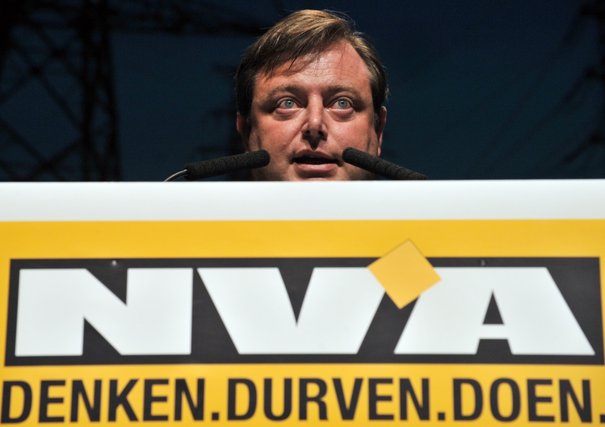
Bart de Wever

Flemish nationalists made sweeping gains across northern Belgium in local elections on Sunday, a success that will bolster separatists’ hopes for a break-up of the country.

Bart de Wever, leader of the New Flemish Alliance (NVA), is set to become mayor of the northern city of Antwerp, Belgium’s economic heartland, after his party emerged as the largest one ending about 90 years of socialist rule.

Soon after the ballot results emerged, Mr De Wever, who had turned the tough mayoral race into a referendum on Flander’s independence for Belgium, demanded that the country’s prime minister give greater independence to the Dutch-speaking north.

“De Wever sent a strong signal to Brussels and he has put his party on course to send an even clearer one in 2014 … they will try to go for an even bigger win in the federal elections,” said a veteran political analyst for the Gazet Van Antwerpen.

“We want to give Flemish people the government they want at all levels. That is why I call on Elio Di Rupo and the francophone politicians. Take up your responsibility,” said De Wever.

The strong result recorded by the Flemish nationalists is likely to have an impact across Europe, where the sovereign debt crisis, which has seen rich countries bail out poor ones, has revived separatist sentiment throughout the continent.

Flanders, which is the most economically prosperous region of Belgium, has long resented financing the ailing economy of French-speaking Wallonia, and Sunday’s victory will strengthen their demand for self-rule.

Lieven De Winter, a political scientist at Université Catholique de Louvain, said that Mr De Wever’s victory was a clear step forward for separatist who had long been campaigning for secession from the southern part of the country. However, he warned that the process towards accomplishing a break-up would be wrath of problems.

“There is no doubt that tonight De Wever made a small step towards completing his dream of a break-up but there are many obstacles ahead … at the end of the day you need two to tango,” Mr De Winter said.

NVA won about 38 per cent of votes in Antwerp against about 28 per cent secured by the Socialists, according to provisional Flanders government data. Meanwhile, in the rest of the northern region the Flemish nationalists won more than 30 per cent of support.

NVA is expected to seek the support of the Socialists to run Antwerp – in Belgium it is common for opposing parties to form a coalition after elections as no one party enjoys an outright majority throughout the country.

Belgium consists of Dutch-speaking Flanders, francophone Wallonia and Brussels, its bilingual capital. The Socialists have tried to keep Brussels French through Arab immigration. Political powers have already been devolved to regional governments, Flanders, in more populous with about 6m people compared with 3.5m in Wallonia.

NVA’s victory in Antwerp and strong result across the north of Belgium will give good momentum to the separatists in the run-up to the key federal elections in 2014, said analysts. – FT


Belgian deputy prime minister in South Africa

South Africa is considering ways of strengthening bilateral economic relations with Belgium, International Relations Minister Maite Nkoana-Mashabane said on Wednesday.

She told reporters in Pretoria that a visiting Belgian delegation would meet South African ministers to explore the possible co-operation.

Belgian deputy prime minister Didier Reynders is on his first official state visit to South Africa. He is also the country’s minister of foreign affairs, foreign trade and European trade.

“I am encouraged by the fact that you will be meeting other members of our Cabinet, specifically our minister of trade and industry, and also the minister of mineral resources,” Nkoana-Mashabane said.

“We believe there is an opportunity there (in the mining sector) to work with Belgium on our plans for beneficiation of our mineral resources and taking advantage of your historical expertise in this field.”

She said the west European country had helped support South Africa’s national priorities since 1994. The help had covered areas such as health, ports management and logistics, education, rural development, and further education and training, Nkoana-Mashabane said.

“Despite the ongoing economic challenges confronting Europe, Belgium has remained steadfast in its support for our development efforts,” Nkoana-Mashabane said.

She said South Africa had expressed interest in having Belgium play an active role in the mooted Tripartite Free Trade Area (T-FTA), which involves the Common Market of East and Southern Africa (Comesa), the East African Community (EAC) and the Southern African Development Community (SADC).

“I indicated to the minister that the T-FTA will encompass 26 countries, with a combined population of 600 million people and a GDP (gross domestic product) of approximately US one trillion,” she said.

“We are convinced that the key to economic development of the continent lies in creating the necessary infrastructure to facilitate the free movement of goods and services,” Nkoana-Mashabane said.

Reynders said Wednesday’s meeting had focused on renewed interest in deepening bilateral trade between his country and South Africa.

On the international front, Reynders said the discussions touched on the possible ways to bring lasting peace and stability to its former colony, the Democratic Republic of Congo.

“Our role is not to blame the DRC or Rwanda or any one of the parties in the conflict in the eastern parts of Congo. We called for dialogue to bring peace in that region.”

An army mutiny by a group of former Congolese Tutsi rebels known as M23, who were integrated into the army but defected this year, started more than two months ago in the eastern DRC.

Rwanda, also a former Belgian colony, has denied accusations that it has been helping the M23 mutineers. – Sapa