Islamic extremists in Belgium have publicly threatened to kill the mayor of the Belgian city of Antwerp, Bart De Wever, if he does not convert to Islam, local media reported Monday.
A sign written in French stating threats against de Wever, who is also the head of the nationalist political party the New Flemish Alliance, was placed on one of the main squares of Antwerp. Experts are currently assessing the seriousness of the action and the message.
“I always warned that we will not get rid of the threat from Islamic extremists in the near future. This was ignored for years. This wound became apparent now with [the current developments in] Syria and will fester for a long time before we will get rid of it,” de Wever said.
Throughout his political career, De Wever has repeatedly received threats. The Belgian government has provided him with security guards at state expense.
In the light of advance of the Islamic State (ISIL) terrorist group in the Middle East and a number of ISIL-inspired terrorist attacks in Europe, the European Union has currently seeing a surge in anti-Islamization sentiment.
According to September 2014 statistics from Belgium’s Ministry of Interior, between 300 and 350 Belgians have gone to fight alongside the ISIL in Iraq and Syria since 2012.
The Economic Freedom Fighters (EFF) is helping the DA by calling on the newly-appointed Nelson Mandela Bay mayor Danny Jordaan to resign from his SA Football Association presidency.
The opposition party says serving both as mayor under the ruling ANC as well as the football association’s president will affect Jordaan’s “impartiality”.
The EFF logic is not clear as Jordaan has always been openly ANC.
”Jordaan must resign from the association since he has chosen active politics and life as an ANC politician. At the helm of SAFA there must be a person that all the supporters of Bafana Bafana, Banyana Banyana, and the rest of national soccer teams can associate with regardless of which political parties they belong to,” said spokesman Mbuyiseni Ndlozi in a statement on Monday.
The ANC announced on Monday that Jordaan would replace 83-year-old former MP Benson Fihla in the troubled Nelson Mandela Bay.
Opposition parties such as the EFF and the Democratic Alliance (DA) have made inroads into Port Elizabeth as the 2016 local government elections draws nearer. DA Eastern Cape leader Athol Trollip has been confirmed as the opposition’s mayoral candidate for the metro.
In the national elections in 2014, the ANC received 48.8 percent of the votes with the DA closing in on it with 40.8 percent.
The DA is furious that Jordaan, a Coloured, will take away the ethnic Coloured vote that they counted on to win the metro.
The renaming of a piazza in a small Italian town has caused a diplomatic incident.
The square in Ceriano Laghetto, in the northern province of Lombardy, is now called “Martyrs of Odessa” in memory of people killed during the recent upheaval in the Ukrainian city. It is named for pro-Russian separatists who died during clashes with Ukrainian government supporters in May 2014, Mayor Dante Cattaneo, of the right-wing Northern League party, tells Il Fatto Quotdiano.
More than 30 people were killed in a fire after barricading themselves into a government-run building in the city to escape the mayhem.
The renaming of the piazza – which is used as a car park – has angered Ukraine’s ambassador in Rome, Yevhen Perelygin.
In a letter to the region’s prefect, he asks for the decision to be revoked, saying the events of May 2014 “are still unclear”.
He also suggested in an interview that the decision was “manipulated by political forces who support the Russian initiative” in Ukraine, something the mayor refutes.
Mr Cattaneo appears to be defiant, despite a request from the regional authority to undo the change, and says Italy shouldn’t be allowing foreign interference in decision making. “Piazza for the Martyrs of Odessa is there and will remain,” he tweeted.
“In Ceriano there’s a democratically elected local authority. It is not Ukraine.”
A black janitor in Brooklyn almost shouted out the name when asked about his vote in the mayoral race. Bill de Blasio, he said, “knows my struggle.”
“He knows what the average person’s going through, because he’s been experiencing what they’re going through.” – Veronica Sibblies, a Jamaican immigrant.
In the Bronx, some African-American voters defaulted to a shorthand: “the man with the black wife.” Nobody thought it necessary to explain whom they meant.
And in a Brooklyn housing project, a lifelong resident said he was tired of mayors who, in his mind, had pitted blacks against whites. Mr. de Blasio, he declared, “is black and white.”
Of all the records shattered by Mr. de Blasio’s landslide victory, perhaps the most remarkable is that virtually every vote cast by black New Yorkers — 96 percent — went his way. He captured a bigger portion of the black vote than David N. Dinkins in 1989 when he was elected New York City’s first black mayor with 91 percent of the black vote, according to exit polls.
After the divisive tenor of the Giuliani years, and the deep grievances engendered by the stop-and-frisk police tactics of the Bloomberg era, black New Yorkers are now claiming Mr. de Blasio’s victory as their own. In postelection interviews, dozens of black New Yorkers said that Mr. de Blasio’s personal touch, his biracial family and his pledge to help the working-class and poor had affected them deeply. His victory, they said, was a chance to gain a voice in City Hall after two decades of leadership they viewed as inattentive, distant and, at times, even callous.
“There was a sense of not being included, not being cared about,” said Charlene Curry, as she walked along Marcy Avenue in Bedford-Stuyvesant, Brooklyn, last week. She said she had never met Mr. de Blasio, but felt as if he were a neighbor. The mayor-elect, she said, has “a more humane approach, a more inclusive approach.” She added, “That reaches home.”
The excitement about Mr. de Blasio — tinged, in some quarters, by a dose of wait-and-see skepticism — was diligently cultivated by the candidate. Mr. de Blasio, who is of Italian and German heritage, kept up a brisk schedule of visits to predominantly black churches, frequently spoke of the effect of stop-and-frisk tactics on young black men, and put his wife and children at the forefront of his campaign, making a celebrity of his son, Dante, who sports a large Afro.
But it was also a result of Mr. de Blasio’s comfort and fluency with black culture, borne of an interracial marriage and personal experience, that offered a credibility voters said could not be bought by consultants or simulated in sound bites.
A protégé of Bill Lynch, an African-American political operative, and a veteran of the Dinkins administration and the congressional campaign of Charles B. Rangel, Mr. de Blasio is steeped in the history of New York’s black politics.
“A woman would say, ‘Do you understand, young man?’ And Bill said, “Yes, ma’am,’ ” a black woman recalled. “Do you know what that little, tiny cultural thing meant?”
That adroitness was frequently apparent on this year’s campaign trail, where Mr. de Blasio received electric receptions when visiting traditionally black neighborhoods, like Harlem and Crown Heights.
With his self-assured mien and casual tendency to call people “brother,” Mr. de Blasio often seemed to play the political preacher, even at run-of-the-mill news conferences. At a rally in late October in Brooklyn, he opened his remarks by intoning, “Brothers and sisters, we are gathered again,” earning appreciative nods and murmurs from supporters. On the Sunday before the election, Mr. de Blasio delivered a 16-minute sermon at First Corinthian Baptist Church in Harlem, a mainstay of his campaign schedule. At one point, he launched into a seemingly earnest soliloquy about the responsibilities of public servants, before pivoting to a jest.
“It’s my obligation to stand up and act when there’s a problem, when there’s a danger,” Mr. de Blasio said. “And I realized in the earlier part of the service — I realized that the choir was on fire! And I needed to rush out and call the Fire Department!” He was drowned out for nearly 15 seconds as the congregation laughed and cheered.
In Brooklyn on Thursday, Bonita Anderson-Watson, 50, smiled as she recounted a recent visit from Mr. de Blasio and his family to her church. “When I spoke with him and shook his hand, it was something different,” she said, adding that in conversations with friends afterward, comparisons to Bill Clinton, who was enthusiastically embraced by African-Americans in his presidential campaigns, quickly came up.
With all that good will, of course, comes high expectations. “Ninety-six percent of the African-American vote went to him,” said the Rev. Johnnie M. Green Jr., senior pastor at Mount Neboh Baptist Church in Harlem. “He should feel some sense of being beholden to the black community.”
Some of those interviewed said they would have voted for him even without his biracial family, citing his staunch Democratic politics and pledge to address economic inequality. Many said they never considered the Republican nominee, Joseph J. Lhota, and some said they did not know his name.
“His biracial family represents so many things and possibilities, too many to even get into,” said Leon Ellis, a Harlem restaurateur. “When people saw his family, they felt, ‘Here is someone who understands and relates to me on a level on which I can be comfortable.’ ”
“You have a black woman sitting there who can say, ‘My side of the family is hurting over here, now.’ He’s going to hear that direct,” said Walter Edwards, a real estate developer in Harlem. “He’s not going to get it from somebody off the street he has no relationship with.”
Veronica Sibblies, 66, a Jamaican immigrant who came to New York more than 50 years ago, said she believed Mr. de Blasio’s interracial family could serve as a model for better relations between blacks and whites in the city.
“You know what I like? I like when he said, ‘I don’t know if I’m going to move into Gracie Mansion,’ ” Ms. Sibblies said. “It doesn’t impress him. Material things don’t mean that much to him. He knows what the average person’s going through, because he’s been experiencing what they’re going through.”
“Some black people probably are breathing a sigh of relief, that finally we have someone that is going to at least represent our concerns, and try and make life better for us,” Mr. Worrell said. “But we all have to sit back and wait to see what happens.” – NYT
Progressive Democrat Bill de Blasio has been elected mayor of New York City, replacing billionaire Michael Bloomberg, US media reported Tuesday.
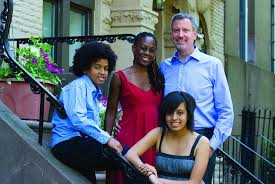
“Thank you, New York City,” de Blasio’s campaign tweeted just after the close of polls, together with a photo showing the presumed winner together with his wife and two children.
The 52-year-old will succeed Bloomberg in January at the helm of the United States’ largest city.
De Blasio promises a new style in a city transformed by 12 years of tough love under Bloomberg, who is stepping down after a record three terms.
He is one of the most progressive politicians in the country and left Republican rival Joe Lhota trailing in the dust by tapping into the worries of the economically vulnerable middle class. – AFP
This website uses cookies to improve your experience. We'll assume you're ok with this, but you can opt-out if you wish. Cookie settingsACCEPT
Privacy & Cookies Policy
Privacy Overview
This website uses cookies to improve your experience while you navigate through the website. Out of these cookies, the cookies that are categorized as necessary are stored on your browser as they are essential for the working of basic functionalities of the website. We also use third-party cookies that help us analyze and understand how you use this website. These cookies will be stored in your browser only with your consent. You also have the option to opt-out of these cookies. But opting out of some of these cookies may have an effect on your browsing experience.
Necessary cookies are absolutely essential for the website to function properly. This category only includes cookies that ensures basic functionalities and security features of the website. These cookies do not store any personal information.
Any cookies that may not be particularly necessary for the website to function and is used specifically to collect user personal data via analytics, ads, other embedded contents are termed as non-necessary cookies. It is mandatory to procure user consent prior to running these cookies on your website.