A American woman in the US hurls a stream of abuse at a parking attendant for a few minutes over a $15 garage fine – and there are so many swear words it would make even the most hard-boiled men wince.
The woman and her girlfriend arrived at the garage on Broadway in New York seven minutes late to collect their car and were slapped a $15 fine.
Instead of coughing up, one of them went berserk and turned the air blue. In the three-minute clip, the woman keeps humiliating the man who is not shown.
She lashes out at the attendant accusing him of poor English skills, being a looser and mocking his place of birth and job.
“Why don’t you learn to speak English? You f**king idiot! You’re garbage! You’re a piece of s**t!” she keeps on shouting for several minutes.
No one present at the scene tried to bring the woman to reason and curtail her ethnocentric rant.
New York City police arrested more than 60 people Wednesday as protesters marched in solidarity with those in Baltimore, where demonstrations and riots were sparked by Freddie Gray’s death in police custody.
The arrests come after hundreds of people gathered in New York’s Union Square to rally against Gray’s death and in support of those in Baltimore. The NYPD had warned participants that marching into the streets or blocking sidewalks could result in arrests.
More than 60 people were arrested throughout the night, an NYPD spokesperson told Reuters. Police are charging many of the protesters with disorderly conduct, according to CNN.
The event was organized by the Millions March coalition, which asked participants who support “social, economic, and racial justice” to head down to Union Square to “stand in solidarity with them and with their resistance because their resistance is for justice and their justice is our justice.”
“People of Baltimore have taken to the streets day after day for justice for Freddie Gray and for Black lives across the country but now that the National Guard has been called in and a curfew set, we must stand in solidarity with the people of Baltimore,” the group wrote on the Facebook page for Wednesday’s event.
“The media will continue to paint the people of Baltimore as rioters and looters but people forget that the City and Police of Baltimore loot and destroy Black and Brown communities of Baltimore every day of the year.”
Hundreds of protesters showed up to Union Square to begin the rally. Prior to the rally’s commencement, police used loudspeakers and distributed flyers warning demonstrators that they could be arrested if they walk in the streets or block the sidewalks.
In Washington, DC, the National Black United Front scheduled its own rally in support of Gray and “all those that have been killed by at the hands of police terrorism.”
Speaking with the Washington Post, one local activist described the motivation behind the event.
“We wanted to come out and show our solidarity with folks who are protesting for Freddie Gray in Baltimore and continue to bring national attention to this, and not allow for this, like any incident, to be treated as isolated to one city,” said Eugene Puryear.
Several hundred people turned out, where protesters were set to march to the White House.
A black janitor in Brooklyn almost shouted out the name when asked about his vote in the mayoral race. Bill de Blasio, he said, “knows my struggle.”
“He knows what the average person’s going through, because he’s been experiencing what they’re going through.” – Veronica Sibblies, a Jamaican immigrant.
In the Bronx, some African-American voters defaulted to a shorthand: “the man with the black wife.” Nobody thought it necessary to explain whom they meant.
And in a Brooklyn housing project, a lifelong resident said he was tired of mayors who, in his mind, had pitted blacks against whites. Mr. de Blasio, he declared, “is black and white.”
Of all the records shattered by Mr. de Blasio’s landslide victory, perhaps the most remarkable is that virtually every vote cast by black New Yorkers — 96 percent — went his way. He captured a bigger portion of the black vote than David N. Dinkins in 1989 when he was elected New York City’s first black mayor with 91 percent of the black vote, according to exit polls.
After the divisive tenor of the Giuliani years, and the deep grievances engendered by the stop-and-frisk police tactics of the Bloomberg era, black New Yorkers are now claiming Mr. de Blasio’s victory as their own. In postelection interviews, dozens of black New Yorkers said that Mr. de Blasio’s personal touch, his biracial family and his pledge to help the working-class and poor had affected them deeply. His victory, they said, was a chance to gain a voice in City Hall after two decades of leadership they viewed as inattentive, distant and, at times, even callous.
“There was a sense of not being included, not being cared about,” said Charlene Curry, as she walked along Marcy Avenue in Bedford-Stuyvesant, Brooklyn, last week. She said she had never met Mr. de Blasio, but felt as if he were a neighbor. The mayor-elect, she said, has “a more humane approach, a more inclusive approach.” She added, “That reaches home.”
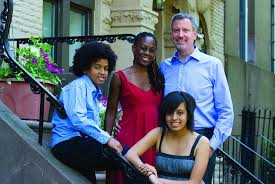
The excitement about Mr. de Blasio — tinged, in some quarters, by a dose of wait-and-see skepticism — was diligently cultivated by the candidate. Mr. de Blasio, who is of Italian and German heritage, kept up a brisk schedule of visits to predominantly black churches, frequently spoke of the effect of stop-and-frisk tactics on young black men, and put his wife and children at the forefront of his campaign, making a celebrity of his son, Dante, who sports a large Afro.
But it was also a result of Mr. de Blasio’s comfort and fluency with black culture, borne of an interracial marriage and personal experience, that offered a credibility voters said could not be bought by consultants or simulated in sound bites.
A protégé of Bill Lynch, an African-American political operative, and a veteran of the Dinkins administration and the congressional campaign of Charles B. Rangel, Mr. de Blasio is steeped in the history of New York’s black politics.
“A woman would say, ‘Do you understand, young man?’ And Bill said, “Yes, ma’am,’ ” a black woman recalled. “Do you know what that little, tiny cultural thing meant?”
That adroitness was frequently apparent on this year’s campaign trail, where Mr. de Blasio received electric receptions when visiting traditionally black neighborhoods, like Harlem and Crown Heights.
With his self-assured mien and casual tendency to call people “brother,” Mr. de Blasio often seemed to play the political preacher, even at run-of-the-mill news conferences. At a rally in late October in Brooklyn, he opened his remarks by intoning, “Brothers and sisters, we are gathered again,” earning appreciative nods and murmurs from supporters. On the Sunday before the election, Mr. de Blasio delivered a 16-minute sermon at First Corinthian Baptist Church in Harlem, a mainstay of his campaign schedule. At one point, he launched into a seemingly earnest soliloquy about the responsibilities of public servants, before pivoting to a jest.
“It’s my obligation to stand up and act when there’s a problem, when there’s a danger,” Mr. de Blasio said. “And I realized in the earlier part of the service — I realized that the choir was on fire! And I needed to rush out and call the Fire Department!” He was drowned out for nearly 15 seconds as the congregation laughed and cheered.
In Brooklyn on Thursday, Bonita Anderson-Watson, 50, smiled as she recounted a recent visit from Mr. de Blasio and his family to her church. “When I spoke with him and shook his hand, it was something different,” she said, adding that in conversations with friends afterward, comparisons to Bill Clinton, who was enthusiastically embraced by African-Americans in his presidential campaigns, quickly came up.
With all that good will, of course, comes high expectations. “Ninety-six percent of the African-American vote went to him,” said the Rev. Johnnie M. Green Jr., senior pastor at Mount Neboh Baptist Church in Harlem. “He should feel some sense of being beholden to the black community.”
Some of those interviewed said they would have voted for him even without his biracial family, citing his staunch Democratic politics and pledge to address economic inequality. Many said they never considered the Republican nominee, Joseph J. Lhota, and some said they did not know his name.
“His biracial family represents so many things and possibilities, too many to even get into,” said Leon Ellis, a Harlem restaurateur. “When people saw his family, they felt, ‘Here is someone who understands and relates to me on a level on which I can be comfortable.’ ”
“You have a black woman sitting there who can say, ‘My side of the family is hurting over here, now.’ He’s going to hear that direct,” said Walter Edwards, a real estate developer in Harlem. “He’s not going to get it from somebody off the street he has no relationship with.”
Veronica Sibblies, 66, a Jamaican immigrant who came to New York more than 50 years ago, said she believed Mr. de Blasio’s interracial family could serve as a model for better relations between blacks and whites in the city.
“You know what I like? I like when he said, ‘I don’t know if I’m going to move into Gracie Mansion,’ ” Ms. Sibblies said. “It doesn’t impress him. Material things don’t mean that much to him. He knows what the average person’s going through, because he’s been experiencing what they’re going through.”
“Some black people probably are breathing a sigh of relief, that finally we have someone that is going to at least represent our concerns, and try and make life better for us,” Mr. Worrell said. “But we all have to sit back and wait to see what happens.” – NYT
Water that had risen six feet high hadn’t completely drained away from the streets of Coney Island in Brooklyn, N.Y., yet looters had already rifled through the remains of vulnerable shops on Mermaid Avenue.
At about 8 a.m. on Tuesday, workers arrived at Mega Aid Pharmacy to find that not only had Hurricane Sandy obliterated the building’s interior the night before, but thieves had broken in and gone through more than 10,000 pharmaceutical items. Most of the stolen goods were prescription meds.
“The water went away and these people started walking down the streets and just robbed stores,” a frustrated worker at the pharmacy, who wished to remain anonymous, told HuffPost Crime.
He and the pharmacy’s manager, 27-year-old Stan Gutkin, looked at their shop in disbelief that afternoon as workers carried out salvageable supplies.
“I don’t even know what it’s going to take until we’re operational,” Gutkin said. “This breaks the business. I don’t even know where to start.”
Their story was just one of many on Mermaid Avenue, one of only a few streets in Coney Island on Tuesday teeming with people — and officers. Locals said that the police presence in the neighborhood came after looters stole from banks, pharmacies and other shops with valuables.
It’s a crime that can almost be expected after a disaster. As Hurricane Irene pummeled the Atlantic Coast last year, looting was so prevalent that truTV put together a security footage slideshow of the crime. Shortly after Hurricane Katrina, New Orleans was plagued with looting and violent attacks, The New York Times reported.
Solid numbers aren’t yet available for New York City crimes connected to the superstorm. The 60th Precinct, which covers Coney Island, was evacuated and subsequently flooded on Monday night. Though several officers couldn’t say definitively whether there had been reports of looting or other crimes in the area, many were quick to tell onlookers to go home.
“It’s getting dark, and it’s real dangerous out here — that’s why there’s a cop on every block,” one NYPD officer told HuffPost Crime. “You could get your stuff stolen.”
Nearby, at a city housing project called Ocean Towers, a fight broke out in front of reporters and cops. Two women threw haymakers at one another as residents — all still without power — stared and yelled from their windows. Other people threw unidentified objects from their windows at officers, who swarmed in to break up the fistfight.
Dena Wells, 39, a resident of Ocean Towers, had had enough after watching the melee.
“People are turning on each other — they’re attacking each other,” she said, shaking her head. “Even when there’s no disaster, this building is disastrous. But after the hurricane, it just got crazy.
“We have to get out of here.” – Huffington Post
This website uses cookies to improve your experience. We'll assume you're ok with this, but you can opt-out if you wish. Cookie settingsACCEPT
Privacy & Cookies Policy
Privacy Overview
This website uses cookies to improve your experience while you navigate through the website. Out of these cookies, the cookies that are categorized as necessary are stored on your browser as they are essential for the working of basic functionalities of the website. We also use third-party cookies that help us analyze and understand how you use this website. These cookies will be stored in your browser only with your consent. You also have the option to opt-out of these cookies. But opting out of some of these cookies may have an effect on your browsing experience.
Necessary cookies are absolutely essential for the website to function properly. This category only includes cookies that ensures basic functionalities and security features of the website. These cookies do not store any personal information.
Any cookies that may not be particularly necessary for the website to function and is used specifically to collect user personal data via analytics, ads, other embedded contents are termed as non-necessary cookies. It is mandatory to procure user consent prior to running these cookies on your website.