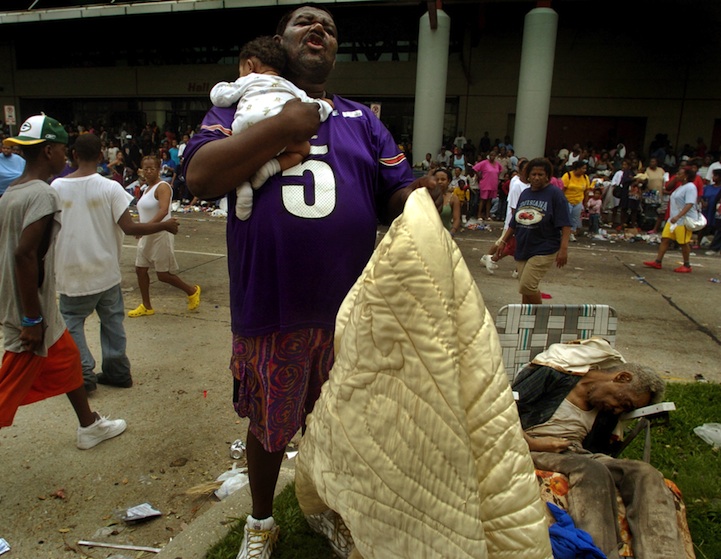
Fewer blacks move back to New Orleans after Katrina devastation

A decade after Hurricane Katrina, New Orleans seems to have found its rhythm again: the French Quarter is choked with tourists, construction cranes tower over the skyline, and hipsters bike to cafes in gentrifying neighbourhoods.

But recovery has been uneven in the city, which took the brunt of the 2005 storm that killed more than 1,800 people and was the costliest in U.S. history.

Many properties still bear physical scars from the hurricane, particularly in poorer African-American neighbourhoods. Social, demographic and political changes still ripple through the city.

In the mostly black Lower Ninth Ward, devastated by the flooding, Charles Brown is still attending services in his pastor’s nearly empty living room, waiting for the day when Mount Nebo Bible Baptist Church is rebuilt.

The black population of the city, long a hub of African-American culture, has plummeted since Aug. 29, 2005, the day Katrina swept in from the Gulf of Mexico and overwhelmed the levees meant to prevent flooding in the low-lying city.

Income gaps between blacks and whites have widened. Many African-American neighbourhoods and the businesses supporting them have not fully recovered.

Brown’s family and neighbours were among more than 1 million evacuated from the region after Katrina, which exposed deep poverty in the city, and displaced more people than any other event since the Dust Bowl drought and dust storms of the 1930s.

Brown, an emergency responder, stayed behind to search for the missing.

“We should have made so much more progress,” said the 55-year-old Brown in an interview before a series of events the city is planning this month to mark the storm’s 10th anniversary. “I don’t see anything to celebrate.”

The population of New Orleans is now about 385,000, according to U.S. Census figures from 2014, representing about 80 percent of its pre-Katrina population.

The number of African-Americans has plunged by nearly 100,000 since the storm, while there are now about 10,000 fewer white residents, according to Census figures and the Data Centre, a local nonprofit tracking demographic and economic trends.

Before the hurricane, African-Americans comprised 67 percent of the population. By 2014, that dwindled to 60 percent, the Census reported.

Orleans Parish, which has the same boundaries as the city of New Orleans, is the only county or parish in the United States with at least 4,500 African-Americans that experienced such a steep decline between 2000 and 2010, a Reuters analysis found, based on the Census counts before and after Katrina.

Some of the black population moved out to the suburbs, the Data Centre notes, and some gradually are moving back. Every year since 2010, the city’s African-American population has increased, adding on average several thousand residents.

Yet some who came back say they live in a different New Orleans. Tracie L. Washington, director of the nonprofit Louisiana Justice Institute, returned to New Orleans after evacuating. Today she says something feels off in the city.

She compares it to a missed beat in the brass band parades, called second lines, that weave through its traditionally African-American neighbourhoods on many Sundays.

“I’m just one of the survivors,” she said. “There shouldn’t be so few.”

INCOME GAP WIDENS

Yet the income gap between black and white residents has widened, according to the local Urban League. In 2013, the median income for African-American households in New Orleans was $25,102, compared to $60,553 for white households. The disparity has increased by 37 percent since 2005, according to figures from the Urban League.

“The folks who are benefiting from the most positive trends are the white community, whereas the African-American community by and large has not benefited in the same way,” said Allison Plyer, chief demographer at the Data Centre.

Among those who left and still want to go home is Philoraine Skipper, who was rescued from a second-story window when flood waters engulfed her house.

She was evacuated to the Superdome arena, where she was reunited with her two daughters, and eventually went with family to Oklahoma, where she still lives.

“We will be coming back,” said the 69-year-old, choking back tears as she described her long and unplanned departure, and her excitement visiting New Orleans this week to continue her house repairs. “This is home.” – Reuters

How $700 million in Katrina relief money went missing

Where did all the money go?

“Your guess is as good as mine,” David Montoya, the inspector general of the Department of Housing and Urban Development, says of $700 million in missing taxpayer money that Louisiana homeowners were given in the wake of Hurricane Katrina to elevate and protect their homes from future storms.

A new report released from the inspector general’s office shows that more than 24,000 homeowners who received grants of up to $30,000 to elevate their homes either misspent or pocketed the money.

“The fact of the matter is that the money they received was for a specific purpose and the specific purpose was to elevate these homes to avoid future catastrophes,” Montoya tells Power Players.

He rates the home elevation program as little more than a complete failure.

“Considering there was just under $1 billion earmarked for this particular program and there’s $700 million that wasn’t used for that, I’d give it a very low D,” he says.

But the lessons learned from the failed home elevation project provides a useful roadmap as Congress moves to offer recovery funds to victims of Hurricane Sandy.

“Clearly, to give money out on the front end right after a disaster, when many of these people lost everything, with a promise to do something down the road, I think is counterproductive to what the program was designed to do,” says Montoya.

Montoya says his office will recommend that, for future disaster relief programs, funds are disbursed to individuals only after the project has been completed.

To hear more of the interview with the inspector general, including his explanation of why the government likely will never get the money back, check out this episode of Power Players. – YahooNews

Looters love Sandy

Water that had risen six feet high hadn’t completely drained away from the streets of Coney Island in Brooklyn, N.Y., yet looters had already rifled through the remains of vulnerable shops on Mermaid Avenue.

At about 8 a.m. on Tuesday, workers arrived at Mega Aid Pharmacy to find that not only had Hurricane Sandy obliterated the building’s interior the night before, but thieves had broken in and gone through more than 10,000 pharmaceutical items. Most of the stolen goods were prescription meds.

“The water went away and these people started walking down the streets and just robbed stores,” a frustrated worker at the pharmacy, who wished to remain anonymous, told HuffPost Crime.

He and the pharmacy’s manager, 27-year-old Stan Gutkin, looked at their shop in disbelief that afternoon as workers carried out salvageable supplies.

“I don’t even know what it’s going to take until we’re operational,” Gutkin said. “This breaks the business. I don’t even know where to start.”

Their story was just one of many on Mermaid Avenue, one of only a few streets in Coney Island on Tuesday teeming with people — and officers. Locals said that the police presence in the neighborhood came after looters stole from banks, pharmacies and other shops with valuables.

It’s a crime that can almost be expected after a disaster. As Hurricane Irene pummeled the Atlantic Coast last year, looting was so prevalent that truTV put together a security footage slideshow of the crime. Shortly after Hurricane Katrina, New Orleans was plagued with looting and violent attacks, The New York Times reported.

Solid numbers aren’t yet available for New York City crimes connected to the superstorm. The 60th Precinct, which covers Coney Island, was evacuated and subsequently flooded on Monday night. Though several officers couldn’t say definitively whether there had been reports of looting or other crimes in the area, many were quick to tell onlookers to go home.

“It’s getting dark, and it’s real dangerous out here — that’s why there’s a cop on every block,” one NYPD officer told HuffPost Crime. “You could get your stuff stolen.”

Nearby, at a city housing project called Ocean Towers, a fight broke out in front of reporters and cops. Two women threw haymakers at one another as residents — all still without power — stared and yelled from their windows. Other people threw unidentified objects from their windows at officers, who swarmed in to break up the fistfight.

Dena Wells, 39, a resident of Ocean Towers, had had enough after watching the melee.

“People are turning on each other — they’re attacking each other,” she said, shaking her head. “Even when there’s no disaster, this building is disastrous. But after the hurricane, it just got crazy.

“We have to get out of here.” – Huffington Post