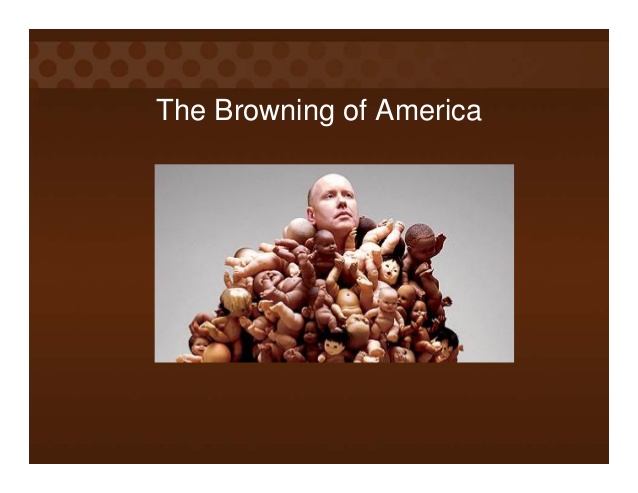
A study of the growing Hispanic immigrant population declares that the country is on the verge of the “Latinization of the United States,” a “browning of America” that by 2050 will be 29 percent Latino — and politically influential.
Published in the authoritative journal “Ethnicities,” the immigration analysis by two California experts noted that while big states such as California and Florida are home to most Hispanics, there has been a recent growth surge exceeding 300 percent of mostly Mexicans to Georgia, Kentucky, South Carolina, North Carolina and Arkansas.
The analysis is focused on how to economically handle the surge so that Latinos do not get left behind — or out of the middle class. The numbers and characterization of the new immigrants spells out the influence of the Hispanics.
In “Latina/o Formations in the United States,” Loyola Marymount University’s Antonia Darder and University of California’s Rodolfo D. Torres write that already 20 percent of the 30 million youths aged 18-24 in America are Latino and are poised to influence American politics and policy.
“By the sheer force of numbers, the kinds of adults that Latino students become will dramatically shape the future history of this country, as the former white majority becomes a minority population, at least in terms of number,” said the study provided to Secrets. It sits behind a paywall.
“Latinos have become more than an electoral voting bloc, emerging as strategic actors in major processes of democratic social transformation,” they added.
And they warned that there could be a backlash as whites try to hang on to power.
“In fact, the current struggle that persists in Arizona may well be a bellwether for the potential backlash that is bound to ensue in others parts of the nation, as the White Anglo-Saxon Protestant population no longer enjoys the political security associated with their past majority status,” said the authors.
“Over the past four decades, Latinos in the United States have emerged as strategic actors in this process of socio economic transformation. This so-called Latinization of the United States comes at a time of increasing social polarization and class inequalities. These forces assert themselves economically, demographically, culturally and politically in the workplaces and in Latino everyday life,” added their analysis.
Musi Maimane has been elected as the new Democratic Alliance (DA) leader at the 2015 DA Federal Congress held at the Boardwalk Convention Centre in Port Elizabeth on Sunday, as PRAAG predicted.
The DA needs a black leader for black votes. Until now the party relied on coloured votes in the Western Cape mostly. Coloured leaders do not appeal to blacks.
The Federal Chairperson is Athol Trollip, a supporter of Maimane.
The three Deputy Federal Chairperson positions went to Ivan Meyer, Refiloe Ntsekhe and Desiree van der Walt. Chairperson of the Federal Council is James Selfe, whose position went unopposed.
The position of Deputy Chairperson of the Federal Council went to Thomas Walters and Chairperson of the Federal Finance Committee is Alf Lees.
A total of 21 nominations were received for the seven positions available. According to Presiding Officer for the Congress, Penny Tainton, of the 1,379 potential voting delegates, 1,283 people cast their vote with a total percentage poll of 93% on Sunday.
A black janitor in Brooklyn almost shouted out the name when asked about his vote in the mayoral race. Bill de Blasio, he said, “knows my struggle.”
“He knows what the average person’s going through, because he’s been experiencing what they’re going through.” – Veronica Sibblies, a Jamaican immigrant.
In the Bronx, some African-American voters defaulted to a shorthand: “the man with the black wife.” Nobody thought it necessary to explain whom they meant.
And in a Brooklyn housing project, a lifelong resident said he was tired of mayors who, in his mind, had pitted blacks against whites. Mr. de Blasio, he declared, “is black and white.”
Of all the records shattered by Mr. de Blasio’s landslide victory, perhaps the most remarkable is that virtually every vote cast by black New Yorkers — 96 percent — went his way. He captured a bigger portion of the black vote than David N. Dinkins in 1989 when he was elected New York City’s first black mayor with 91 percent of the black vote, according to exit polls.
After the divisive tenor of the Giuliani years, and the deep grievances engendered by the stop-and-frisk police tactics of the Bloomberg era, black New Yorkers are now claiming Mr. de Blasio’s victory as their own. In postelection interviews, dozens of black New Yorkers said that Mr. de Blasio’s personal touch, his biracial family and his pledge to help the working-class and poor had affected them deeply. His victory, they said, was a chance to gain a voice in City Hall after two decades of leadership they viewed as inattentive, distant and, at times, even callous.
“There was a sense of not being included, not being cared about,” said Charlene Curry, as she walked along Marcy Avenue in Bedford-Stuyvesant, Brooklyn, last week. She said she had never met Mr. de Blasio, but felt as if he were a neighbor. The mayor-elect, she said, has “a more humane approach, a more inclusive approach.” She added, “That reaches home.”
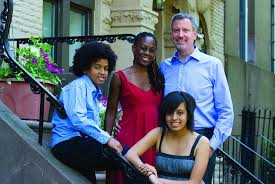
The excitement about Mr. de Blasio — tinged, in some quarters, by a dose of wait-and-see skepticism — was diligently cultivated by the candidate. Mr. de Blasio, who is of Italian and German heritage, kept up a brisk schedule of visits to predominantly black churches, frequently spoke of the effect of stop-and-frisk tactics on young black men, and put his wife and children at the forefront of his campaign, making a celebrity of his son, Dante, who sports a large Afro.
But it was also a result of Mr. de Blasio’s comfort and fluency with black culture, borne of an interracial marriage and personal experience, that offered a credibility voters said could not be bought by consultants or simulated in sound bites.
A protégé of Bill Lynch, an African-American political operative, and a veteran of the Dinkins administration and the congressional campaign of Charles B. Rangel, Mr. de Blasio is steeped in the history of New York’s black politics.
“A woman would say, ‘Do you understand, young man?’ And Bill said, “Yes, ma’am,’ ” a black woman recalled. “Do you know what that little, tiny cultural thing meant?”
That adroitness was frequently apparent on this year’s campaign trail, where Mr. de Blasio received electric receptions when visiting traditionally black neighborhoods, like Harlem and Crown Heights.
With his self-assured mien and casual tendency to call people “brother,” Mr. de Blasio often seemed to play the political preacher, even at run-of-the-mill news conferences. At a rally in late October in Brooklyn, he opened his remarks by intoning, “Brothers and sisters, we are gathered again,” earning appreciative nods and murmurs from supporters. On the Sunday before the election, Mr. de Blasio delivered a 16-minute sermon at First Corinthian Baptist Church in Harlem, a mainstay of his campaign schedule. At one point, he launched into a seemingly earnest soliloquy about the responsibilities of public servants, before pivoting to a jest.
“It’s my obligation to stand up and act when there’s a problem, when there’s a danger,” Mr. de Blasio said. “And I realized in the earlier part of the service — I realized that the choir was on fire! And I needed to rush out and call the Fire Department!” He was drowned out for nearly 15 seconds as the congregation laughed and cheered.
In Brooklyn on Thursday, Bonita Anderson-Watson, 50, smiled as she recounted a recent visit from Mr. de Blasio and his family to her church. “When I spoke with him and shook his hand, it was something different,” she said, adding that in conversations with friends afterward, comparisons to Bill Clinton, who was enthusiastically embraced by African-Americans in his presidential campaigns, quickly came up.
With all that good will, of course, comes high expectations. “Ninety-six percent of the African-American vote went to him,” said the Rev. Johnnie M. Green Jr., senior pastor at Mount Neboh Baptist Church in Harlem. “He should feel some sense of being beholden to the black community.”
Some of those interviewed said they would have voted for him even without his biracial family, citing his staunch Democratic politics and pledge to address economic inequality. Many said they never considered the Republican nominee, Joseph J. Lhota, and some said they did not know his name.
“His biracial family represents so many things and possibilities, too many to even get into,” said Leon Ellis, a Harlem restaurateur. “When people saw his family, they felt, ‘Here is someone who understands and relates to me on a level on which I can be comfortable.’ ”
“You have a black woman sitting there who can say, ‘My side of the family is hurting over here, now.’ He’s going to hear that direct,” said Walter Edwards, a real estate developer in Harlem. “He’s not going to get it from somebody off the street he has no relationship with.”
Veronica Sibblies, 66, a Jamaican immigrant who came to New York more than 50 years ago, said she believed Mr. de Blasio’s interracial family could serve as a model for better relations between blacks and whites in the city.
“You know what I like? I like when he said, ‘I don’t know if I’m going to move into Gracie Mansion,’ ” Ms. Sibblies said. “It doesn’t impress him. Material things don’t mean that much to him. He knows what the average person’s going through, because he’s been experiencing what they’re going through.”
“Some black people probably are breathing a sigh of relief, that finally we have someone that is going to at least represent our concerns, and try and make life better for us,” Mr. Worrell said. “But we all have to sit back and wait to see what happens.” – NYT
Hillary Clinton began her 2016 march to the White House last week, and it wasn’t a promising debut. The former first lady and Senator used her first big policy speech since leaving the State Department to portray American election laws as fundamentally racist. The speech was longer on anecdotes than statistics, so allow us to fill in some of the holes.
“In 2013, so far, more than 80 bills restricting voting rights have been introduced in 31 states,” Mrs. Clinton told her political base of lawyers at the American Bar Association. She portrayed these laws as part of an effort reaching back years to “disproportionately impact African-Americans, Latino and young voters.” And she threw the Supreme Court in as part of this racist conspiracy, assailing its recent decision finding the “preclearance” section of the Voting Rights Act to be unconstitutional.
She claimed the High Court had “struck at the heart” of the law, though all it did was eliminate a section that had forced such states as Mississippi to meet higher legal burdens for election laws than other states with a worse current record of minority voter participation. “Now not every obstacle is related to race,” Mrs. Clinton added, “but anyone who says that racial discrimination is no longer a problem in American elections must not be paying attention.”
No one thinks racial discrimination has vanished from American life or the human condition. But as for minority voting, Mrs. Clinton is the one who hasn’t been paying attention. In particular, she must have missed the May 2013 Census Bureau study on “The Diversifying Electorate—Voting Rates by Race and Hispanic Origin in 2012 (and Other Recent Elections).”
The study, based on data from the November 2012 Current Population Survey, shows that minority voter turnout nationwide has been rising—dramatically so. Take blacks, who as recently as 1996 had a low voter turnout rate of 53%.
As the nearby chart shows, black turnout has jumped in each of the last four presidential elections. In 2012, black turnout as a share of all eligible voters exceeded the turnout of non-Hispanic white voters—66.2% to 64.1%. Nearly five million more African-Americans voted in 2012 (17.8 million) than voted in 2000 (12.9 million). In both 2008 and 2012, black voters even exceeded their share of the eligible black voting age population. In 2012, blacks made up 12.5% of the eligible electorate but 13.4% of those voting.
Having Barack Obama at the top of the ticket no doubt helped this black voter mobilization, but the trend shows that the surge preceded his candidacy. Remember when liberals portrayed Bill Clinton as “America’s first black President”? The black turnout surge accelerated after Mr. Clinton’s last election. Such a large increase in black voter turnout over 16 years would seem to refute the claim by Mrs. Clinton that racial obstacles to voting are increasing.
Mrs. Clinton ignores all of this and focuses instead on anecdotes, while raising alarm about the voter ID laws that have passed in the last decade. She specifically raises fears about North and South Carolina. Yet the same Census Bureau study shows that black turnout exceeded non-Hispanic white turnout by statistically significant rates in both Carolinas, and was higher in most states east of the Mississippi River outside of New England.
North Carolina, she says, has this year “pushed through a bill that reads like the greatest hits of voter suppression.” But that supposed horror show merely reduces early voting by a week, and bars same-day registration and extending voting hours by political whim. All of these are designed to preserve ballot integrity, which is as vital as voter access to public confidence in honest elections. Voters without an ID can get one free at the Department of Motor Vehicles and they can also cast a provisional ballot pending confirmation that they are legally registered.
By the way, Georgia, Indiana and Tennessee have some of the strictest voter ID laws of the more than 30 states that have such laws, yet the Census report says black turnout exceeded that of non-Hispanic whites in 2012 in all three. Where is the evidence that voter ID laws keep minorities from voting?
The disconnect between these facts and Mrs. Clinton’s assertions suggests that she is the one playing racial politics. The current narrow Democratic majority is largely a coalition based on gender and racial identity. It requires big turnout among single women and non-whites. As the Obama era winds down, the fear among Democrats is that these voters won’t have the same enthusiasm.
Mrs. Clinton can play the “first woman President” card, but she also needs large minority turnout. If she can’t motivate that turnout based on rising economic optimism or opportunity, which is hard given the Obama economic record, she and Democrats will play to racial fears to drive it. She wants a racially polarized electorate.
This is a tragedy for the country, and Republicans like Mitt Romney share the blame for doing so little to attract minority votes. But this strategy and Mrs. Clinton’s speech don’t bode well for a less polarized politics as Democrats try to extend their electoral dominance.
Mrs. Clinton billed her speech last week as the first of a series addressing what she called “eroding public trust” in government. Government could use the help, though note the irony that Mrs. Clinton’s party has been running the government even as its reputation sinks. In any case, stoking racial fears based on imaginary government racism won’t make Americans feel better about politics or government.
A version of this article appeared August 19, 2013, on page A16 in the U.S. edition of The Wall Street Journal, with the headline: Hillary’s Racial Politics.
That young black man Trayvon Martin was killed last year by white neighbourhood watch volunteer George Zimmerman is not in dispute. But as Zimmerman’s trial begins today it may be harder to establish what represents justice.
Frank Taaffe ponders how fast the gated community here in Sanford where he bought his house seven years ago went to pot once the economy went south. Other buyers went into foreclosure or rented their homes out to strangers. Burglaries went up. A heroin ring was cracked by the police a few doors down.
“I could see the ambience here eroding,” Mr Taaffe, 56, says. “I don’t want to say darker, but that too.” Until a few months ago, the only gap in the perimeter fence around the community – “the Retreat at Twin Lakes” – was here right behind his house. “The scum that used to come through here…” he says, gesturing to the sliver of grass separating him from next door. “This was the corridor of crime.”
Mr Taaffe doesn’t mean to be racist discussing the trial that starts today of his friend, George Zimmerman, accused of murdering Trayvon Martin last year here at Twin Lakes. Zimmerman is white Hispanic while Trayvon, just 17, was black.
“There are cases of African-Americans being castigated because of the colour of their skin, I do believe that,” he acknowledges. It’s just that he thinks he knows better than most what happened here that February night.
Others in Sanford might tell you something similar. No town wants to be called racist. “We have been portrayed as some kind of racially charged city but that’s not the case,” City Manager Norton Bonaparte notes over coffee at a recent Chamber of Commerce breakfast at Sanford Zoo. “This was a tragic interaction between two individuals.”
But that, of course, is a sparse version of the truth and even Mr Bonaparte knows it. The reason this trial will be besieged by media crews from around the world has everything to do with the perception, at least, of racial stereotyping. It’s also why everything is being done to get ready for when the verdict comes in – to keep Sanford from blowing up all over again.
The worst might actually be over. What ignited the African-Americans nearly 18 months ago and sparked Trayvon support rallies everywhere was the police decision to release Mr Zimmerman without charge soon after taking him in. He had belonged to the Twin Lakes Neighbourhood Watch, had seen Trayvon outside a house (Mr Taaffe’s, in fact), figured he was “up to no good” and given chase. He didn’t know the boy was staying in the house of his father’s girlfriend at Twin Lakes and was merely returning from a corner shop.
Most outrageous to some was the notion that he had been freed under Florida’s “Stand Your Ground” law that says if you are facing possible lethal danger you are not obliged to try to flee and can act right there to save yourself. That means shooting your assailant if you have a permit to carry a weapon, which Mr Zimmerman did, without fear of prosecution. The African-American community saw a pattern.
“It was the straw that broke the camel’s back,” explains Francis Oliver, who runs the Goldsboro Historical Museum in a double-wide trailer in the worn down and mostly black Goldsboro section of Sanford. “They got the man who pulled the trigger, he admitted pulling the trigger and they had him in the police station. He tells them he stood his ground. You can’t stand your ground against a boy with a bag of Skittles and a bottle of iced tea.”
As Mr Bonaparte, who is black, puts it at the Chamber breakfast, the killing of Trayvon Martin highlighted what “has not been resolved in America even going back to the lynchings. A white man shot and killed a black person and nothing happened, again. That’s what struck a chord.” Locally, he adds, “it was the like the removal of a scab that showed that the healing that should have happened had not”.
But that early boil of outrage has been partially lanced. Mr Zimmerman, 28, turned himself in and eventually was charged with second-degree murder. The then chief of police, Bill Lee, was sacked by Mr Bonaparte. (Mr Lee was white and his replacement is black.) In the spring of this year, lawyers for Mr Zimmerman said they would not use a Stand Your Ground defence. To some it is enough that the wheels of justice are finally turning as they should.
“It’s in God’s hands now,” says Frederick Turner, a Goldsboro resident, “but I can’t say the community is happy because a young black man died for no reason”. He also echoed many in voicing dismay at the attempts by the defence to introduce evidence, including records from his mobile phone, that disparage Trayvon as wayward at least, even a wannabe gangster with an enthusiasm for marijuana and violence.
“All that stuff doesn’t have nothing to do with what happened to him in those seconds, minutes and hours.” Even if the judge in the case refuses to admit it, the publicity around these claims is unlikely to have escaped potential jurors.
Jury selection begins today. When it is over and the trial proper begins, the nub will be determining exactly what happened in those “seconds and minutes” between Mr Zimmernan spying the teenager outside Mr Taaffe’s house and shooting him from close range.
We know a bit – for example that he got out of his car and pursued the youngster on foot through the neighbourhood. It’s on the tapes of his call with the police dispatcher, who asked: “Are you following him?” “Yeah,” he replied. “OK, we don’t need you to do that,” said the dispatcher. “OK,” Zimmerman said. But he followed him anyway.
The difficulty is that no one else actually witnessed that final, fatal confrontation at a bend on Twin Trees Road, about a minute from Mr Taaffe’s house if you are running quickly. Some residents phoned the emergency services and screaming is heard on the tapes of those calls but experts do not agree which of the two men is doing the screaming. Do the lacerations that were on the back of Mr Zimmerman’s head support his claim that it was Trayvon who turned on him and that he fired in self-defence? Or was Trayvon indeed the sole victim?
“It’s called ‘prevent-defence’ – it’s a football term,” say Mr Taaffe, who expects to be called as a witness by both sides. “That’s what [Zimmerman] did. He cared for his neighbours and for his community. He wasn’t profiling anyone… He wasn’t chasing anybody. How could it be Trayvon screaming? If it was me, I would have gone into ‘prevent-defence’.”
Indeed, Mr Taaffe, who is in internet marketing, is about as exasperated now as the Travyon Martin supporters were when Mr Zimmerman was first allowed to walk free.
“This case has become so polarised and the other side just don’t want to take the cotton wool out of their ears. Where is the common sense? What happened to common sense?”
As for the verdict he is in no doubt. “George Zimmerman will walk out a free man,” he predicts. “But he will have to spend the rest of his life either in hiding or trying to justify his actions.” Such are the passions of this case. – The Independent
Issues of race, ethnicity and transformation dominated the Judicial Service Commission’s first day of interviews for judicial positions.
On Tuesday, the importance of Zulu ethnicity being a prerequisite to holding one of the top two positions in the KwaZulu-Natal division was raised during the interviews of judges Achmat Jappie and Mjabuliseni Madondo for the vacant deputy judge president position in that division.
The other candidate vying for one of the three vacant positions on the North and South Gauteng High Court bench, advocate David Fourie, was also questioned about his former membership of the “two secret organisations”, the Afrikaner Broederbond (which he resigned from in 1993), and its youth wing, the Ruiterwag.
Tanya Brenner, white, was especially grilled by advocate Dumisane Ntsebeza, and then by fellow commissioner KwaZulu-Natal state attorney Krish Govender on her statement that she appeared not to know enough black counsel to brief at her private practice.
Responding to Ntsebeza’s suggestion that there appeared to be an impression among litigants and lawyers that “briefing black people is taking a risk”, Brenner said: “With respect, I wouldn’t brief any person that I didn’t know … It doesn’t have a colour sensitivity.”
Ntsebeza at one point mused on how, 18 years after the end of apartheid, Brenner had been unable to acquaint herself with black counsel during her time as an attorney with the high profile Feinsteins law firm in Johannesburg, later in private practice or while serving as an acting judge in that division over the past eight years.
Brenner was also quizzed on a perceived lack of judgment when she admitted she had kept doing private attorney work while acting as a judge – which goes against section 11 of the Supreme Courts Act. The section requires an acting judge in such a position to get special permission from the justice minister.
Some of the commissioners was however convinced by Fourie’s reconstruction as a committed South African despite at one time belonging to the Broederbond, the secret Afrikaner society that wielded considerable political and economic influence during apartheid.
Ntsebeza noted the “values of our Constitution are the antithesis of what these organisations stood for” and asked Fourie whether his attitude “had changed since you were a member of these organisations?” To which Fourie responded in the affirmative.
Said Fourie: “I made a terrible mistake in my past, and I am haunted until this day. I am sorry,”
Recalling his time as a commissioner at the Truth and Reconciliation Commission, Ntsebeza, noted for that commission, it was imperative there was “an acknowledgment that should precede reconciliation”, and that he was “impressed by [Fourie’s] honesty and all the responses you have given”.
Fourie was also asked about how he would help assist young black judges if appointed and also on his record as convener of the transformation committee of the Pretoria Bar.
Madondo had in an interview for the judge president position last year that caused controversy when he had stated that the judge president of the KwaZulu-Natal division should be an ethnic Zulu, as that part of the population was in the majority in the province and that the judge president would have to interact in his official duties with political leadership of the same ethnic group.
This time around he suggested that these “social dynamics” made it a requirement that at least one of the judicial leaders in the province should be someone sensitive to that ethnicity and their historical and contemporary experiences.
The other contender for that position, Achmat Jappie, is the longest serving judge in that division and has the support of the majority of his colleagues on that bench, as well as the Advocates for Transformation in the province, the General Council of the Bar and the University of KwaZulu-Natal’s law school. During his interview Jappie noted wryly that he was classified “other coloured” during apartheid; “whatever that means”. He noted there were social issues that required attention in KwaZulu-Natal but was not convinced that his racial classification impacted the work that needed to be done as deputy judge president.
The commission also interviewed acting Labour Court judge president Basheer Waglay – the sole candidate for that position. He appeared to have a convivial interview.
This website uses cookies to improve your experience. We'll assume you're ok with this, but you can opt-out if you wish. Cookie settingsACCEPT
Privacy & Cookies Policy
Privacy Overview
This website uses cookies to improve your experience while you navigate through the website. Out of these cookies, the cookies that are categorized as necessary are stored on your browser as they are essential for the working of basic functionalities of the website. We also use third-party cookies that help us analyze and understand how you use this website. These cookies will be stored in your browser only with your consent. You also have the option to opt-out of these cookies. But opting out of some of these cookies may have an effect on your browsing experience.
Necessary cookies are absolutely essential for the website to function properly. This category only includes cookies that ensures basic functionalities and security features of the website. These cookies do not store any personal information.
Any cookies that may not be particularly necessary for the website to function and is used specifically to collect user personal data via analytics, ads, other embedded contents are termed as non-necessary cookies. It is mandatory to procure user consent prior to running these cookies on your website.