US Report warns of backlash against whites

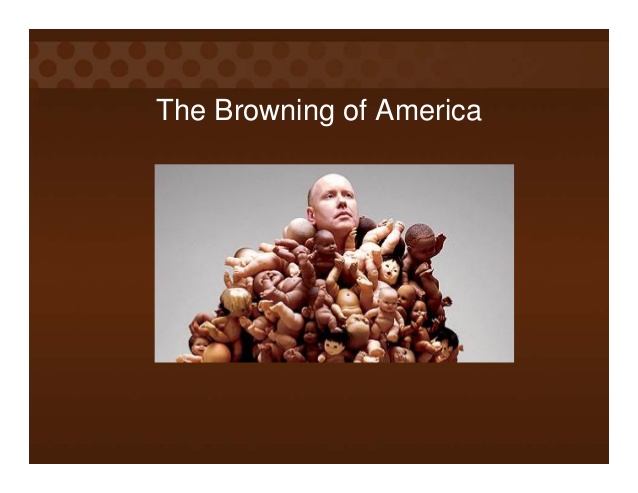
A study of the growing Hispanic immigrant population declares that the country is on the verge of the “Latinization of the United States,” a “browning of America” that by 2050 will be 29 percent Latino — and politically influential.

Published in the authoritative journal “Ethnicities,” the immigration analysis by two California experts noted that while big states such as California and Florida are home to most Hispanics, there has been a recent growth surge exceeding 300 percent of mostly Mexicans to Georgia, Kentucky, South Carolina, North Carolina and Arkansas.

The analysis is focused on how to economically handle the surge so that Latinos do not get left behind — or out of the middle class. The numbers and characterization of the new immigrants spells out the influence of the Hispanics.

In “Latina/o Formations in the United States,” Loyola Marymount University’s Antonia Darder and University of California’s Rodolfo D. Torres write that already 20 percent of the 30 million youths aged 18-24 in America are Latino and are poised to influence American politics and policy.

“By the sheer force of numbers, the kinds of adults that Latino students become will dramatically shape the future history of this country, as the former white majority becomes a minority population, at least in terms of number,” said the study provided to Secrets. It sits behind a paywall.

“Latinos have become more than an electoral voting bloc, emerging as strategic actors in major processes of democratic social transformation,” they added.

And they warned that there could be a backlash as whites try to hang on to power.

“In fact, the current struggle that persists in Arizona may well be a bellwether for the potential backlash that is bound to ensue in others parts of the nation, as the White Anglo-Saxon Protestant population no longer enjoys the political security associated with their past majority status,” said the authors.

“Over the past four decades, Latinos in the United States have emerged as strategic actors in this process of socio economic transformation. This so-called Latinization of the United States comes at a time of increasing social polarization and class inequalities. These forces assert themselves economically, demographically, culturally and politically in the workplaces and in Latino everyday life,” added their analysis.

Source: Washington Examiner

The tsunami of Latino immigrants to the US

Critics say the ginned-up fears of terrorism is a nearly non-existent threat. Americans are not about to be overwhelmed by Islam in the U.S..

Islam is used to distract whites from an enormous existential threat to their country, they say.

Immigration, legal and illegal, from Latin America must be stopped, or whites will be wiped from America, and many whites fear that it may already be too late. The Economist reports on the trend:

America is a country built by immigration, but nothing in its history compares to the rise in its Hispanic population. Changes to immigration law in the 1960s triggered a decades-long surge in arrivals, taking the Hispanic population from just 7m in 1970 to 57m today, a number that is set to double by mid-century.

At that point one in four Americans will be of Latino descent. In relation to the population of the day, there have been proportionally larger surges in the past, notably involving European migrations in the 19th and early 20th centuries.

Two factors make the rise of Hispanic America different. Never before has such a large group of new arrivals lived so close to their ancestral homelands, linked to grandparents in the same time zone by cheap flights and Skype.

Secondly, America is entering an era of white decline. For almost two centuries, from the time of George Washington’s presidency to the election of Ronald Reagan, whites of European descent made up at least 80% of the population. That share is below two-thirds now, and the white majority is set to become a minority by 2044.

That brings both challenges and opportunities. Today’s Hispanics lag behind whites when it comes to education and wealth. But they are strikingly young, lowering America’s median age and offering workers to fill the labour market when other rich countries face greying decline.

Politicians too often discuss Hispanics as almost a single-issue group, as victims or villains of immigration. But five-sixths are legal residents and recent Latino growth has been mostly from births, not new arrivals.

Hispanics are dispersing across the country and their political clout will only grow: nearly 1m US-born Latinos reach voting age annually.

Brown power: You never keep control forever

Two decades after California voters approved Proposition 187, barring public services to those in the country illegally, Gov. Jerry Brown said Thursday that the political tide has turned in the state with a growing wave of Latino voters demanding more tolerant policy from Sacramento.

The governor cited the history of various groups controlling California as a lesson.

“The Mexicans threw out the Spanish around 1815, and then, of course, the gringos threw out the Mexicans in 1846, or 1848,” Brown said. “But the point is you never keep control forever. There’s always new waves coming so you’ve got to stay ahead of the wave.”

“That’s what we call Brown power,” he joked with a play on his name.

Speaking to hundreds of Latino elected officials from throughout the country holding a conference in San Diego, Brown said the shift in power has made possible public support for changes including his signing of legislation providing driver’s licenses to immigrants in the country illegally and providing them with scholarships and the right to practice law.

“The power you represent is growing and it is growing in very important ways,” Brown told the members of the National Association of Latino Elected and Appointed Officials at the Loews Coronado Bay Resort.

Brown went on to credit “the sheer power of the Latino community as it is felt in the towns and cities and counties up and down this state. That is the tide that is turning the political feelings and philosophy of state government.”

Source: LATimes