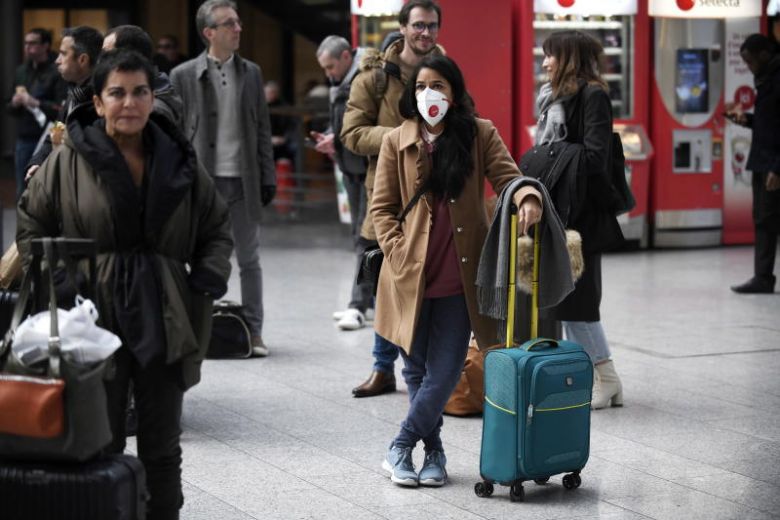
French flee from Paris to the countryside

PARIS – Parisians thronged the city’s rail stations and took to the highway early on Tuesday to escape the French capital before a lockdown imposed to slow the rate of coronavirus contagion kicked in at midday.

The Paris exodus drew dismay from provincial France, where many fear that city-dwellers will bring the virus with them and accelerate its spread.

Health Minister Olivier Veran said the government had no intention of preventing people travelling to secondary residences but said the stringent restrictions on public life would apply on the coast as they would in the city.

At Paris’s Gare du Nord, passengers, many wearing masks, stared up at departure boards.

“We’d rather be in a more open environment, in a bigger house with a garden, than in a Parisian apartment,” said education journalist Camille, who was travelling to her mother’s home in northern France with her partner. Both plan to work remotely.

France’s death toll from the coronavirus has reached 148 and a total of 6,600 people have been confirmed infected.

President Emmanuel Macron late on Monday said the country “was at war” with coronavirus and announced restrictions unprecedented in post-war France.

He ordered people to stay at home from Tuesday lunchtime. He said they should leave only to buy groceries, travel to work if essential, exercise or for medical care. The army will be mobilised to help move the sick to hospitals, he said.

Junior transport minister Jean-Baptiste Djebbari said services of the high-speed intercity TGV trains would be reduced under the lockdown to help curb infections.

But many in the provinces remained incredulous.

“Parisians are fleeing the city and will infect the provinces, just to be confined in the open air. This exodus is unthinkable, selfish and a ticking time-bomb,” one Twitter user wrote. – Reuters

Jew secretly films Parisian reactions to his religion

A journalist wearing a religious skullcap in Paris had the French public’s reaction filmed by a hidden camera.

Zvika Klein, a reporter for Jewish news outlet NRG, walked in the city for ten hours wearing a kippah – also known as a yarmulke – on his head as well as knotted ritual religious tassels.

Posting the video on YouTube, he wrote: ‘Welcome to Paris 2015, where soldiers are walking every street that houses a Jewish institution, and where keffiyeh-wearing men and veiled women speak Arabic on every street corner.’

He spent a day in Paris with a bodyguard while a photographer secretly documented reactions of the public using a GoPro camera hidden in his backpack.

He wandered through Jewish neighborhoods, around the Eiffel Tower, and then through mostly Muslim neighborhoods.

In an article accompanying the video, he said tourist attractions were ‘relatively calm’ – ‘but the further from them we walked, the more anxious I became over the hateful stares, the belligerent remarks, and the hostile body language,’ he wrote.

Boys shouted ‘Viva Palestine’ and as he passes a group of youths, one remarks: ‘I’m joking, the dog will not eat you’.

Fingers were pointed at him in a cafe – and moments later, thugs awaited him on a street corner, he adds.

A little boy was shocked at his appearance in his neighbourhood, he reports. ‘What is he doing here Mommy?’ he asked. ‘Doesn’t he know he will be killed?’

Israeli premier Netanyahu said Europe was no longer a safe haven for Jews following attacks in Paris and Copenhagen, adding that Israel is now the only country in the world where Jews can feel safe.

His comments sparked fury from Jewish groups and were promptly refuted by the leaders of France, Germany and Denmark.

But Mr Klein’s video shows, in Paris, Jews ‘are barred from entering certain areas’.

Source: Daily Mail

India scraps French Rafale deal

India has scrapped a deal with France to buy 126 Rafale medium multi-role combat aircraft (MMRCA), after three years of negotiations, due to the high cost of the project.

India has announced that a deal to buy 126 Rafale medium multi-role combat aircraft (MMRCA) from French manufacturer Dassault Aviation is “effectively dead”.

The reason is the announced high cost of the overall project, according to the country’s online newspaper Business Standard.

The global tender for 126 medium multi-role combat aircraft (MMRCA) was the first time the Indian Ministry of Defense (MoD) had awarded a contract based on life cycle costing (LCC). This meant the winner of the tender would not be the fighter with the cheapest purchase price; instead the chosen fighter would be the one that was the cheapest to buy, fly, maintain and overhaul over its 30-40 year service life.

As per the original tender, eighteen of the 126 planes were supposed to be purchased directly from Dassault, while Hindustan Aeronautics Limited (HAL) was due to manufacture the other 108 under license at a to-be-built facility in the city of Bangalore.

Dassault Aviation has refused to take full responsibility for these 108 fighters to be manufactured in India, which automatically increased the overall cost of the whole project.

Defence Minister Manohar Parrikar has recently said that Sukhoi-30 MKI fighters, which had been built by Hindustan Aeronautics at its Nashik plant, could be substituted for them, according to the website IndiaSpend.

The Sukhoi-30 MKI is currently India’s most advanced fighter and forms the backbone of its air force. It’s also half the current cost of a Rafale.

The Indian Air Force first signed a deal with the Russian government to purchase eight air defense Su-30K and 32 multi-role Su-30 MK aircraft in 1996. IAF bought an additional 10 Su-30 MKs in December 1998.

Meanwhile former French Foreign Minister Roland Dumas said his country should deliver the Mistral class helicopter carriers to Russia.

Dumas has urged the authorities to give the Mistral helicopter carriers to Russia under the existing contract and called the anti-Russian sanctions imposed by his country a gross mistake.

According to Russian experts, Paris could face penalties as high as $10 billion if it fails to fulfill its contractual obligations over the Mistral order.

Source: Sputnik News

Male nudity taboo broken for fashion

Exposed nipples? Naked bottoms? Bare breasts? The insouciant editors who sit in the front row of fashion shows have seen the lot at womenswear shows – and will barely raise an eyebrow. But the flesh on show at Rick Owens’ menswear show in Paris on Thursday surprised even them.

In a highly unusual move, the American designer sent four of his models down the runway wearing clothes with peepholes that showed full-frontal male nudity underneath.

The flash of flesh was presented subtly, in an otherwise typically dramatic, drapey collection of dark colours and loose silhouettes. As the audience gradually realised that a taboo was being broken in front of their eyes, whispers and occasional giggles rippled down the front row like a Mexican wave.

Rick Owens has a history of winning headlines with his catwalk shows. For spring/summer 2014, he was widely applauded for sending a fierce, muscular Step Dance team down the catwalk stomping and scowling.

That show was heralded as a significant moment in the rise of diverse casting in fashion shows.

Source: The Guardian

Russian, Turkish media hint at Paris false flag

Conspiracy theories are swirling around last week’s terror attacks in Paris, and beyond the customary fringe websites, they are being aired by Turkish politicians and mainstream Russian and Iranian media outlets.

Those making – or hinting at – the claims would have the world believe that U.S. or Israeli intelligence services were behind the attacks on the offices of the Charlie Hebdo newspaper and a kosher supermarket, which together with a street shooting left 17 victims and three terrorists dead over three days.

A mass circulation Russian newspaper, Komsomolskaya Pravda, ran a front-page headline Monday asking whether “the Americans” were behind the Paris terror attacks.

In the related story, a political analyst, Col. Alexander Zhilin, linked his theory to differences between the U.S. and European Union over sanctions against Russia in response to the Ukraine crisis.

Zhilin, who heads a body called the Moscow Center for the Study of Applied Problems, said immediately after French President Francois Hollande on January 5 raised doubts about continuing with the sanctions, he – Zhilin – had predicted that terror attacks could now be expected in France.

The U.S. needed a way to consolidate U.S.-E.U. unity over the sanctions, he said, and planning a terror attack was a “cheap and effective” option.

Separately, Komsomolskaya Pravda interviewed Russian economist Mikhail Khazin, head of a consulting firm called Neoconomics. He wondered who benefited most from the Paris attacks, and concluded that the primary beneficiary was the United States.

“Let me add that in the elite of the United States there are several groups, each of which has its own opportunities to promote and organize such attacks,” he was quoted as saying.

Khazin went on to list others who, in his view, could also benefit from the attacks, including Britain, Saudi Arabia and “Islamic State, al-Qaeda and so on” – although he added that the latter possibility was “the least likely.”

Other reports in the paper highlighted skepticism expressed by some quarters over the attacks, with one headline highlighting a comment by an Arab café waiter in Paris: “Someone needs a war between Muslims and Christians …”

In Iran, the Press TV broadcaster ran on its website an article by Paul Craig Roberts, a columnist, former U.S. Treasury official, and 9/11 conspiracy theorist, who wrote that one way of seeing the attack on Charlie Hebdo “is as an attack designed to shore up France’s vassal status to Washington.”

“The suspects can be both guilty and patsies,” said Roberts. “Just remember all the terrorist plots created by the FBI that served to make the terrorism threat real to Americans.”

On Roberts’ own website, he also highlights reports from other sources suggesting that the Paris attacks were a “false flag operation” – that is, a covert operation designed to point a finger at a purported perpetrator, while the actual mastermind’s identity remains hidden.

“Whether or not it is a false flag operation, the shootings are being used for a wider purpose or purposes,” he said.

Those purposes could include “bringing France back into Washington’s orbit,” stifling “the growing European sympathy for the Palestinians,” and countering “the rising opposition in Europe to more Middle Eastern wars,” Roberts charged.

‘A plot against the Islamic world’

Meanwhile Melih Gokcek, the veteran mayor of the Turkish capital, Ankara, raised the specter of the Mossad’s involvement, while speaking at a youth congress of the Islamist ruling Islamist Justice and Development Party (AKP) on Sunday.

According to a report by the official Anadolu news agency, Gokcek laid the blame on Israel’s security agency, charging that Israel was angry by a recent vote by French lawmakers supportive of Palestinian statehood.

“Israel certainly doesn’t want this [pro-Palestinian independence] sentiment to expand in Europe,” he said. “That’s why it is certain that Mossad is behind these kinds of incidents. Mossad enflames Islamophobia by causing such incidents.”

Turkish lawmaker Ali Sahin, a senior AKP member, was quoted as saying in Twitter messages that the attack on Charlie Hebdo was “staged like a scene from a movie,” by forces determined to discredit Islam.

The most senior figure to insinuate that all was not as it appeared in the Paris attacks – although he did also condemn them – was Turkish President Recep Tayyip Erdogan.

“Take note that the acts of terror are not carried out in a vacuum,” he said during a joint press conference in Ankara with Palestinian Authority chairman Mahmoud Abbas “The acts follow a predetermined script and we should be alive to a plot against the Islamic world.”

Erdogan, an arch-critic of Israel and key supporter of Hamas – a U.S.-designated foreign terrorist organization – also used the opportunity to slam Prime Minister Binyamin Netanyahu’s participation with other leaders in a mass anti-terror rally in Paris on Sunday.

“I also hardly understand how he dared to go there,” Anadolu quoted Erdogan as saying, accusing Netanyahu of carrying out “state terrorism by massacring 2,500 people in Gaza.”

Source: CNS News

Twelve killed in attack on French satirical magazine

Masked gunmen stormed the offices of a French satirical newspaper Wednesday, killing 11 people before escaping, police and a witness said. The weekly has previously drawn condemnation from Muslims.

French President Francois Hollande called the slayings a terrorist attack and said that several other terror attacks have been thwarted “in recent weeks.”

Xavier Castaing, head of communications for the Paris police prefecture, confirmed the deaths in the shooting at the offices of Charlie Hebdo, a satirical weekly that been repeatedly threatened for publishing caricatures of the Prophet Muhammad, among other controversial sketches.

Hollande rushed to the scene and top government officials planned an emergency meeting.

Luc Poignant, an official of the SBP police union, said the attackers escaped in two vehicles.

A witness to the attack, Benoit Bringer, told the iTele network he saw multiple masked men armed with automatic weapons at the newspaper’s office in central Paris.

Source: AP

Paris: Massive fire at Radio France HQ

A massive fire has broken out at the Radio France headquarters building in Paris, causing the evacuation of personnel, according to reports.

The fire engulfed the seventh and eight floors of Maison de la radio (Radio House) in the 16 arrondissement of Paris. Several windows exploded due to the extreme heat. Firefighters were called to the scene.

Radio programmes of France Inter and France Info, the two most important news stations, were suspended as a necessary safety measure. The fire reportedly hit the area of a ventilation system under works.

No injuries were immediately reported.

“I hope we can resume our radio programmes as soon as possible,” Laurent Guimier, director of France Info, told AFP.

Gaza protest in Paris draws thousands despite ban

Several thousand gathered in Place de la République in Paris, France to protest the Israeli operation in the Gaza Strip on Saturday, defying a state ban on the demonstration.

Protesters chanted “Israel is an assassin, Holland is an accomplice” and “we are all Palestinians,” and some were seen gesturing the quenelle, a reverse Nazi-salute, AFP reported.

Palestinian supporters decided to defy the ban and hold the protest as planned.

Earlier, France’s interior minister called on the protest’s organizers to observe the order, fearing anti-Semitic violence.

Bernard Cazeneuve made his public appeal shortly before Saturday’s demonstration in Paris was to start. Hours earlier, the Council of State, France’s top administrative body, ruled the protest ban was legal.

A court had ruled likewise, but organizers said they still planned to hold the protest.

France has Western Europe’s largest Jewish and Muslim populations.

Source: Haaretz

Yuan clearing banks in Luxembourg, Paris

In its continued push to make the yuan a global currency, China’s central bank said Sunday it plans to designate clearing banks for its currency in Paris and Luxembourg, as the two financial centers battle with London to become the leading European offshore yuan-trading city.

The People’s Bank of China announced the move in two separate statements Sunday. It didn’t say when it would designate the clearing banks.

The French and Luxembourg central banks said Sunday they had signed agreements with PBOC allowing for greater cooperation in the oversight of their domestic yuan market.

The weekend moves are the latest salvos in the race to win a major share of business in cross-border transactions in the Chinese currency. Singapore and Sydney are also vying for a significant share of the global yuan market, which is expected to expand rapidly along with China’s fast-growing economy.

On June 18, the PBOC appointed China Construction Bank Co., one of the country’s top-four state-owned banks, to clear yuan-related transactions in London. It became the first yuan clearing bank in a European country.

Opening a clearing bank is a critical step in developing an offshore yuan-based business. The designated banks will be able to supply yuan liquidity in case of a shortage by directly accessing China’s onshore currency market.

The Chinese central bank said that setting up the clearing banks will benefit Chinese, French and Luxembourg ” businesses and financial institutions in using the renminbi [yuan] for cross-border transactions and in further promoting trade and investment.”

French authorities have openly pushed for Paris to become a center for yuan transactions.

In March, China also granted 80 billion yuan ($12.9 billion) of quotas to French financial institutions that enable direct investment in the Chinese domestic financial market.

The Bank of France said Sunday the latest decisions by the PBOC “confirm the prominent role of the French market place” in cross-border use of the currency.

Luxembourg, home to a powerful asset-management industry, has built strong ties with Chinese investors in recent years and currently hosts the European headquarters of China’s three leading banks.

Last year, former Luxembourg Finance Minister Luc Frieden cited figures showing that the country was the leading center for yuan business in the euro zone, with some 40 billion yuan in deposits, 62 billion yuan in loans from Luxembourg banks and 220 billion yuan under management in the fund industry.

For China, the move to allow the yuan to be used more freely abroad aims to boost demand for the currency and reduce the amount of dollars entering the country. China still maintains a tight grip on the yuan’s value, with its trading strictly controlled in the mainland market.

Source: Nasdaq

Paris as polluted as Beijing

parispollutedPublic transport will be free from Friday until Sunday evening in Paris as the authorities try to encourage drivers to leave their cars at home, as much of France suffers severe air pollution caused by unusually warm weather.

The French capital and 30 other regions of France have been on maximum pollution alert for several days, with conditions set to continue until the end of the weekend.

The European Environment Agency says the pollution is the worst since 2007, and almost three-quarters of France is affected.

The air pollution has also affected neighboring Belgium where authorities have introduced a maximum speed limit to reduce the concentration of polluting particles. Free public transport has also been introduced in Belgium’s southern Wallonia region.

Jean-Paul Huchon, head of the STIF organization that manages Paris’s complex transport network, said that public transport would be free from Friday morning until Sunday evening.

“I am asking all residents in Paris and neighboring areas to favor the use of public transport,” Huchon said.

Subways, buses and trains will be free, as will bike-shares and one-hour sessions in electric cars.

The cities of Caen, Reims and Rouen, all in northern France, are following Paris’s lead and also offering free transport.

As air quality dipped Thursday to the same as Beijing, Ecology Minister Philippe Martin admitted that air quality was “an emergency and a priority for the government.”

A lack of wind and cold nights followed by balmy days have conspired to create conditions where polluting particles, most of them emitted by vehicle exhaust fumes, have been stuck under a warm layer of air.

Monitoring centers have been reporting a particularly strong concentration of so-called PM10 particles, which have a diameter of less than 10 microns.

Pollution alerts in France are issued when these PM10 particles reach 80 micrograms per cubic meter.

These tiny particles are also some of the most dangerous to public health and can cause asthma, allergies and other respiratory ailments.

Source: RT

South African, French, African foreign ministers to meet today

Paris-0792International Relations and Cooperation Minister Maite Nkoana-Mashabane arrived in Paris, France, yesterday morning, 04 December 2013, where she is leading a South African Government delegation to the France-Africa Summit taking place from 06-07 December 2013.

The summit will be preceded on 05 December 2013 by a meeting of Ministers of Foreign Affairs.

It is expected that the summit will focus on three identified themes; namely (i) Peace and Security, (ii) Economic Partnership and Development and (iii) the Environment.

It is further expected that the summit will examine policies for preventing conflicts, trafficking and piracy, how to deter the formation of armed movements and terrorist groups, and the strengthening of African security mechanisms.

South Africa’s participation at the summit will be informed by its foreign policy, which champions, amongst other things, peace, security and development as well as the African Agenda.

The South African Government delegation to the summit includes Defence Minister Nosiviwe Mapisa-Nqakula and senior officials. – DIRCO press release

France names suspect in Paris newspaper shooting

Abdelhakim Dekhar
Abdelhakim Dekhar

by Nicolas Gaudichet, Pauline Talagrand

France said Thursday the suspect arrested over this week’s shootings in Paris is a man previously jailed for his role in a “Bonnie-and-Clyde” style multiple murder that gripped the country 20 years ago.

Abdelhakim Dekhar was arrested on Wednesday after a major manhunt following a shooting at the left-wing newspaper Liberation that left an assistant photographer seriously hurt and another at the headquarters of the Societe Generale bank.

His DNA matched samples from the scenes of the attacks, officials said.

“All the evidence today points to his involvement in the events that he has been charged with,” Interior Minister Manuel Valls said.

Dekhar, who is in his late 40s, was convicted in 1998 of buying a gun used in an October 1994 shooting attack by student Florence Rey and her lover Audry Maupin. Three policemen, a taxi driver and Maupin himself were killed in a case that shook France.

He served four years in jail for his role in the killings, and his former lawyers have described him as “enigmatic” and “strange”.

Dekhar was arrested Wednesday evening in a vehicle in an underground parking lot in the northwestern Paris suburb of Bois-Colombes, after apparently trying to commit suicide.

Valls said that “everything appears to point to a suicide attempt”, and sources told AFP Dekhar was semi-conscious when he was found.

The head of the Paris criminal police department, Christian Flaesch, said he was in custody in a “medical environment” and was not in a fit state to speak to investigators.

Valls said investigators would need more information to be able to “understand his motivation”, adding that “one or two letters” had been found.

Investigators said the letters were “confused” and sought to “explain this act.”

In a press conference, Paris prosecutor Francois Molins said the letters spoke of a “fascist plot,” touched on “how suburbs are run” and accused the media of participating in the “manipulation of the masses”.

Molins said Dekhar was in detention for attempted murder and kidnapping.

The arrest came after a witness statement to police, who had on Tuesday released a new photograph of the suspect and received hundreds of calls from potential witnesses.

One of them was a man who had housed the suspect, said a source connected with the investigation.

The witness quoted the suspect as saying “I’ve made a stupid mistake.”

The shooter opened fire with a 12-gauge shotgun at the offices of Liberation early on Monday, hitting a 23-year-old photographer’s assistant as he hauled gear in the lobby, then firing another blast that hit the roof before leaving within seconds.

He then crossed the city to the La Defense business district on its western edge, where he fired several shots outside the main office of the Societe Generale bank, hitting no one.

He hijacked a car and forced the driver to drop him off near the Champs Elysees in the centre of the French capital, before disappearing.

Police say he was the same man who last Friday stormed into the Paris headquarters of a 24-hour TV news channel, BFMTV, briefly threatening staff with a gun before hurrying out.

Dekhar was suspected of being the third man in the so-called Rey-Maupin affair in 1994, which shocked France.

Investigators at the time compared the young couple to the infamous American outlaws Bonnie and Clyde.

Witnesses at the trial in 1998 described him as a mentor to the couple and accused him of exploiting their youth to manipulate them.

He argued that he had been a secret agent in the pay of Algerian security services, charged with infiltrating the radical left in France in search of those acting in coordination with Islamists in Algeria.

In the early 1990s Dekhar was known to hang out at squats used by left-wing radicals and which were often under police surveillance.

Maupin died of injuries sustained during a shootout with police and Rey, a middle-class student hitherto unknown to the police, was tried and sentenced to 20 years in jail. She was released in 2009.

Dekhar was acquitted of armed assault but found guilty of procuring the weapon and sentenced to four years. He was released soon afterwards, having already served his time in pre-trial detention.

This week’s attacks set off a major manhunt and raised concerns about violence against media outlets.

The photographer, who suffered wounds to the chest and stomach, appeared to be in better condition on Wednesday.

Hospital officials said he had regained consciousness and was no longer on an artificial respirator. – AFP

US civil rights march was a watershed event

The march on Washington that took place on 28 August 1963. About 80% of participants were black and an estimated 250 000 people took part.

by Shaun Tandon

As 250,000 people packed central Washington to push for civil rights 50 years ago, the actor Burt Lancaster opened a scroll and read a petition brought in from Paris.

The statement, signed by 1,500 Americans in the French capital, saluted the March on Washington for providing “an example of what America aspires to become.”

“All Americans, traveling no matter where in the world today, are in the position of ambassadors and are very often made bitterly aware of our country’s reputation,” said the petition, read by Lancaster in his crisp delivery.

“It is not easy to be an American abroad,” said the petition, calling the movement for civil rights part of a “struggle toward freedom” being waged worldwide.

American students learn of the March on Washington for Jobs and Freedom as a defining moment in the nation’s history, with Martin Luther King Jr. delivering his “I Have a Dream” speech and Congress less than a year later banning laws that enforced racial segregation.

But the march also carried an international dimension, coming at a delicate moment in the Cold War in which the United States increasingly realized that its oppression of African Americans cost it dearly on the global stage.

The march was one of the first events to be broadcast live internationally, with the BBC and other networks in Europe fed from the then-revolutionary Telstar satellite. The now defunct Washington Evening Star reported that police issued media credentials to television crews from Canada, France, Germany and Japan.

The Americans in Paris, in an initiative organized partly by self-exiled novelist James Baldwin, walked to the US embassy ahead of the march to show solidarity. Similar gatherings took place in other cities, although — in one echo of how little has changed 50 years later — authorities prevented a demonstration in Cairo.

Mary L. Dudziak, a professor at the Emory University School of Law and author of the book “Cold War Civil Rights,” said that John F. Kennedy’s administration initially opposed the march but, unable to stop it, gave out talking points to US diplomats.

The message, she said, was to cast the march not as a protest against racial injustice but as a triumph of free expression that could not happen under Communism. Much of the global media embraced a similar narrative, other than in the Soviet bloc where newspapers were predictably critical.

“The US government felt like they had effectively used the story of the march to reinforce their Cold War message about the wonders of democracy,” Dudziak said.

The United States, which since its independence has prided itself on its values, has faced international pressure at various points of its history over its own human rights record.

Abolitionist Frederick Douglass campaigned in England before the US Civil War. In more recent times, the United States has faced European criticism over capital punishment and its prison camp for terror suspects at Guantanamo Bay in Cuba.

But Dudziak said that 1963 was a particularly sensitive moment, with much of Africa freshly independent and Cold War alliances not yet solidified.

“In this very dynamic and fluid environment, the US cared a lot about the American image. American diplomats and presidents thought that that was going to have an impact on their ability to develop alliances and keep countries on the democratic side of the column,” she said.

In a cause of deep embarrassment, African diplomats were routinely snubbed when traveling near Washington. A highway cafe in Maryland in 1961 refused to serve the ambassador of newly independent Chad as he was heading to Washington from New York to present his credentials to Kennedy.

Besides Africa, the United States paid close attention to coverage of the civil rights movement in India, a democracy which refused to take sides in the Cold War.

In an editorial at the time, The Indian Express said that African Americans “have every right to feel frustrated” with their conditions but lauded the “new mood” represented by the peace march.

In a news article, the newspaper said that the US ambassador, Chester Bowles, had sent a telegram to King voicing support for the march and noting that the civil rights leader was inspired by Mahatma Gandhi, India’s independence leader and apostle of non-violence. – AFP

French leftist left brain-dead in Paris fight with skinheads

Clement Meric (centre)

A group of skinheads attacked a French far-left activist in the heart of Paris’ shopping district, leaving the young man brain-dead in the hospital Thursday, officials said, in an attack that raised fears of increased far-right violence.

Political tensions are high in France after months of protests against legalizing gay marriage that sometimes ended with troublemakers from the extreme right clashing with police.

Interior Minister Manuel Valls said a fight broke out Wednesday evening between two groups of young people in a pedestrian street just steps away from the famous Printemps department store. At one point, the 19-year-old leftist was beaten by several skinheads, according to Valls, a widely respected, center-leaning member of President Francois Hollande’s Socialist government.

No suspects have been arrested, and Valls told reporters at the scene of the attack – a crowded street with cafes and chain stores – that finding them is the top priority.

It was unclear how the fight developed and how many people were involved.

Politicians from left and right lashed out at the violence, as did Valls, who focused his anger at the skinheads.

“There is no place for small neo-Nazi groups whose enemy is the nation,” he said. “A group of the extreme right is at the heart of this assassination. There is a discourse of hate and a climate that favors this discourse. We need to pay attention to this because they threaten our values.”

The Party of the Left said Meric, one of its activists, was declared brain dead. The party, one of several small political movements on France’s vocal and active far left, called for demonstrations in Paris on Wednesday against violence by groups on the extreme right.

The victim, Clement Meric, is a student at Sciences Po, one of France’s most prestigious universities, according to the school. – AP