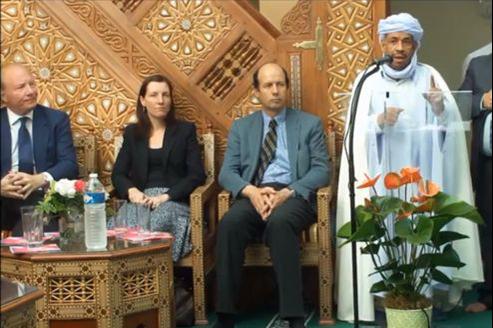
French Muslim leader asks for 5000 churches to be turned into mosques

France’s top Muslim official has suggested turning empty or abandoned Catholic churches into mosques, saying as many as 5,000 are needed for the country’s Muslim population – the largest in Europe.

“It’s a delicate issue, but why not?” Dalil Boubakeur, rector of the Grand Mosque in Paris and the president of the French Council of Muslim Faith, told Europe 1 radio on Monday.

There are currently about 2,500 mosques in France with another 300 under construction, but the number falls short of what is needed, he said. With roughly 5 million Muslims in France, at least 5,000 mosques are needed, Boubakeur said.

During the interview with French radio he gave an example of the transition of a church into a mosque in Clermont-Ferrand, which was welcomed by the local religious community. The church had been abandoned for more than 30 years and the building was given to the Muslim community in 2012.

“It’s the same God, these are neighboring rites, fraternal, and I think that Muslims and Christians can coexist and live together,” he said.

It’s not the first time the lack of places of worship for millions of Muslims has been brought up in France. In April, Boubakeur called for doubling the number of mosques.

His remarks were welcomed by the Christian community as a “legitimate” demand.

“Muslims should, like Christians and Jews, be able to practice their religion,” Monseigneur Ribadeau-Dumas, spokesperson for the Bishops’ Conference of France, told French radio station Europe 1.

However, this suggestion has been criticized by the National Front party. In April, Florian Philippot, its vice-president, argued France doesn’t need more, because “100 percent of places of radicalization are mosques.”

The party’s leader Marine Le Pen called to stop the construction of new mosques in March.

“We must today freeze the construction of new mosques while we verify the origin of their financing,” she said in an interview to France 24.

The question of building closer ties with the Muslim community was discussed at the talks between the French government and about 150 Muslim leaders in Paris on Monday.

French Prime Minister Manuel Valls stressed there was no link between extremism and Islam.

“We must say all of this is not Islam,” he said. “The hate speech, anti-Semitism that hides behind anti-Zionism and hate for Israel… the self-proclaimed imams in our neighborhoods and our prisons who are promoting violence and terrorism…

“Islam still provokes misunderstandings, prejudices, and is rejected by some citizens,” he added. “Yet Islam is here to stay in France. It’s the second largest religious group in our country.”

The first conference between the government and Muslim community leaders comes five months after the Charlie Hebdo and kosher store jihadist attacks in Paris that killed 17 people.

The terrorists responsible for the attacks “belong to a different world than we do,” said Boubakeur, speaking at the conference. – RT.COM

French prime minister wants to heal ‘apartheid’ in his country

France’s prime minister is launching a new bid to heal what he called a nation fractured between haves and have-nots, after terrorist attacks exposed long-simmering discrimination and social and religious tensions.

Manuel Valls shocked many this week by referring to a “territorial, social, ethnic apartheid” in the suburbs, or “banlieues,” ringing France’s major cities, where neglected housing projects are home mainly to minorities with immigrant roots.

Valls is holding a special government meeting Thursday to address the problem. His proposals will not be the first.

France’s suburbs have haunted French leaders for at least 25 years. Long havens for drug-dealing and other crimes, they took on new visibility with the attacks this month by French Islamic radicals who had lived in such neighborhoods. Twenty people, including the gunmen, were killed.

Dieudonne show banned in France due to anti-Jewish remarks

Dieudonne
Dieudonne

The highest court in France has reinstated a ban on a show by controversial comic Dieudonne M’bala M’bala, just before it was due to open.

Interior Minister Manuel Valls appealed to the Council of State to intervene minutes after a judge in the city of Nantes overturned the ban.

The comic has seven convictions for anti-Semitic hate speech.

He has already arrived at the theatre in Nantes, where more than 5,000 people were due to see the show.

Police have deployed outside the venue as a precaution. The verdict was greeted with boos and chants of Dieudonne’s name by those who had gathered to see the show.

On his Facebook page, Dieudonne appealed to those gathered outside Nantes’ Zenith theatre to return peacefully to their homes, saying he had been denied permission to address them.

He said that on Friday he would post a new video on his YouTube channel.

The judge in Nantes had earlier said he did not regard the show, entitled The Wall, as having “an attack on human dignity as its main object”.

But the Council of State upheld the ban on Thursday’s performance, the first on a scheduled tour, despite a challenge by the comic’s lawyers saying his freedom of expression had been breached.

The council cited the risk to public order in its reinstatement of the ban.

The president of the World Jewish Congress, Ronald Lauder, had called on France to “confront this preacher of hate head on”.

The government can be satisfied that a man they regard as a dangerous anti-Semite has been kept from the public arena, the BBC’s Hugh Schofield reports from Paris.

Dieudonne’s supporters will say it is just more evidence of how he and his ideas are silenced by the system, he adds.

‘Peddlers of hate’

French media who have sent reporters to previous performances of the The Wall say it contained a string of derogatory references to Jews.

Speaking on Thursday from Brittany, Mr Valls said that “peddlers of hate stop at nothing and show boundless creativity”.

“Faced with this creativity of hate, should we do nothing? Certainly not. The status quo is not a solution,” he said.

The French government made a concerted effort to stop the tour after Dieudonne was recorded making remarks about Jewish journalist Patrick Cohen.

“When I hear him talking, I say to myself: Patrick Cohen, hmm… the gas chambers… what a shame,” Dieudonne was recorded as saying. – extract from bbc.co.uk


Mayor of Paris, minister call for ban on French comedian Dieudonne

dieudonne
Poster of Dieudonne’s Le Mur at the entrance of the theatre

The mayor of Paris is also calling for comedian Dieudonne M’bala M’bala, known for his anti-Jewish humour, to be banned from performing in public.

France’s interior minister, Manuel Valls, voiced his displeasure first in wanting Dieudonne, as he is known, banned from the stage.

The well-known comedian, started out years ago with a Jewish partner in sketches that mocked racism.

But in 1997, he fell out with Elie Semoun over money owed to him.

He has now joined the political right and alienated some fans with anti-Jewish comments. Dieudonne maintains that most people find joking about blacks in order, but not humour about Jews.

His latest joke about gas chambers has irked Paris mayor Bertrand Delanoe, who likened Dieudonne to a criminal who “defends crimes against humanity”.

“We must ban the performances” he said, echoing recent comments made by interior minister Valls. Valls himself has been accused of discrimination after he said in September that Roma did not want to integrate.

Dieudonne has already been fined a couple of times for defamation, insults, hate speech and racial discrimination, and over his salute, called the “quenelle”.

The “quenelle” has been used by several personalities since, including footballer Nicolas Anelka, who recently used it to celebrate a goal.

But the 47-year-old comedian says the Holocaust gets too much attention to the exclusion of other crimes.

Valls, meanwhile, has said he wants to ban performances by Dieudonne on his nationwide tour this month, after the comedian joked about Jewish radio presenter Patrick Cohen.

“When I hear Patrick Cohen speak, I tell myself, you know, the gas chambers… A shame,” joked Dieudonne.

Despite the criticism, the comedian has scores of die-hard fans who feel he is unjustly being hounded by the media and politicians.

Dieudonne’s official page has 466,000 likes.

He won fans by exposing a well-known Jewish author’s denials of ethnic focus as flimsy and insincere.

The French-born son of a Cameroonian father and a white mother, Dieudonne M’Bala M’Bala shot to fame in the 1990s in a double-act with his childhood friend Semoun.

He stood for EU-wide elections in 2009 on an anti-Zionist platform, describing Holocaust commemorations as “memorial pornography”.

But his shows at a small theatre in Paris that he manages attract packed audiences.

At his show on Thursday, the comedian joked about “kippa city” and “the banking slave master” to general hilarity.

France adamant about separating state and Islam

Islamic women protest in France

Riots over a full-face Islamic veil, a woman losing her unborn baby in another similar confrontation and tensions flaring over a supermarket chain’s ad for the end-of-day feast for the Muslim holy month of Ramadan, are almost a daily staple for France.

France’s enforcement of its prized secularism is inscribed in law, most recently in a ban on wearing full-face veils in public. The policy instead may be fueling a rising tide of Islamophobia and driving a wedge between some Muslims and the rest of the population.

Yet ardent defenders of secularism, the product of France’s separation of church and state, say the country hasn’t gone far enough, AP reported.

They want to continue the cause of Voltaire helped and Victor Hugo, with a law targeting headscarves in the work place. Political pressure from a resurgent far-right has increased the tension.

A new generation of French Muslims — which at some 5 million, or about eight percent of the population, is the largest in Western Europe —  are defending mosques, halal food and Muslim religious dress.

Women who wear Muslim apparel “are no longer safe,” said a 26-year-old mother of three living in Trappes, a town south of Paris known for its large immigrant population.

Women wearing Muslim headscarves, suffered three attacks in Reims and three more in Orleans. Investigations and court cases are underway.

Police clashed last week with crowds protesting the arrest of a man who allegedly attacked an officer after his wife was ticketed for veiling her face in public. Dozens of cars were set afire in two nights of unrest in Trappes and an adjoining town. A 14-year-old boy suffered an eye injury.

Weeks earlier, a man allegedly assaulted a pregnant woman and ripped off her veil— one of two separately accosted in the Paris suburb of Argenteuil. She lost her baby days later, although the link with the incident remains unclear.

Interior Minister Manuel Valls insisted that Islam and the French Republic are compatible and denounced “a rise of violence against the Muslims of France.” At a dinner celebrating the end of Ramadan at the Grand Mosque of Paris, he denounced “those who want to make France a land of conquest.”

People told a veiled woman who is of Algerian origin, “If you’re not happy, leave, go home,” she said. But, she pointed out, she was born in France.

Most French people are Catholic, but church attendance has been in decline for decades and secular ideals run deep. With the growth of France’s Muslim population, lawmakers have increasingly turned to legislation to try to stifle public displays of Islamic faith.

In 2004, a law banned “ostentatious” religious symbols in public schools, a measure clearly directed at Islamic headscarves. It has been enforced without resistance.

A two-year-old law banning burqa-style veils from the streets of France has met with more outcry, even though only some 2,000 Muslim women cover their faces. Most Muslim women in France wear neither, as Islam does not Islam does not require face veils or covered head

A report by the Observatory of Secularism, created in 2013 by President Francois Hollande, revealed that a handful of the 705 women stopped by police for covering their faces in public chalked up more than 10 tickets each – two of them more than 25 – suggesting that some are provoking authorities intentionally.

A local official in Nimes, posted on his Facebook account an ad by the Carrefour supermarket chain publicizing “oriental” dishes for the nightly breaking of the fast during Ramadan with the comment, “Our Republic, is it still secular? Everything is on the way out.” The post was hastily removed after an outcry from Muslims.

While several European countries embrace secular values, France has been at the forefront of enforcing them, with the separation of church and state enshrined in law since 1905.

“Laicite,” is the French word for secularism. Associations throughout France work to uphold it. Far-right groups use it as a mantra, and leftists embrace it as well. There is even a secularism prize.

Hicham Benaissa of the National Center for Scientific Research said today’s secularism “appears to be a sort of (protection) against the religious influence of Islam” when “its spirit is to protect the faiths.”

A pre-school has just fired a woman who refused to remove her headscarf. An appeals court ruling in March calling the firing illegal spurred a demand for laws protecting secularism in private companies that would govern, for instance, dress and schedule requirements for prayer time or religious holidays.

A resulting bill to regulate religion in companies, sponsored by the opposition conservatives, failed.

Another report, released in June by the Observatory, tried to tone down the controversy, suggesting that slights to secularism have been exaggerated and dialogue, not a new law, may solve problems.

Some Muslims believe they are being driven away from the mainstream, leading to the growth of private Muslim schools and propelling Muslims to open their own businesses.

The law and the media “with their constant finger-pointing at Muslims are the reason the French population has become aggressive,” one woman said. Because of her robes, she sells cosmetics from her home. “I myself couldn’t apply for a job in an office.”

France names suspect in Paris newspaper shooting

Abdelhakim Dekhar
Abdelhakim Dekhar

by Nicolas Gaudichet, Pauline Talagrand

France said Thursday the suspect arrested over this week’s shootings in Paris is a man previously jailed for his role in a “Bonnie-and-Clyde” style multiple murder that gripped the country 20 years ago.

Abdelhakim Dekhar was arrested on Wednesday after a major manhunt following a shooting at the left-wing newspaper Liberation that left an assistant photographer seriously hurt and another at the headquarters of the Societe Generale bank.

His DNA matched samples from the scenes of the attacks, officials said.

“All the evidence today points to his involvement in the events that he has been charged with,” Interior Minister Manuel Valls said.

Dekhar, who is in his late 40s, was convicted in 1998 of buying a gun used in an October 1994 shooting attack by student Florence Rey and her lover Audry Maupin. Three policemen, a taxi driver and Maupin himself were killed in a case that shook France.

He served four years in jail for his role in the killings, and his former lawyers have described him as “enigmatic” and “strange”.

Dekhar was arrested Wednesday evening in a vehicle in an underground parking lot in the northwestern Paris suburb of Bois-Colombes, after apparently trying to commit suicide.

Valls said that “everything appears to point to a suicide attempt”, and sources told AFP Dekhar was semi-conscious when he was found.

The head of the Paris criminal police department, Christian Flaesch, said he was in custody in a “medical environment” and was not in a fit state to speak to investigators.

Valls said investigators would need more information to be able to “understand his motivation”, adding that “one or two letters” had been found.

Investigators said the letters were “confused” and sought to “explain this act.”

In a press conference, Paris prosecutor Francois Molins said the letters spoke of a “fascist plot,” touched on “how suburbs are run” and accused the media of participating in the “manipulation of the masses”.

Molins said Dekhar was in detention for attempted murder and kidnapping.

The arrest came after a witness statement to police, who had on Tuesday released a new photograph of the suspect and received hundreds of calls from potential witnesses.

One of them was a man who had housed the suspect, said a source connected with the investigation.

The witness quoted the suspect as saying “I’ve made a stupid mistake.”

The shooter opened fire with a 12-gauge shotgun at the offices of Liberation early on Monday, hitting a 23-year-old photographer’s assistant as he hauled gear in the lobby, then firing another blast that hit the roof before leaving within seconds.

He then crossed the city to the La Defense business district on its western edge, where he fired several shots outside the main office of the Societe Generale bank, hitting no one.

He hijacked a car and forced the driver to drop him off near the Champs Elysees in the centre of the French capital, before disappearing.

Police say he was the same man who last Friday stormed into the Paris headquarters of a 24-hour TV news channel, BFMTV, briefly threatening staff with a gun before hurrying out.

Dekhar was suspected of being the third man in the so-called Rey-Maupin affair in 1994, which shocked France.

Investigators at the time compared the young couple to the infamous American outlaws Bonnie and Clyde.

Witnesses at the trial in 1998 described him as a mentor to the couple and accused him of exploiting their youth to manipulate them.

He argued that he had been a secret agent in the pay of Algerian security services, charged with infiltrating the radical left in France in search of those acting in coordination with Islamists in Algeria.

In the early 1990s Dekhar was known to hang out at squats used by left-wing radicals and which were often under police surveillance.

Maupin died of injuries sustained during a shootout with police and Rey, a middle-class student hitherto unknown to the police, was tried and sentenced to 20 years in jail. She was released in 2009.

Dekhar was acquitted of armed assault but found guilty of procuring the weapon and sentenced to four years. He was released soon afterwards, having already served his time in pre-trial detention.

This week’s attacks set off a major manhunt and raised concerns about violence against media outlets.

The photographer, who suffered wounds to the chest and stomach, appeared to be in better condition on Wednesday.

Hospital officials said he had regained consciousness and was no longer on an artificial respirator. – AFP

French interior minister faces outcry over Roma girl’s deportation

Manuel Valls
Manuel Valls, France’s Interior Minister

France’s Interior Minister Manuel Valls has defended the treatment of a 15-year-old Roma girl who was detained by police during a school trip and deported to Kosovo, amid an outcry within the ruling party.

Valls on Wednesday defended the deportation of Leonarda Dibrani, her parents and five siblings aged between one and 17 as legal, but ordered officials to review the handling of the case.

Confronted with an angry backlash from the left of the ruling Socialist party, Prime Minister Jean-Marc Ayrault promised the family would be brought back to France if the girl’s rights were found to have been infringed.

“If there is a God we will be aboard the first plane back to France,” Leonarda told AFP in an interview in the Kosovan town of Mitrovica, where the family have been given temporary housing by the local authorities.

“I’m frightened, I don’t speak Albanian. My life is in France. I don’t want to go to school here because I don’t speak any of the local languages. I had freedom there. I do not want to stay here.”

Opposition lawmakers backed Valls and warned that a decision to reverse the deportation would send out a damaging message that illegal immigrants were welcome in France.

“The law has to be applied and in this case an expulsion order had twice been upheld by the judicial system,” said Christian Jacob, leader of the parliamentary group of the centre-right UMP.

The fresh row over France’s treatment of Roma migrants erupted Wednesday when an NGO that campaigns against the expulsion of school-age children highlighted the incident, which happened on October 9 in the eastern town of Levier.

Claude Bartolone, the speaker of the National Assembly, underlined the extent of the disquiet in the Socialist camp over the case.

“There is the law but there are also values on which the left must never compromise,” he said in a tweet.

Education Minister Vincent Peillon said: “School has to be a sanctuary, we have to retain our principles based on rights and humanity.”

The controversy follows an outcry last month over remarks by Valls in which he said most of the 20,000 Roma in France had no intention of integrating and should be sent back to their countries of origin.

Polls have suggested as many as three in four French voters support that stance and Valls, who was already France’s most popular politician, has enjoyed a surge in his standing as a result of comments regarded as racist by his critics.

Leonarda’s father, Reshat, 47, who was deported a day before the rest of the family, said the family had been victimised because of their ethnicity.

“There are bad refugees in France who get papers easily — we didn’t do anything bad. They did it to us because we are Roma. We would be treated differently if our skin was a different colour.”

Valls insisted that the deportation of Leonarda and the rest of her family had been carried out in line with established procedure following the rejection of their application for asylum.

“Everyone should keep a cool head. Do not for one single moment doubt that the rules, based on the law, are applied by my services with intelligence, discretion and humanity,” the minister said.

“We have to carry out these deportations,” he added. “It is of course a difficult subject but any immigration policy requires respect for the law, respect for individuals and great firmness. I am accountable for that to the French people.”

Speaking later upon his arrival at the French Caribbean island of Martinique, Valls stressed that he backed “a policy of integration”.

The exact circumstances in which the girl was taken off the school bus remained unclear but both the interior ministry’s version and the account of a teacher agree that her arrest did not take place in view of other pupils.

The teacher, who gave her account via the Network for Education without Borders (RESF), however, claimed that the other children were fully aware of what was happening and were deeply distressed by the incident.

Leonarda herself said: “All my friends and my teacher were crying, some of them asked me if I had killed someone or stolen something as the police were looking for me. When the police reached the bus they told me to get out and that I had to go back to Kosovo.”

President Francois Hollande did not make any public statement on the row, prompting opposition accusations the government was in chaos. – AFP

French leftist left brain-dead in Paris fight with skinheads

Clement Meric (centre)

A group of skinheads attacked a French far-left activist in the heart of Paris’ shopping district, leaving the young man brain-dead in the hospital Thursday, officials said, in an attack that raised fears of increased far-right violence.

Political tensions are high in France after months of protests against legalizing gay marriage that sometimes ended with troublemakers from the extreme right clashing with police.

Interior Minister Manuel Valls said a fight broke out Wednesday evening between two groups of young people in a pedestrian street just steps away from the famous Printemps department store. At one point, the 19-year-old leftist was beaten by several skinheads, according to Valls, a widely respected, center-leaning member of President Francois Hollande’s Socialist government.

No suspects have been arrested, and Valls told reporters at the scene of the attack – a crowded street with cafes and chain stores – that finding them is the top priority.

It was unclear how the fight developed and how many people were involved.

Politicians from left and right lashed out at the violence, as did Valls, who focused his anger at the skinheads.

“There is no place for small neo-Nazi groups whose enemy is the nation,” he said. “A group of the extreme right is at the heart of this assassination. There is a discourse of hate and a climate that favors this discourse. We need to pay attention to this because they threaten our values.”

The Party of the Left said Meric, one of its activists, was declared brain dead. The party, one of several small political movements on France’s vocal and active far left, called for demonstrations in Paris on Wednesday against violence by groups on the extreme right.

The victim, Clement Meric, is a student at Sciences Po, one of France’s most prestigious universities, according to the school. – AP