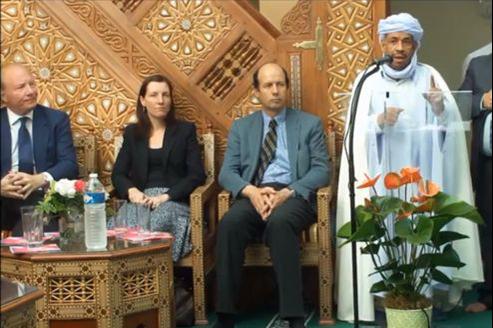
France’s top Muslim official has suggested turning empty or abandoned Catholic churches into mosques, saying as many as 5,000 are needed for the country’s Muslim population – the largest in Europe.
“It’s a delicate issue, but why not?” Dalil Boubakeur, rector of the Grand Mosque in Paris and the president of the French Council of Muslim Faith, told Europe 1 radio on Monday.
There are currently about 2,500 mosques in France with another 300 under construction, but the number falls short of what is needed, he said. With roughly 5 million Muslims in France, at least 5,000 mosques are needed, Boubakeur said.
During the interview with French radio he gave an example of the transition of a church into a mosque in Clermont-Ferrand, which was welcomed by the local religious community. The church had been abandoned for more than 30 years and the building was given to the Muslim community in 2012.
“It’s the same God, these are neighboring rites, fraternal, and I think that Muslims and Christians can coexist and live together,” he said.
It’s not the first time the lack of places of worship for millions of Muslims has been brought up in France. In April, Boubakeur called for doubling the number of mosques.
His remarks were welcomed by the Christian community as a “legitimate” demand.
“Muslims should, like Christians and Jews, be able to practice their religion,” Monseigneur Ribadeau-Dumas, spokesperson for the Bishops’ Conference of France, told French radio station Europe 1.
However, this suggestion has been criticized by the National Front party. In April, Florian Philippot, its vice-president, argued France doesn’t need more, because “100 percent of places of radicalization are mosques.”
The party’s leader Marine Le Pen called to stop the construction of new mosques in March.
“We must today freeze the construction of new mosques while we verify the origin of their financing,” she said in an interview to France 24.
The question of building closer ties with the Muslim community was discussed at the talks between the French government and about 150 Muslim leaders in Paris on Monday.
French Prime Minister Manuel Valls stressed there was no link between extremism and Islam.
“We must say all of this is not Islam,” he said. “The hate speech, anti-Semitism that hides behind anti-Zionism and hate for Israel… the self-proclaimed imams in our neighborhoods and our prisons who are promoting violence and terrorism…
“Islam still provokes misunderstandings, prejudices, and is rejected by some citizens,” he added. “Yet Islam is here to stay in France. It’s the second largest religious group in our country.”
The first conference between the government and Muslim community leaders comes five months after the Charlie Hebdo and kosher store jihadist attacks in Paris that killed 17 people.
The terrorists responsible for the attacks “belong to a different world than we do,” said Boubakeur, speaking at the conference. – RT.COM
After torching a Franciscan school, Islamists paraded three nuns on the streets like “prisoners of war” before a Muslim woman offered them refuge. Two other women working at the school were sexually harassed and abused as they fought their way through a mob.
In the four days since security forces cleared two sit-in camps by supporters of Egypt’s ousted president, Islamists have attacked dozens of Coptic churches along with homes and businesses owned by the Christian minority. The campaign of intimidation appears to be a warning to Christians outside Cairo to stand down from political activism.
Christians have long suffered from discrimination and violence in Muslim majority Egypt, where they make up 10 percent of the 90 million population. Attacks increased after the Islamists rose to power in the wake of the 2011 Arab Spring uprising that drove Hosni Mubarak from power, emboldening extremists. But Christians have come further under fire since President Mohammed Morsi was ousted on July 3, sparking a wave of Islamist anger led by Morsi’s Muslim Brotherhood.
Nearly 40 churches have been looted and torched, while 23 others have been attacked and heavily damaged since Wednesday, when chaos erupted after Egypt’s military-backed interim administration moved in to clear two camps packed with protesters calling for Morsi’s reinstatement, killing scores of protesters and sparking deadly clashes nationwide.
One of the world’s oldest Christian communities has generally kept a low-profile, but has become more politically active since Mubarak was ousted and Christians sought to ensure fair treatment in the aftermath.
Many Morsi supporters say Christians played a disproportionately large role in the days of mass rallies, with millions demanding that he step down ahead of the coup.
Despite the violence, Egypt’s Coptic Christian church renewed its commitment to the new political order on Friday, saying in a statement that it stood by the army and the police in their fight against “the armed violent groups and black terrorism.”
While the Christians of Egypt have endured attacks by extremists, they have drawn closer to moderate Muslims in some places, in a rare show of solidarity.
Hundreds from both communities thronged two monasteries in the province of Bani Suef south of Cairo to thwart what they had expected to be imminent attacks on Saturday, local activist Girgis Waheeb said. Activists reported similar incidents elsewhere in regions south of Cairo, but not enough to provide effective protection of churches and monasteries.
Waheeb, other activists and victims of the latest wave of attacks blame the police as much as hard-line Islamists for what happened. The attacks, they said, coincided with assaults on police stations in provinces like Bani Suef and Minya, leaving most police pinned down to defend their stations or reinforcing others rather than rushing to the rescue of Christians under attack.
Another Christian activist, Ezzat Ibrahim of Minya, a province also south of Cairo where Christians make up around 35 percent of the population, said police have melted away from seven of the region’s nine districts, leaving the extremists to act with near impunity.
Two Christians have been killed since Wednesday, including a taxi driver who strayed into a protest by Morsi supporters in Alexandria and another man who was shot to death by Islamists in the southern province of Sohag, according to security officials, who spoke on condition of anonymity because they weren’t authorized to release the information.
The attacks served as a reminder that while on the defensive in Cairo, Islamists maintain influence and the ability to stage violence in provincial strongholds with a large minority of Christians.
Gamaa Islamiya, the hard-line Islamist group that wields considerable influence in provinces south of Cairo, denied any link to the attacks. The Muslim Brotherhood, which has led the defiant protest against Morsi’s ouster, has condemned the attacks, spokesman Mourad Ali said.
Sister Manal is the principal of the Franciscan school in Bani Suef. She was having breakfast with two visiting nuns when news broke of the clearance of the two sit-in camps by police, killing hundreds. In an ordeal that lasted about six hours, she, sisters Abeer and Demiana and a handful of school employees saw a mob break into the school through the wall and windows, loot its contents, knock off the cross on the street gate and replace it with a black banner resembling the flag of al-Qaida.
By the time the Islamists ordered them out, fire was raging at every corner of the 115-year-old main building and two recent additions. Money saved for a new school was gone, said Manal, and every computer, projector, desk and chair was hauled away. Frantic SOS calls to the police, including senior officers with children at the school, produced promises of quick response but no one came.
The Islamists gave her just enough time to grab some clothes.
In an hourlong telephone interview with The Associated Press, Manal, 47, recounted her ordeal while trapped at the school with others as the fire raged in the ground floor and a battle between police and Islamists went on out on the street. At times she was overwhelmed by the toxic fumes from the fire in the library or the whiffs of tears gas used by the police outside.
Sister Manal recalled being told a week earlier by the policeman father of one pupil that her school was targeted by hard-line Islamists convinced that it was giving an inappropriate education to Muslim children. She paid no attention, comfortable in the belief that a school that had an equal number of Muslim and Christian pupils could not be targeted by Muslim extremists. She was wrong.
The school has a high-profile location. It is across the road from the main railway station and adjacent to a busy bus terminal that in recent weeks attracted a large number of Islamists headed to Cairo to join the larger of two sit-in camps by Morsi’s supporters. The area of the school is also in one of Bani Suef’s main bastions of Islamists from Morsi’s Muslim Brotherhood and ultraconservative Salafis.
“We are nuns. We rely on God and the angels to protect us,” she said. “At the end, they paraded us like prisoners of war and hurled abuse at us as they led us from one alley to another without telling us where they were taking us,” she said. A Muslim woman who once taught at the school spotted Manal and the two other nuns as they walked past her home, attracting a crowd of curious onlookers.
“I remembered her, her name is Saadiyah. She offered to take us in and said she can protect us since her son-in-law was a policeman. We accepted her offer,” she said. Two Christian women employed by the school, siblings Wardah and Bedour, had to fight their way out of the mob, while groped, hit and insulted by the extremists. “I looked at that and it was very nasty,” said Manal.
The incident at the Franciscan school was repeated at Minya where a Catholic school was razed to the ground by an arson attack and a Christian orphanage was also torched.
“I am terrified and unable to focus,” said Boulos Fahmy, the pastor of a Catholic church a short distance away from Manal’s school. “I am expecting an attack on my church any time now,” he said on Saturday.
Bishoy Alfons Naguib, a 33-year-old businessman from Minya, has a similarly harrowing story.
His home supplies store on a main commercial street in the provincial capital, also called Minya, was torched this week and the flames consumed everything inside.
“A neighbor called me and said the store was on fire. When I arrived, three extremists with knifes approached me menacingly when they realized I was the owner,” recounted Naguib. His father and brother pleaded with the men to spare him. Luckily, he said, someone shouted that a Christian boy was filming the proceedings using his cell phone, so the crowd rushed toward the boy shouting “Nusrani, Nusrani,” the Quranic word for Christians which has become a derogatory way of referring to them in today’s Egypt.
Naguib ran up a nearby building where he has an apartment and locked himself in. After waiting there for a while, he left the apartment, ran up to the roof and jumped to the one next door building from which he exited at a safe distance from the crowd.
“On our Mustafa Fahmy street, the Islamists had earlier painted a red X on Muslim stores and a black X on Christian stores,” he said. “You can be sure that the ones with a red X are intact.”
In Fayoum, an oasis province southwest of Cairo, Islamists looted and torched five churches, according to Bishop Ibram, the local head of the Coptic Orthodox church, by far the largest of Egypt’s Christian denominations. He said he had instructed Christians and clerics alike not to try to resist the mobs of Islamists, fearing any loss of life.
“The looters were so diligent that they came back to one of the five churches they had ransacked to see if they can get more,” he told the AP. “They were loading our chairs and benches on trucks and when they had no space for more, they destroyed them.” – AP
Egypt was under a tense state of emergency Thursday after security forces stormed the Cairo protest camps supporting ousted Islamist president Mohamed Morsi, in a bloody assault that sparked violence across the country which officials said claimed 278 lives.
The army-backed interim government imposed a month-long nationwide state of emergency, and curfews in Cairo and 13 other provinces after the violence on Wednesday.
Gory photographs and video images of the Cairo bloodbath dominated social media networks, as world powers called for restraint and condemned the show of force by security forces.
At least four churches were attacked, with Christian activists accusing Morsi loyalists of waging “a war of retaliation against Copts in Egypt”.
Hours after tear gas canisters first rained down on tents of protesters in the sprawling Rabaa al-Adawiya camp in eastern Cairo, an AFP correspondent counted at least 124 bodies in makeshift morgues there.
In a field hospital, its floors slippery with blood, doctors struggled to cope with the casualties, leaving the hopeless cases, even if still alive.
The health ministry said 235 civilians were killed in the Cairo crackdown and in subsequent clashes across Egypt. The interior ministry added that 43 security personnel had lost their lives.
Morsi’s Muslim Brotherhood spoke of 2,200 dead overall and more than 10,000 wounded.
Among those killed in Cairo was 17-year-old Asmaa al-Beltagui, daughter of wanted Muslim Brotherhood leader Mohammed al-Beltagui, a spokesman for Morsi’s movement said.
Britain’s Sky News said a veteran cameraman, Briton Mick Deane, was shot and killed while covering the assaults.
The violence prompted vice president and Nobel laureate Mohamed ElBaradei to resign, saying his conscience was troubled over the loss of life, “particularly as I believe it could have been avoided”.
“It has become too difficult to continue bearing responsibility for decisions I do not agree with and whose consequences I fear,” he said.
The state of emergency went into effect at 4:00 pm (1400 GMT) on Wednesday, with daily overnight curfews from 7:00 pm to 6:00 am.
The dramatic descent on the squares shortly after dawn came as a surprise to many. Security officials had originally spoken of gradually dispersing the sit-ins over several days.
Shortly after dawn on Wednesday, witnesses and an AFP correspondent said security forces fired tear gas before surging into Rabaa al-Adawiya, sparking pandemonium among the thousands of protesters who had set up the camp soon after Morsi was ousted in a military coup on July 3.
Men in gas masks rushed to grab each canister and dunk them in containers of water, as the main stage near the mosque of the camp blared Islamic anthems and protesters chanted “Allahu Akbar” (God is greatest).
Many Morsi supporters were given safe passage out of the camp, some flashing victory signs as they left through a security corridor.
A security official told AFP that hundreds of people were taking advantage of the safe passage offer, but that some diehards had stayed behind to fight on.
By Wednesday evening, a security official said Rabaa al-Adawiya was “totally under control”, adding: “There are no more clashes”.
In the smaller of the protest camps, at Al-Nahda square in central Cairo, police said they had control of the area after two hours.
Television footage showed flattened tents, as women and children flanked by police and army troops were led out of the square.
Dozens rounded up in the dispersal were shown sitting on the ground, handcuffed and surrounded by security forces.
Authorities later said calm had been restored across the country.
Use of force widely condemned
Europe’s leading powers, along with Iran, Qatar and Turkey, strongly denounced the use of force by the interim government.
The White House said Washington, which provides Egypt with $1.3 billion in annual military aid, “strongly condemns” the violence against the protesters and opposes the imposition of a state of emergency.
Interim prime minister Hazem al-Beblawi praised the police for their “self-restraint” and said the government remained committed to an army-drafted roadmap that calls for elections in 2014.
The Muslim Brotherhood urged Egyptians to take to the streets in their thousands to denounce the “massacre”.
“This is not an attempt to disperse, but a bloody attempt to crush all voices of opposition to the military coup,” Brotherhood spokesman Gehad al-Haddad said on Twitter.
Interior Minister Mohamed Ibrahim said no more protests would be tolerated.
The anger against the Islamist movement was evident as residents of several neighbourhoods clashed with Morsi loyalists.
Clashes also erupted between security forces and Morsi supporters in the northern provinces of Alexandria and Beheira, the canal provinces of Suez and Ismailiya, and the central provinces of Assiut and Menya.
In Alexandria, hundreds of angry Morsi supporters marched through the streets armed with wooden clubs chanting “Morsi is my president”.
An AFP reporter said they set fire to tyres and tore down pictures of army chief Abdel Fattah al-Sisi, who led the coup against Morsi.
It was a dramatic turn of events for the Muslim Brotherhood, who just over a year ago celebrated Morsi’s victory as Egypt’s first elected president.
His turbulent year in power, marred by political turmoil, deadly clashes and a crippling economic crisis, turned many against the Islamist movement, with millions taking to the streets on June 30 to call for his removal. – AFP
This website uses cookies to improve your experience. We'll assume you're ok with this, but you can opt-out if you wish. Cookie settingsACCEPT
Privacy & Cookies Policy
Privacy Overview
This website uses cookies to improve your experience while you navigate through the website. Out of these cookies, the cookies that are categorized as necessary are stored on your browser as they are essential for the working of basic functionalities of the website. We also use third-party cookies that help us analyze and understand how you use this website. These cookies will be stored in your browser only with your consent. You also have the option to opt-out of these cookies. But opting out of some of these cookies may have an effect on your browsing experience.
Necessary cookies are absolutely essential for the website to function properly. This category only includes cookies that ensures basic functionalities and security features of the website. These cookies do not store any personal information.
Any cookies that may not be particularly necessary for the website to function and is used specifically to collect user personal data via analytics, ads, other embedded contents are termed as non-necessary cookies. It is mandatory to procure user consent prior to running these cookies on your website.