Egypt’s Mubarak leaves jail for house arrest

Hosni Mubarak
Hosni Mubarak

Egypt’s toppled dictator Hosni Mubarak was transferred from prison to house arrest at a military hospital on Thursday, in a move overshadowed by a blistering crackdown against his Islamist successors.

The former strongman, forced to quit in early 2011, was flown by medical helicopter to a military hospital, where he will remain under house arrest as he stands trial on corruption and murder charges.

His ouster in 2011 was a pivotal moment in regional democratic upheavals that in Egypt led to an Islamist government, which lasted a year before a popularly backed military coup last month.

In other circumstances, the 85-year-old’s removal from prison might have caused shockwaves.

But with Egypt mired in a deadly conflict between the military-installed government and Islamists, Mubarak’s transfer took place amid little fanfare or protest.

He was ordered released after his lawyer argued Mubarak’s stay in prison had exceeded the maximum pre-verdict detention, and Mubarak made financial amends for one of his charges.

He still faces trial for corruption and his role in the deaths of protesters during the uprising that toppled him, with his next hearing on Sunday.

Prime Minister Hazem al-Beblawi, empowered with the authority to order arrests under the current state of emergency, ordered Mubarak to be placed under house arrest after release from jail.

Mubarak chose to be held at the military hospital, the official MENA news agency reported.

The decision to grant Mubarak pre-trial release added a volatile new element to the political turmoil that has gripped Egypt since the army ousted Islamist president Mohamed Morsi on July 3 following massive protests against him.

More than 1,000 people have been killed in the past week in violence following the forcible break-up of two pro-Morsi camps in the capital.

Authorities have arrested dozens of members of Morsi’s Muslim Brotherhood, including its supreme guide Mohamed Badie — the first time the group’s chief has been arrested since 1981.

Morsi himself is being held at a secret location and faces charges related to his 2011 escape from prison and inciting the death and torture of protesters.

The juxtaposition between the fates of the two ousted presidents, Mubarak and Morsi, is notable, analyst Hisham Kassem said.

Mubarak “committed numerous crimes… against the country, but managed to hide the evidence, particularly as all the state’s institutions were working for him at the time he was overthrown”.

“The opposite is true for Morsi, who was thrown in prison while all the state’s apparatus were against him.”

Arrests of Brotherhood leaders continued, with authorities detaining Ahmed Aref, a spokesman for the group, in Cairo.

Despite the pressure, a Brotherhood-led coalition has defiantly called for mass rallies on Friday, in a test of its support following the crackdown.

Egypt has experienced unprecedented political bloodletting since August 14, when security forces stormed two pro-Morsi protest camps in the capital.

The crackdown and resulting violence across the country killed nearly 600 people in a single day, the bloodiest in Egypt’s recent history.

Islamists have been accused of torching and attacking dozens of Christian churches, schools, businesses and homes — mostly in the rural south –accusing Egypt’s sizable Coptic minority of backing Morsi’s ouster.

On Thursday, Human Rights Watch condemned the government for failing to protect churches, but also the Brotherhood for failing to halt incitement against Christians.

Violence has also targeted police and soldiers, including two who were killed in a drive-by shooting near the Suez Canal town of Ismailia on Thursday.

The unrest has prompted international criticism, and EU foreign ministers agreed at an emergency meeting Wednesday to suspend the sale of arms and security equipment to Cairo in response to the mounting violence.

They issued a statement calling recent security operations “disproportionate”, while also condemning “acts of terrorism” in the Sinai and the church attacks.

But they expressed concern over the economic situation and said “assistance in the socio-economic sector and to civil society will continue”.

The United States has also criticised the violence, as well as Badie’s arrest, and announced the cancellation of joint military exercises.

But it has stopped short of halting its $1.3 billion annual defence aid package to Egypt, and denied reports it was withholding aid.

Washington on Thursday also sidestepped questions about Mubarak’s release, saying it was a matter for Cairo to decide, but called for Morsi to be freed.

“With respect to the Mubarak trial and decisions made, this is an internal Egyptian legal matter,” said State Department spokeswoman Jen Psaki.

“Our position on Mr. Morsi remains the same. We believe there should be a process for his release,” Psaki said.

Reporters had for days asked the State Department to comment on the seemingly paradoxical situation of the two leaders.

Oil-rich Saudi Arabia, which backs the army-installed interim government, has said it would step in with other Arab nations to fill any funding gap if Washington halts aid.

Meanwhile, a Hamas official said Egypt was set to reopen the Rafah border crossing with the Gaza Strip daily from Saturday after closing it in the wake of last week’s bloodshed. – AFP

Egyptian Islamists attack churches

A burnt-out Coptic Church in Egypt

by Hamza Hendawi

After torching a Franciscan school, Islamists paraded three nuns on the streets like “prisoners of war” before a Muslim woman offered them refuge. Two other women working at the school were sexually harassed and abused as they fought their way through a mob.

In the four days since security forces cleared two sit-in camps by supporters of Egypt’s ousted president, Islamists have attacked dozens of Coptic churches along with homes and businesses owned by the Christian minority. The campaign of intimidation appears to be a warning to Christians outside Cairo to stand down from political activism.

Christians have long suffered from discrimination and violence in Muslim majority Egypt, where they make up 10 percent of the 90 million population. Attacks increased after the Islamists rose to power in the wake of the 2011 Arab Spring uprising that drove Hosni Mubarak from power, emboldening extremists. But Christians have come further under fire since President Mohammed Morsi was ousted on July 3, sparking a wave of Islamist anger led by Morsi’s Muslim Brotherhood.

Nearly 40 churches have been looted and torched, while 23 others have been attacked and heavily damaged since Wednesday, when chaos erupted after Egypt’s military-backed interim administration moved in to clear two camps packed with protesters calling for Morsi’s reinstatement, killing scores of protesters and sparking deadly clashes nationwide.

One of the world’s oldest Christian communities has generally kept a low-profile, but has become more politically active since Mubarak was ousted and Christians sought to ensure fair treatment in the aftermath.

Many Morsi supporters say Christians played a disproportionately large role in the days of mass rallies, with millions demanding that he step down ahead of the coup.

Despite the violence, Egypt’s Coptic Christian church renewed its commitment to the new political order on Friday, saying in a statement that it stood by the army and the police in their fight against “the armed violent groups and black terrorism.”

While the Christians of Egypt have endured attacks by extremists, they have drawn closer to moderate Muslims in some places, in a rare show of solidarity.

Hundreds from both communities thronged two monasteries in the province of Bani Suef south of Cairo to thwart what they had expected to be imminent attacks on Saturday, local activist Girgis Waheeb said. Activists reported similar incidents elsewhere in regions south of Cairo, but not enough to provide effective protection of churches and monasteries.

Waheeb, other activists and victims of the latest wave of attacks blame the police as much as hard-line Islamists for what happened. The attacks, they said, coincided with assaults on police stations in provinces like Bani Suef and Minya, leaving most police pinned down to defend their stations or reinforcing others rather than rushing to the rescue of Christians under attack.

Another Christian activist, Ezzat Ibrahim of Minya, a province also south of Cairo where Christians make up around 35 percent of the population, said police have melted away from seven of the region’s nine districts, leaving the extremists to act with near impunity.

Two Christians have been killed since Wednesday, including a taxi driver who strayed into a protest by Morsi supporters in Alexandria and another man who was shot to death by Islamists in the southern province of Sohag, according to security officials, who spoke on condition of anonymity because they weren’t authorized to release the information.

The attacks served as a reminder that while on the defensive in Cairo, Islamists maintain influence and the ability to stage violence in provincial strongholds with a large minority of Christians.

Gamaa Islamiya, the hard-line Islamist group that wields considerable influence in provinces south of Cairo, denied any link to the attacks. The Muslim Brotherhood, which has led the defiant protest against Morsi’s ouster, has condemned the attacks, spokesman Mourad Ali said.

Sister Manal is the principal of the Franciscan school in Bani Suef. She was having breakfast with two visiting nuns when news broke of the clearance of the two sit-in camps by police, killing hundreds. In an ordeal that lasted about six hours, she, sisters Abeer and Demiana and a handful of school employees saw a mob break into the school through the wall and windows, loot its contents, knock off the cross on the street gate and replace it with a black banner resembling the flag of al-Qaida.

By the time the Islamists ordered them out, fire was raging at every corner of the 115-year-old main building and two recent additions. Money saved for a new school was gone, said Manal, and every computer, projector, desk and chair was hauled away. Frantic SOS calls to the police, including senior officers with children at the school, produced promises of quick response but no one came.

The Islamists gave her just enough time to grab some clothes.

In an hourlong telephone interview with The Associated Press, Manal, 47, recounted her ordeal while trapped at the school with others as the fire raged in the ground floor and a battle between police and Islamists went on out on the street. At times she was overwhelmed by the toxic fumes from the fire in the library or the whiffs of tears gas used by the police outside.

Sister Manal recalled being told a week earlier by the policeman father of one pupil that her school was targeted by hard-line Islamists convinced that it was giving an inappropriate education to Muslim children. She paid no attention, comfortable in the belief that a school that had an equal number of Muslim and Christian pupils could not be targeted by Muslim extremists. She was wrong.

The school has a high-profile location. It is across the road from the main railway station and adjacent to a busy bus terminal that in recent weeks attracted a large number of Islamists headed to Cairo to join the larger of two sit-in camps by Morsi’s supporters. The area of the school is also in one of Bani Suef’s main bastions of Islamists from Morsi’s Muslim Brotherhood and ultraconservative Salafis.

“We are nuns. We rely on God and the angels to protect us,” she said. “At the end, they paraded us like prisoners of war and hurled abuse at us as they led us from one alley to another without telling us where they were taking us,” she said. A Muslim woman who once taught at the school spotted Manal and the two other nuns as they walked past her home, attracting a crowd of curious onlookers.

“I remembered her, her name is Saadiyah. She offered to take us in and said she can protect us since her son-in-law was a policeman. We accepted her offer,” she said. Two Christian women employed by the school, siblings Wardah and Bedour, had to fight their way out of the mob, while groped, hit and insulted by the extremists. “I looked at that and it was very nasty,” said Manal.

The incident at the Franciscan school was repeated at Minya where a Catholic school was razed to the ground by an arson attack and a Christian orphanage was also torched.

“I am terrified and unable to focus,” said Boulos Fahmy, the pastor of a Catholic church a short distance away from Manal’s school. “I am expecting an attack on my church any time now,” he said on Saturday.

Bishoy Alfons Naguib, a 33-year-old businessman from Minya, has a similarly harrowing story.

His home supplies store on a main commercial street in the provincial capital, also called Minya, was torched this week and the flames consumed everything inside.

“A neighbor called me and said the store was on fire. When I arrived, three extremists with knifes approached me menacingly when they realized I was the owner,” recounted Naguib. His father and brother pleaded with the men to spare him. Luckily, he said, someone shouted that a Christian boy was filming the proceedings using his cell phone, so the crowd rushed toward the boy shouting “Nusrani, Nusrani,” the Quranic word for Christians which has become a derogatory way of referring to them in today’s Egypt.

Naguib ran up a nearby building where he has an apartment and locked himself in. After waiting there for a while, he left the apartment, ran up to the roof and jumped to the one next door building from which he exited at a safe distance from the crowd.

“On our Mustafa Fahmy street, the Islamists had earlier painted a red X on Muslim stores and a black X on Christian stores,” he said. “You can be sure that the ones with a red X are intact.”

In Fayoum, an oasis province southwest of Cairo, Islamists looted and torched five churches, according to Bishop Ibram, the local head of the Coptic Orthodox church, by far the largest of Egypt’s Christian denominations. He said he had instructed Christians and clerics alike not to try to resist the mobs of Islamists, fearing any loss of life.

“The looters were so diligent that they came back to one of the five churches they had ransacked to see if they can get more,” he told the AP. “They were loading our chairs and benches on trucks and when they had no space for more, they destroyed them.” – AP

Thousands march in Morocco in support of Egyptian Islamists

Protest in Rabat
Protest in Rabat

Around 10,000 people took part in a demonstration in the Moroccan capital, Rabat, on Sunday in support of Islamists in Egypt locked in a deadly showdown with security forces.

The crowd carried banners condemning the police operations that have cost hundreds of lives among demonstrators demanding the reinstatement of Egypt’s army-ousted Islamist president Mohamed Morsi and posters showing the dead in makeshift morgues in Cairo.

“Soldiers should be carrying out their duty of protecting the nation’s territory instead of killing their own people,” said Driss Leghroudi, a 33-year-old academic.

“History is repeating itself. It happened in Algeria in 1992 (with its civil war) … It’s Saudi Arabia which is behind it” in Egypt, he charged, as the crowd chanted for the expulsion of the Egyptian ambassador to Morocco.

Morocco initially adopted a neutral stand after last month’s toppling of Morsi but the authorities in Rabat have since expressed alarm over the carnage resulting from a security crackdown to remove Morsi’s supporters from the streets.

More than 750 people have been killed in violence across Egypt since Wednesday, official figures show. – AFP

French war in Mali with hostage crisis in Algeria

French troops arriving in Mali

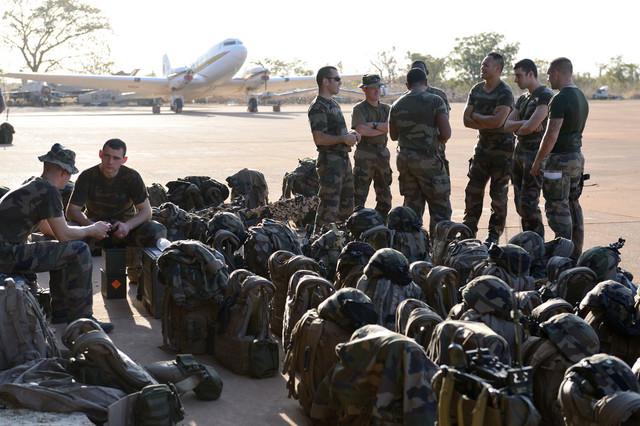
French troops fought Islamist rebels in Mali while in neighbouring Algeria Al-Qaeda-linked fighters killed two people, took more than 40 foreign hostages and called for an end to France’s “crusade”.

Chad meanwhile announced it would be sending 2,000 soldiers to fight in Mali.

After days of air strikes on Islamist positions in northern Mali, controlled by the rebels since April, French and Malian ground forces battled the insurgents in the central towns of Diabaly and Konna.

But the assault on a gas field over the border in Algeria dramatically raised the stakes.

Islamists said they were holding 41 foreign hostages, including seven Americans, after their attack on the In Amenas gas field in the east of the country.

A group calling itself “Signatories for Blood” claimed the action in a post to the Mauritanian website Alakhbar.

The attack was in reprisal for “the crusade being waged by French forces in Mali” and for Algerian’s cooperation, it said, calling for an end to the operation.

Algerian Interior Minister Dahou Ould Kablia said that one Briton and an Algerian had been killed in the attack, while another six people — a Briton, a Norwegian a Scot and three Algerians — had been wounded.

Other reports said the hostages included Japanese, Malaysian, Norwegian and Filipino nationals. Dublin confirmed the kidnapping of an Irish national while the US State Department said several of its nationals were being held.

The attackers had also demanded the release of 100 Islamists held in Algeria in exchange for their hostages, a worker at the gas field site told AFP.

The attack came less than a week after France launched its air strikes on Islamists in northern Mali on January 11 and just days after Algeria opened its airspace to French fighter jets engaged in the mission.

Jointly operated by British oil giant BP, Norway’s Statoil and state-run Algerian energy firm Sonatrach, the gas field is located 1,300 kilometres (810 miles) southeast of Algiers, close to the Libyan border.

On the ground in central Mali, French troops engaged Islamist fighters in Diabaly, a town seized two days earlier by fighters led by Algerian Abou Zeid, one of the leaders of AQIM.

“The special forces are currently in Diabaly, in close-quarter combat with the Islamists. The Malian army is also in place,” a Malian security source said on condition of anonymity.

There were also clashes near Konna, the central town Islamists seized last week, prompting the French intervention, security sources said.

The French military said it had secured a strategic bridge on the Niger river near the town of Markala, south of Diabaly, blocking a key route to Bamako.

French Defence Minister Jean-Yves Le Drian said the western zone around Diabaly was home to “the toughest, most fanatical and best-organised groups. It’s under way there but it’s difficult”.

— ICC launches Mali war crimes probe —

The International Criminal Court said it had launched a warcrimes probe Wednesday, as rights groups and military sources denounced the Islamists’ use of child soldiers and use of civilians as human shields.

“Different armed groups have caused havoc and human suffering through a range of alleged acts of extreme violence,” chief prosecutor Fatou Bensouda said in a statement.

“I have determined that some of these deeds of brutality and destruction may constitute war crimes.”

Chad announced Wednesday it would send 2,000 soldiers to Mali, a significant boost to the African forces gathering there.

“We intend to send an infantry regiment and two support battalions, which comes to around 2,000 men,” Moussa Faki Mahamat told Radio France Internationale. They would work closely with the Malian army and the multinational West African force taking shape, he added.

Nigeria will command the UN-approved 3,300-strong multinational African intervention force and has promised 900 troops. Niger, Burkina Faso, Togo, Senegal, Guinea and Ghana have also promised troops.

Some 2,000 men will arrive within the next 10 days, according to a report from a meeting of regional army chiefs seen by AFP.

Ivory Coast President and ECOWAS regional bloc chairman Alassane Ouattara called for all European countries to lend support to the operation after a meeting with Chancellor Angela Merkel in Germany.

Germany has already pledged two transport planes and Italy logistical support.

France says it will ultimately send 2,500 troops, pitted against what are thought to be around 1,300 Islamic fighters.

Mali has been effectively split in two since April 2012, when Islamists took advantage of a military coup in Bamako and an offensive launched by Tuareg separatists in the north to seize half the country.

The UN and aid agencies report some 370,000 Malians have been displaced by the fighting. – AFP