Yemeni leader flees while Saudi Arabia continues with air strikes

Yemen’s President Abd-Rabbu Mansour Hadi left his refuge in Aden for Saudi Arabia on Thursday as Houthi rebels battled with his forces on the outskirts of the southern port city.

Throughout the day, warplanes from Saudi Arabia and Arab allies struck at the Shi’ite Houthis and allied army units, who have taken over much of the country and seek to oust Hadi.

Warplanes resumed bombing the Houthi-held capital Sanaa on Thursday evening, shaking whole neighborhoods and terrifying residents. Several civilians have been reported killed in Sanaa.

“My whole family and I are preparing to sleep in the basement, as it’s the safest part of the house,” said resident Fawzia Nedras.

“The windows are rattling and we think they may break. We live near the airport, where we think a lot of the Houthi leaders are living and many of the air strikes are.”

Houthi leader Abdel-Malek al-Houthi said in a televised speech Yemenis would confront the “criminal, unjust and unjustified aggression” by Saudi Arabia.

Residents and security officials said the second night of air strikes throughout Yemen targeted air and ground force bases loyal to ex-president Ali Abdullah Saleh, whose forces have bolstered the Houthi advance.

The Saudi-led military intervention marked a major escalation of the Yemen crisis, in which Iran supports the Shi’ite Muslim Houthis, and Sunni Muslim monarchies in the Gulf back Hadi and his fellow Sunnis in Yemen’s south.

Iran denounced the surprise assault on the Houthis and demanded an immediate halt to Saudi-led military operations.

Tehran also made clear Saudi Arabia’s deployment of a coalition of Sunni states against its Shi’ite enemies would inflame the sectarian hatreds already fuelling wars around the Middle East.

Hadi’s departure under Saudi protection from Aden, his embattled base since fleeing Sanaa in February, could be a turning point.

Saudi state news showed pictures of Hadi smiling and holding hands with the Saudi defense minister receiving him at an airport in the capital Riyadh and said he would go on to Egypt to attend an Arab summit on Saturday.

Mohammed Marem, the director of Hadi’s office, confirmed he would attend the meeting in person, dropping his original plan to address it via video link.

Hadi would seek a “Marshall Plan” from Arab leaders to aid his war-torn country, his foreign minister Riyadh Yaseen told pan-Arab Al Jazeera TV, referring to a major economic stimulus for Europe after World War Two.

It was far from certain whether Hadi would be able to return to Aden.

On the city’s northern outskirts, Houthis and allied troops fought gun battles with militiamen loyal to Hadi. Thirteen pro-Houthi fighters and three militiamen were killed and several others were killed in running street fights in nearby towns.

Pro-Hadi fighters retook Aden airport, a day after it was captured by Houthi forces. The facility remained closed.

Major gamble

The Saudi move was a major gamble by the world’s top oil exporter to check Iranian influence in its backyard without direct military backing from Washington.

“We will do whatever it takes in order to protect the legitimate government of Yemen from falling,” Saudi Arabia’s ambassador to the United States, Adel al-Jubeir, told a news conference in Washington.

In Sanaa, which the Houthis seized in September, warplanes earlier bombed the main airport and al Dulaimi military air base, residents said.

A Reuters witness said four or five houses had been damaged. Rescue workers put the death toll at 13, including a doctor pulled from the rubble of his clinic.

Warplanes also struck Houthi fighters near Yemen’s border with Saudi Arabia, tribal and Houthi sources said. There was heavy street fighting in Houta, north of Aden, in which five pro-Houthi fighters and four militiamen were killed.

Thousands of Houthi supporters gathered to condemn the air strikes at the gate to Sanaa’s old city, waving Houthi banners and chanting “Death to America!”

Al-Arabiya said Saudi Arabia was contributing 100 warplanes to operation “Storm of Resolve” and more than 85 were being provided by the United Arab Emirates, Qatar, Bahrain, Kuwait, Jordan, Morocco and Sudan.

Egyptian air forces were participating and four naval ships headed to secure the Gulf of Aden. Turkey said it might provide logistical support.

Turkish President Tayyip Erdogan said later Iran had been trying to dominate the Middle East.

“It is really not possible to tolerate this. Iran has to understand,” he said, adding Tehran should withdraw any forces it had in Yemen as well as from Syria and Iraq.

Pakistan’s Prime Minister Nawaz Sharif said any threat to Saudi Arabia would “evoke a strong response” from Islamabad.

Pakistan, which borders eastern Iran, said it was considering a Saudi request that it send troops to Yemen.

Saudi Brigadier General Ahmed Asseri, spokesman for the operation, told a news conference:

“There are no plans at this stage for ground forces operations, but if the need arises, the Saudi ground forces and those of the friends and sisterly forces are ready and will repel any aggression.”

Arab foreign ministers agreed in Egypt on Thursday on a draft resolution to form a unified Arab military force.

“The task of the force will be rapid military intervention to deal with security threats to Arab nations,” Arab League Secretary General Nabil Elaraby said.

Russia’s President Vladimir Putin called for an immediate cessation of military activities in Yemen in phone conversations with Iran’s President Hassan Rouhani, the Kremlin said.

U.S. Secretary of State John Kerry raised Yemen on Thursday with his Iranian counterpart before turning to nuclear negotiations in Switzerland.

Iran’s Foreign Ministry demanded an immediate halt to the “aggression and air strikes” in Yemen.

“Military actions in Yemen … will further complicate the situation,” ministry spokeswoman Marzieh Afkham said, quoted by Fars news agency.

A senior Iranian official told Reuters: “Iran will use all possible political ways to allay tension in Yemen. Military intervention is not an option for Tehran.”

Riyadh accuses Iran of stirring up sectarian strife throughout the region and in Yemen with its support for the Houthis. Iran denies funding and training the Houthis.

Ambassador Jubeir said the assaults were in response to a request by Hadi. Washington said it supported the operation and had authorized U.S. logistical and intelligence support.

A widening Yemen conflict could disrupt the narrow Bab el-Mandeb strait, through which nearly 4 million barrels of oil are shipped daily to Europe, the United States and Asia. Oil prices surged as much as 6 percent on Thursday.

Yemen closed its main ports. The U.S. military said it would help ensure the strait at the tip of the Red Sea remains open. -Reuters
US targets Syrian oil field in anti-ISIS air strike

The United States and its partners launched a new round of strikes against Islamic State militants in Syria on Wednesday.

According to Agency France-Presse, strikes involved targeting an oil field in Syria near the towns of Al-Omar and Deir ez-Zor, journalist Zaid Benjamin reported.

“I can confirm that US military and Arab partner forces are undertaking additional strikes today against ISIL terrorists in Syria,” Pentagon press secretary Rear Adm. John Kirby said on Wednesday, using the Obama-administration’s preferred language for the group formerly known as ISIS that today identifies as the Islamic State. “These operations are ongoing, so we will not provide additional details at this time. We will do so later as operationally appropriate.”

Later, the Pentagon confirmed that less than a dozen aircraft are involved in the latest attack. US Central Command (CENTCOM), meanwhile, confirmed that Saudi Arabia and the United Arab Emirates also participated.

The latest round of strikes was acknowledged on Wednesday just shy of 12 a.m. local time in Syria and marks at least the third consecutive wave of attacks launched by the US and allied partners since Monday. Prior to then, the US had only attacked Islamic State militants in neighboring Iraq.

French war in Mali with hostage crisis in Algeria

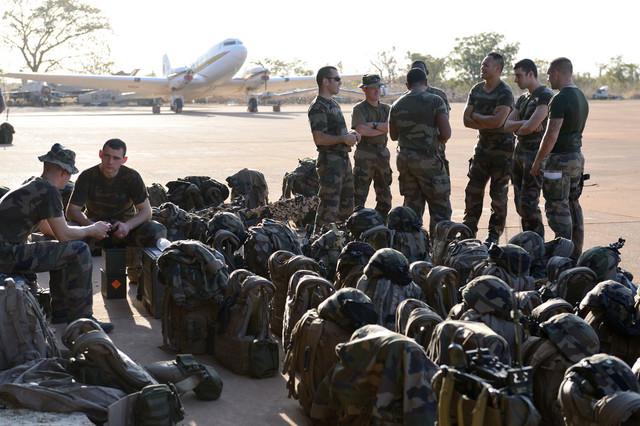
French troops arriving in Mali

French troops fought Islamist rebels in Mali while in neighbouring Algeria Al-Qaeda-linked fighters killed two people, took more than 40 foreign hostages and called for an end to France’s “crusade”.

Chad meanwhile announced it would be sending 2,000 soldiers to fight in Mali.

After days of air strikes on Islamist positions in northern Mali, controlled by the rebels since April, French and Malian ground forces battled the insurgents in the central towns of Diabaly and Konna.

But the assault on a gas field over the border in Algeria dramatically raised the stakes.

Islamists said they were holding 41 foreign hostages, including seven Americans, after their attack on the In Amenas gas field in the east of the country.

A group calling itself “Signatories for Blood” claimed the action in a post to the Mauritanian website Alakhbar.

The attack was in reprisal for “the crusade being waged by French forces in Mali” and for Algerian’s cooperation, it said, calling for an end to the operation.

Algerian Interior Minister Dahou Ould Kablia said that one Briton and an Algerian had been killed in the attack, while another six people — a Briton, a Norwegian a Scot and three Algerians — had been wounded.

Other reports said the hostages included Japanese, Malaysian, Norwegian and Filipino nationals. Dublin confirmed the kidnapping of an Irish national while the US State Department said several of its nationals were being held.

The attackers had also demanded the release of 100 Islamists held in Algeria in exchange for their hostages, a worker at the gas field site told AFP.

The attack came less than a week after France launched its air strikes on Islamists in northern Mali on January 11 and just days after Algeria opened its airspace to French fighter jets engaged in the mission.

Jointly operated by British oil giant BP, Norway’s Statoil and state-run Algerian energy firm Sonatrach, the gas field is located 1,300 kilometres (810 miles) southeast of Algiers, close to the Libyan border.

On the ground in central Mali, French troops engaged Islamist fighters in Diabaly, a town seized two days earlier by fighters led by Algerian Abou Zeid, one of the leaders of AQIM.

“The special forces are currently in Diabaly, in close-quarter combat with the Islamists. The Malian army is also in place,” a Malian security source said on condition of anonymity.

There were also clashes near Konna, the central town Islamists seized last week, prompting the French intervention, security sources said.

The French military said it had secured a strategic bridge on the Niger river near the town of Markala, south of Diabaly, blocking a key route to Bamako.

French Defence Minister Jean-Yves Le Drian said the western zone around Diabaly was home to “the toughest, most fanatical and best-organised groups. It’s under way there but it’s difficult”.

— ICC launches Mali war crimes probe —

The International Criminal Court said it had launched a warcrimes probe Wednesday, as rights groups and military sources denounced the Islamists’ use of child soldiers and use of civilians as human shields.

“Different armed groups have caused havoc and human suffering through a range of alleged acts of extreme violence,” chief prosecutor Fatou Bensouda said in a statement.

“I have determined that some of these deeds of brutality and destruction may constitute war crimes.”

Chad announced Wednesday it would send 2,000 soldiers to Mali, a significant boost to the African forces gathering there.

“We intend to send an infantry regiment and two support battalions, which comes to around 2,000 men,” Moussa Faki Mahamat told Radio France Internationale. They would work closely with the Malian army and the multinational West African force taking shape, he added.

Nigeria will command the UN-approved 3,300-strong multinational African intervention force and has promised 900 troops. Niger, Burkina Faso, Togo, Senegal, Guinea and Ghana have also promised troops.

Some 2,000 men will arrive within the next 10 days, according to a report from a meeting of regional army chiefs seen by AFP.

Ivory Coast President and ECOWAS regional bloc chairman Alassane Ouattara called for all European countries to lend support to the operation after a meeting with Chancellor Angela Merkel in Germany.

Germany has already pledged two transport planes and Italy logistical support.

France says it will ultimately send 2,500 troops, pitted against what are thought to be around 1,300 Islamic fighters.

Mali has been effectively split in two since April 2012, when Islamists took advantage of a military coup in Bamako and an offensive launched by Tuareg separatists in the north to seize half the country.

The UN and aid agencies report some 370,000 Malians have been displaced by the fighting. – AFP

Israeli air strikes kill 12 in Gaza

Palestinian medical officials said early Saturday that a total of 12 people had been killed and 12 injured in a series of Israeli air strikes in the Gaza Strip.

The Israeli raids came as Palestinians fired dozens of rockets and mortar rounds into southern Israel, wounding four people, one seriously, Israeli military sources said.

One Israeli strike, on a car travelling in the Tel El-Hawa neighbourhood west of Gaza City, killed the head of the militant Popular Resistance Committees, Zohair al-Qaisi, and fellow member Mahmud Hanani, the group said.

Both the PRC and the military wing of Hamas threatened to retaliate for Qaisi’s death.

The Al Quds Brigades, the military arm of Islamic Jihad, said that strikes on the east side of the city had killed its members Obeid al-Gharabli, Mohammed Harara, Hazem Qoureqa and Shadi Seqali.

It said that another two of its members, Fayeq Saad and Moatasem Hajaj, were also killed in strikes.

The Israeli attacks came in response to Palestinian mortar and rocket fire which started on Friday morning. The Israeli military said that in the course of the day about 40 rockets and mortar rounds had landed in southern Israel.

The PRC and the Al-Aqsa Martyrs Brigades, an armed offshoot of Palestinian president Mahmud Abbas’s Fatah movement, issued statements claiming to have fired rockets into Israel on Friday.

The official Palestinian WAFA news agency quoted a statement by the Fatah-dominated Palestinan Authority condemning the Israeli retaliation, saying it had created a “negative environment” that would “escalate the circle of violence in the region.”

The Israeli military said Qaisi “was among the leaders who planned, funded and directed” a deadly cross-border attack into southern Israel from Egypt’s Sinai last August.

In that incident, gunmen carried out a coordinated series of shooting ambushes on buses and cars on Route 12, which runs along the Egyptian border some 20 kilometres (12 miles) north of the Red Sea resort of Eilat.

The shootings took place over several hours, leaving eight dead and more than 25 wounded.

The military statement said Qaisi was also involved in a 2008 attack on a terminal for pumping fuel from Israel into the Gaza Strip, in which two Israeli civilians were killed.

The statement added that both the dead men were “responsible for planning a combined terror attack that was to take place via Sinai in the coming days.”

It said that other strikes were aimed at men about to fire rockets into Israel.

Hamas, which rules the Gaza Strip, has maintained a tacit truce with Israel, but other armed Palestinian groups regularly fire rockets and mortars across the border, which can spark air strikes in response.

The relatively small Popular Resistance Committees is one of the most active, and it pledged to avenge its men’s deaths.

“We are not committed to the truce; we will respond very strongly to this (Israeli) crime,” Abu Ataya, a spokesman for the PRC’s military wing, the Al-Nasser Salahadin Brigades, told AFP.

Hamas’s military wing, the Ezzedine al-Qassam Brigades also warned of retribution.

“Al-Qassam Brigades mourns the martyr leader Zohair Qaisi and martyr Mahmud Hanani and confirms that their blood will not be wasted, the enemy’s crime will be a curse on him,” it said in a statement.

Its political leaders were more restrained.

“The recent Zionist escalation is an unjustified crime, it comes as a part of the destabilization of a stable security situation in the Gaza Strip” the Hamas-run Gaza government’s interior ministry said in a statement.

“We hold the international community fully responsible for the attacks.”

Before Friday’s air strikes, Israeli army radio quoted what it called “senior military sources” as saying the army “does not intend to allow the firing to continue.” – AFP