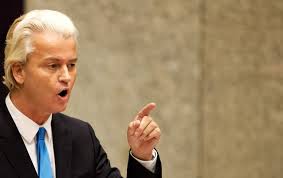
Dutch anti-Islam lawmaker Geert Wilders said Wednesday he plans to show cartoons of the Prophet Muhammad on Dutch television after Parliament refused to display them.
Wilders said he would show the cartoons during television airtime reserved for political parties, in a move likely to offend Muslims since Islamic tradition holds that any physical depiction of the Prophet Muhammad is blasphemous.
Political parties in the Netherlands get a small amount of airtime each year and broadcasting authorities have no say in what the parties show. Wilders said the broadcast would likely take place in the next few weeks, but an exact date has yet to be determined.
The announcement came a month after Wilders gave a speech at a contest in Garland, Texas, for cartoon depictions of Muhammad. Shortly after Wilders left the event, it was targeted by two men with pistols and assault rifles. Security guards shot and killed the attackers.
Wilders, whose Freedom Party holds 12 of the 150 seats in Parliament’s lower house, told The Associated Press he wants to air cartoons from the Texas competition to support people “who use the pen and not the sword.”
Wilders is no stranger to pushing the boundaries of free speech and targeting Islam. He has lived under round-the-clock protection since 2004 because of death threats.
He was acquitted in 2011 of hate speech as judges said that his anti-Islam rhetoric came in the context of a fierce national debate about immigration and multiculturalism.
Wilders is again facing prosecution for hate speech over a chant last year in which he asked his supporters whether they wanted more or fewer Moroccans in the Netherlands and they shouted back “Fewer! Fewer! Fewer!”
A UK law society has stepped up its pursuit of the Sun and its ‘Nazi propaganda’ spouting columnist Katie Hopkins over alleged anti-migrant hate speech, referring both to a powerful international court usually reserved for war criminals.
The Society of Black Lawyers, which originally reported the column written by Hopkins and published by the Sun just hours before 800 migrants drowned in the Mediterranean, has referred the case to the International Criminal Court (ICC).
The SBL’s efforts come after UN human rights chief Zeid Ra’ad Al Hussein said the column – in which Hopkins referred to migrants as “cockroaches” – recalled Europe’s darkest days of fascist hate speech and “Nazi propaganda.”
“The case is an exceptionally strong one as the incitement of racial hatred in Hopkins’ unfounded rant illustrated her xenophobic views on the issue surrounding migrants in general,” SBL committee member Shireen Khan told RT.
“This is further portrayed from the numerous articles that are published by the Sun newspaper that are anti-immigrant and majority of the time simply untrue.”
Khan is confident the ICC, which is best known for investigating atrocities in the Balkans and Africa, will take SBL’s referral very seriously.
“I believe that the ICC will take up this case fully as they have a duty to investigate such matters especially the seriousness of this case, which is further emphasized by the UN High Commissioner for Human Rights’ endorsement of our report.
“There is also a strong evidential basis on which SBL have brought this claim. It is quite a sad reality that [the] majority of the time racist abuse is unreported as a crime and secondly is hidden behind the ideas surrounding freedom of speech.”
Khan said the legitimization of anti-immigrant rhetoric under the banner of free speech was a scourge that had become all too common.
She pointed out that Hopkins’ controversial views proved infectious in some quarters, saying they were almost immediately echoed on LBC radio.
“Katie Hopkins’ column was published in the paper but it was then echoed in a viscous, xenophobic and racist tirade on radio, which led to exposure to further parts of society who may be disillusioned in thinking that immigrants are the cause of all destruction our country is facing.
“This has led to some of the most vulnerable people in the world being turned away from the support that they are entitled to under international law. These migrants trying to come to the EU are fleeing persecution, war and death.”
“Immigrants do not deserve to be the scapegoat of this country’s problems and it’s about time we stopped making them it.”
She blasted reactionary anti-immigrant elements within UK politics, arguing they were to blame for creating the political space in which such views could be aired without due criticism.
Zimbabwean youths were stopped yesterday from digging up the remains of Cecil Rhodes from his grave in the Matopos Hills, just outside Bulawayo.
The Zanu-PF youths assembled at the party’s Bulawayo offices, from which they intended to go to the hills. They apparently planned to exhume Rhodes’s remains so they could be repatriated to Britain.
But a directive from Zanu-PF headquarters in Harare put an end to their plan.
Zweli Malinga, a Zanu-PF youth activist from Masotsha Ndlovu district, where Rhodes is buried, reportedly told NewZimbabwe online: ”We cannot stand seeing whites coming from abroad every day to honour and conduct rituals before their ancestor who is here buried on our own land. The sooner they take [Rhodes] to their own land the better. If they do not we will do it ourselves.”
Zimbabwe’s President Robert Mugabe in 2012 blocked attempts by “war veterans” to exhume Rhodes’ remains.
A member of the Zanu-PF politburo, Sikhanyiso Ndlovu, said: “We decided to preserve it after independence for historical [reasons].”
The deputy head of communication at the British High Commission in Pretoria, Isabel Potgieter, said it was up to South Africans and Zimbabweans how they handled the Rhodes saga.
“It is not for us to comment. It is for stakeholders in the countries to decide,” she said.
The Rhodes Must Fall campaign has spread from UCT to Kimberley, with calls for a statue of him there to be removed.
Comment boards placed next to the Rhodes statue at UCT were removed after being covered in racist remarks prompting vice-chancellor Max Price to whine about “hate speech”, something he somehow finds perfectly in order when directed against Afrikaners.
A WhatsApp post has led to the investigation of a police officer in the Pretoria dog unit after 12 white colleagues accused him of hate speech and racism.
Provincial police spokesman Lieutenant-Colonel Lungelo Dlamini confirmed that Sergeant Hendric Mthimunye was the subject of a grievance process following the post on WhatsApp earlier this month, Rekord East reported.
“Never Trust the White Man, the only Time you Trust Him is when he is Dead.” the post allegedly read.
According to the grievance lodged by his colleagues, Mthimunye’s post was racist and promoted hate speech.
The complaint also stated that it was a police officer’s duty in this country to deliver a service to all citizens, including whites.
“We work with him on a daily basis… We feel that we cannot trust a person who makes extreme racists comments. As members of the police we must be able to trust one another and depend on colleagues to protect us in unthinkable dangerous situations,” the grievance stated.
Dlamini said Mthimunye’s commanding officer was currently involved in a grievance process against the Sergeant.
It was later reported that Mthimunye had defended the post, saying it was a misunderstanding and that it in fact referred to a friend of his with the surname “Mlunga”, which translates to “white man” in Zulu.
Mthimunye said he had been angry with his friend who had owed him money, and refused to repay the debt.
He said the post was not aimed at his white colleagues and that he had never foreseen that it would hurt or upset them.
Whites are a small minority in South Africa but nevertheless subject to extreme racial legislation to keep them out of government jobs, industry and sport.
Being a white farmer in the country is more dangerous than being a soldier in Iraq.
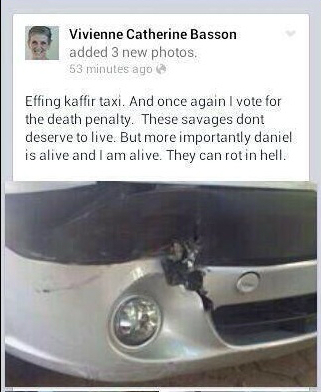
Telecommunications firm Ericsson has fired a worker who used the word “kaffir” in a tweet.
The tweet from the account of Vivienne Basson used the word while expressing frustration over a taxi accident.
The Tweet went on to say, “These savages don’t deserve to live. They can rot in hell.”
Ericsson South Africa M.D Magnus Mchunguzi says Basson who was a sub-contractor, has breached their business ethics.
Social Networks may seem to many as lawless, but World Wide Worx Technology expert, Arthur Goldstuck says people may be prosecuted for hate speech posted online.
He also says the law on social networks applies as it would in other public spaces.
Social network leaves a pure trail of evidence as numerous people can copy it and save it for the whole world to see.
Goldstuck says once you put something up online, it can never be entirely deleted.
Basson explained on twitter what led to her offensive speech before apologising.
Poster of Dieudonne’s Le Mur at the entrance of the theatre
The mayor of Paris is also calling for comedian Dieudonne M’bala M’bala, known for his anti-Jewish humour, to be banned from performing in public.
France’s interior minister, Manuel Valls, voiced his displeasure first in wanting Dieudonne, as he is known, banned from the stage.
The well-known comedian, started out years ago with a Jewish partner in sketches that mocked racism.
But in 1997, he fell out with Elie Semoun over money owed to him.
He has now joined the political right and alienated some fans with anti-Jewish comments. Dieudonne maintains that most people find joking about blacks in order, but not humour about Jews.
His latest joke about gas chambers has irked Paris mayor Bertrand Delanoe, who likened Dieudonne to a criminal who “defends crimes against humanity”.
“We must ban the performances” he said, echoing recent comments made by interior minister Valls. Valls himself has been accused of discrimination after he said in September that Roma did not want to integrate.
Dieudonne has already been fined a couple of times for defamation, insults, hate speech and racial discrimination, and over his salute, called the “quenelle”.
The “quenelle” has been used by several personalities since, including footballer Nicolas Anelka, who recently used it to celebrate a goal.
But the 47-year-old comedian says the Holocaust gets too much attention to the exclusion of other crimes.
Valls, meanwhile, has said he wants to ban performances by Dieudonne on his nationwide tour this month, after the comedian joked about Jewish radio presenter Patrick Cohen.
“When I hear Patrick Cohen speak, I tell myself, you know, the gas chambers… A shame,” joked Dieudonne.
Despite the criticism, the comedian has scores of die-hard fans who feel he is unjustly being hounded by the media and politicians.
Dieudonne’s official page has 466,000 likes.
He won fans by exposing a well-known Jewish author’s denials of ethnic focus as flimsy and insincere.
The French-born son of a Cameroonian father and a white mother, Dieudonne M’Bala M’Bala shot to fame in the 1990s in a double-act with his childhood friend Semoun.
He stood for EU-wide elections in 2009 on an anti-Zionist platform, describing Holocaust commemorations as “memorial pornography”.
But his shows at a small theatre in Paris that he manages attract packed audiences.
At his show on Thursday, the comedian joked about “kippa city” and “the banking slave master” to general hilarity.
The leftist Greek government said on Monday it would soon present a bill targeting “racist hate speech”, part of a crackdown on the Golden Dawn party after an anti-fascist rapper died.
“(The bill) will be submitted to parliament in a matter of days. It has symbolic and moral value,” Deputy Prime Minister Evangelos Venizelos told reporters, adding that it would align Greek legislation with European standards.
Greece’s ruling coalition had been at loggerheads over whether it needed a new anti-racism law to deal with inflammatory talk used by Golden Dawn.
Venizelos’s Socialist PASOK party had pushed for a new law, while the main ruling conservative party of Prime Minister Antonis Samaras had argued that current legislation was enough.
But the murder of rapper Pavlos Fissas on September 17 by a suspected Golden Dawn supporter prompted a crackdown on Greece’s third-most popular party, whose fierce anti-immigrant rhetoric has attracted support amid a severe economic crisis.
Golden Dawn leader Nikolaos Mihaloliakos and four other party lawmakers are due to appear in court this week to respond to charges of forming a criminal organization.
The government is also preparing another law that would suspend Golden Dawn’s state funding on the grounds that its leadership is facing prosecution on felony charges.
“Democracy can’t fund its opponents,” Venizelos said.
Prosecutors are investigating the party for links to about 30 violent attacks, including the killing of the rapper and a Pakistani immigrant.
The party has denied any connection to the rapper’s death and also rejects the neo-Nazi label.
An outright ban of a political party is difficult under Greek law. The government plans instead to undermine Golden Dawn by cutting its money flows and dismantling its leadership.
South Africa’s multiracial and multicultural society is exploding into a never-ending Kulturkampf or American-style culture war. Anti-racists are the new racists, spreading intolerance and even violence ahead of them with a megaphone, figuratively speaking. During the court appearance of a wine farmer, Mr Johnny Burger, the crowd in the Cape had been swept up into a lynch mob threatening to kill him on the spot. Police had to use pepper spray and a stun grenade to disperse them. Shades of the Ku Klux Klan? Except here the Klansmen are anti-racists.
Anti-racist intolerance is growing in leaps and bounds. In another recent incident, it led to the unfortunate resignation from Pretoria University of one of our praag columnists after Dr Piet Croucamp from the University of Johannesburg had accused her of hate speech. As I have commented elsewhere in an Afrikaans column:
“The media group Naspers and a small group of academics acting in bad faith and attacking others in the name of race, mostly for personal reasons, represent a danger to freedom of speech in South Africa.”
This afternoon I got an email from a friend saying that Mr Burger’s case reminded him of the notorius “Black Circuit” of the early nineteenth century. At the time a 1000 Cape farmers had to appear before a roving court to answer to trumped-up charges of murder, rape and assault. In the end, no-one was convicted and it was found that colonial English missionaries had colluded with local Khoi-San tribesmen to falsely accuse farmers of heinous crimes.
Contrary to our law, Mr Burger, accused of assaulting a Coloured child, was presumed guilty until his innocence could be proven. Two days ago, the Cape Times newspaper wrote about the case of Flippie Engelbrecht, the child concerned: “Those who brought the case to court charged that after the assault Engelbrecht had lost his sight, had epileptic fits, and because of this had rolled into a fire and suffered terrible burns, losing his hands.” In yesterday’s Cape Times, headlined Questions surround Flippie’s assault, “new evidence” came to light in the form of medical records showing that Flippie Engelbrecht had reported a “swelling on the side of his face”, which may have been a tumour, causing his epileptic fits and other medical problems. The same medical records contradict some of the dates advanced by the victim. However, in the meantime the wine farmer had committed suicide after his life and his business had been ruined by hysterical anti-racists pursuing him in the media, both traditional and social, led by the radical, Afrikaner-hating ex-lawyer (who was struck off the record as an attorney after dubious business deals and bankruptcy), Carina Papenfus.
So here we have two incidences of whites being subjected to histrionic public campaigns by so-called “liberal” anti-racists whose objectives have more in common with the Spanish Inquisition than with advancing the precepts of liberalism. Freedom of speech and even academic freedom in South Africa have been casualties of these campaigns, not to mention the two white victims, one committing suicide and another resigning her post and leaving the country, presumably for fear of being further persecuted.
Our universities are no longer places of learning but over-politicised shrines to political correctness and obtuse hatreds that are seemingly ignited by throwing a switch.
Volumes have been written on the cultural, linguistic, racial, anthropological, ethnic, ideological and religious divisions of South African society and I do not wish to dwell on the obvious. What concerns me more, is the apparent descent of people with nominal university qualifications into this kind of racial street fighting. They wield race and the word “racist” like a Cape Flats gangster brandishes his knife. Not so long ago, twelve schools had to be closed in that area as a result of gang activity and Mrs Helen Zille, the premier of the Western Cape, was calling for the army to be brought in to stabilise Manenberg.
Yet, ostensibly, we have more to fear from the pseudo-intellectual gangsters than from the drug-dealing, turf-warring criminals of the Cape Flats. Their influence on public discourse is far more insidious and destructive of the last vestiges of civilisation that remain in South Africa. They are intolerant zealots such as are to be found throughout history, wherever religious wars or ethnic conflicts have ignited and blazed.
Except for the Sunday paper Rapport, no-one seems to take Papenfus seriously. She waged a slanderous email and Twitter campaign against the hapless winemaker, apparently threatening and cajoling his customers into ceasing to order from him, with the intention of ruining his business and his life. Ms. Papenfus is a kind of cyber thug that replicates the intimidation tactics of petty gangsters in the public sphere. After all, as any mafioso or racketeer knows, a small business may be ruined by hitting one or two of its weak spots. Although she must have studied at one time for a degree or diploma, she has no intellectual pretensions. Her creed is simple: harass the whites. And being white and Afrikaans herself, but an ANC member, it is a case of être plus royaliste que le roi.
Papenfus is dangerous, but easily understood. The other two zealots who pounced upon the soft-spoken Pretoria woman philosopher, occupy positions of institutional power. Croucamp is a lecturer at the University of Johannesburg in political science and frequently appears on talk shows, both on radio and on television, wearing his trademark blue bandana. Schutte writes a column in the Mail & Guardian newspaper which is also avidly read by the “tenured radicals” at South Africa’s more than twenty universities.
Schutte was due to debate Croucamp’s victim on the topic: “‘Do white people have an obligation to withdraw from the public sphere?’ But as she stated in a subsequent column: “I am obviously not going to validate Louise Mabille’s hate speech by actually debating with her. Rather I will end by saying that she has presented a shining example of how whites should not participate in the public arena. It is a good thing that Louise Mabille has handed in her resignation and that the University of Pretoria has accepted it.”
From Rhodes University, we have already had an opinion by Dr Samantha Vice that all whites, i.e. everyone of European descent, should take some form of vow to remain silent in public. So white guilt leads to the ultimate form of self-censorship, public silence.
Elsewhere, Ms Gillian Schutte describes herself, somewhat pretentiously, as a “feminist-neopagan-post-structuralist-deconstructionist-socialist” and she apparently has a Master’s degree in creative writing from the University of the Witwatersrand.
The one thing we can already deduce is that the mob outside the Cape courtroom who wanted to lynch Mr Burger at least believed in some form of dialogue. They were screaming, hurling abuse and gesticulating. With police intervention and protection, one could still call it communication.
Croucamp and Schutte want to reduce us to silence, however. Theirs is the monologue of totalitarianism, of censorship, of “There is only one truth and it is mine”. They pontificate in the name of power, the corrupt power that is ruling, nay, pillaging, South Africa.
It is therefore ironic that Schutte should describe herself as a “post-structuralist-deconstructionist”. Does she even know what she is referring to? The very basis of any “deconstruction” is the existence of more than one meaning, even the uncertainty, indetermination and radical plurality of meanings. Just over ten years ago a small group of us Afrikaner thinkers had a private seminar with Jacques Derrida, the father of deconstruction, at the École des hautes études en sciences sociales on the boulevard de Raspail in Paris. I remember Derrida as a modest, soft-spoken, amiable figure who reminisced about his single visit to South Africa. He liked Potchefstroom and even told me that “Heidegger would have felt at home there”. Derrida was full of gentle irony, self-doubt and respect for others, even the Other, as he so often termed it in his more political writings.
Schutte, by contrast, is a third-world ideologue, possessed by a terrible certainty. She has more in common with Robert Mugabe or Idi Amin than Jacques Derrida. Like so many others strutting about our campuses today, she has no real culture but the fad of the moment. The more politically correct such fads are, the better. Her meretricious pseudo-intellectualism has all the charm of Winnie Mandela’s expensive sunglasses and jewellery, being the brash expression of a corrupt and power-hungry soul. Ideas are but slogans, brands, to market yourself to another kind of mob to the one that wanted to lynch the Cape winemaker.
I have often thought that South Africa today has much in common with Nero’s Rome. Our country has become murderous, corrupt and decadent. Innocence has died. Approximately a thousand children are raped every day, including babies, and nobody says a word. Or if they broach the subject, they are immediately reduced to silence, given the ritual knife for disembowelling themselves. Schutte’s smug satisfaction (“It is a good thing that Louise Mabille has handed in her resignation and that the University of Pretoria has accepted it”) may be deconstructed to reveal two things: Schadenfreude and a paradoxical expectation of honour in others.
There is no English word for Schadenfreude, hence the German loanword that is universally used. However, the Afrikaans (and Dutch) term leedvermaak expresses the same thing, with a few more connotations (“signifieds” for post-structuralists) thrown in. The other day I tweeted in Afrikaans, something to the effect that leedvermaak is the apotheosis of journalism in South Africa. Vermaak also means entertainment, hence the misery of others, their travails amid hysterical accusations, calumny and vilification provide entertainment. Anti-racist Blitzkrieg, either on the vineyards of the Cape or on the campus of Pretoria University, therefore feeds the sensationalist mainstream media machine, sated on the blood of murder victims.
Celebrity “businessman” Kenny Kunene
Due to the surfeit of murders in South Africa, people are becoming bored with news of another killing, no matter how ruthless and macabre. Celebrity murder, such as the Oscar Pistorius case, is still news, but not even serial killings elicit much attention. In a society as utterly cruel and corrupt as ours, we are in desperate need of frivolity, such as the camp antics of that incorrigible clown in drag, Pieter-Dirk Uys, or Kenny Kunene’s parties where guests eat sushi off the bodies of bikini-clad ladies.
South Africa is profoundly amoral. It lacks a moral or ethical code to define right and wrong. Someone like Baudrillard would say that this “lack”, in a psychoanalytical sense, creates a need for a kind of pseudo-ethics, a moral simulacrum.
This is where anti-racism comes in. Anti-racism is the simulacrum of our lost moral code. It is no coincidence that the objectionable sentence in Louise Mabille’s column contained references to both Calvinism and baby rape, the former marking the overtly Christian morality of the old South Africa and the latter epitomising the radical “freedom from all scruples” that characterises the new South Africa.
In this respect, Gillian Schutte, despite her evidently defective grasp of some basic philosophical and literary concepts, understands the “new amorality” well. In one of her “feminist” videos, a rape victim explains that the “cure” for the shame attached to having been raped, is to join the so-called “slutwalk”, ardently recommended by Ms. Schutte. By self-identifying as a slut, a woman is freed from the fear of rape and “forced sex” as it is euphemistically called. Miracle cures are to be found everywhere in South Africa, peddled by immigrant Nigerian pastors and indigenous witchdoctors alike. Not to forget the infamous “virgin cleansing myth” by which one may be cured of HIV-Aids by raping a virgin, including an infant, and which Louise Mabille alluded to in her column.
Gillian Schutte is also a champion of the word “cunt” which, according to her, should become part of our everyday discourse. As she puts it,
“When women finally reclaim and speak this word, its full potential will be released and women will repossess their collective cunt-power and rise up against misogyny and patriarchy with the absolute intent of ending it.”
Amid the universal amorality and Neronic decadence of South Africa, Schutte is clutching at ethical straws, more precisely: pubic hairs. Instead of simply affirming and enjoying the slutwalk, she opts for the simulacrum of the good, which has now turned out to be the “collective cunt-power” of women.
But there is no “good” anymore. South Africa is really living according to the famous maxim from Dostoyevsky’s Brothers Karamazov: “If there is no God, then everything is permitted.” As I intimated the other day, SA really stands for “Sadists’ Apocalypse”. Eighteenth-century French literature, specifically the writings of the Marquis de Sade, is all that we have to remotely begin to understand our baby rapists and farm murderers.
Apart from Gillian Schutte’s “cunt-power”, the other pseudo-morality that people desperately cling to is anti-racism. In our sadistic universe where nothing is wrong, some people imagine that racism is the one remaining sin. You may kill, rape, bribe, lie and steal, more or less with impunity, but uttering the word “Bantu” will earn you the opprobrium of polite society, that society which is now reappropriating the magical power of four-letter words.
The simulacrum of sin is transgression of anti-racist etiquette. That alone awakens some form of long-lost moral response which is delivered with predictable ecclesiastical ritual: denunciation, excommunication, prohibition, censorship. From the TV studio did Schutte, the high priestess of atavistic cunt-power and pagan ritual, deliver her sermon against what Orwell called thoughtcrime: “racist” thoughts and suspicions, including the mere mention of “baby rape”, which is a proven and documented phenomenon in this country.
Did Johnny Burger, the Cape winemaker, commit suicide to save his honour? In a country where “trial by media” and populist passions have come to influence courts and the judicial system, Burger probably correctly surmised that he would not receive a fair trial. His suicide reminds me of the death of the patrician Latin author Petronius who, having got wind of Nero’s henchmen being sent to kill him, preferred taking his own life while drinking wine and having musicians perform for him.
Thanks to Carina Papenfus’s hate campaign, no-one will ever drink Burger’s wine again.
Similarly to Burger, Louise Mabille fell upon her own sword and resigned. Understandably, there is despair and pessimism among the remaining class of thinking people in South Africa. We are outnumbered and outscreamed by those who are playing for the gallery.
However, notwithstanding samurai customs, there are other ways of saving one’s honour. On these shores, we have the example of the bittereinder, of someone fighting to the very, bitter end, against all odds.
Are we ready for that thankless struggle, knowing full well that we shall face calumny all the way? If reason be dead, can thought or the mind still withstand the mob, baying for our blood?
Following upon the recent controversial campaign conducted by Dr. Piet Croucamp against Dr. Louise Mabille of Tuks, Mr. Johann Botha of Johannesburg has lodged a complaint against Croucamp with the University of Johannesbur for unprofessional and unethical conduct. The text of his letter is reproduced here.
Dear Dr Croucamp, Prof Sadie and members of UJ Executive Management,
The recent public debacle surrounding a complaint of alleged hate speech by Dr Piet Croucamp from the Department of Politics at UJ against Dr Louise Mabille, former academic from TUKS, refers. Given the serious nature of the allegation, in conjunction with Dr Croucamp’s position as academic, public figure as political analyst and commentator, and representative of the University of Johannesburg, it was important that his actions in this regard should be beyond reproach. However, it would appear that this has not been the case, and, as such, has the potential to reflect negatively on the respected reputation and integrity of your university unless constructively dealt with.
Piet Croucamp
It would appear that Dr Croucamp based his complaint on a sentence from a recent opinion piece on feminism written by Dr Mabille and published on the Praag website, in which she says: “Naturally, it is much easier [for Western feminists] to endlessly complain about ‘Calvinism’ than to ask the question why the rape of babies is a cultural phenomenon among black ethnic groups”. Dr Croucamp construed this statement as racist and hate speech in nature.
While Dr Mabille’s statement is of course provocative and debatable, it is not my intention to defend her or to justify such a statement, nor to judge whether it is indeed racist and/or an example of hate speech. That is for Dr Mabille to do, although I understand that she has retracted her remark with apology.
Rather, while Dr Croucamp’s complaint and subsequent actions appear to have the honourable motive of standing up against and counteracting racism and hate speech, his handling of the debacle unfortunately raises serious doubts about the true nature of his motives and practical actions in this regard, which already had negative implications in general for the state of debate on race in South Africa and attempts to deal with racism and hate speech effectively.
Firstly, in a TV interview with eNuus on Kyknet earlier this week and available on Youtube (where I first had the opportunity to watch it this weekend), Dr Croucamp did not put Dr Mabille’s remark in proper context. He did not clearly state that she asked why Western feminists find it easier to endlessly complain about ‘Calvinism’ rather than asking ‘why the rape of babies is a cultural phenomenon among black ethnic groups’. Instead, he contracted her remark to a statement that the rape of babies as a cultural phenomenon among black people, thus facilitating and amplifying his allegation of racism and hate speech. Yet he went even further: He alleged and in fact emphasised that she purportedly stated black people have a ‘genetic propensity‘ toward the rape of babies.
In actuality, and as should be clear from sentence I quoted, she made no such statement, nor does the broader context of her article suggest such an interpretation. In contrast, and bearing in mind the fact of her article’s obvious intent to expose the intellectual hypocrisy of many Western feminists, it appears far more likely that she intended part of her remark as a reference to the prevalence of the myth that HIV/Aids can be cured by having sex with a virgin or baby, which is a ‘cultural phenomenon’ presumably in the sense that people often commit these acts under influence from (arguably aberrant ) traditional healers (an interpretation since commonly expressed by many people on social media and online news commentary platforms). In this context then, Dr Mabille would appear more guilty of imprecision and/or provocation in her remark than necessarily racism and/or hate speech.
As a regular commentator in the media, Dr Croucamp naturally would be aware that his comments necessarily could influence the perceptions and opinions of eNuus viewers. However, by adding a far more inflammatory slant to a Dr Mabille’s remark by failing to place it in its full and proper context and instead baselessly portraying it as an argument of black people’s racial genetic propensity, Dr Croucamp thus not only acted unethically, unprofessionally and with intellectual dishonesty, but also with grave social irresponsibility given our broader South African community’s sensitivity towards race. Ironically, Dr Croucamp’s misrepresentation during the TV interview was much more likely to fuel the flames of polarisation (as hate speech does), rather than counteracting it, as has since been clear from the reaction of members of the public on social media and online news commentary platforms. In short, he clearly contradicted and undermined his own alleged cause.
Secondly, my impression from reports in the media and Dr Croucamp’s Twitter account (though he has deleted several relevant tweets in recent days), is that Dr Croucamp had shown great haste in contacting the media (Kyknet’s eNuus in particular – he has a rather high media profile on Kyknet actuality programmes). He did not merely approach the University of Pretoria with a request that Dr Mabille’s remarks be investigated (even though she expressly made it clear that she made her remarks in a personal capacity), then contacting the media in the event the reaction was unsatisfactory. This shows an apparent desire by Dr Croucamp to publicise the matter as much as possible and (by simultaneously threatening to lay a complaint of hate speech at the Human Rights Commission) indeed in a provocative manner. In this context, however, presumed agent provocateur or not, it should have been even more crucial that Dr Croucamp’s motives, behaviour and comments would be beyond reproach.
Thirdly and finally, Dr Croucamp has evidently been involved in an ongoing war of words with Praag and Dan Roodt in particular, sparked by Dr Croucamp’s recent controversial comments about the ‘Afrikaner’. From what I can tell after reading up on the matter, his engagement with them has been highly crude and undignified. Whatever his personal views towards and perceptions of their provocations, he certainly has no basis of a moral high ground. Furthermore, it is my understanding from several sources that he fared poorly in a public debate against Dr Mabille in April, as well as during the occasion of another public debate (of which Dr Mabille was one of the organisers) at UP between Dr William Lane Craig and others in May.
Viewed in context with the above then, it throws further doubts on his true motives in sparking the debacle re Dr Mabille. Everything considered, it would appear that Dr Croucamp more than likely targeted Dr Mabille as an easy target for his own personal considerations rather than the pursuit of any presumed lofty ideals, and subsequently played the woman, not the ball.
To be sure, his actions during this debacle do not reflect favourably on his own integrity as a private individual, public political analyst and commentator, academic or representative of the University of Johannesburg at all.
Dr Mabille took responsibility for her actions, and I think it only right that Dr Croucamp does the same regarding his own. A public apology to Dr Mabille may be a good start.
Given the serious sensitivities of cases regarding race and racism, the need that such issues be debated and dealt with in a responsible manner in line with the advancement of the objectives of our Constitution, and in conjunction with the way that Dr Croucamp’s regrettable behaviour during this particular incident reflects on your university, I trust that you will seriously consider this matter and follow it up constructively with Dr Croucamp and other affected parties.
Regards,
Johann Botha
PS: For the record, I am not involved with Praag and do not identify myself with their activities in any way. As a private citizen, however, I am concerned with the fundamental principle of personal and social responsibility guiding one’s actions.
A draft Policy Framework on Combating Hate Crimes, Hate Speech and Unfair Discrimination has been finalised that will introduce the concept of hate crime to South African criminal law, giving effect to international legislation aimed at balancing the right to dignity with the right to free speech. Legalbrief Policy Watch reports that Justice and Constitutional Development Minister announced this yesterday during an address to guests at a discussion panel hosted by the South African Jewish Board of Deputies.
According to the Minister, the draft framework seeks to address ‘newly-defined hate crimes’ – including hate speech – where there is evidence of a discriminatory motive for targeting characteristics that include but are not limited to race, nationality, religion and sexual orientation. He said that the draft policy framework attempts to define the concept of hate speech in a way that reflects South Africa’s commitment to freedom of expression.
Jeff Radebe, South Africa’s Minister of Justice and Constitutional Development
Acknowledging that people are often victimised despite ‘the presence of the law’, Radebe emphasised the importance of ensuring that hate crime does not spin out of control and lead to anarchy. He also pointed to the need for ordinary South Africans to be educated about the values underpinning the proposed new policy, referring in particular to an ill-conceived perception that foreigners are not entitled to the same rights as South Africans.
Once the draft policy framework has been approved by Cabinet, it will be released for public comment. – Legalbrief Today at legalbrief.co.za
Hate speech, a policy based on racism and an economic policy of nationalisation clash with the letter and spirit of the South African Constitution and the Freedom Front Plus has in the light of this, lodged its strong objection with the Independent Electoral Commission to the registration of Julius Malema’s political party, the Economic Freedom Fighters.
According to Mr. Pieter Groenewald, the FF Plus’ chairperson, a strongly worded letter about this matter was sent to the Independent Electoral Commission (IEC) in which the commission has been requested to decline the application of Malema on constitutional grounds. Individuals and parties had until the end of last week had the opportunity to object to the registration.
“The EFF propagates the nationalisation of land, mines, banks and other assets without compensation and in particular on a racial basis. It is unconstitutional.
“Malema is already been found guilty in the High Court of South Africa of hate speech about the singing of the controversial song ‘Shoot the Boer’ which has subsequently been declared to be hate speech.
“With the singing of the song, Malema created race polarisation and incited emotions against a specific race and ethnic group, which is unconstitutional.
“To date, Malema as the leader of EFF has not shown any remorse. The FF Plus believes that he will continue with his unconstitutional actions and that he will abuse his party as a vehicle for similar discriminating actions and policy directions.
“In addition, the word ‘fighters’ is not suitable for a democratic system where political parties compete in elections in an orderly and democratic fashion. Section 16 of the Electoral Commission Act, states it clearly that any name or abbreviation which portrays the propagation or incitement of violence or hatred, is not acceptable,” Mr. Groenewald said.
A further request was also directed to the IEC in which the FF Plus objects to the English abbreviations of the name of the EFF, as it could lead to confusion amongst the public.
Mr. Groenewald said the FF Plus has already experienced that there is confusion on amongst others, social media networks.
“The FF Plus will in this regard be submitting the necessary proof to the IEC should it be necessary. About the issue of the name, we expect a thorough explanation from the IEC about its decision.
“To date the FF Plus is the only party which is opposing the registration of Malema’s party. We do not doubt for one minute that it is unconstitutional and the IEC will indeed neglect its mandate if the registration of the EFF is approved,” Mr. Groenewald said.
At the beginning of the programme and also on the BBC’s website at http://www.bbc.co.uk/news/magazine-22554709 John Simpson states: “Apartheid South Africa looked after white people and nobody else. Now some of its white communities face a level of deprivation, or of violence, which threatens their future in the country.” The first sentence is factually incorrect because so-called “Apartheid South Africa” (National Party rule from 1948 to 1994) supplied social and educational services to all inhabitants of the country, albeit at differential rates, from budgets tabled in parliament and therefore widely available. Schools, universities for the use of non-whites were built, as well as hospitals, including the Baragwanath Hospital in Soweto where medical students from the University of the Witwatersrand also trained.
The programme and website article then establish a causal link between such “lack of care” for non-whites under the previous dispensation with the deprivation and violence currently suffered by poor whites. Or at least this is how the viewer/reader will interpret it as they are seen to be “getting their just deserts”.
Although the rest of the programme is not unsympathetic to the current plight of Afrikaners, the factual inaccuracy concerning so-called “apartheid” is but one in a general, systematic, ethnocentric bias against Afrikaners on the BBC, intended to incite world-wide hatred against an essentially powerless minority in South Africa.
END OF COMPLAINT TEXT
PRAAG, as well as Dr. Dan Roodt in his personal capacity, reserves the right to lodge further complaints against the BBC, either with the relevant bodies in South Africa or with the Council of Europe for promoting intolerance and hate speech against Afrikaners.
Anti-Islamic advertisements will go up across New York City’s subway system next week after a federal judge ruled that the city’s Metropolitan Transportation Authority could not legally refuse to host the signs on the basis of “demeaning” language.
As early as next Monday, ten NYC subway stations will showcase adverts declaring, “In any war between the civilized man and the savage, support the civilized man. Support Israel. Defeat Jihad.” The campaign was created by the American Freedom Defense Initiative (AFDI), an organization considered a hate group by the Southern Poverty Law Center watch group.
Pamela Geller, the executive director of the AFDI, stands by her signage despite rampant complaints circulating before the campaign has even begun.
“I will not abridge my freedoms so as not to offend savages,” Geller tells Sky News
Geller has long advocated against so-called “Islamist propaganda” in America and has campaigned in the past to call for the shutting down of a Washington, DC museum exhibit that highlighted Muslim contributions to science. The installation was declared “Best Touring Exhibit” by the Museum Heritage Awards in 2011, but Geller claimed “It has indoctrinated hundreds of thousands of children into a rosy and romanticized view of Islam that makes them less appreciative of their own culture’s achievements and more complacent about Islamization in the West.”
For her overt actions waged against Islamic culture, the pro-Israel Anti-Defamation League has said Geller “fuels and fosters anti-Muslim bigotry in society.”
Those ideals will be brought to New York subway stations next week despite a legal battle that ended in July with a Manhattan federal judge agreeing that the First Amendment allowed Geller to have her ads run in the metro system.
“I live in America and in America we have the first amendment,” Geller tells Sky News.
[ad 1]
Ibrahim Hooper, spokesman for the Council on American Islamic Relations, responded to the outlet by condemning Geller’s actions, but agreeing with the federal judge’s decision regardless.
“Our basic position is that the first amendment means that everyone is free to be a bigot or even an idiot like Pamela Geller,” Hooper tells Sky. “We wish she wasn’t provoking and inciting hatred, but in America that’s her right.”
“We encourage Muslims to exercise the same right to publicly denounce such adverts. The real danger is the spread of hatred in our society, which can lead to attacks on innocent people.”
On the website for the AFDI, Geller critiques a journalist who has labeled her efforts as anti-Muslim, insisting that such a label “implies that every Muslim is a jihadi who wants to impose sharia and ‘eliminate and destroy Western civilization from within and sabotage its miserable house.’”
Defending her advertisements to KQED News last month, Geller said it was right to refer to Islamic worshipers as “savage,” because “any targeting of innocent civilians is savagery.”
“Mothers and children on a bus are targeted, and that is savagery. Kidnapping and murdering is savagery. The U.S. does not conduct war that way, and neither does Israel. Now, there is sometimes the accidental death of civilians, which is far different than the targeting of innocent civilians,” she said.
Previously, Geller told Huffington Post of her ads, “If I had my way, they’d be in every city in the United States of America and if I can get the funding, that’s exactly what’s going to happen.”
She has successfully campaigned to have the adverts included in San Francisco and is all but certain to expand to New York in the coming days. In California, San Francisco’s transit authority promised to donate the $3,400 Geller spent on advertising fees to the Human Rights Commission.
This website uses cookies to improve your experience. We'll assume you're ok with this, but you can opt-out if you wish. Cookie settingsACCEPT
Privacy & Cookies Policy
Privacy Overview
This website uses cookies to improve your experience while you navigate through the website. Out of these cookies, the cookies that are categorized as necessary are stored on your browser as they are essential for the working of basic functionalities of the website. We also use third-party cookies that help us analyze and understand how you use this website. These cookies will be stored in your browser only with your consent. You also have the option to opt-out of these cookies. But opting out of some of these cookies may have an effect on your browsing experience.
Necessary cookies are absolutely essential for the website to function properly. This category only includes cookies that ensures basic functionalities and security features of the website. These cookies do not store any personal information.
Any cookies that may not be particularly necessary for the website to function and is used specifically to collect user personal data via analytics, ads, other embedded contents are termed as non-necessary cookies. It is mandatory to procure user consent prior to running these cookies on your website.