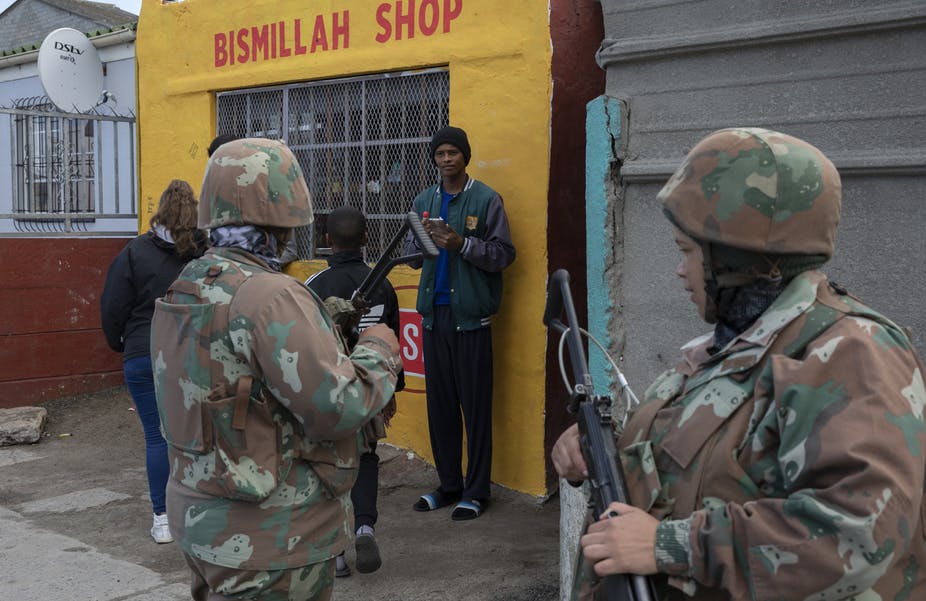
The initial response to the recent deployment of the South African army to areas of Cape Town hit hard by gang violence evoked relief that peace and stability would be restored to the area.
But this has been replaced with a much more nuanced view. Some community leaders claim the deployment has fallen well short of residents’ expectations. The “lock-down operation” needed to target and identify the culprits behind the violence has not occurred.
Despite their limited mandate, the army has just too few soldiers to patrol the ten suburbs that are home to over 1 million people. Less than 300 soldiers are on the streets of the Cape Flats, not the 1320 mentioned by President Cyril Ramaphosa. This figure allows for rotation of troops.
Also, the soldiers will be there for less than the three months, as the deployment is authorised only until 16 September 2019.
But, even if more soldiers are requested, the South African National Defence Force simply doesn’t have the capacity to deploy them. This is because it is severely overstretched in terms of both personnel and financial resources.
Of the 37 000 in the army, less than half serve in the 14 infantry battalions. One battalion is tied up in peacekeeping operations and 15 companies are deployed on the borders (far short of the 22 required). Some military analysts claim that the army is 8.5 infantry battalions short (roughly 8500 members) to perform their current tasks.
Capacity problems
A great deal has been written on the military’s financial woes. In my analysis the real problem lies with its force structure and design. These have driven up personnel costs to unacceptable levels.
The ideal ratios in terms of expenditure differ by country. This is influenced by mission priorities, tasks and service. The army, for example, is more personnel than capital intensive, compared to the navy and air force
It has enough people, but they are just not deployable. There are numerous reasons for this. The approach associated with the contract-based “flexible service system” of short, medium and long term service has not materialised.
The result is an escalation in personnel expenditure, the retention of people who are no longer fit for their post profile due to age and health, a high ratio of general officers to other ranks, and rank inflation making the armed forces top heavy. Senior ranks are very expensive with extensive salary and pension costs.
Added to this the military has been unable to reduce the number of people in the full-time force through rationalisation and rightsizing, or to rejuvenate its full-time and reserve forces.
Another challenge is the age profile. In 2003 the defence force introduced the military skills development programme to rejuvenate the full-time and reserve forces. The programme was to provide an adequate number of young, fit and healthy personnel for the full time forces; and to serve as a feeder for the Reserve Force. This has not happened due to financial restraints and lack of career planning, leaving the reserves understaffed and underfunded.
The consequence is an ageing force with average troop age of 38 years and the Reserve Force age of around 40 years. The average age of an infantry soldier should be around 23-25 years.
Redesigning the defence force
The other factor affecting the capacity of the military is its force design. The South African National Defence Force is structured, funded and
trained for its primary, not secondary tasks. Using the military continuously in internal
secondary roles has stretched it beyond capacity and contributed to its downward spiral of decline.
There is a clear “disconnect between the defence mandate, government expectation and resource allocation”. If the government is serious about providing security for its citizens, it is crucial to fix the structure and design of the force, which have eroded its capacity to function optimally. Failure to do so will have dire implications for the defence force’s ability to carry out its mandate – to protect the country and its citizens as required by the Constitution.
The “old South Africa” is still alive and well on the Cape Flats.
The country’s old “oranje, blanje, blou” flag was spotted fluttering over a Coloured [mixed race] residence in Fifth Road, Heathfield.
But neighbours say the flag is an insult to those who fought for freedom, and reminds them of the brutal days of apartheid.
They say the flag has been hoisted since October, and requests for it to be taken down have been ignored.
“This behaviour, in my opinion, indicates a total disrespect to the law and an insult to others,” said resident Richard Talliard.
But Mishkah Jappie, 36, says her husband Thaabied, 40, has “very good reasons” why he hung the flag on their roof.
“We believe nothing has changed from the apartheid days,” said the mom of six.
Thaabied was out on the road, looking for work when the Daily Voice visited. He lost his job as a paramedic in 2009.
“We don’t have water or electricity here and nothing seems to be better in our lives,” added Mishkah.
She said Thaabied got the flag from his stepfather, who served in the army during apartheid.
Her husband has become bitter because doors are still being slammed in his face more than 20 years after democracy.
“I am proud to say Nelson Mandela has opened up the pathway for us to prosper equally. But a lot of people are struggling while a few are getting richer everyday,” she added.
She said neighbours have asked them to remove the weathered and faded flag, but they refused.
The flag has become her family’s own symbol of oppression in the new South Africa.
“The neighbours say it’s hurting them to see the flag, but there are still features of the old order here,” said Mishkah.
A neighbour who did not want to be identified said: “Many people died because of that flag, it opens up old wounds for all of us.”
The South African Human Rights Commission said it would look into the matter.
Spokesman Isaac Mangena says: “South Africa has a flag that represents a rainbow nation. People must desist from displaying anything that would remind others of their sad past.”
South Africa’s multiracial and multicultural society is exploding into a never-ending Kulturkampf or American-style culture war. Anti-racists are the new racists, spreading intolerance and even violence ahead of them with a megaphone, figuratively speaking. During the court appearance of a wine farmer, Mr Johnny Burger, the crowd in the Cape had been swept up into a lynch mob threatening to kill him on the spot. Police had to use pepper spray and a stun grenade to disperse them. Shades of the Ku Klux Klan? Except here the Klansmen are anti-racists.
Anti-racist intolerance is growing in leaps and bounds. In another recent incident, it led to the unfortunate resignation from Pretoria University of one of our praag columnists after Dr Piet Croucamp from the University of Johannesburg had accused her of hate speech. As I have commented elsewhere in an Afrikaans column:
“The media group Naspers and a small group of academics acting in bad faith and attacking others in the name of race, mostly for personal reasons, represent a danger to freedom of speech in South Africa.”
This afternoon I got an email from a friend saying that Mr Burger’s case reminded him of the notorius “Black Circuit” of the early nineteenth century. At the time a 1000 Cape farmers had to appear before a roving court to answer to trumped-up charges of murder, rape and assault. In the end, no-one was convicted and it was found that colonial English missionaries had colluded with local Khoi-San tribesmen to falsely accuse farmers of heinous crimes.
Contrary to our law, Mr Burger, accused of assaulting a Coloured child, was presumed guilty until his innocence could be proven. Two days ago, the Cape Times newspaper wrote about the case of Flippie Engelbrecht, the child concerned: “Those who brought the case to court charged that after the assault Engelbrecht had lost his sight, had epileptic fits, and because of this had rolled into a fire and suffered terrible burns, losing his hands.” In yesterday’s Cape Times, headlined Questions surround Flippie’s assault, “new evidence” came to light in the form of medical records showing that Flippie Engelbrecht had reported a “swelling on the side of his face”, which may have been a tumour, causing his epileptic fits and other medical problems. The same medical records contradict some of the dates advanced by the victim. However, in the meantime the wine farmer had committed suicide after his life and his business had been ruined by hysterical anti-racists pursuing him in the media, both traditional and social, led by the radical, Afrikaner-hating ex-lawyer (who was struck off the record as an attorney after dubious business deals and bankruptcy), Carina Papenfus.
So here we have two incidences of whites being subjected to histrionic public campaigns by so-called “liberal” anti-racists whose objectives have more in common with the Spanish Inquisition than with advancing the precepts of liberalism. Freedom of speech and even academic freedom in South Africa have been casualties of these campaigns, not to mention the two white victims, one committing suicide and another resigning her post and leaving the country, presumably for fear of being further persecuted.
Our universities are no longer places of learning but over-politicised shrines to political correctness and obtuse hatreds that are seemingly ignited by throwing a switch.
Volumes have been written on the cultural, linguistic, racial, anthropological, ethnic, ideological and religious divisions of South African society and I do not wish to dwell on the obvious. What concerns me more, is the apparent descent of people with nominal university qualifications into this kind of racial street fighting. They wield race and the word “racist” like a Cape Flats gangster brandishes his knife. Not so long ago, twelve schools had to be closed in that area as a result of gang activity and Mrs Helen Zille, the premier of the Western Cape, was calling for the army to be brought in to stabilise Manenberg.
Yet, ostensibly, we have more to fear from the pseudo-intellectual gangsters than from the drug-dealing, turf-warring criminals of the Cape Flats. Their influence on public discourse is far more insidious and destructive of the last vestiges of civilisation that remain in South Africa. They are intolerant zealots such as are to be found throughout history, wherever religious wars or ethnic conflicts have ignited and blazed.
Except for the Sunday paper Rapport, no-one seems to take Papenfus seriously. She waged a slanderous email and Twitter campaign against the hapless winemaker, apparently threatening and cajoling his customers into ceasing to order from him, with the intention of ruining his business and his life. Ms. Papenfus is a kind of cyber thug that replicates the intimidation tactics of petty gangsters in the public sphere. After all, as any mafioso or racketeer knows, a small business may be ruined by hitting one or two of its weak spots. Although she must have studied at one time for a degree or diploma, she has no intellectual pretensions. Her creed is simple: harass the whites. And being white and Afrikaans herself, but an ANC member, it is a case of être plus royaliste que le roi.
Papenfus is dangerous, but easily understood. The other two zealots who pounced upon the soft-spoken Pretoria woman philosopher, occupy positions of institutional power. Croucamp is a lecturer at the University of Johannesburg in political science and frequently appears on talk shows, both on radio and on television, wearing his trademark blue bandana. Schutte writes a column in the Mail & Guardian newspaper which is also avidly read by the “tenured radicals” at South Africa’s more than twenty universities.
Schutte was due to debate Croucamp’s victim on the topic: “‘Do white people have an obligation to withdraw from the public sphere?’ But as she stated in a subsequent column: “I am obviously not going to validate Louise Mabille’s hate speech by actually debating with her. Rather I will end by saying that she has presented a shining example of how whites should not participate in the public arena. It is a good thing that Louise Mabille has handed in her resignation and that the University of Pretoria has accepted it.”
From Rhodes University, we have already had an opinion by Dr Samantha Vice that all whites, i.e. everyone of European descent, should take some form of vow to remain silent in public. So white guilt leads to the ultimate form of self-censorship, public silence.
Elsewhere, Ms Gillian Schutte describes herself, somewhat pretentiously, as a “feminist-neopagan-post-structuralist-deconstructionist-socialist” and she apparently has a Master’s degree in creative writing from the University of the Witwatersrand.
The one thing we can already deduce is that the mob outside the Cape courtroom who wanted to lynch Mr Burger at least believed in some form of dialogue. They were screaming, hurling abuse and gesticulating. With police intervention and protection, one could still call it communication.
Croucamp and Schutte want to reduce us to silence, however. Theirs is the monologue of totalitarianism, of censorship, of “There is only one truth and it is mine”. They pontificate in the name of power, the corrupt power that is ruling, nay, pillaging, South Africa.
It is therefore ironic that Schutte should describe herself as a “post-structuralist-deconstructionist”. Does she even know what she is referring to? The very basis of any “deconstruction” is the existence of more than one meaning, even the uncertainty, indetermination and radical plurality of meanings. Just over ten years ago a small group of us Afrikaner thinkers had a private seminar with Jacques Derrida, the father of deconstruction, at the École des hautes études en sciences sociales on the boulevard de Raspail in Paris. I remember Derrida as a modest, soft-spoken, amiable figure who reminisced about his single visit to South Africa. He liked Potchefstroom and even told me that “Heidegger would have felt at home there”. Derrida was full of gentle irony, self-doubt and respect for others, even the Other, as he so often termed it in his more political writings.
Schutte, by contrast, is a third-world ideologue, possessed by a terrible certainty. She has more in common with Robert Mugabe or Idi Amin than Jacques Derrida. Like so many others strutting about our campuses today, she has no real culture but the fad of the moment. The more politically correct such fads are, the better. Her meretricious pseudo-intellectualism has all the charm of Winnie Mandela’s expensive sunglasses and jewellery, being the brash expression of a corrupt and power-hungry soul. Ideas are but slogans, brands, to market yourself to another kind of mob to the one that wanted to lynch the Cape winemaker.
I have often thought that South Africa today has much in common with Nero’s Rome. Our country has become murderous, corrupt and decadent. Innocence has died. Approximately a thousand children are raped every day, including babies, and nobody says a word. Or if they broach the subject, they are immediately reduced to silence, given the ritual knife for disembowelling themselves. Schutte’s smug satisfaction (“It is a good thing that Louise Mabille has handed in her resignation and that the University of Pretoria has accepted it”) may be deconstructed to reveal two things: Schadenfreude and a paradoxical expectation of honour in others.
There is no English word for Schadenfreude, hence the German loanword that is universally used. However, the Afrikaans (and Dutch) term leedvermaak expresses the same thing, with a few more connotations (“signifieds” for post-structuralists) thrown in. The other day I tweeted in Afrikaans, something to the effect that leedvermaak is the apotheosis of journalism in South Africa. Vermaak also means entertainment, hence the misery of others, their travails amid hysterical accusations, calumny and vilification provide entertainment. Anti-racist Blitzkrieg, either on the vineyards of the Cape or on the campus of Pretoria University, therefore feeds the sensationalist mainstream media machine, sated on the blood of murder victims.
Celebrity “businessman” Kenny Kunene
Due to the surfeit of murders in South Africa, people are becoming bored with news of another killing, no matter how ruthless and macabre. Celebrity murder, such as the Oscar Pistorius case, is still news, but not even serial killings elicit much attention. In a society as utterly cruel and corrupt as ours, we are in desperate need of frivolity, such as the camp antics of that incorrigible clown in drag, Pieter-Dirk Uys, or Kenny Kunene’s parties where guests eat sushi off the bodies of bikini-clad ladies.
South Africa is profoundly amoral. It lacks a moral or ethical code to define right and wrong. Someone like Baudrillard would say that this “lack”, in a psychoanalytical sense, creates a need for a kind of pseudo-ethics, a moral simulacrum.
This is where anti-racism comes in. Anti-racism is the simulacrum of our lost moral code. It is no coincidence that the objectionable sentence in Louise Mabille’s column contained references to both Calvinism and baby rape, the former marking the overtly Christian morality of the old South Africa and the latter epitomising the radical “freedom from all scruples” that characterises the new South Africa.
In this respect, Gillian Schutte, despite her evidently defective grasp of some basic philosophical and literary concepts, understands the “new amorality” well. In one of her “feminist” videos, a rape victim explains that the “cure” for the shame attached to having been raped, is to join the so-called “slutwalk”, ardently recommended by Ms. Schutte. By self-identifying as a slut, a woman is freed from the fear of rape and “forced sex” as it is euphemistically called. Miracle cures are to be found everywhere in South Africa, peddled by immigrant Nigerian pastors and indigenous witchdoctors alike. Not to forget the infamous “virgin cleansing myth” by which one may be cured of HIV-Aids by raping a virgin, including an infant, and which Louise Mabille alluded to in her column.
Gillian Schutte is also a champion of the word “cunt” which, according to her, should become part of our everyday discourse. As she puts it,
“When women finally reclaim and speak this word, its full potential will be released and women will repossess their collective cunt-power and rise up against misogyny and patriarchy with the absolute intent of ending it.”
Amid the universal amorality and Neronic decadence of South Africa, Schutte is clutching at ethical straws, more precisely: pubic hairs. Instead of simply affirming and enjoying the slutwalk, she opts for the simulacrum of the good, which has now turned out to be the “collective cunt-power” of women.
But there is no “good” anymore. South Africa is really living according to the famous maxim from Dostoyevsky’s Brothers Karamazov: “If there is no God, then everything is permitted.” As I intimated the other day, SA really stands for “Sadists’ Apocalypse”. Eighteenth-century French literature, specifically the writings of the Marquis de Sade, is all that we have to remotely begin to understand our baby rapists and farm murderers.
Apart from Gillian Schutte’s “cunt-power”, the other pseudo-morality that people desperately cling to is anti-racism. In our sadistic universe where nothing is wrong, some people imagine that racism is the one remaining sin. You may kill, rape, bribe, lie and steal, more or less with impunity, but uttering the word “Bantu” will earn you the opprobrium of polite society, that society which is now reappropriating the magical power of four-letter words.
The simulacrum of sin is transgression of anti-racist etiquette. That alone awakens some form of long-lost moral response which is delivered with predictable ecclesiastical ritual: denunciation, excommunication, prohibition, censorship. From the TV studio did Schutte, the high priestess of atavistic cunt-power and pagan ritual, deliver her sermon against what Orwell called thoughtcrime: “racist” thoughts and suspicions, including the mere mention of “baby rape”, which is a proven and documented phenomenon in this country.
Did Johnny Burger, the Cape winemaker, commit suicide to save his honour? In a country where “trial by media” and populist passions have come to influence courts and the judicial system, Burger probably correctly surmised that he would not receive a fair trial. His suicide reminds me of the death of the patrician Latin author Petronius who, having got wind of Nero’s henchmen being sent to kill him, preferred taking his own life while drinking wine and having musicians perform for him.
Thanks to Carina Papenfus’s hate campaign, no-one will ever drink Burger’s wine again.
Similarly to Burger, Louise Mabille fell upon her own sword and resigned. Understandably, there is despair and pessimism among the remaining class of thinking people in South Africa. We are outnumbered and outscreamed by those who are playing for the gallery.
However, notwithstanding samurai customs, there are other ways of saving one’s honour. On these shores, we have the example of the bittereinder, of someone fighting to the very, bitter end, against all odds.
Are we ready for that thankless struggle, knowing full well that we shall face calumny all the way? If reason be dead, can thought or the mind still withstand the mob, baying for our blood?
Cape Coloured gangster. Sometimes residents have to stay indoors when they flash their guns in broad daylight
Initiations into gangs and the release of gang members from prison may be causing a surge of shootings in Cape Town, it was reported on Tuesday.
The Cape Times reported that at least nine men had been killed in apparent gang-related shootings around the city in about two months.
Manenberg Community Police Forum spokesman Kader Jacobs said that in the past six to eight weeks, roughly five shootings had been reported in his area.
He said one of the reasons for this could be that “high-flyer gangsters” had been released from prison, had returned to their power base, and needed to “stamp their authority”.
He reportedly said another factor could be the gang initiation process, in which a person had to kill someone to get into a gang.
In the latest attack, Rashied Fortune, 20, was killed in Manenberg in a drive-by shooting on Saturday.
Gangsterism is particularly high on the Cape Flats where Coloureds live and it does not involve the organised crime syndicates of the Godfather with Armani-suited men saying “kapeesh” but more a volatile mess of street-gangs, hungry for blood and the next ego trip. Status and fear is the driving force behind these gangs, where moving up the ranks involves killing a rival gang member or even your own mother. It’s brutal.
[ad 1]
Sometimes gang members rule whole neighbourhoods and residents are put on ‘lockdown’ by police, due to gang members whipping out their guns and going trigger-happy in broad daylight.
But is there really a solution to this mess? Police and local government have tried in vain to clamp down on gangsterism, but it goes hand-in-hand with poverty and drugs so where does one even begin to find an end? As always it is a vicious cycle with the youth on the Cape Flats seeing nothing but glamourised gangsterism. To these kids joining a gang is an admirable and predestined thing for them to do. With a lack of role models due to mostly absent fathers, children growing up on the streets of the ‘ghetto’ are impressionable and often misguided. Many of them claim to see gangs as a sort of family structure that they’ve never had. It has become a culture, a way of life with its own lingo ‘logo’s and hand signals. One could argue that joining a gang is a means of survival for these men. But even thinking of it that way makes it all seem more hopeless. – Sapa and other sources
This website uses cookies to improve your experience. We'll assume you're ok with this, but you can opt-out if you wish. Cookie settingsACCEPT
Privacy & Cookies Policy
Privacy Overview
This website uses cookies to improve your experience while you navigate through the website. Out of these cookies, the cookies that are categorized as necessary are stored on your browser as they are essential for the working of basic functionalities of the website. We also use third-party cookies that help us analyze and understand how you use this website. These cookies will be stored in your browser only with your consent. You also have the option to opt-out of these cookies. But opting out of some of these cookies may have an effect on your browsing experience.
Necessary cookies are absolutely essential for the website to function properly. This category only includes cookies that ensures basic functionalities and security features of the website. These cookies do not store any personal information.
Any cookies that may not be particularly necessary for the website to function and is used specifically to collect user personal data via analytics, ads, other embedded contents are termed as non-necessary cookies. It is mandatory to procure user consent prior to running these cookies on your website.