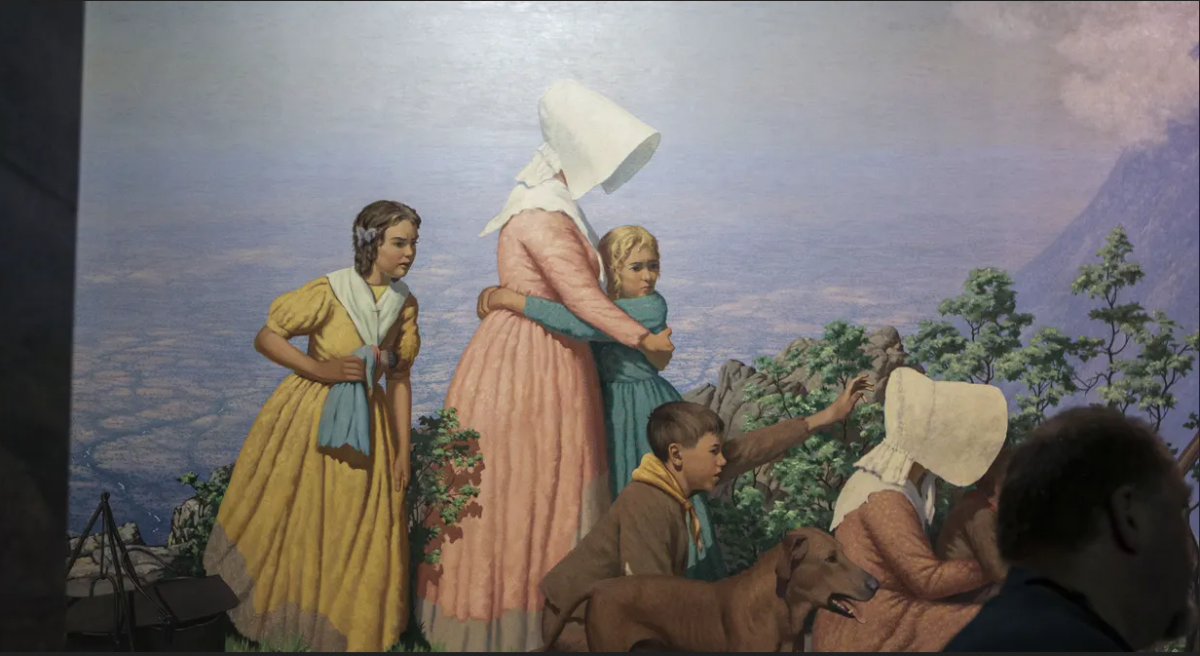
In this revised extract from the introduction to Troubling Images: Visual Culture and the Politics of Afrikaner Nationalism, the book’s editors assess how art and design helped forge Afrikaner nationalism.
In Banal Nationalism British academic Michael Billig writes, “If the future remains uncertain, we know the past history of nationalism. And that should be sufficient to encourage a habit of watchful suspicion.”
This warning has perhaps never been truer or more relevant than in the second decade of the new millennium. It has been characterised by a marked turn towards right-wing populism and nationalism.
The historical context and circumstances underlying the rise of Afrikaner nationalism belong to a different era of international politics. But it is essentially rooted in the experience of a people who were denied social and economic power. They were people whose political and cultural agency was marginalised by the imperialist agenda.
Indeed, hindsight shows that both the imperialist establishment and the international community were slow to understand the depth of Afrikaner humiliation in the aftermath of the South African War.
Consequently, they were unprepared for the meteoric rise of Afrikaner nationalism in the first three decades of the twentieth century.
Against the backdrop of resurgent nationalist sentiments across the world, it seems opportune to reassess the mechanisms through which it established and sustained itself. This is important, if only as a reminder of the need to pay attention to the risks that are posed to liberal democracy.
A painting by Jacobus Hendrik Pierneef, often commissioned by the apartheid state to create work for government buildings. Kandukuru Nagarjun/Flickr
Theorists in the humanities have done extensive work understanding the impetuses and effects of Afrikaner nationalism and identities. But no prior book that we have encountered has been dedicated exclusively to a critical engagement with a broad range of visual manifestations and responses to Afrikaner nationalism.
Visual culture and politics
Troubling Images focuses on manifestations of Afrikaner nationalism in paintings, sculptures, monuments, cartoons, photographs, illustrations and exhibitions. In doing so it offers a much-needed critical account of the relationship between Afrikaner nationalist visual culture and Afrikaner political and cultural domination in South Africa.
Visual culture was one important mechanism for rationalising and normalising apartheid and the Afrikaner nationalist ideology that supported it. It was a domain that was multifaceted and wide-ranging. It extended from imagery accessed in private homes via print culture and television to what might be encountered in public via monuments, sculptures and art exhibitions.
Preparation of the CR Swart sculpture by Cigdem Aydemir for Plastic Histories, 2014. The work is in the process of being sprayed pink. Paul Mills
Apartheid South Africa was a context in which images that challenged the status quo tended to be suppressed, and their authors threatened. It also celebrated visual discourse associated with Afrikaner nationalist ideals and values.
There were limited chances for South Africans to view state propaganda through a critical outsider lens. The country’s pariah status, as well as academic and cultural boycotts, limited opportunities for international connections.
The impact of whiteness
White South Africans who were born and reached maturity during the apartheid years tend to recognise the full impact only with hindsight. Repeated exposure to a slanted rhetoric meant that even those who sought to criticise nationalistic views were influenced by its biases.
In an article titled How do I Live in This Strange Place? published some 16 years ago, Samantha Vice called for shame and a retreat from public life as the appropriate response by white South Africans to the horrific racial injustices perpetrated in their interests.
Though controversial, her position highlights the fact that a decade after apartheid ended people were still coming to terms with the long-term impact of its rule.
Taal (Language) I (detail), 2012 by Mea Ox. The work uses the form of the Afrikaans Language Monument in South Africa. Mea Ox/Lizamore & Associates
For white South Africans, this involved critically engaging with questions about their own culpability. The growth in critical whiteness studies in the new millennium is surely also tied to a need to interrogate debates in South Africa prior to 1994. And that includes its visual ones.
It stands to reason that the current retrieval of a positive blackness from decades of systematically imposed inferiority should be accompanied by a critical reconsideration of whiteness and its strategies of domination and control.
The living monuments
Images celebrating Afrikaner nationalist imagery remain visible – and sometimes even prominent – in South Africa. The public domain still includes numerous sculptural commemorations of key figures within a white Afrikaner imaginary.
South Africa retains architectural monuments of significant scale. There’s the Voortrekker Monument in Pretoria, the Women’s Monument in Bloemfontein and the Language Monument in Paarl. Their retention can be understood in light of the National Heritage Resources Act (1999). It sought “to enable and encourage communities to nurture and conserve their legacy so that it may be bequeathed to future generations”.
The controversial statue of Cecil John Rhodes being removed from the University of Cape Town amid protests in 2015. Charlie Shoemaker/Getty Images
But the appropriateness of this approach has increasingly been questioned. Since the removal of Marion Walgate’s sculpture of Cecil John Rhodes from the University of Cape Town, many of South Africa’s monuments have suffered some form of desecration.
In such a context, the discussion of Afrikaner nationalism and visual imagery undertaken in this book seems timely.
Troubling Images: Visual Culture and the Politics of Afrikaner Nationalism is available from Wits University Press. Order a copy over here.
In a recent article in the Sunday Independent, Gillian Schutte mistakenly blames so-called “white conservative narratives” for the appalling sexual violence that is sweeping South Africa at present. As rape is notoriously underreported, most estimates put the number of such crimes at more than a million per year or approximately three thousand per day.
The macabre forms of dehumanising torture during farm murders provide another clue to the societal breakdown that is occurring in our country. Even calling it “our country” might be a malapropism in that Afrikaners like myself are no longer considered full citizens in an Afro-Saxon state that is slouching towards some incarnation of Mugabe’s Zimbabwe or, better still, Charles Taylor’s Liberia. This week, Taylor’s conviction as a war criminal was confirmed by an international court, the first head of state to be jailed for such crimes committed in Sierra Leone while he was in office.
South Africa has become a sadists’ apocalypse. No amount of “reframing”, circumlocution or leftist pseudo-intellectualism can disguise it any longer. Nor can the seemingly desperate massaging of the crime statistics. In the age of social media, people communicate their horror and despair at being captives in this, our “paradise of cruelty”. Policing our language as in the cowardly attack upon Louise Mabille is a poor substitute for the lack of policing elsewhere.
As the twentieth century has shown, utopias are always dangerous, be they fascist or communist. Every utopia has turned into its mirror image, a dystopia replete with genocide. South Africa’s pursuit of a racial biopolitics known as “transformation”, as well as extreme forms of cultural relativism, have unleashed hitherto unknown social consequences. In the domain of sexual violence at least, the country has earned the dubious title of “rape capital of the world” and it regularly tops international murder tables too.
Understanding the causes of this immense violence, unknown in peacetime, represents a rare analytical challenge. None of the usual explanations actually fit. The same people denouncing “colonialism” are the most accomplished colonialists in their slavish subordination to US or British racial discourse and political correctness.
However, neither Britain nor America has absorbed any significant African cultural influence so it is of no use applying the sociology of New York or London to an outbreak of sadistic violence in Limpopo province. It is risible to see ostensibly educated people constantly blaming either “apartheid” or “poverty” for the horrors and cruelties afflicting this society.
The retreat of Afrikaner power in South Africa has been coterminous with the resurgence of African belief systems, including witchcraft and ritual murders. In the early nineties South Africa experienced hundreds of killings associated with witchcraft and occult beliefs, leading to the Commission of Inquiry into Witchcraft Violence and Ritual Murders. We still do not understand the role that occult beliefs played during the revolution, especially in establishing hegemonic black politics and racial nationalism. The necklace, that symbol of revolution, is pregnant with ethnographic and cultural meaning. There is also evidence that young “comrades” intimidated traditional healers to extract money from clients and that the accusation of being a witch was used to eliminate political opponents.
Mrs. Winnie Madikizala-Mandela, that international heroine and former wife of Nelson Mandela, subscribed to the Maoist doctrine – ‘kill one, scare a thousand’ – that support is gained through terror and horror. She notoriously stated in 1986:
…with our boxes of matches and our necklaces we shall liberate this country.
A necklace killing whereby a tyre is placed around the victim’s neck, filled with petrol and then set alight
Child and even baby rape is another ghastly phenomenon indicating that South Africa has navigated to a new, alien moral code. Stating that white men sometimes do it in some other country too, hardly mitigates the particular horror that it has assumed here.
The British Guardian ran an article on 12 March 2009 entitled, “Raped and killed for being a lesbian: South Africa ignores ‘corrective’ attacks“. The Guardian’s website contains an accompanying video interview with lesbian rape victims, as well as young black men who are outspoken in their support of “corrective rape”. One of them says:
Me, I have no time to rape them, but if there are some of the other guys who want to teach them the way, they must rape them, they must rock them.
But perhaps white conservatives are a bigger problem: they might go to church or caution their children against drugs and sexual promiscuity, which would undermine the libertine morals that so many have advocated for so long in South Africa. In Hillbrow, as recounted to me by a former policeman, young white female drug addicts are employed as prostitutes by Nigerian gangsters. When they are no longer useful to their pimps, they simply get injected with heroine and pushed off highrise buildings in what gets officially recorded by the police as “suicides”. In South Africa, the crime reality show is so much better than the fiction.
The country’s academics are all but ignoring the scourge of rape, including infant rape, judging from the paucity of published articles in the field. To some extent they have acculturated to the witch-hunting culture in persecuting dissidents in their own ranks. Otherwise they engage in repetitive denunciations of “patriarchy” as if there were still a father left somewhere that has not been killed.
South Africa’s “transformed” universities have been turned into the “armed brothels” Erik von Kuehnelt-Leddihn spoke about when he said:
Rousseau is the grandfather of the concentration camps and also of those armed brothels that we continue to call universities. We have with us on one hand the Old Left, a finished product of L’éducation sentimentale, with its bent for social engineering and its tendency to identify its own plans and policies with the volonté générale; on the other the New Left which has taken up the slogan Retournons à la nature! exemplified in the rabble of unwashed, unkempt, debauched, unbridled ignoble savages who look to the Third World of the underdeveloped for inspiration. Its heroes are Chairman Mao with his Little Red Book, Ché Guevara, Ho Chi Minh, Holden Roberto, the Harlem criminals and the pistol-packing priests.*
That is why leftist university intellectuals find any form of criticism of traditional African culture to be inherently “racist” and eschew references to practices such as ukuthwala(the kidnapping and forced marriage of young maidens). Recent legislation has placed about 18 million black South Africans under so-called customary law in which such practices are legal.
Everybody in South Africa, whether white or black, fears a witch-hunt in some or other form. Especially the kind of witch-hunt whereby you are called a “racist”, lose your tenured university job and spend the rest of your life in ignominy. Therefore white academics are completely silent on ukuthwalaor the so-called “virgin cleansing myth” if the professors do not actually deny in writing that such phenomena exist!
Here and there information filters through the iron curtain of political correctness. The only academic article worth reading on the “virgin cleansing myth” is that by Suzanne Leclerc-Madlala which appeared in The African Journal of AIDS Research in 2002 under the title, “On The Virgin Cleansing Myth: Gendered Bodies, AIDS and Ethnomedicine“. It provides a fascinating glimpse into the psycho-sexual paradigm in which, as she puts it, “virgin cleansing is believed to have both a therapeutic and a prophylactic effect” (against HIV-AIDS). Raping a child or a disabled person is therefore seen as a form of AIDS prevention or cure.
But even the virgin cleansing myth obliquely alluded to by Dr. Mabille in her critique of insipid Western feminism does not go far enough in explaining South Africa’s journey upriver into the heart of darkness. We really lack the concepts to understand the enormity of what we are faced with.
Much of what passes for analysis of sex and culture in South Africa consists of rehashed hippie or New Left thinking from 1960s America. Get liberated, man, is more or less the gist of it. Call it Marcuse on Durban Poison. Repression or any form of “holding back” is invariably seen as “bad”. But sometimes repression might be desirable, even imperative. Freud was old-fashioned enough to advocate a balance between the pleasure principle and the reality principle.
The old Afrikaner government, while encouraging African ethnic identities, saw fit to suppress witchcraft and ritual murder by making it a criminal offence. Prior to becoming the first president of a united South African republic, Charles Robberts Swart introduced the Suppression of Witchcraft Act 3 of 1957. To the principled cultural relativist, the act – which is still on the statute books – is an affront and he would probably agree with the Marquis de Sade that “morality is just geography misapplied”, meaning that a crime in one culture is a harmless pastime in another.
One could even argue that the very structure of the South African political system is tending towards sado-masochism. Last Sunday the new CEO of the liberal Institute of Race Relations, Dr Frans Cronjé, argued in Rapport that whites should assume a far more submissive role in South Africa, lest they expose themselves to some form of collective revenge during a Second Revolution. According to Cronjé, such a revolution will be
…a violent, racist and destructive transition from a reconciling democratic state to a hostile, black nationalist state… After the Second Revolution, white South Africans will lose their homes, their jobs and their businesses.
Apart from exhortations to submissiveness, white guilt and even “vows of silence” à la Samantha Vice of Rhodes University, South Africa’s academic sycophants contribute little to our grasp of contemporary violence. In this respect, French literature is more instructive. Sade’s amoral theory of nature, of course. But also his notion of the sovereignty of sexual instincts that should not be tamed by any man-made law or religious scruple.
The Marquis de Sade had a disciple in the surrealist author Georges Bataille who espoused a theory of “transgression”. He took an interest in violence, punishment and eroticism. Bataille also collected photographs of Chinese executions which included horrific torture.
South Africa’s army of sadists regularly commit acts that shock a weaker Eurocentric sensibility. At the same time they are creating a world without limits, revelling in a new-found innocence that to them must represent the perfect freedom, the sovereignty of Sade’s libertine who pursues excess in celebration of pristine nature, a nature that punishes the weak and rewards the strong. To impose one’s will on a woman is also a gift of nature to all men. As Sade writes in Philosophy in the Bedroom:
If then it becomes incontestable that we have received from Nature the right indiscriminately to express our wishes to all women, it likewise becomes incontestable that we have the right to compel their submission, not exclusively, for I should then be contradicting myself, but temporarily. It cannot be denied that we have the right to decree laws that compel woman to yield to the flames of him who would have her; violence itself being one of that right’s effects, we can employ it lawfully. Indeed! has Nature not proven that we have that right, by bestowing upon us the strength to bend women to our will?**
Human rights or even a puritanical code such as feminism is not incompatible with sadism. As Bataille would argue, morality is needed for transgression to take place.
Sylvia Plath wrote in her poem “Daddy” that “Every woman adores a Fascist”. She was wrong. Every woman adores a sadist. Especially if she happens to be a feminist.
* Erik van Kuehnelt-Leddihn. “The Western Dilemma: Calvin or Rousseau?” in Modern Age, Winter 1971, p. 55.
** The Marquis de Sade. The complete Justine, Philosophy in the Bedroom and other writings, transl. RIchard Seaver and Austryn Wainhouse. New York: Grove Press, 1965, p. 319.
South Africa’s multiracial and multicultural society is exploding into a never-ending Kulturkampf or American-style culture war. Anti-racists are the new racists, spreading intolerance and even violence ahead of them with a megaphone, figuratively speaking. During the court appearance of a wine farmer, Mr Johnny Burger, the crowd in the Cape had been swept up into a lynch mob threatening to kill him on the spot. Police had to use pepper spray and a stun grenade to disperse them. Shades of the Ku Klux Klan? Except here the Klansmen are anti-racists.
Anti-racist intolerance is growing in leaps and bounds. In another recent incident, it led to the unfortunate resignation from Pretoria University of one of our praag columnists after Dr Piet Croucamp from the University of Johannesburg had accused her of hate speech. As I have commented elsewhere in an Afrikaans column:
“The media group Naspers and a small group of academics acting in bad faith and attacking others in the name of race, mostly for personal reasons, represent a danger to freedom of speech in South Africa.”
This afternoon I got an email from a friend saying that Mr Burger’s case reminded him of the notorius “Black Circuit” of the early nineteenth century. At the time a 1000 Cape farmers had to appear before a roving court to answer to trumped-up charges of murder, rape and assault. In the end, no-one was convicted and it was found that colonial English missionaries had colluded with local Khoi-San tribesmen to falsely accuse farmers of heinous crimes.
Contrary to our law, Mr Burger, accused of assaulting a Coloured child, was presumed guilty until his innocence could be proven. Two days ago, the Cape Times newspaper wrote about the case of Flippie Engelbrecht, the child concerned: “Those who brought the case to court charged that after the assault Engelbrecht had lost his sight, had epileptic fits, and because of this had rolled into a fire and suffered terrible burns, losing his hands.” In yesterday’s Cape Times, headlined Questions surround Flippie’s assault, “new evidence” came to light in the form of medical records showing that Flippie Engelbrecht had reported a “swelling on the side of his face”, which may have been a tumour, causing his epileptic fits and other medical problems. The same medical records contradict some of the dates advanced by the victim. However, in the meantime the wine farmer had committed suicide after his life and his business had been ruined by hysterical anti-racists pursuing him in the media, both traditional and social, led by the radical, Afrikaner-hating ex-lawyer (who was struck off the record as an attorney after dubious business deals and bankruptcy), Carina Papenfus.
So here we have two incidences of whites being subjected to histrionic public campaigns by so-called “liberal” anti-racists whose objectives have more in common with the Spanish Inquisition than with advancing the precepts of liberalism. Freedom of speech and even academic freedom in South Africa have been casualties of these campaigns, not to mention the two white victims, one committing suicide and another resigning her post and leaving the country, presumably for fear of being further persecuted.
Our universities are no longer places of learning but over-politicised shrines to political correctness and obtuse hatreds that are seemingly ignited by throwing a switch.
Volumes have been written on the cultural, linguistic, racial, anthropological, ethnic, ideological and religious divisions of South African society and I do not wish to dwell on the obvious. What concerns me more, is the apparent descent of people with nominal university qualifications into this kind of racial street fighting. They wield race and the word “racist” like a Cape Flats gangster brandishes his knife. Not so long ago, twelve schools had to be closed in that area as a result of gang activity and Mrs Helen Zille, the premier of the Western Cape, was calling for the army to be brought in to stabilise Manenberg.
Yet, ostensibly, we have more to fear from the pseudo-intellectual gangsters than from the drug-dealing, turf-warring criminals of the Cape Flats. Their influence on public discourse is far more insidious and destructive of the last vestiges of civilisation that remain in South Africa. They are intolerant zealots such as are to be found throughout history, wherever religious wars or ethnic conflicts have ignited and blazed.
Except for the Sunday paper Rapport, no-one seems to take Papenfus seriously. She waged a slanderous email and Twitter campaign against the hapless winemaker, apparently threatening and cajoling his customers into ceasing to order from him, with the intention of ruining his business and his life. Ms. Papenfus is a kind of cyber thug that replicates the intimidation tactics of petty gangsters in the public sphere. After all, as any mafioso or racketeer knows, a small business may be ruined by hitting one or two of its weak spots. Although she must have studied at one time for a degree or diploma, she has no intellectual pretensions. Her creed is simple: harass the whites. And being white and Afrikaans herself, but an ANC member, it is a case of être plus royaliste que le roi.
Papenfus is dangerous, but easily understood. The other two zealots who pounced upon the soft-spoken Pretoria woman philosopher, occupy positions of institutional power. Croucamp is a lecturer at the University of Johannesburg in political science and frequently appears on talk shows, both on radio and on television, wearing his trademark blue bandana. Schutte writes a column in the Mail & Guardian newspaper which is also avidly read by the “tenured radicals” at South Africa’s more than twenty universities.
Schutte was due to debate Croucamp’s victim on the topic: “‘Do white people have an obligation to withdraw from the public sphere?’ But as she stated in a subsequent column: “I am obviously not going to validate Louise Mabille’s hate speech by actually debating with her. Rather I will end by saying that she has presented a shining example of how whites should not participate in the public arena. It is a good thing that Louise Mabille has handed in her resignation and that the University of Pretoria has accepted it.”
From Rhodes University, we have already had an opinion by Dr Samantha Vice that all whites, i.e. everyone of European descent, should take some form of vow to remain silent in public. So white guilt leads to the ultimate form of self-censorship, public silence.
Elsewhere, Ms Gillian Schutte describes herself, somewhat pretentiously, as a “feminist-neopagan-post-structuralist-deconstructionist-socialist” and she apparently has a Master’s degree in creative writing from the University of the Witwatersrand.
The one thing we can already deduce is that the mob outside the Cape courtroom who wanted to lynch Mr Burger at least believed in some form of dialogue. They were screaming, hurling abuse and gesticulating. With police intervention and protection, one could still call it communication.
Croucamp and Schutte want to reduce us to silence, however. Theirs is the monologue of totalitarianism, of censorship, of “There is only one truth and it is mine”. They pontificate in the name of power, the corrupt power that is ruling, nay, pillaging, South Africa.
It is therefore ironic that Schutte should describe herself as a “post-structuralist-deconstructionist”. Does she even know what she is referring to? The very basis of any “deconstruction” is the existence of more than one meaning, even the uncertainty, indetermination and radical plurality of meanings. Just over ten years ago a small group of us Afrikaner thinkers had a private seminar with Jacques Derrida, the father of deconstruction, at the École des hautes études en sciences sociales on the boulevard de Raspail in Paris. I remember Derrida as a modest, soft-spoken, amiable figure who reminisced about his single visit to South Africa. He liked Potchefstroom and even told me that “Heidegger would have felt at home there”. Derrida was full of gentle irony, self-doubt and respect for others, even the Other, as he so often termed it in his more political writings.
Schutte, by contrast, is a third-world ideologue, possessed by a terrible certainty. She has more in common with Robert Mugabe or Idi Amin than Jacques Derrida. Like so many others strutting about our campuses today, she has no real culture but the fad of the moment. The more politically correct such fads are, the better. Her meretricious pseudo-intellectualism has all the charm of Winnie Mandela’s expensive sunglasses and jewellery, being the brash expression of a corrupt and power-hungry soul. Ideas are but slogans, brands, to market yourself to another kind of mob to the one that wanted to lynch the Cape winemaker.
I have often thought that South Africa today has much in common with Nero’s Rome. Our country has become murderous, corrupt and decadent. Innocence has died. Approximately a thousand children are raped every day, including babies, and nobody says a word. Or if they broach the subject, they are immediately reduced to silence, given the ritual knife for disembowelling themselves. Schutte’s smug satisfaction (“It is a good thing that Louise Mabille has handed in her resignation and that the University of Pretoria has accepted it”) may be deconstructed to reveal two things: Schadenfreude and a paradoxical expectation of honour in others.
There is no English word for Schadenfreude, hence the German loanword that is universally used. However, the Afrikaans (and Dutch) term leedvermaak expresses the same thing, with a few more connotations (“signifieds” for post-structuralists) thrown in. The other day I tweeted in Afrikaans, something to the effect that leedvermaak is the apotheosis of journalism in South Africa. Vermaak also means entertainment, hence the misery of others, their travails amid hysterical accusations, calumny and vilification provide entertainment. Anti-racist Blitzkrieg, either on the vineyards of the Cape or on the campus of Pretoria University, therefore feeds the sensationalist mainstream media machine, sated on the blood of murder victims.
Celebrity “businessman” Kenny Kunene
Due to the surfeit of murders in South Africa, people are becoming bored with news of another killing, no matter how ruthless and macabre. Celebrity murder, such as the Oscar Pistorius case, is still news, but not even serial killings elicit much attention. In a society as utterly cruel and corrupt as ours, we are in desperate need of frivolity, such as the camp antics of that incorrigible clown in drag, Pieter-Dirk Uys, or Kenny Kunene’s parties where guests eat sushi off the bodies of bikini-clad ladies.
South Africa is profoundly amoral. It lacks a moral or ethical code to define right and wrong. Someone like Baudrillard would say that this “lack”, in a psychoanalytical sense, creates a need for a kind of pseudo-ethics, a moral simulacrum.
This is where anti-racism comes in. Anti-racism is the simulacrum of our lost moral code. It is no coincidence that the objectionable sentence in Louise Mabille’s column contained references to both Calvinism and baby rape, the former marking the overtly Christian morality of the old South Africa and the latter epitomising the radical “freedom from all scruples” that characterises the new South Africa.
In this respect, Gillian Schutte, despite her evidently defective grasp of some basic philosophical and literary concepts, understands the “new amorality” well. In one of her “feminist” videos, a rape victim explains that the “cure” for the shame attached to having been raped, is to join the so-called “slutwalk”, ardently recommended by Ms. Schutte. By self-identifying as a slut, a woman is freed from the fear of rape and “forced sex” as it is euphemistically called. Miracle cures are to be found everywhere in South Africa, peddled by immigrant Nigerian pastors and indigenous witchdoctors alike. Not to forget the infamous “virgin cleansing myth” by which one may be cured of HIV-Aids by raping a virgin, including an infant, and which Louise Mabille alluded to in her column.
Gillian Schutte is also a champion of the word “cunt” which, according to her, should become part of our everyday discourse. As she puts it,
“When women finally reclaim and speak this word, its full potential will be released and women will repossess their collective cunt-power and rise up against misogyny and patriarchy with the absolute intent of ending it.”
Amid the universal amorality and Neronic decadence of South Africa, Schutte is clutching at ethical straws, more precisely: pubic hairs. Instead of simply affirming and enjoying the slutwalk, she opts for the simulacrum of the good, which has now turned out to be the “collective cunt-power” of women.
But there is no “good” anymore. South Africa is really living according to the famous maxim from Dostoyevsky’s Brothers Karamazov: “If there is no God, then everything is permitted.” As I intimated the other day, SA really stands for “Sadists’ Apocalypse”. Eighteenth-century French literature, specifically the writings of the Marquis de Sade, is all that we have to remotely begin to understand our baby rapists and farm murderers.
Apart from Gillian Schutte’s “cunt-power”, the other pseudo-morality that people desperately cling to is anti-racism. In our sadistic universe where nothing is wrong, some people imagine that racism is the one remaining sin. You may kill, rape, bribe, lie and steal, more or less with impunity, but uttering the word “Bantu” will earn you the opprobrium of polite society, that society which is now reappropriating the magical power of four-letter words.
The simulacrum of sin is transgression of anti-racist etiquette. That alone awakens some form of long-lost moral response which is delivered with predictable ecclesiastical ritual: denunciation, excommunication, prohibition, censorship. From the TV studio did Schutte, the high priestess of atavistic cunt-power and pagan ritual, deliver her sermon against what Orwell called thoughtcrime: “racist” thoughts and suspicions, including the mere mention of “baby rape”, which is a proven and documented phenomenon in this country.
Did Johnny Burger, the Cape winemaker, commit suicide to save his honour? In a country where “trial by media” and populist passions have come to influence courts and the judicial system, Burger probably correctly surmised that he would not receive a fair trial. His suicide reminds me of the death of the patrician Latin author Petronius who, having got wind of Nero’s henchmen being sent to kill him, preferred taking his own life while drinking wine and having musicians perform for him.
Thanks to Carina Papenfus’s hate campaign, no-one will ever drink Burger’s wine again.
Similarly to Burger, Louise Mabille fell upon her own sword and resigned. Understandably, there is despair and pessimism among the remaining class of thinking people in South Africa. We are outnumbered and outscreamed by those who are playing for the gallery.
However, notwithstanding samurai customs, there are other ways of saving one’s honour. On these shores, we have the example of the bittereinder, of someone fighting to the very, bitter end, against all odds.
Are we ready for that thankless struggle, knowing full well that we shall face calumny all the way? If reason be dead, can thought or the mind still withstand the mob, baying for our blood?
This website uses cookies to improve your experience. We'll assume you're ok with this, but you can opt-out if you wish. Cookie settingsACCEPT
Privacy & Cookies Policy
Privacy Overview
This website uses cookies to improve your experience while you navigate through the website. Out of these cookies, the cookies that are categorized as necessary are stored on your browser as they are essential for the working of basic functionalities of the website. We also use third-party cookies that help us analyze and understand how you use this website. These cookies will be stored in your browser only with your consent. You also have the option to opt-out of these cookies. But opting out of some of these cookies may have an effect on your browsing experience.
Necessary cookies are absolutely essential for the website to function properly. This category only includes cookies that ensures basic functionalities and security features of the website. These cookies do not store any personal information.
Any cookies that may not be particularly necessary for the website to function and is used specifically to collect user personal data via analytics, ads, other embedded contents are termed as non-necessary cookies. It is mandatory to procure user consent prior to running these cookies on your website.