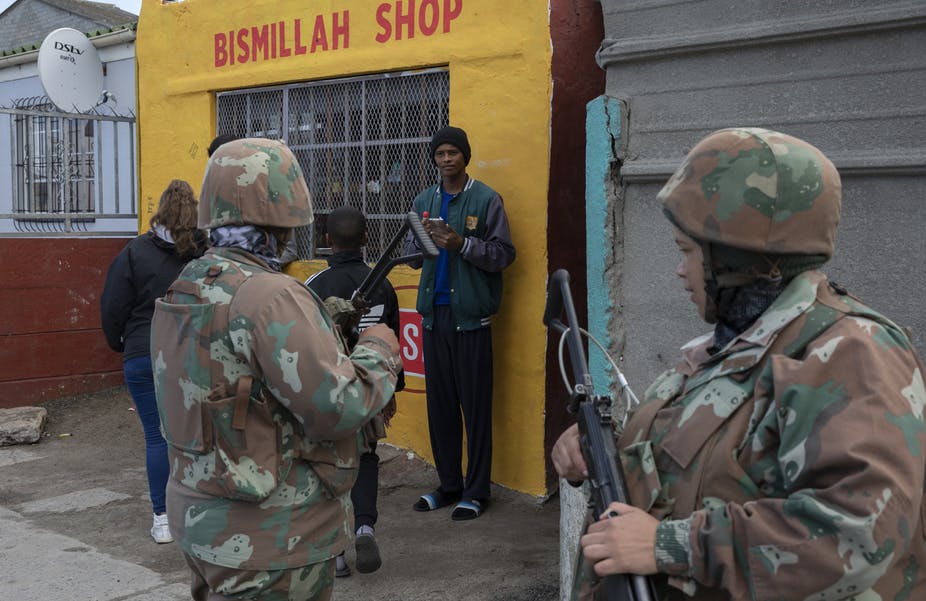
Soldiers won’t stem gang violence because South Africa’s army is in a sorry state

Lindy Heinecken, Stellenbosch University

The initial response to the recent deployment of the South African army to areas of Cape Town hit hard by gang violence evoked relief that peace and stability would be restored to the area.

But this has been replaced with a much more nuanced view. Some community leaders claim the deployment has fallen well short of residents’ expectations. The “lock-down operation” needed to target and identify the culprits behind the violence has not occurred.

Despite their limited mandate, the army has just too few soldiers to patrol the ten suburbs that are home to over 1 million people. Less than 300 soldiers are on the streets of the Cape Flats, not the 1320 mentioned by President Cyril Ramaphosa. This figure allows for rotation of troops.

Also, the soldiers will be there for less than the three months, as the deployment is authorised only until 16 September 2019.

The result is that people in the affected areas are fast realising that the army is not the solution. This echoes previous cases were soldiers were deployed to crime hot-spots in the country but failed to have a measurable impact.

But, even if more soldiers are requested, the South African National Defence Force simply doesn’t have the capacity to deploy them. This is because it is severely overstretched in terms of both personnel and financial resources.

Of the 37 000 in the army, less than half serve in the 14 infantry battalions. One battalion is tied up in peacekeeping operations and 15 companies are deployed on the borders (far short of the 22 required). Some military analysts claim that the army is 8.5 infantry battalions short (roughly 8500 members) to perform their current tasks.

Capacity problems

A great deal has been written on the military’s financial woes. In my analysis the real problem lies with its force structure and design. These have driven up personnel costs to unacceptable levels.

In terms of the defence budget the ideal expenditure ratio is 40 % personnel, 30% operations and 30% capital expenditure. Some claim this is closer to 80:5:15 in reality, leading to the defence force being labelled a welfare, rather than a warfare agency.

The ideal ratios in terms of expenditure differ by country. This is influenced by mission priorities, tasks and service. The army, for example, is more personnel than capital intensive, compared to the navy and air force

It has enough people, but they are just not deployable. There are numerous reasons for this. The approach associated with the contract-based “flexible service system” of short, medium and long term service has not materialised.

The result is an escalation in personnel expenditure, the retention of people who are no longer fit for their post profile due to age and health, a high ratio of general officers to other ranks, and rank inflation making the armed forces top heavy. Senior ranks are very expensive with extensive salary and pension costs.

Added to this the military has been unable to reduce the number of people in the full-time force through rationalisation and rightsizing, or to rejuvenate its full-time and reserve forces.

Another challenge is the age profile. In 2003 the defence force introduced the military skills development programme to rejuvenate the full-time and reserve forces. The programme was to provide an adequate number of young, fit and healthy personnel for the full time forces; and to serve as a feeder for the Reserve Force. This has not happened due to financial restraints and lack of career planning, leaving the reserves understaffed and underfunded.

The consequence is an ageing force with average troop age of 38 years and the Reserve Force age of around 40 years. The average age of an infantry soldier should be around 23-25 years.

Redesigning the defence force

The other factor affecting the capacity of the military is its force design. The South African National Defence Force is structured, funded and
trained for its primary, not secondary tasks. Using the military continuously in internal
secondary roles has stretched it beyond capacity and contributed to its downward spiral of decline.

There is a clear “disconnect between the defence mandate, government expectation and resource allocation”. If the government is serious about providing security for its citizens, it is crucial to fix the structure and design of the force, which have eroded its capacity to function optimally. Failure to do so will have dire implications for the defence force’s ability to carry out its mandate – to protect the country and its citizens as required by the Constitution.The Conversation

Lindy Heinecken, Chair of the Department of Sociology and Social Anthropology, Stellenbosch University

This article is republished from The Conversation under a Creative Commons license. Read the original article.

SANDF soldiers open fire on marked police car

No arrests have been made after three South African National Defence Force (SANDF) soldiers allegedly opened fire on a marked police vehicle and that of a tracking company.

According to provincial spokesperson Colonel Leonard Hlati, detectives from Mbuzini are investigating three SANDF soldiers who allegedly “ambushed” a marked police vehicle and that of a tracking company following the hijacking near the Mozambican border at around 22:30 last Wednesday, Lowvelder reported.

The incident came after a vehicle was reported stolen in Tonga, Mpumalanga that night. The vehicle was fitted with a tracking device and the managing company, Cartrack, located the abandoned vehicle a few hundred metres from the border.

Tonga police were then notified of the recovery and invited to the scene where the abandoned vehicle had been left. An SANDF commander was then notified that the abandoned vehicle would be returned.

“Soldiers are patrolling the border and we wanted to warn them that we would be returning to the scene, so that they would not open fire on us,” a source who was at the scene, said.

With the Cartrack vehicle travelling in the front, followed by the marked police vehicle, the party approached the hijacked vehicle. “We had our emergency lights and sirens on,” the source added. However, the recovery party was still fired upon.

The occupants of both vehicles saw it was SANDF soldiers patrolling the fence who were shooting at them.

They shouted and called on the radio for the soldiers to cease fire, but to no avail. The soldiers kept on firing at the convoy. The police vehicle’s engine was hit and it eventually seized.

One witness described the incident as an “ambush” and added that the shots fired were not warning shots, but aimed to kill.

The SANDF soldiers accused of firing the shots claimed to have thought the approaching convoy to be hijackers, despite the notification from police.

SANDF spokesperson Colonel Piet Paxton, confirmed the incident and said a panel of inquiry had been requested.

“As far as we know, five shots were fired, believed to be from one firearm.

“One soldier could not account for five bullets and it seemed as though five shots were fired at the convoy. The panel of inquiry will investigate the circumstances around the shooting, as well as which disciplinary steps would have to be followed,” He said.

Paxton added that it was almost impossible for the major on duty to notify troops in the field of the police’s arrival, thus the troops had been unaware.

French intel chief questions NATO claims

France’s intelligence chief has questioned NATO’s claims of Russia preparing to attack Ukraine as their agents failed to spot any activities signaling this – either before or after the crisis began.

A statement by the chief of France’s military intelligence, General Christophe Gomart, was published on the National Assembly’s website.

“NATO announced that the Russians were about to invade Ukraine. But, according to French intelligence, there is nothing to corroborate this hypothesis – we determined that the Russians were deploying neither command posts nor logistical facilities, including field hospitals, needed for a military incursion,” General Gomart told a parliamentary hearing.

NATO’s top brass has been incanting mantras about a “Russian invasion” ever since the crisis in Ukraine began a year ago. NATO Secretary-General Jens Stoltenberg, as well as his predecessor Anders Fogh Rasmussen, have lashed at Russia on numerous occasions, claiming that the Russian military is present on the ground in Ukraine, but failing to provide evidence supporting these claims.

“Our conclusion eventually proved correct because even if some Russian soldiers had indeed been seen on the Ukrainian side of the border, it was just a ploy, meant to bring pressure to bear on President Poroshenko, rather than an attempt to invade Ukraine,” General Gomart said.

The French intelligence chief’s remarks came in the context of France’s role in NATO. Gomart noted that at the moment the alliance is dominated by US intelligence, while France’s intelligence is taken not taken into consideration so much.

“France will not be fooled. France has its own sources of information and we are aware what the explanation for the crisis in Ukraine is,” Philippe Migault, expert on Ukraine from the University of International and Strategic Relations, said.

Meanwhile an American RC-135U reconnaissance aircraft was buzzed by a Russian Sukhoi Su-27 fighter jet over the Baltic Sea near Russia’s Kaliningrad Region, according to the Pentagon.

Major-General Igor Konashenkov, spokesman for the Russian Defense Ministry, said that the interception was launched after “Russian air defense radars spotted an unidentified air target over the Baltic Sea making steady progress toward the national border.” The aircraft had its transponder turned off, Konashenkov said.

The head of Russia’s Upper House Committee for Foreign Relations, Konstantin Kosachev, called on to NATO to stop their “hysterics” over flights by the Russian Air Force, “presenting them as aggression and demonizing Russia.”

“In connection with the incident over the Baltic one should keep in mind that Russia is a Baltic country, whereas the US is not,” Kosachev said.

Frants Klintsevich, of the United Russia party, said the report showed US intelligence has been working to fulfill a political order.

Meanwhile, on Friday five Northern European states, non-NATO Finland and Sweden included, signed a declaration on the expansion of military cooperation to counter “Russian aggression against Ukraine.”

Since Finland and Sweden intend to interact with NATO on a matching contribution basis, which might indicate a desire to join the alliance, Moscow will view this declaration as an act of aggression, Norwegian defense analyst Janne Haaland Matlary warned.

“Finland and Sweden have also decided to keep their exercises to NATO standards, which implies a step on the way toward NATO. Today, there are no political grounds for them to join NATO, public opinion is not frightened enough, and referendums will be required. But what is happening now still looks like a preparation for membership,” Matlary told Aftenposten newspaper on Friday.

Whites must die for South Africa

The Department of Defence is apparently trying to reverse racial quotas in its recruitment.

The latest South African Survey by the SA Institute of Race Relations shows that the military plans to employ more whites and fewer blacks.

The defence force admits there is a shortage of white personnel but says its recruitment drives are not based on racial quotas.

The survey shows the department’s employment equity targets are changing:

The black employment target from the current 72% to 65%;
Coloured employment from 13% to 10%;
Indian employment will remain at 1%;
The target for whites will increase from 14% to 24%.

The Institute of Race Relations figures are based on information contained in the defence department’s annual report and on its own calculations.

Stats SA’s 2015 midyear population estimates show that blacks represent 80% of the population, coloureds 8.8%, whites 8.2% and Indians 2.4%.

The research shows that there are huge numbers of vacancies in the military’s land and air defence, medical, and defence intelligence services.

The military currently has 57141 black, 10991 white, 10099 coloured and 916 Indian members.

SA National Defence Union national secretary Pikkie Greeff said the military found itself in this position because “when they started awarding exit packages they let go too many of the racial groupings that they now want to increase”.

Defence Department spokesman Siphiwe Dlamini admitted that there was a shortage of full-time white members but denied there were plans to change racial quotas.

Source: timeslive

NATO a threat to the security of its members, the world

NATO lives in some weird fantasy world. It reminds me of the Warsaw Pact

The North Atlantic Treaty Organization poses a threat to its members by involving them in interventions based on pretty flimsy evidence, Patrick Armstrong, former political counselor at the Canadian Embassy in Moscow told RT.

The new NATO Secretary General Jens Stoltenberg has made his first policy speech.

RT: The face of NATO has changed. Is this a chance for the politics to change?

Patrick Armstrong: Let me suggest what Stoltenberg should have said if he wanted to show that NATO was seriously discussing events. He might have said, and this should have been on the agenda at the recent meeting: “Mr. Kerry, a year ago you were telling us that you were absolutely certain that the Syrian government was using chemical weapons and that we had go bomb it. Today you are now telling us that we should go bomb the people that last year we would have been supporting. Please explain, discuss.” We all saw the photos of the militia cavorting in the US embassy swimming-pool in Tripoli. “Was armed NATO’s intervention in Libya a good idea or bad idea? Discuss.” A month ago we learned that the Kosovo Liberation Army that we supported -indeed we gave the entire country to it 15 years ago – was in fact a pretty nasty, criminal organization. Discuss. In conclusion, Mr. Stoltenberg, that would seem to me that based on past practice, NATO’s interventions appears to have made things worse, have detracted from the security of its members, and were based on pretty flimsy evidence. Discuss that, Mr. General Secretary, rather than blithering on about how wonderful NATO is.

RT: Why exactly does NATO see Russia as a threat? And how is that possible when at the same time the alliance is announcing such a buildup?

PA: The latest sentiment coming out of NATO is that Russia is doing terrible things on NATO’s doorstep. And NATO’s doorstep keeps moving… Speaking as a member of the country that had a great deal to do with the creation of NATO, NATO is in fact a very great threat to the security of Canada let alone its other members and the rest of the world. It keeps getting us involved in these wars for reasons that turn out to be not as solid as we were told. Why Russia? I don’t know. Maybe NATO is about being anti-Russia.

RT: The new alliance leader claimed that NATO troops are leaving Afghanistan a more stable a secure place when statistic shows the exact opposite. Is this conscious denial of the situation?

PA: NATO lives in some weird fantasy world. It reminds me of the Warsaw Pact. At some level they must know that every word they say is a lie and yet they keep on saying that. I honestly don’t know what is going on. I supported NATO back in the days of the Cold War. But at the moment it is just this destructive like a juggernaut, this huge vehicle rolls on crushing, and smashing, and destroying.

Muslim Brotherhood leader vows to reinstate Morsi in Egypt

Mohammed Badie
Mohammed Badie, leader of the Muslim Brotherhood

The head of Egypt’s Muslim Brotherhood Friday vowed that the group’s followers would hold open-ended protests to press for the reinstatement of ousted Islamist president Mohammed Morsi, as violence mounted in the country.

“All the measures taken (by the army) are invalid,” Mohammed Badie said at a massive Cairo rally. “The millions supporting Morsi will stay in the squares until the president of Egypt is reinstated.”

Badie, who is the spiritual leader of the Brotherhood to which Morsi belongs, denied media reports he had been arrested.

His influential deputy, Khayrat al-Shater, was arrested Friday in Cairo on charges of inciting violence against opponents, the official Middle East News Agency reported.

The army ousted Morsi on Wednesday following unprecedented protests by millions of Egyptians who demanded his resignation and early presidential elections. Several leading Islamists have since been detained.

The former president’s backers staged huge protests across Egypt, demanding his reinstatement.

“The situation is very clear. The democratic process in Egypt has been assassinated by a coup d’etat against the first democratically elected president,” Omar Ibrahim, a school teacher attending the pro-Morsi rally in the Cairo area of Nasr City, told dpa.

“But I can assure you that the Egyptian people will defend their revolution.”

Violence on Friday in the wake of Morsi’s overthrow left 17 people dead and 315 injured in Cairo and other areas, state television reported, citing the Health Ministry. There were no details on how and where the casualties occurred.

The broadcaster reported clashes between Morsi’s opponents and backers in Alexandria, Egypt’s second most populous city, the Nile Delta provinces of Damietta and Beheira, and the coastal city of Suez.

One person was reported killed and 66 injured in fighting between the two sides near the Nile-side TV building in Cairo near Tahrir Square, where Morsi’s opponents continued to celebrate his removal.

The army positioned tanks and armoured vehicles outside the building apparently to prevent potential attacks.

There were clashes in al-Arish, a city in the Sinai Peninsula near Israel. A police car was torched in the violence.

State television said the army had foiled an attempt by Morsi’s supporters to storm the city hall of the Suez Canal city of Ismailia. No casualties were reported.

Egypt’s top Muslim cleric, Ahmed al-Tayyeb, appealed for calm.

“I call on all Egyptians to avoid bloodshed. I entreat to God to put an end to this ugly sedition,” al-Tayyeb, head of the prestigious Sunni al-Azhar institution, said in a televised statement.

Earlier Friday, gunmen attacked army and police checkpoints in Sinai, killing one soldier and injuring three others, a security official said.

The attacks prompted Egyptian authorities to indefinitely close the Rafah border crossing with the Palestinian Gaza Strip. Troops deployed in Suez and South Sinai provinces were put on maximum alert following the assaults.

Interim President Adli Mansour, sworn in Thursday, has dissolved the Islamist-dominated Shura Council, which served as a temporary legislature.

Mansour appointed Refaat Shehata, outgoing intelligence service chief, as presidential advisor on security and named Mohamed Farid as new intelligence chief.

The African Union Peace and Security Council suspended Egypt on Friday from the 54-nation bloc, citing an unconstitutional power grab in the North African nation.

Cairo said it “deeply regretted” the bloc’s decision.

“We deeply regret this decision, which has been taken on the basis of unrealistic information,” Foreign Ministry spokesman Badr Abdel-Atti said.

Morsi became Egypt’s first democratically elected president last year after winning the polls with a narrow margin.

The opposition accused him of being keen on tightening the Muslim Brotherhood’s hold on power and becoming a dictator. – dpa

Statement by Egypt’s military chief

Egyptian soldiers near the Rafah border crossing with the Gaza Strip earliers this year

“The armed forces couldn’t plug its ears or close its eyes as the movement and demands of the masses calling for them to play a national role, not a political role as the armed forces themselves will be the first to proclaim that they will stay away from politics.

The armed forces sensed – given their sharp vision – that the people sought their support, not power or rule but for general services and necessary protection of the demands of the revolution. This is the message that the armed forces received from all over urban Egypt, its cities, and its villages; it (the military) recognized the invitation, understood its intentions, appreciated its necessity and got closer to the national scene hoping, willing and abiding by all limits of duty, responsibility and honesty.

The armed forces have exerted lots of efforts over the past few months, directly and indirectly, to contain the internal situation and carry out a national reconciliation among all political forces including presidency starting on November 2012. It started with a call for national dialogue that all political forces responded to and was rejected by the presidency at the last moment. Then invitations and initiatives followed and continued since this time until this date.

The armed forces presented more than once their strategic assessment of the situation internally and outside the country, including the challenges and the dangers that are facing the nation on the security, economic, political and social levels along with the vision of the armed forces as a national institution on how to contain the causes of the social divisions and remove the causes of congestion and confront the challenges and the dangers to get out of the current crisis.

As part of the follow up to the current crisis, the general command of the armed forces held a meeting with the president of the republic at the Qasr al-Qobba presidential palace on June 22, 2013, during which it presented the opinion of the general command and its rejection of harming the national and religious state institution. And it assured its rejection of terrorizing and threatening the masses of the Egyptian people.

There was hope of achieving national reconciliation, developing a future plan and providing causes of confidence, assurances and stability to the people in order to achieve their ambitions and hopes. But the president’s speech last night and before the end of the 48-hour ultimatum didn’t meet or agree with the demands of the people. The situation prompted the armed forces, given their national and historic responsibility, to consult with some of the symbols of the national, political and youth forces without excluding or alienating anyone. The participants agreed on the future plan, which includes the initial steps to achieve a strong, coherent Egyptian society that doesn’t alienate of its sons and movements and end the state of struggle and divisions.

This map includes:

– Suspending the constitution temporarily.

– The head of the Supreme Constitutional Court takes the oath of office in front of the general assembly of the court.

– Carry out early presidential elections while the head of the Supreme Constitutional Court will be in charge of managing the state affairs during a transitional period until the election of a new president.

– The head of the Supreme Constitutional Court will have the power to issue constitutional declarations during the transitional period until the election of a new president.

– Forming a Cabinet of national, strong, capable experts who enjoy all powers during the current period.

– Forming a committee from across the spectrum and experts to review the proposed amendments of the constitution that has been temporarily suspended.

– Urging the Supreme Constitutional Court to expedite an elections law for parliament and to start to take measures to prepare for the parliamentary elections.

– Putting together a media code of ethics that ensures media freedom and achieves professional standards, credibility and objectivity and to prioritize the nation’s high interests.

– Taking executive measures to empower and engage the youth in the state institutions, to be a decision-making partner as aides to ministers, governors and in different executive posts.

– Forming a supreme committee for national reconciliation of personalities who enjoy credibility and acceptance by all national elites and represent different movements.

– The armed forces urge the great Egyptian people from across the spectrum to abide by peaceful demonstrations, avoid violence, which leads to more congestion and spills the blood of the innocent. It warns that it will confront, with cooperation of the men of the Interior Ministry, with all force and decisiveness any violation of peacefulness according to the law and driven by the national and historic responsibility.

– The armed forces salute and express gratitude to the men of the armed forces, the police, the judiciary, the honorable and the sincere for their great national role and their continued sacrifices to preserve the safety and security of Egypt and its great people.

God preserve Egypt and its great defiant people. – AP