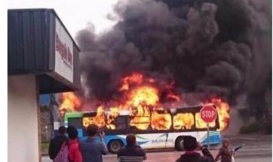
Five Go George buses have been set alight by black taxi drivers in a protest action in George. The taxi drivers complain that the buses hamper their profits.
The first bus was set alight in front of the depot, and more were set alight near the N2 Garden Route Mall.
A heavy police presence was deployed in the mainly coloured area.
Police spokesperson Malcom Pojie said, “We are currently monitoring the situation, and have deployed a lot of police personal to make sure commuters are safe.”
Police said they are currently interrogating a number of people in connection to the burning of the buses.
Pojie said, “We have not arrested, nor have we charged anyone but we are talking to a numbers of suspects and have impounded two taxis in connection with the burning of the buses.”
“We are aware of tensions between the taxi operators and the bus system, but this came as a surprise as we thought the situation had been sorted out with the local government,” he added.
Five people have been arrested over sporadic violence in Sydney, where right-wing activists from the ‘Reclaim Australia’ movement held a protest with police trying to keep them separated from a counter-rally by pro-tolerance protesters.
Some 150 Reclaim Australia activists gathered in Sydney’s Martin Place to protest against what they called the Islamization of the country, some of them wearing Spartan outfits and carrying Eureka flags, controversial symbols of rebellion in Australia.
Separated by a police-enforced buffer zone, a counter-protest standing for multiculturalism and against Islamophobia gathered.
The five were arrested over violent clashes between the two rallies, AAP reported. Police said at least two of the arrests may lead to charges.
“We respect your right to protest and police will facilitate that and work to support peaceful demonstration on every occasion. But those who wish to come and commit offences, intimidate or be offensive will be arrested,” NSW Assistant Commissioner Alan Clarke told SBS News.
Similar pro and counter-rallies were held in other Australian cities on Sunday, including Brisbane, Perth, Hobart and Canberra, with no major incidents reported. In Mackay, Federal Coalition MP George Christensen addressed a Reclaim Australia rally, calling for action to defend the nation’s values.
“Our voice says we will not surrender, we will not sit idly by and watch the Australian culture and the Australian lifestyle that we love, and that is envied around the world … we are not going to see that surrendered and handed over to those who hate us for who we are and what we stand for,” he said.
Police said the Sunday rallies demonstrated a “good level of compliance” by the protesters, an improvement compared to the altercations of Saturday’s rally in Melbourne, when police had to use pepper spray to maintain order.
Reclaim Australia says it stands for maintaining Australia’s national identity and is against the spread of Islam in the country. Their critics consider them racist and accuse of neo-Nazi leanings.
“Claiming to be a patriot is one thing and being too patriot[ic] is another. We [Muslims] are a 2 percent minority here, so to say that radical Islam is taking over Australia is completely false, there’s no reality to it,” Waseem Razvi, president of Australia’s Islamic Research and Education Academy, told RT.
“A real patriot would not stand against minorities, but stand alongside the minorities, respecting the constitution and respecting the multicultural spirit of Australia,” he said.
The weekend protests come during this year’s Eid al-fitr festivities, when Muslims celebrate the end of the holy month of Ramadan.
A French court delivers its verdict in the case of two police officers accused of not helping two youths electrocuted in 2005, whose deaths sparked three weeks of rioting.
The deaths of Bouna Traore, 15, and Zyed Benna, 17, following a chase by police ignited three weeks of arson and running clashes with security forces in downtrodden French city suburbs.
The two officers, Sebastien Gaillemin and Stephanie Klein, stand accused of “non-assistance to individuals in danger” by failing to raise the alarm after the two youths scarpered into an electricity substation.
They risk a five-year prison sentence and a fine of up to 75,000 euros ($86,000) if found guilty, but both prosecution and defence have called for them to be let off.
Gaillemin told the court during the trial that he had checked twice to see whether the youngsters were still in the substation and, satisfied that they were clear, left the scene.
“As he was not aware of the danger, he cannot be blamed for not acting to deal with it,” said prosecutor Delphine Dewailly.
“You don’t ease the pain of one drama by adding another injustice,” she told the court at the emotional trial, during which both officers broke down in tears.
Daniel Merchant, a lawyer for the officers, said: “There will only be closure if they are let off. The case will then be closed… Ten years, that’s enough now.”
Merchant added that in the case of a conviction, he would appeal on behalf of his client.
However, relatives of the two dead youths — as well as a third youth who escaped with burns — have launched a civil case, seeking a total of 1.6 million euros in compensation and damages.
A lawyer for the families said he was certain the officers were guilty of not coming to the boys’ aid. “Lets call the crime what it is,” said Jean-Pierre Mignard.
Much of the trial turned on one phrase uttered by Gaillemin during the chase.
According to transcripts from the police radio, he was heard to say: “They are climbing over to get to the EDF (electric company) site. If they enter the EDF site, I don’t give them much of a chance.”
During the trial, Gaillemin said he was only aware the boys were running “towards the site” and was not sure they had actually entered it.
Nevertheless, the trial has again brought to the fore the alienation felt by many in France’s ghetto-like suburbs, which Prime Minister Manuel Valls said earlier this year still represent a form of “territorial, social and ethnic apartheid”.
A church was set alight during a violent protest in Kalkfontein near Kuils River on Sunday evening, Western Cape police said.
“It’s confirmed that the church has been set alight. Apparently it appears it was set alight by protestors,” said police spokesperson Colonel Thembinkosi Kinana.
“As I understand it, it’s a continuation of the land invasion protests that were going on the weekend,” he says.
No injuries were reported.
“No arrests have been made so far. The investigation is still on going,” says Kinana.
Kinana could not confirm whether the protests were linked to similiar protests late in March when a council home rented by law enforcement officer was petrol bombed, allegedly by a group of people evicted from land they illegally occupied.
Members of the public order policing unit would remain on scene, Kinana says.
Since March, the area has seen an invasion to occupy a stretch of land belonging to the city council.
Protesting students of the Tshwane University of Technology (TUT), formerly the Pretoria Technikon, have set alight at least 18 cars belonging to the institution, police said on Saturday.
Several campuses shutdown as Tshwane University of Technology clamps down on violence Several campuses shutdown as Tshwane University of Technology clamps down on violence
TUT students Photo: SABC
“Cases of malicious damage to property and public violence have been opened,” spokeswoman Lt-Col Khensani Magoai said.
The cars were set alight at TUT’s Soshanguve campus on Friday night, as students continued with the protest action which has been on going for almost two weeks. Magoai said there were no injuries and no one had been arrested. She said police were monitoring the situation.
The protests have seen the closure of the institution on a number of occasions and the suspension of the Student Representative Council (SRC).The suspension was lifted on Wednesday, following talks between the two parties.
On September 17, it was agreed that the strike would be suspended and lectures would resume. Students were protesting against the lack of funds in the National Student Financial Aid Scheme.
TUT spokeswoman Willa de Ruyter was not immediately available for comment. She said the institution would release a statement. The SRC were not immediately available to comment.
Several thousand gathered in Place de la République in Paris, France to protest the Israeli operation in the Gaza Strip on Saturday, defying a state ban on the demonstration.
Protesters chanted “Israel is an assassin, Holland is an accomplice” and “we are all Palestinians,” and some were seen gesturing the quenelle, a reverse Nazi-salute, AFP reported.
Palestinian supporters decided to defy the ban and hold the protest as planned.
Earlier, France’s interior minister called on the protest’s organizers to observe the order, fearing anti-Semitic violence.
Bernard Cazeneuve made his public appeal shortly before Saturday’s demonstration in Paris was to start. Hours earlier, the Council of State, France’s top administrative body, ruled the protest ban was legal.
A court had ruled likewise, but organizers said they still planned to hold the protest.
France has Western Europe’s largest Jewish and Muslim populations.
Hundreds staged a silent protest in Tokyo against the bloodshed in Gaza on Monday, the biggest such gathering in the Japanese capital since the violence began early this month, organizers said.
As night fell demonstrators holding candles formed huge letters spelling “Gaza” in a city park, and offered a one-minute prayer for victims of the violence in the Palestinian territory.
Some waved Palestinian flags while others carried signs reading: “Stop the killing in Gaza. Japan cares.”
“We want people in Gaza to know that they are not isolated from the world,” said Sonoko Kawakami, one of the organizers.
“Gaza is far from Japan, but we are going to continue to do whatever we can do here.”
Leading members of the Muslim, Christian, Buddhist and Jewish faiths delivered brief messages calling for an end to the violence.
The Palestinian death toll in Gaza has now topped 500, the overwhelming majority of them civilians. Israel said 18 of its soldiers had been killed, its heaviest losses in eight years, along with two civilians.
Pro-Palestinian demonstrations have been held in recent weeks in cities across Europe, along with smaller protests in Asia.
In France they have spiraled into violent clashes with riot police, leading to dozens of arrests.
Thousands of people protested against Israel and in support of residents in the Gaza Strip, where a six-day conflict has left 168 Palestinians dead.
Some clashes erupted at the end of the march on Bastille Square, with people throwing projectiles onto a cordon of police who responded with tear gas.
Police announced six arrests had been made, after a small group tired to break into two synagogues in central Paris, a police source told AFP.
In the northern city of Lille, meanwhile, between 2,300 and 6,000 people protested peacefully, according to differing figures provided by the police and organisers.
The descent into violence in the Gaza Strip began on June 12 when three Israeli teenagers were kidnapped and later murdered, triggering a major military crackdown on Hamas in the West Bank and an escalation of rocket fire from Gaza.
The brutal revenge killing of a Palestinian teenager by Jews on July 2 added further fuel to the fire, turning into an all-out conflict on July 8 when Israel launched an air campaign against Gaza militants.
The Palestinian death toll from Israel’s punishing air campaign has hit 168.
So far, no Israelis have been killed.
“I came to say no to this massacre,” Amid Hamadouch, 30, told AFP at the Paris protest while it was still peaceful, with a sticker reading “Boycott Israel, Racist State” on his jacket.
“They are bombing innocent people. There are missiles being launched by Hamas, but the Israeli response is disproportionate. They are attacking the civilian population and not Hamas officials.”
The crowd, very young, shouted slogans such as: “We Are All Palestinians!” and “Only One Solution, End the Occupation!”.
Many protesters carried banners on which they had stuck photos taken from the Internet, reportedly showing Palestinian children killed or injured, houses razed to the ground or clouds of smoke emerging from bombed districts in Gaza.
According to the UN Office for the Coordination of Humanitarian Affairs, a majority of those killed in Gaza so far — 70 percent — have been civilians, of whom 30 percent were children.
The violent protests that started in Bloemhof and spread to Christiana has claimed its first casualty: a Grade 9 pupil who was shot and killed when protesters in Christiana marched to the municipal offices on Wednesday.
The angry residents said that the 17-year-old boy had been shot and killed by a white tavern owner who allegedly shot at them when they were marching to the Lekwa-Teemane Municipality.
“We were marching from Geluksoord then we went over the N12 and then onto the road leading to town and as we were about to enter the town, the white man and his friends came out of the tavern wielding their guns and approached us,” the residents said.
They said that as the white men approached them, “we got frightened and started turning back”.
“As we ran, one of the men shot at us like he was shooting animals at a game farm. We ran until we crossed over the N12 onto the side of the township. This is why we started to barricade the highway with rocks,” the protesters added.
They said that shortly after they barricaded the highway, the police arrived “and they started shooting at us too”.
The residents vowed to avenge the death of the 17-year-old.
“We are going to pay revenge for the killing of one of our own,” they said.
“That white man must be arrested or else we will set that tavern of his alight or kill him,” they said.
They said that the killing of the pupil was going to divide the town along racial lines.
“Racial tensions in this town are serious already and this latest incident is like pouring petrol onto the fire,” the protesters added.
Efforts to speak to the man who allegedly killed the boy were futile as he was arrested by the police.
The man’s wife, said that it was not true that her husband had killed the boy.
“My husband was given an advice by the local chief of traffic, who told him to shoot in the air if the protesters came into town. So he did exactly that. He did not shoot at the people. He only shot in the air. The person who died could have been trampled on during a stampede that occurred when the marchers were running away,” she said.
She added that “for almost an hour my husband held those people off from accessing the town”.
“What would have happened had he not done so? Police arrived a bit late. Some of those marchers wanted to come to the tavern to harass the people who are working here because some of them are foreign nationals,” she added.
Police officers on the scene refused to speak to the DFA on the killing of the boy.
The spokesman for the North West police, Brigadier Thulani Ngubane, confirmed that one person was shot and killed in Christiana during the protest.
“The police found the man already dead and it is believed that he was shot dead during the time when people went into the town and started looting shops belonging to foreign shop owners,” Ngubane added.
He said that although no one had been arrested in connection with the killing, “the police have taken some people in for questioning”.
The teenager’s mother, Tshidi Mokonono, said that although she had not yet identified her son’s body she was certain that it was him.
“The people that were with him at the protest confirmed this to me. It pains me a lot to lose a child like this,” the emotional woman said.
Battling to hold back tears, Mokonono said that it was “sad that I will never see his dream of wanting to be a teacher come true”.
“I would like to see the man who did this to my child arrested and sentenced to jail for a long time,” she added.
On Thursday, North West premier Thandi Modise appealed for calm following the shooting.
“We are saddened that the life of a person so young was cut short under such unfortunate circumstances and wish to convey our condolences to the family that lost their loved one,” she said.
“Everything has to be done to normalise the situation, prevent destruction of private and private properties and loss of lives.”
The protesting residents said they were marching to the offices of their municipality to show solidarity with their peers who were protesting in Bloemhof.
“Christiana is part of the same Lekwa-Teemane Municipality. So we were marching to the municipal offices to demand that the mayor and the councillors be removed from their positions.”
Late on Wednesday, the house belonging to a councillor, Tebogo Mokgosi, in the adjacent Utlwanang township was reported to have been burned down.
Modise was expected to lead a provincial executive council (Exco) intervention task team to talk to protesters in Boitumelong in Bloemhof on Thursday at 3pm.
She was also expected to meet with residents of Bodibe in Itsoseng near Lichtenburg on Friday.
A teenage boy was shot during a protest in Bolobedu at the weekend — the sixth person to be killed by police this year, a spokesman said on Monday.
Saturday’s shooting comes after the body of a woman was found about 8km away in Mandlakazi, Brigadier Hangwani Mulaudzi said.
The woman was found on Friday with her hands cut off, and her cellphone and keys placed inside her open stomach. Two men were taken in for questioning on Saturday.
“While we were busy with the questioning, the community mobilised and went and started to burn the houses of those two men, including one house that belonged to the boyfriend of the deceased woman,” he said.
“During that time, police went in to try and stop them from burning those houses. It is alleged that during that moment, one of our members [officers] shot at the protesting villagers, which led to the death of a 15-year-old boy.”
Mulaudzi said police also received information that villagers were planning to mobilise and burn down a police satellite station on Sunday because of the shooting.
“But that did not happen because police intervened.”
Provincial police had since instructed that all police officers who were at the shooting scene on Saturday hand in their firearms.
Ballistic tests would be carried out to determine who shot the boy.
“We are still waiting for the results from the ballistic test. No officer has been suspended or arrested yet,” he said.
No villagers had been arrested for the mob justice, but a case of arson had been opened.
Mulaudzi said the two men who were questioned were later released as they could not be linked to the murder of the woman.
Police were presently searching for the woman’s boyfriend for questioning.
“We don’t know where he is at this point”.
The Independent Police Investigative Directorate was investigating the matter.
Since January, at least five others have been killed by police officers.
On January 13, a photographer and protester were killed in clashes with police in Brits during a protest for running water.
A third man died the following day from injuries sustained when jumping off a moving Nyala, according to police.
Police said a fourth person died on January 19 of injuries sustained in the clashes. Residents claim the 36-year-old man was shot in the head.
On January 23, a 28-year-old man was shot dead by a police officer during a protest in Durban Deep, Roodepoort, over housing.
A bomb attack wounded dozens of people at an opposition protest march in Thailand’s capital on Friday, sending tensions soaring following weeks of mass rallies aimed at overthrowing the government.
“The bomb went off about 30m from popular opposition figure Suthep and then his bodyguards escorted him back to a rally stage,” spokesman Akanat Promphan told AFP news agency.
The kingdom has been periodically rocked by political bloodshed since former prime minister Thaksin Shinawatra was overthrown by royalist generals in a coup seven years ago.
His sister, Prime Minister Yingluck Shinawatra, has faced more than two months of street demonstrations aimed at forcing her government from office and installing an unelected “people’s council”.
The authorities and the demonstrators both blamed each other for the blast, which was apparently caused by a grenade-type device thrown from a nearby building.
The protesters have been demonstrating in Bangkok since Monday, blocking key intersections in what they are calling a shutdown of the city.
They say they will remain in place until the government resigns.
On Wednesday Ms Yingluck offered to discuss postponing the polls, but Mr Suthep boycotted the meeting.
On Thursday, the country’s anti-corruption commission said it was investigating Ms Yingluck in connection with a controversial government rice subsidy scheme.
The scheme guarantees Thai rice farmers – key supporters of Ms Yingluck’s government – a much higher price than on the global market, but critics say it is too expensive and vulnerable to corruption.
The City of Cape Town obtained a court interdict preventing the city’s informal settlements’ organisation from holding a march, said mayor Patricia de Lille.
The march was scheduled to take place on Friday.
She said the order was obtained as a last resort on Thursday, Sapa reported.
De Lille said she did not want to see a repetition of the disorder last month, when protesters claiming to be part of a service delivery demonstration looted shops and vendors’ stalls, and damaged property in central Cape Town.
“One of the senior leaders of the group and ANC councillor in the City of Cape Town Loyiso Nkohla is quoted in today’s media reports saying that: ‘… we will only stop the march if a court of law says so,'” said De Lille.
She said the group’s application to march was not approved because of evidence indicating that it could disrupt vehicular and pedestrian traffic, result in injury to people, and possible damage to property.
On Thursday, the police said they were fully deployed for the march.
“There will be heavy police deployments in the CBD as well as areas of congregation for the marchers,” said Colonel Tembinkosi Kinana.
Kinana said air support would be deployed if required and warned that protesters who broke the law would be arrested.
Several thousand Russian nationalists rallied Monday in Moscow, venting against the migrants they accuse of pushing up the crime rate and taking their jobs.
The protest took place on the national holiday of Unity Day, established in 2005 to replace commemorations of the Bolshevik Revolution.
Many demonstrators carried Russian imperial flags. One group displayed a banner reading “Young People Against Tolerance.” The protesters in a southern neighborhood of the Russian capital ranged from tough-looking youths to older people.
Animosity is strong among nationalists against migrants both from the former Soviet Central Asian republics and non-Slavs from the largely Muslim Russian Caucasus region.
Monday’s rally came three weeks after rioters targeted a vegetable warehouse where they believed the killer of an ethnic Russian man was working. Police later rounded up more than 1,000 migrants working at the warehouse.
Some demonstrators praised the riot and suggested it was backed by the state.
“People received a signal that if they engage in such pogroms, there will be progress,” said Yevgeny Morgunov, a 36-year-old researcher at the Russian National Academy of Sciences.
He said he didn’t support the radical exclusionary sentiment reflected in the nationalist slogan “Russia for Russians,” but said “if Russians feel good, the other people of Russia will feel it too.”
There were no immediate reports of trouble at the Moscow rally, but the Interfax news agency said police detained 12 participants in a similar rally in the Siberian city of Krasnoyarsk. Nationalist demonstrations were also reported in the cities of Irkutsk and Kazan.
A U.N. report in September said Russia has about 11 million migrants. The state news agency RIA-Novosti, however, cited the Federal Migration Service as saying only about 718,000 of them have residency permits. – AP
Traffic will be diverted in Newtown on Friday during a protest march by members of the Economic Freedom Fighters against e-tolls, Johannesburg metro police said.
Spokesman Chief Superintendent Wayne Minnaar said the protest would start from Mary Fitzgerald Square at 10am.
“They will proceed up Bree Street, turn right into Simmonds Street up to the office of the premier where a memorandum will be handed over,” he said.
“They will return to Mary Fitzgerald Square along Fox Street and Miriam Makeba Street. The march should be over by 1pm and we are expecting about 2000 marchers.”
On Wednesday, the EFF in Gauteng said the implementation of e-tolling would rob Gauteng residents of their hard-earned money.
The EFF called on citizens, civil society and anyone opposed to e-tolling to reject the system, as it represented a “systematic and well planned robbery by the [President Jacob] Zuma-led African [National Congress] government”.
A legal challenge to e-tolling by the Opposition to Urban Tolling Alliance (Outa) was dismissed by the Supreme Court of Appeal on October 9.
Outa announced on October 18 it did not have money to continue the legal fight against e-tolling. Outa’s argument remained that the SA National Roads Agency Ltd and government did not conduct a proper public participation process. – Sapa
This website uses cookies to improve your experience. We'll assume you're ok with this, but you can opt-out if you wish. Cookie settingsACCEPT
Privacy & Cookies Policy
Privacy Overview
This website uses cookies to improve your experience while you navigate through the website. Out of these cookies, the cookies that are categorized as necessary are stored on your browser as they are essential for the working of basic functionalities of the website. We also use third-party cookies that help us analyze and understand how you use this website. These cookies will be stored in your browser only with your consent. You also have the option to opt-out of these cookies. But opting out of some of these cookies may have an effect on your browsing experience.
Necessary cookies are absolutely essential for the website to function properly. This category only includes cookies that ensures basic functionalities and security features of the website. These cookies do not store any personal information.
Any cookies that may not be particularly necessary for the website to function and is used specifically to collect user personal data via analytics, ads, other embedded contents are termed as non-necessary cookies. It is mandatory to procure user consent prior to running these cookies on your website.