Panama staring at empty grocery shelves

Less than four weeks after starting his new job, Panama’s President Juan Carlos Varela already has a serious challenge to deal with: empty grocery shelves.

Over the last five years, in fact, food prices have risen more than 24%.

Inflation isn’t a particularly unusual phenomenon in Central America, or in developing countries in general.

But what sets Panama apart is that the country is dollarized.

In its entire 111-year history as a sovereign nation, in fact, Panama has never issued its own currency.

This means that the country is subject to US monetary policy; when the Fed prints money, negative effects are quickly exported to Panama.

Of the jobs that the Fed claims they have created by printing $3.7 trillion over the last few years, zero of those have ended up in Panama.

Not to mention, the Panamanian government doesn’t have an endless supply of foreigners lining up to buy its debt.

Source: Sovereign Man

China backs Russia on Ukraine

russekrim

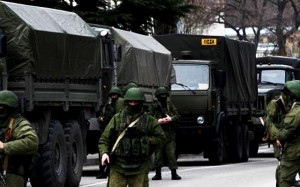
The Russian Foreign Minister Sergey Lavrov, justified the military incursion into Ukraine on Monday and said it was necessary in order to protect his country’s citizens living there. “This is a question of defending our citizens and compatriots, ensuring human rights, especially the right to life,” he said.

Panama was invaded in 1989 over the exact same pre-text by the US. US nationals were ‘in danger’ and the US military needed to protect them, analysts pionted out. Panama was considered in the US ‘sphere of influence’ which was the reason given by the Bush senior administration to invade a sovereign nation.

Earlier on Monday, as Russia sought to draw support from the international community, Mr Lavrov said that he had discussed Ukraine with his Chinese counterpart and that the two veto-wielding UN Security Council members had “broadly coinciding points of view” and would stay in close contact on the issue.

President Vladimir Putin has defended Russia’s actions, blaming “ultra-nationalist forces” for seizing power in Kiev. A Kremlin statement posted online said Putin told the German Chancellor, Angela Merkel, on Sunday that measures taken by Russia so far were “fully adequate” and in response to the unrelenting threat of violence” to “Russian citizens and the whole Russian-speaking population”.

Russia has told Ukrainian forces surrender its control of the strategic Crimean region by 3am on Tuesday or face military assault.

Relations with the US and Britain continued to plummet as the Russian Government continued to ignore calls from their leaders to leave the Ukrainian area.

It followed claims from the Ukrainian Defence Ministry that Russian fighter jets had “violated” the country’s airspace over the Black Sea overnight and that Russian forces were now in control of the port city of Sevastopol, where the Black Sea fleet is based.

The takeover of the ferry terminal on the eastern tip of Crimea by Russian troops has exacerbated fears that Moscow is planning to bring even more troops into the strategic Black Sea region. There was no immediate comment from the Russian Defence Ministry.

During a visit to Kiev today, the Foreign Secretary William Hague described the situation as “certainly the biggest crisis in Europe in the 21st century”, adding that there was “no justification” for the actions in Crimea, where Russia had “in effect taken control”.

Echoing US President Obama’s speech on Friday, the Foreign Secretary said Moscow should be in no doubt that it faced “significant costs” for its move into the Ukrainian region.

Yesterday, Ukraine’s country’s acting Prime Minister said that his country was “on the brink of disaster”, fanning fears that his position might be in danger too.

Emerging from a closed session of parliament in Kiev, Mr Yatsenyuk described President Putin’s decision to send in troops as a “declaration of war”, and said “there was no reason for the Russian Federation to invade Ukraine.

The Nato Secretary-General, Anders Fogh Rasmussen, called on Russia to “stop its military activities and its threats” after convening an emergency meeting. “What Russia is doing now in Ukraine violates the principles of the United Nations Charter,” he said. “It threatens peace and security in Europe.”

The G7 group of major industrialised nations condemned Russia’s intrusion into Ukraine on Sunday. It has also cancelled preparations for the G8 summit that was to include Russia, scheduled for Sochi in June, the White House confirmed.

The group said in a statement: “We, the leaders of Canada, France, Germany, Italy, Japan, the United Kingdom and the United States and the President of the European Council and President of the European Commission, join together today to condemn the Russian Federation’s clear violation of the sovereignty and territorial integrity of Ukraine.

“We have decided for the time being to suspend our participation in activities associated with the preparation of the scheduled G8 Summit in Sochi in June,” it added.

The G7 also urged Russia to hold talks with Ukraine directly to address any human rights or security concerns it has.

The group expressed its support for Ukraine’s bid to secure financial help from the International Monetary Fund and to make reforms to its economy.

Source: The Independent


South African Deputy Foreign Minister to visit Cuba, Panama

Marius Fransman
Marius Fransman

International Relations and Cooperation Deputy Minister Marius Fransman is scheduled to arrive in the Republic of Panama today, 09 September 2012, ahead of his two-nation visit to Panama and Cuba.

Deputy Minister Fransman visits Panama at the invitation of his Panamanian counterpart, Deputy Foreign Minister Francisco Alvarez de Soto.

Deputy Minister Alvarez de Soto visited South Africa in April 2012, the first high-level bilateral visit from Panama to South Africa since full diplomatic relations were established on in January 1995.

The Government of Panama opened an Embassy in Pretoria in August 2000. South Africa is non-residentially represented in Panama from Mexico City, Mexico, with an Honorary Consulate in Panama.

The visit by Deputy Minister Fransman will provide an opportunity to continue bilateral discussions between the two Deputy Ministers, with a focus on strengthening economic relations.

It is expected that Deputy Minister Fransman will also meet with Panama’s Deputy Minister of Commerce and Industry, the Deputy Minister of Finance and Economics and the Chamber of Commerce, Agriculture and Industry.

Deputy Minister Fransman is also expected to meet with the CEO and Board of Directors of Panama’s COPA Airlines to discuss cooperation with SAA through code sharing, to create direct links for passengers between the two countries. Panama is a hub for air traffic in Latin America.

The Deputy Minister will visit the Panama Canal and the Colon Duty Free Zone to witness and be informed first-hand of the opportunities and advantages for shipping access to the Pacific and trade in general offered.

The visit will also include a tour of the City of Knowledge, an institution providing facilities and support to programmes in education, research, technological development and innovation, while promoting integration of institutions and business, as well as being self-sustainable.

The visit promises to provide impetus to South Africa’s already solid bilateral and multilateral relations with Panama, a prominent maritime country and a hub for trade with a strong economic growth.

Following his visit to Panama, Deputy Minister Fransman will visit Havana, Cuba, on 12-14 September 2012, where it is expected that he will meet with Deputy Minister Rogelio Serra, responsible for Africa, the Middle East and Asia in the Cuban Foreign Ministry. The two Deputy Ministers will hold bilateral discussions on issues of mutual interest.

Deputy Minister Fransman is expected to deliver a lecture at the Superior Institute of International Relations (ISRI) in Havana on the upcoming International Solidarity Conference in South Africa and on the commemoration of the ANC centenary, amongst other issues.

Relations between South Africa and Cuba remain excellent. The Governments of both countries share similar interests in relation to addressing the socio-economic needs and aspirations of the peoples of South Africa and Cuba.

Cuba is an established key partner of South Africa in Latin America and the Caribbean.

South Africa is a beneficiary of Cuba’s ongoing assistance in the form of scholarships for our youth. There are currently 408 South African students studying medicine in Cuban universities. A total of 323 South African graduates from the Cuba programme work as medical doctors in various South African hospitals. In addition, 74 South African students are currently doing a one-year internship in South Africa after finishing their studies in Cuba this year, 2012.

From October 2012, South Africa will begin to train 1 000 students in medical science at Cuban universities.

On the economic front, authorities of both countries have in the past few years increased efforts to enhance bilateral trade and commercial relations.