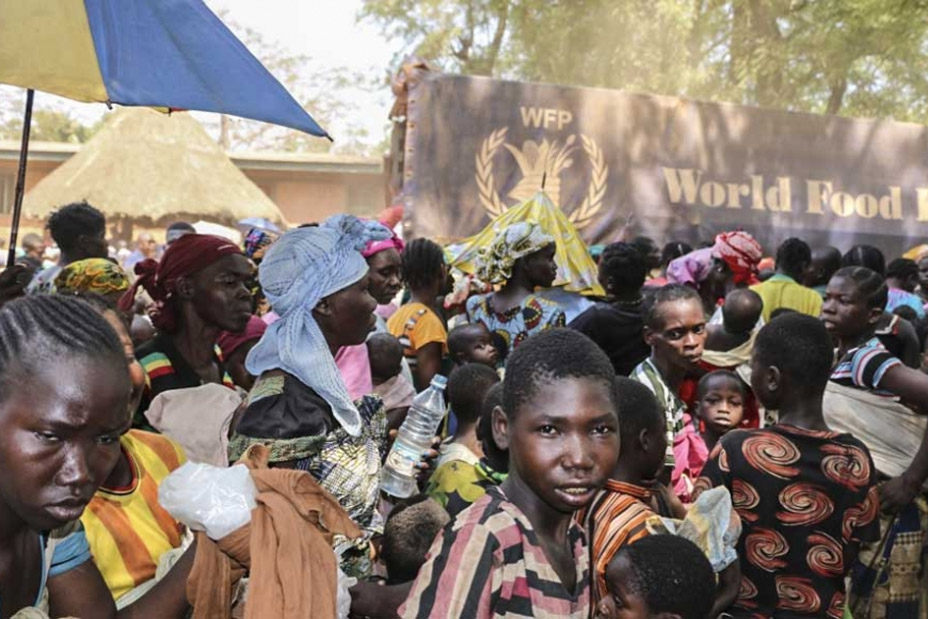
The United Nations peacekeeping operation in the Central African Republic (CAR) today condemned a recent series of armed attacks perpetrated by rebel elements.
“The United Nations Multidimensional Integrated Stabilization Mission in the Central African Republic (MINUSCA) strongly condemns the marked increase of armed attacks on the Main Supply Road 1 (MSR1) attributable to members of the rebel group Front démocratique du peuple centrafricain (FDPC),” said a press release issued today.
The latest incident took place over the weekend when gun shots were fired against a convoy with World Food Programme (WFP) supplies, escorted by MINUSCA peacekeepers, in the North-Western part of the country.
The driver was fatally wounded after being shot by three times in the chest and his truck shoved on the side, causing serious injuries to other passengers.
“This violence goes against the current momentum aimed at peace and national reconciliation following the conclusions and recommendations of the Bangui Forum and of the agreement signed between the government and armed groups on the cessation of hostilities and on disarmament,” underlines the Mission.
MINUSCA added that it will reinforce the “robust measures” aimed at raising the level of security on this vital route that supplies the Central African Republic.
More than two years of civil war and sectarian violence have displaced thousands of people in CAR amid ongoing clashes between the mainly Muslim Séléka alliance and anti-Balaka militia, which are mostly Christian. The UN estimates that some 450,000 people remain displaced inside the country while thousands of others have sought asylum across the borders. – UN News Centre
The CIA has begun delivering weapons to rebels in Syria, ending months of delay in lethal aid that had been promised by the Obama administration, according to U.S. officials and Syrian figures. The shipments began streaming into the country over the past two weeks, along with separate deliveries by the State Department of vehicles and other gear — a flow of material that marks a major escalation of the U.S. role in Syria’s civil war.
The arms shipments, which are limited to light weapons and other munitions that can be tracked, began arriving in Syria at a moment of heightened tensions over threats by President Obama to order missile strikes to punish the regime of Bashar al-Assad for his alleged use of chemical weapons in a deadly attack near Damascus last month.
The arms are being delivered as the United States is also shipping new types of nonlethal gear to rebels. That aid includes vehicles, sophisticated communications equipment and advanced combat medical kits.
U.S. officials hope that, taken together, the weapons and gear will boost the profile and prowess of rebel fighters in a conflict that started about two and a half years ago.
Although the Obama administration signaled months ago that it would increase aid to Syrian rebels, the efforts have lagged because of the logistical challenges involved in delivering equipment in a war zone and officials’ fears that any assistance could wind up in the hands of jihadists. Secretary of State John F. Kerry had promised in April that the nonlethal aid would start flowing “in a matter of weeks.”
The delays prompted several senior U.S. lawmakers to chide the Obama administration for not moving more quickly to aid the Syrian opposition after promising lethal assistance in June. The criticism has grown louder amid the debate over whether Washington should use military force against the Syrian regime, with some lawmakers withholding support until the administration committed to providing the rebels with more assistance.
Sen. Bob Corker (R-Tenn.), who has pressed the Obama administration to do more to help the rebels, said he felt embarrassed when he met with Syrians along the Turkish border three weeks ago.
“It was humiliating,” he said in an interview Wednesday night. “The president had announced that we would be providing lethal aid, and not a drop of it had begun. They were very short on ammunition, and the weapons had not begun to flow.”
The latest effort to provide aid is aimed at supporting rebel fighters who are under the command of Gen. Salim Idriss, according to officials, some of whom spoke on the condition of anonymity because part of the initiative is covert. Idriss is the commander of the Supreme Military Council, a faction of the disjointed armed opposition.
U.S. officials, speaking about the provision of nonlethal aid, said they are determined to increase the cohesion and structure of the rebel fighting units.
“This doesn’t only lead to a more effective force, but it increases its ability to hold coalition groups together,” said Mark S. Ward, the State Department’s senior adviser on assistance to Syria, who coordinates nonlethal aid to rebels from southern Turkey. “They see their leadership is having some impact.”
The CIA shipments are to flow through a network of clandestine bases in Turkey and Jordan that were expanded over the past year as the agency sought to help Middle Eastern allies, including Saudi Arabia and Qatar, direct weapons to moderate Syrian rebel forces.
Syrian rebels, including jihadists linked to Al-Qaeda, have taken control of the historic Christian town of Maalula, north of Damascus, a watchdog and a resident said on Sunday.
Maalula is home to around 5,000 residents and is of strategic importance for the rebels, who are trying to tighten their grip around the capital Damascus, adding a northern post to existing bases in the south and west of the city.
Capturing the town, around 55 kilometres north of the capital, could also help rebels threaten the nearby highway between Damascus and Homs, a supply route used by the regime.
The battle for the town left at least 17 rebels dead and more than 100 wounded overnight, the Syrian Observatory for Human Rights said, adding that dozens of regime forces and pro-militia members were also killed or wounded in the fighting.
“Overnight, Syrian regime troops moved into the village, but rebel forces sent reinforcements and were able to take control of the entire town,” Observatory director Rami Abdel Rahman told AFP.
He said the Al-Nusra Front, which has pledged allegiance to Al-Qaeda leader Ayman al-Zawahiri, was among the forces that had taken control of the town.
A Maalula resident, reached by phone, confirmed that regime forces had withdrawn from the area and rebel forces were now in control.
Speaking on condition of anonymity, the resident said the situation on the ground was quiet.
“The rebels are inside Maalula, all of Maalula. The government troops have pulled out of Maalula,” the resident said.
Abdel Rahman said “fierce fighting broke out between regime forces and rebel fighters overnight, and the soldiers withdrew to the outskirts of the town.”
Troops were still stationed around the town, raising the possibility of renewed fighting.
Picturesque Maalula is nestled under a large cliff and is considered a symbol of the Christian presence in Syria.
Many of its inhabitants speak Aramaic, the language spoken by Jesus Christ that only small, scattered communities around the world still use.
It is full of troglodyte caves dating back to the first centuries of Christianity, and also houses the Mar Takla Greek Orthodox monastery.
The clashes first erupted on Wednesday, when Al-Nusra Front fighters and other Islamist rebels attacked a regime checkpoint at one entrance to the town.
The advance raised fears of attacks against churches or Christians in the town but on Friday, the opposition Syrian National Coalition said rebels had withdrawn from the area.
On Saturday, the Observatory said rebel forces were fighting pro-regime militias in the west of the town, and were also engaged in clashes with Syrian troops on the outskirts of Maalula. – AFP
Syrian rebels stand on a tank shouting slogans and flashing ‘Victory signs’, in Aleppo, Syria, 20 July 2012.
Syrian activists in Aleppo have staged protests calling for the lifting of a rebel siege of regime-held districts that has created food shortages, an NGO said on Wednesday.
The Syrian Observatory for Human Rights said the first demonstration calling for the siege to be lifted came on Tuesday, adding that a demonstrator was shot dead during the protest.
The watchdog group said it was unclear who had shot the demonstrator, but added that protesters took to the streets in the northern Syrian city again on Wednesday.
A video of Tuesday’s protest posted by the Observatory on Wednesday showed a small group of youths chanting “the people want to break the siege”.
Suddenly, four men in black t-shirts, including one armed with a handgun, start pushing the protesters back. The sound of gunfire can be heard, but it is unclear where the shooting comes from.
Rebel forces have imposed a siege on several regime-controlled neighbourhoods, where government forces have not been able to deliver food.
The blockade has created food shortages in their neighbourhoods and pushed up prices just as Syrian Muslims begin the fasting month of Ramadan.
Another video posted by the Observatory showed that the siege policy has a variety of opponents among the opposition.
The footage shows a woman accompanied by her child trying to cross into regime-held Ashrafiyeh with a pram full of shopping bags.
“I came to buy food. We have nothing, our children are dying of hunger. My son is sick and needs medicine and to eat,” the woman pleads with a rebel fighter armed with a Kalashnikov.
Her plea sparks an exchange between two rebels, one trying to convince the other to let her pass with the food.
“What crime has this woman committed? She bought two kilos of potatoes, two kilos of tomatoes and some bread to allow her to keep her children alive,” one rebel says.
The other rebel suggests consulting an opposition chief, but the proposal is rejected by the fellow fighter.
“I know what he’ll say. He will repeat that this is Islam and the other side are apostates, but that’s not true.”
Rebel forces have sought to block the entry of medicine and food to regime-held parts of Aleppo for some time, but in recent days they have succeeded in blockading the districts completely after cutting off regime access to the area by blowing up a bridge and blocking a key road.
In Damascus, meanwhile, a senior official at Syria’s foreign ministry, after meeting with UN representatives, told journalists that the government was concerned about the situation in Aleppo.
“We had an important meeting to increase our joint efforts to send urgent humanitarian aid to Aleppo province and we agreed to begin this work from tomorrow,” the official said.
Rebel forces seeking the overthrow of the regime entered Aleppo, Syria’s second city, a year ago, and have seized large parts of it but have not managed to capture it completely. – AFP
Samples taken at the Syrian town where chemical weapons were allegedly used indicate that it was rebels – not the Syrian army – behind the attack, Russia’s UN envoy Vitaly Churkin has said.
Russia has handed over the analyzed samples to the UN, he added.
“I have just passed the analysis of samples taken at the site of the chemical attack to the UN Secretary General (Ban Ki-moon),” Churkin said on Tuesday.
Evidence studied by Russian scientists indicates that a projectile carrying the deadly nerve agent sarin was most likely fired at Khan al-Assal by the rebels, Churkin pointed out.
“It was determined that on March 19 the rebels fired an unguided missile Bashair-3 at the town of Khan al-Assal, which has been under government control. The results of the analysis clearly show that the shell used in Khan al-Assal was not factory made and that it contained sarin,” he said.
Churkin added that the contents of the shell “didn’t contain chemical stabilizers in the toxic substance,” and therefore “is not a standard chemical charge.” The RDX – an explosive nitroamine commonly used for industrial and military applications – found in the warhead was not consistent with what the armed forces use.
According to Moscow, the manufacture of the ‘Bashair-3’ warheads started in February, and is the work of Bashair al-Nasr, a brigade with close ties to the Free Syrian Army.
Churkin stressed that unlike other reports which have been handed to the UN, the samples were taken by Russian experts at the scene, without any third party involvement.
More than 30 people died in the Khan al-Assal incident in the northern province of Aleppo in March. Damascus was the first to ask for the UN investigation, accusing opposition fighters of launching a chemical weapon attack. Syrian rebel groups denied the accusations, in turn blaming government forces.
However, the UN investigation has largely become stalled after a group of Western nations insisted on launching an inquiry into a separate case of alleged chemical weapons use in Homs in December 2012. The inquiry requires access to military objects, which Damascus has been unwilling to give.
The UN has also decided to exclude Russian and Chinese experts from the investigation team, with Syria protesting this decision.
So far, the UN commission of inquiry for Syria has not found any conclusive evidence proving that either side of the conflict used chemical weapons. This is despite several reports submitted by the US, UK and France, which claim to show that Syrian President Bashar Assad’s forces used such weapons.
Syria finds enough chemicals to ‘destroy the whole country’
The Syrian government invited chief UN chemical weapons investigator Ake Sellstrom and UN disarmament chief Angela Kane for talks in Damascus on Monday, announcing that a rebels-linked storage site containing piles of dangerous chemicals had been discovered.
“The Syrian authorities have discovered yesterday in the city of Banias 281 barrels filled with dangerous, hazardous chemical materials,” Syrian UN Ambassador Bashar Ja’afari said, adding that the chemicals were “capable of destroying a whole city, if not the whole country.”
The chemicals, which included monoethylene glycol and polyethylene glycol, were found in a storage site used by “armed terrorist groups,” Ja’afari explained. He said that Syria has started an investigation into the discovery.
The Syrian envoy expressed Damascus’ confidence that there will be “constructive negotiations with the Syrian officials in order to reach an agreement,” particularly in terms of “reference, mechanism, and time frame” of the UN mission.
Ja’afari added, however, that one should not “jump to the conclusion” that the Monday invitation means that Syria would consider allowing the UN team access to sites beyond Aleppo.
UN Secretary-General Ban Ki-moon’s spokesman, Martin Nesirky, reacted by calling the invitation “a move in the right direction,” but did not say whether UN investigators would accept it. The UN has been demanding that Sellstrom’s team be granted access across Syria “without further delay and without conditions,” ordering the Aleppo investigation not to begin until those demands were reached.Following Churkin’s announcement, both US and UK officials voiced their disbelief over any evidence suggesting that Syrian rebels used chemical weapons, stating they have yet been unable to see the whole report of Russia’s UN envoy.
The US has “yet to see any evidence that backs up the assertion that anybody besides the Syrian government has the ability to use chemical weapons, has used chemical weapons,” White House spokesman Jay Carney said.
When asked whether Washington had seen the Russian report, Carney replied that it had not.
The UK also voiced its skepticism regarding the report, stating that it didn’t believe the opposition could have obtained chemical weapons.
“We will examine whatever is presented to us, but to date we have seen no credible reporting of chemical weapons use by the Syrian opposition, or that the opposition have obtained chemical weapons,” BBC quoted a UK government spokesman as saying. – RT
The so-called “Friends of Syria” group comprises Britain, France, the US, Germany, Italy, Jordan, Qatar, Saudi Arabia, Turkey, Egypt and the United Arab Emirates. We can safely say that America and Britain are the driving forces behind the initiative and that the other countries have merely been roped in to lend some international legitimacy to what is turning into a proxy war between the US-UK and Russia.
The Syrian conflict represents a threat to world peace. In fact, it could lead to the end of civilisation as we know it!
That may sound like an outrageous statement, but let me explain.
The civil war in Syria is not only a proxy war between the Atlantic powers (or Atlanticists) and Russia, but once Syria falls, the next target will be Iran and after that Russia itself.
Putin understands this. He is also correct when he accuses the American and British governments of disregarding the sovereignty of other states and nations. Especially Democratic and Labour governments have in recent decades embraced the doctrine of “regime change” whereby the two Anglo-Saxon powers see fit to start wars and uprisings in other countries to serve their own interests. However, a lot of the time they are not even serving their own interests but are acting to promote the new Soviet ideology of multiculturalism. Racial equality, or “equality of outcomes” is to the Atlanticists what class equality was to the former totalitarian states of Eastern Europe.
Elsewhere on this website, Felicity Arbuthnot quotes Sbigniew Brzesinski as saying that the United States is courting “large-scale disaster” in Syria:
“Having covertly provided arms and equipment to insurgents from numerous different countries for over two years, they have now moved to the overt stage, a move over which even arch hawks such as former National Security Advisor Zbigniew Brzezinski, and former Republican Senator Richard Luger, six term leader of the Senate Foreign Relations Committee urged caution.
“Luger said such action would boost extremists, with Brzezinski dismissing Obama’s talk of ‘red lines’ as thoughtless and risking “a large-scale disaster for the United States.”
Carl Schmitt
The geostrategic scenario predicted by Russian writer and commentator Aleksandr Dugin, is being realised. I posted his essay The Great War of Continents on my personal blog some time ago. Dugin was influenced by the great German legal philosopher, Carl Schmitt, who was skeptical of democracy. In fact, we can see how democracy plays hardly any role in the decisions taken by the Atlanticists as the populations of both the US and the UK are vehemently opposed to further wars. A recent poll conducted by the Pew Research Center shows that Americans (are) overwhelmingly against arming Syrian rebels. Schmitt also wrote a book on Land and sea in which he theorised about the conflict between the Atlantic “sea powers” and the Eurasian “land powers”.
However, I think the Syrian conflict, together with the so-called “Arab Spring”, colour revolutions, as well as the South African revolution of 1994 portend a major movement with the ultimate objective of abolishing the nation state as we know it. Almost all of these revolutions were fomented from the outside by Atlanticists who discerned weaknesses in the ethnic, religious and multinational compositions of the states being attacked. The use of media and the arming or financing of “rebels” and terrorists were features of all these revolutions or “regime changes”.
Apart from the thalassocratic elements identified by Schmitt and Dugin – the USA and the UK being maritime powers – there is another, archaic driver behind Atlanticist overreach and that is the resurrection of a kind of Zombie British Empire (ZBE). America, being a republic, has always been ill at ease with its role as the New Rome. Americans are not well-versed in foreign languages, customs and geography. The average intern or staffer in Washington would not be able to find Syria on a map, let alone appreciate the ethnic, religious and political complexities of that society.
But in its economic and geostrategic decline, Britain has become the tail wagging the dog. It is clearly seeking to influence and direct the United States in re-establishing its nineteenth-century dominance as a global imperium. Earlier this year, an Historic strategy meeting between the USA and the UK was announced. More recently, it was revealed by Edward Snowden that the British are worse than US in spying. Just yesterday, it appeared that the UK (was) tapping the EU’s data flows and the “German Justice Minister… called the British spy agency’s massive eavesdropping of international fiber-optic cables ‘a catastrophe’.”
There is a long-standing hostility towards the nation state in Britain, which has become deeply rooted in academia, the media, the ubiquitous left-wing NGOs and especially in the Labour Party. European nationalism or the historical desire of European peoples to exercise their right to self-determination is routinely equated with Hitlerism. But even in the United States where Woodrow Wilson is remembered as a champion of self-determination and the nation state, there is another school of thought expressed by Wilson’s secretary of state, Robert Lansing, in the aftermath of World War I:
“The more I think about the President’s declaration as to ‘self-determination’, the more convinced I am of the dangers of putting such ideas into the minds of certain races. It is bound to be the basis of impossible demands on the Peace Congress, and create trouble in many lands. What effect will it have on the Irish, the Indians, the Egyptians, and the nationalists among the Boers? Will it not breed discontent, disorder and rebellion?”
The successful suppression of Afrikaner self-determination or “Boer nationalism” over more than a century, as well as the so-called “peaceful regime change” in South Africa in 1994, has emboldened neo-imperialists in the UK and the US to engineer many more regime changes, starting in Iraq, but also the Maghreb and Egypt, with the focus now on Syria.
This is what opponents of the Obama administration in the United States are starting to call the “New World Order”. The adherents of the NWO envisage such a radical change in global government, coupled with Big Brother spying techniques and sci-fi mind control, that we are indeed seeing the end, not only of Wilsonian self-determination, but even of the European order that arose at the end of the Thirty Years War in 1648. The so-called “Peace of Westphalia” in 1648 established national sovereignty and religious freedom as the two inviolable principles of European statecraft.
Under its current government, there is religious freedom in Syria, unlike in other Muslim states. On the other hand, we have seen Christian churches being attacked by the so-called rebels. The question has already been asked on this website: Who will the US really arm in Syria? Quoting from that RT report, we can only conclude that it must be radical Islamists opposed to the current modern-Arab regime of Bashar al-Assad:
“The US decision to arm the Syrian rebels fighting government troops has sparked feuds among various rebel factions dominated by radical Islamist fighters. As internal schisms among the rebels deepen, fighters from the Al-Qaeda-linked Al-Nusra Front have reportedly assassinated a large number of officers of the Free Syrian Army.”
The love-hate relationship that the USA is entertaining with Al-Qaeda may be conceptually difficult to grasp. But not if one takes a step back to look at the big picture, both present and past. On the one hand and especially after 9/11, Al-Qaeda was Enemy No. 1, the target for Bush’s “war on terror”. On the other hand, Al-Qaeda, the Muslim Brotherhood and similar fundamentalist groups are being funded, supported and armed by the United States to take over Arab countries and establish a form of theocracy, including shariah. Are the US and the UK being run by idiots who simply do not understand what they are doing?
The answer is no. The ostensible paradox of modern, so-called Western states with same-sex marriage laws, equality of the sexes, religious and political pluralism, aiding and abetting mediaeval, theocratic groups is no paradox at all.
Some years ago I realised with a shock that globalist capitalism would succeed where communism had failed, in establishing a denationalised, internationalist empire. Two Marxists, one American and one Italian – a former member of the Red Brigades – wrote a book looking forward to this global imperium being created by the United States, appropriately entitled Empire. We all know that Lenin was apparently funded by a New York banker called Jacob Schiff.
Like globalism, fundamentalist Islam is also a doctrine that does not recognise secular government within a nation state, of the form established in Europe and America after 1648. Arabic Islamic culture is already transnational, as opposed to the Nasserist nationalist regimes of a Saddam Hussein or a Bashar al-Assad that must be destroyed at all costs. What the proponents of the New World Order, or the Atlanticists, are telling us is that Muslims and Arabs have no need of nation states. Neither do Europeans, Asians or Africans, for that matter. Within the globalist, new-world-order logic, only transnational entities such as the UN, the EU or the African Union matter. The nation state must be razed to the ground.
It follows that a failed state is always preferable to a functional one. Iraq was attacked and in its wake there is now a failed state, more or less bordering on chaos. Africa is littered with failed states, including Zimbabwe, the creation of British foreign policy. Many of these states cannot even supply potable water to their citizens, yet they are praised to high heaven as examples of “postcolonial democracy”. The New York Times recently declared Zimbabwe’s disastrous “land reform” a “success”, during which the property of private white land owners was confiscated. South Africa too, is on its way to becoming a failed state with rampant, crime, corruption and marauding bandits attacking houses and farms, often torturing white farmers to death. But South Africa is the darling of the Anglo-American world, as a transnational state with more or less open borders – that which is envisaged for the whole planet as peoples, races and cultures mingle and we all sit at McDonald’s having a Coke. However, some of us will be wearing the burka and others will be sacrificing a goat outside to appease the forefathers.
Apart from the ideological imperative to destroy national identities and nation states wherever they are to be found, the globalist powers also have an economic imperative. As we all know, the United States has to a large extent transferred its manufacturing to China and the Far East. Both American and Britain have financial and service economies that depend on capital flows and trade. Up to a quarter of British GDP is generated in the City of London, by bankers, brokers, traders, consultants, accountants and other economic parasites that produce absolutely nothing. They are so-called “intermediaries”.
The British bank HSBC, one of the world’s largest, has been described as a criminal enterprise, for its role in money laundering.
The two bellicose countries are also bankrupt, amassing mountains of government and private debt. Successive bailouts of the banking industry have left them with amounts of debt that normal handheld calculators cannot even process unless one leaves out substantial numbers of zeroes. It is an old adage that war is the only way out of a prolonged economic downturn and financial melt-down. After the failure of quantative easing to kickstart the US economy, war is all that America has left.
The war economy is, by definition, a subsidised economy. The American taxpayer is funding the military-industrial complex, which can almost charge what it likes, having a captive market for its goods. Free weapons for Syrian rebels may therefore be seen as the latest round of quantitative easing and “stimulus”.
America will not attack China because, as some commentator put it the other day on a blog, that country represents “our T-bill sugar daddy”. China is the biggest buyer and holder of US debt, so for the moment no Chinese rebels will be armed.
Not so Russia, which competes with the USA in fhe only field where it has real industrial capacity left: armaments. With its military parades, patriotism and sense of tradition, Russia is the exact antithesis of globalist transnationalism. It also celebrates its own language, music and literature. In the USA and Britain, what passes these days for “literature” is mostly guilt-ridden, anti-white tracts attacking any sense of identity, tradition, genius or cultural standards. Nietzsche called it “nihilism”. Risking opprobium, one may even resuscitate a German term from the 1930s, Entartete Kunst or “degenerate art”. Let’s stick to “nihilism”.
The Nasserist, nationalist Arab regimes have fallen like the proverbial dominoes, pushed by American money and CIA tricks. Syria is proving a harder nut to crack. After Syria, Iran will be next, that citadel of Shiite power. Not only is Iran a country with a large population, but it also has a unique sense of self, with its religion and traditions.
However, the ultimate target is Russia. Whatever one may think of Russia and its role in the twentieth century, it is obvious that it has become a “guarantor of sovereignty” of sorts. Many Afrikaners muse today that we would have been better off if Vorster had surrendered to the Soviet Union in the 1970s than De Klerk’s capitulation to the Nordic and British-backed “rebels” of the ANC in 1994. Soviet nationalities policy was an enlightened way of allowing regional and national identities to flourish. Even as communists, Russians had respect for culture, including the culture of others.
Looking at pictures of Syrian churches being vandalised and sacked by the US-backed rebels, it saddens one to think that such acts are being condoned by some of the fresh-faced, all-American and probably Christian boys and girls that one still encounters in Washington offices, although they will probably soon be replaced by multicultural imports.
The modern civilisation whose fruits we are enjoying today came about during the European Renaissance and after the Peace of Wesphalia during 1648. French Socialist President François Mitterand was wrong when he stated: Le nationalisme, c’est la guerre. (“Nationalism means war.”) More often than not, nation states have created institutions, schools, universities, academies, opera houses, and theatres; such states have allowed peoples to determine their own destiny. As Woodrow Wilson put it to Congress a month after his famous Fourteen Points Speech, sometimes referred to as his “Four Point Speech” on 11 February 1918:
“National aspirations must be respected; people may now be dominated and governed only by their own consent. ‘Self-determination’ is not a mere phrase; it is an imperative principle of action…”
In Syria and elsewhere, Obama and Cameron, like Bush and Blair before them, are pitting themselves against this principle and that of sovereignty. If the Atlanticists succeed, a global disaster might ensue which could take us back to a high-tech version of the Middle Ages. We will be subjected to and even forcibly converted to various faiths, of which fundamentalist Islam is one and multicultural leftism is another. Heretics will again be persecuted, stoned to death or simply executed by various uniformed militiamen, either belonging to rebel movements or government forces.
Perhaps some of the global corporations and oil companies, employing their own private armies for protection, will do quite well in such a postnational world. But the rest of us will be terrorised by gangs, mobs and armed “rebels”, as is happening in many parts of Africa already.
Of course, South Africa is the guinea pig country, the first open-border, transnational state with hardly any sovereignty where any government official may be bought. Organised crime and multinational corporations share the spoils. Private property is open to interpretation and any Marxist historian’s vague theories about exploitation could jeopardise your title deed.
Is this the kind of world we want?
If Germany and France want to follow the arming of rebels and the destabilisation of whole countries, we should start boycotting their cars and buy Korean or Japanese. Russia should also do its best to wake Europe up to the dangers of the New World Order unfolding before our very eyes. Patriotic Americans and Britons who oppose the inteventionist role of their countries in wrecking the states and societies of other peoples, should also make their voices heard. Many are already doing so, via radio staions and the internet, but if we are to stop the powerful insiders taking control of the globe, much more action and information are needed.
The decision by the United States and its allies to arm rebel groups in Syria is “very dangerous” and will prolong the violence and killing on the ground, Syria’s foreign minister said Monday.
Walid al-Moallem said sending more weapons to the opposition will also hinder efforts to bring both sides to the table in a planned peace conference in Geneva. He said his country remains ready and willing to take part but added President Bashar Assad will not step down.
Al-Moallem’s comments came two days after an 11-nation group that includes the U.S. met in the Qatari capital of Doha and agreed to step up military and other assistance to the Syrian rebels. He said all those who met in Doha “have Syrian blood on their hands.”
U.S. Secretary of States John Kerry, who took part in the conference, would not disclose details of the aid, saying only that it would re-balance the fight between the rebels and the government. Assad’s better-equipped forces are increasingly backed by fighters from Lebanon’s Hezbollah militant group.
“We are not scared,” al-Moallem said of the decision. “If they dream or are delusional about achieving a balance with the Syrian Arab Army, I think they need to wait years and this won’t be achieved.”
“They will not be victorious no matter how much they conspire,” al-Moallem added. He said arming the rebels “is a dangerous decision because it aims at prolonging the crisis, prolonging the violence and killing and encouraging terrorism.”
The Friends of Syria gathering in Doha was Kerry’s first meeting with his counterparts on the practicalities of assisting the Syrian rebels since President Barack Obama announced that the U.S. would send lethal aid to the opposition. The decision came despite concerns that the weapons could fall into the hands of Islamic extremists in the rebel coalition.
Obama’s change of policy was partly based on a U.S. intelligence assessment that Assad had used chemical weapons, but Kerry expressed deeper concern about Damascus’ foreign support. He said that Iranian as well as Hezbollah fighters had joined the war.
Al-Moallem denied categorically that any Iranian fighters were in Syria. Damascus admits that Hezbollah is assisting government troops.
The foreign minister said his regime was willing to take part in any peace conference, but will go to Geneva not to hand over power to the other side but rather to establish “a real partnership” and a national unity government that includes representatives of all Syrian society.
“President Bashar Assad will not step down,” he said. “If anyone has such illusions on the other side, my advice to them is not to go to Geneva,” he said. He nonetheless called the conference an “opportunity that should not be missed.”
He defiantly said Syria will not accept any solutions or even ideas dictates from the outside.
More than 93,000 people have been killed in Syrian conflict that started in March 2011 as largely peaceful protest against Assad’s rule. The uprising turned into a bloody insurgency in response to a military crackdown by regime forces on the protest movement. In the past year, the war has taken on increasingly sectarian overtones. – AP
Foreign ministers of the “Friends of Syria” group meet in Doha on Saturday to discuss military help and other aid for rebels after an onslaught by government forces who have retaken key areas.
The meeting will address in a “concerted, coordinated and complementary manner” the concerns raised by the opposition’s military chief, Salim Idriss, during a “Friends of Syria” meeting in Ankara last Friday, a French diplomat said.
The rebels had notably asked for anti-tank and anti-air missiles to fight the regime forces. Western aid for them so far has been confined to non-military equipment like sophisticated communications materiel.
The upcoming talks — attended by ministers of Britain, France, the United States, Germany, Italy, Jordan, Saudi Arabia, Qatar, the United Arab Emirates, Turkey and Egypt — will also discuss a proposed peace meeting between President Bashar Al-Assad’s regime and the opposition to end the 27-month conflict which has claimed some 93,000 lives and shows no sign of abating.
“We will try in Doha to sum up the situation on the ground and to see how we can aid the opposition coalition and arrive at a political solution,” French Foreign Minister Laurent Fabius said.
The Doha talks will be held against the backdrop of a string of successes by government troops into rebel territory, backed up by Iranian forces and Lebanon’s Hezbollah group.
They have retaken Qusayr in the central Homs province near Lebanon and trying to recapture the key city of Aleppo.
It also comes days after a summit of G8 leaders issued a non-committal statement for a peace conference on Syria to be held as soon as possible. The group was deeply divided on key issues, especially owing the intransigence of Russia, Assad’s ally.
The G8 also agreed to push for a transitional government in Syria that could include members of Assad’s regime who switched sides.
French President Francois Hollande, who will be in Qatar and Jordan over the weekend in a visit that had been planned earlier, will also discuss the Syrian unrest with Qatar’s ruler Sheikh Hamad bin Khalifa Al Thani, officials said.
Qatar and Saudi Arabia have been the two major Middle Eastern states providing aid to the rebels.
Britain and France have recently pushed for providing weapons to them but have underscored that this must be done in a responsible manner to avoid the kind of anarchy that took place in Libya after the fall of dictator Moamer Kadhafi.
United States President Barack Obama has authorised sending small arms to the rebels after confirmation that chemical weapons were being used in the conflict. But he has refused to specify what they will be.
Syrian rebels have asked friendly world powers to give them heavier weapons and to impose a no-fly zone over parts under their control to avert a humanitarian disaster.
“The regime could use Scud missiles with unconventional warheads to shell liberated areas. So we need a safe haven,” Free Syrian Army spokesman Louay Meqdad told AFP.
“It is necessary to establish secure areas and impose no-fly zones in the south or north,” he said.
Calling for anti-tank and anti-aircraft weapons, he said that “if they do not provide us with arms to protect civilian areas, a humanitarian disaster will occur because regime troops are committing massacres in the areas they are recapturing”. – AFP
A rebel group believed to be backed by Rwanda seized the strategic, provincial capital of Goma in eastern Congo on Tuesday, home to more than 1 million people as well as an international airport in a development that threatens to spark a new, regional war, officials and witnesses said.
Explosions and machine-gun fire rocked the lakeside city as the M23 rebels pushed forward on two fronts: toward the city center and along the road that leads to Bukavu, another provincial capital which lies to the south. Civilians ran down sidewalks looking for cover and children shouted in alarm. A man clutched a thermos as he ran.
Thousands of residents fled across the border to Rwanda, the much-smaller nation to the east which is accused of funneling arms and recruits to the M23 rebels.
By early afternoon the gunfire had stopped and M23 soldiers marched down the potholed main boulevards, unimpeded. Their senior commanders, who the United Nations has accused of grave crimes including recruiting child soldiers, summary executions and rape, paraded around the town in all-terrain vehicles, waving to the thousands of people who left their barricaded houses to see them.
The United Nations peacekeepers, known by their acronym MONUSCO, were not helping the government forces during Tuesday’s battle because they do not have a mandate to engage the rebels, said Congolese military spokesman Olivier Hamuli, who expressed frustration over the lack of action by the peacekeepers.
“MONUSCO is keeping its defensive positions. They do not have the mandate to fight the M23. Unfortunately, the M23 did not obey the MONUSCO warnings and went past their positions (at the airport). We ask that the MONUSCO do more,” he said.
A U.N. spokesman said in New York said that the nearly 1,500 U.N. peacekeepers in Goma held their fire to avoid triggering a battle. The peacekeepers “cannot substitute for the efforts of national forces” in Congo, said spokesman Eduardo del Buey.
On Wednesday the Security Council will review the mandate of the U.N. peacekeeping force in Congo. A resolution adopted Tuesday by the Security Council asks the U.N. secretary-general to recommend possible redeployment, and possible “additional force multipliers.”
The resolution approved unanimously by the council imposes targeted sanctions, including a travel ban and assets freeze on the M23 rebel group leadership. But it did not name two countries accused by Congo of supporting the rebels: Rwanda and Uganda.
The council demanded that the M23 rebels withdraw from Goma, disarm and disband, and insisted on the restoration of the crumbing Congolese government authority in the country’s turbulent East.
The resolution also calls for an immediate end to external support to the rebels and asks the U.N. secretary-general to report on the allegations of foreign support while expressing its readiness to take appropriate measures.
French Foreign Minister Laurent Fabius said Tuesday that the mandate of the U.N. forces in Congo “must be reviewed.” Speaking in Paris, he said it is “absurd” that the U.N. has 17,000 peacekeepers in all of Congo but they “couldn’t stop several hundred men” in Goma.
The French minister also said a rapprochement between Congo and Rwanda was critical to solving the crisis. Fabius said he’s been in touch with officials in both countries.
The rebels are believed to be backed by Rwanda, and to a smaller extent by Uganda, which are accused of equipping them with sophisticated arms, including night vision goggles and 120 mm mortars. Evidence is mounting of the involvement by the neighboring country and on Friday, the United Nations Group of Experts is expected to release its final report, detailing the role the neighboring nations played in the recruitment, financing and arming of the rebel movement, which was born in April.
Congolese government spokesman Lambert Mende said that Rwandan soldiers had crossed into Goma, hiking over footpaths across a volcano that looms between the two countries.
“Goma is in the process of being occupied by Rwanda,” said Mende, speaking from Congo’s distant capital of Kinshasa. “We have people who saw the Rwandan army traverse our frontier at the Nyamuragira volcano. They have occupied the airport and they are shooting inside the town. Our army is trying to riposte but this poses an enormous problem for them -this is an urban center where hundreds of thousands of people live,” he said.
A Congolese colonel, who was at the frontline in Goma before the city fell, said that the soldiers he saw were Rwandan. Neither his claim nor Mende’s could be independently verified.
Congo’s President Joseph Kabila flew to Uganda Tuesday for talks with President Yoweri Museveni, a Ugandan government spokesman confirmed. The official spoke in Kampala on condition of anonymity because he was not authorized to divulge the information.
M23 rebel spokesman Col. Vianney Kazarama confirmed that they had taken the airport and the city. “We are now inside the city of Goma,” he said.
Goma, a city of low-lying buildings, many topped by rusted corrugated roofs, was last threatened by rebels in 2008 when fighters from the now-defunct National Congress for the Defense of the People, or CNDP, stopped just short of the city. Their backs to the wall, the Congolese government agreed to enter into talks with the CNDP and a year later, on March 23, 2009, a peace deal was negotiated calling for the CNDP to put down their arms in return for being integrated into the national army.
The peace deal fell apart this April, when up to 700 soldiers, most of them ex-CNDP members, defected from the army, claiming that the Congolese government had failed to uphold their end of the deal. Like in 2008, they again advanced toward Goma. This time, the city fell and the disastrous consequences for the population were already on display.
At a municipal hospital, 19-year-old Nene Lumbulumbu described how she was cleaning her house, when she was hit by a stray bullet in the torso. A father stood over his little girl’s bed, clutching an X-ray showing the bullet lodged in her chest. He had sent her to fetch water in this city where most live without running water. She was brought back by neighbors, after being hit by a bullet.
The hospital was treating children whose arms were sheared off by exploding shells, and teenagers paralyzed from the neck down. Hospital director Justin Lussy said the injuries were just the tip of the iceberg.
“Regional and international actors must now prevent this turning into a new regional war,” said the International Crisis Group in a statement. “The past week has shown history repeating itself in eastern Democratic Republic of Congo, with the same tragic consequences for civilians in the region.”
If the rebels succeed in taking Bukavu, it will mark the biggest gain in rebel territory since at least 2003, when Congo’s last war with its neighbors, including Rwanda and Uganda, ended.
Jean-Claude Bampa, who lives near the road to Sake, the first town on the drive to Bukavu, spoke on the telephone over loud gunfire in the background. “I can hear gunshots everywhere, it is all around my home,” he said on Tuesday morning. “We are stuck inside and are terrified. I pray this will be over soon.” – AFP
Rwanda – along with Australia, Argentina, Luxembourg and South Korea – won a seat on the U.N. Security Council on Thursday, despite accusations by a U.N. panel that Rwanda’s defense minister commands a rebellion in Democratic Republic of Congo.
Rwanda was unopposed in its bid for the African seat on the council that South Africa will vacate at the end of December, but still needed approval from two-thirds of the U.N. General Assembly members present to secure the two-year term. It won 148 votes in the 193-nation assembly.
Argentina also was elected to the council unopposed, winning 182 votes. Australia won a seat with 140 votes, Luxembourg with 131 votes and South Korea with 149.
Cambodia, Bhutan and Finland failed to secure two-year seats on the council.
There are five veto-holding permanent members of the council – the United States, Britain, France, Russia and China – and 10 temporary members without veto power. Thursday’s election was for the term from Jan. 1, 2013, to Dec. 31, 2014.
Rwanda’s government said that it would work with all members of the council to ensure “it is responsive and reflective of the views & aspirations of the developing world.”
“Rwanda’s troubling and tragic past allows it to bring to the UNSC a unique perspective on matters of war and peace,” it posted on a Twitter account created for its Security Council term (@RwandaUNSC).
Before the vote, the Congolese delegation told the General Assembly it objected to Rwanda joining the Security Council, accusing its neighbor of harboring “war criminals operating in the eastern part of the DRC and who are being sought by international justice.”
A confidential U.N. report, seen by Reuters on Tuesday, cast a shadow over Rwanda’s election to the 15-member U.N. power center – which has the ability to impose sanctions and authorize military interventions.
The Security Council’s “Group of Experts” said that Rwanda and Uganda – despite their strong denials – continued to support M23 rebels in their six-month fight against Congolese government troops in the east of the country.
BLATANT VIOLATIONS?
Rwandan President Paul Kagame posted a declaration on Twitter welcoming the result: “No matter what haters say … justice&truth will prevail!!! Sometimes it just requires a bit of good fight for all that…!!!”
Speaking to reporters in New York, Rwandan Foreign Minister Louise Mushikiwabo complained about the timing of the leak of the experts report to Reuters two days ahead of the Security Council vote, but added that the leak was “predictable.”
She also sought to assure Congo that Rwanda would be a responsible council member. “I believe the Democratic Republic of Congo should see Rwanda on the Security Council as value addition,” she said after the vote.
Philippe Bolopion of the advocacy group Human Rights Watch criticized the inclusion of Rwanda on the Security Council
“After blatantly violating the Security Council’s arms embargo and undermining the work of the U.N. by propping up the abusive M23 rebels, Rwanda is rewarded with a seat at the table,” he said.
“Kigali is now in a position to try to shield its own officials implicated in abuses from U.N. sanctions, which is a flagrant conflict of interest,” Bolopion said in a statement. “Other Security Council members now have an even greater responsibility to hold Rwanda to account.”
Britain’s Deputy U.N. Ambassador Philip Parham put a more positive spin on Rwanda’s election, saying: “We look forward to working with them on issues of international peace and security including the efforts to try to end the cycle of violence in the eastern DRC.”
Australian Foreign Minister Bob Carr described Australia’s election as a “big juicy, decisive win” that endorsed the country as a good global citizen.
“For us as a middle power a long way from the centers of clout in the world, the centers of power in the world, this is a lovely moment,” Carr told reporters after the vote.
South Africa, Colombia, Germany, India and Portugal are leaving the Security Council in December. Azerbaijan, Guatemala, Pakistan, Togo and Morocco will remain until the end of 2013.
The last time Rwanda was on the council was in 1994-95. That coincided with a genocide in which 800,000 people were killed when Rwanda’s Hutu-led government and ethnic militias went on a 100-day killing spree, massacring Tutsis and moderate Hutus.
The Congolese government on Wednesday demanded targeted sanctions against Rwandan and Ugandan officials named in the U.N. experts report.
According to the U.N. experts, who monitor compliance with sanctions and an arms embargo on the Congo, Rwandan Defense Minister General James Kabarebe was ultimately commanding the rebellion and both Rwanda and Uganda were providing weapons, troops and military and political aid to the insurgency. – Reuters
This website uses cookies to improve your experience. We'll assume you're ok with this, but you can opt-out if you wish. Cookie settingsACCEPT
Privacy & Cookies Policy
Privacy Overview
This website uses cookies to improve your experience while you navigate through the website. Out of these cookies, the cookies that are categorized as necessary are stored on your browser as they are essential for the working of basic functionalities of the website. We also use third-party cookies that help us analyze and understand how you use this website. These cookies will be stored in your browser only with your consent. You also have the option to opt-out of these cookies. But opting out of some of these cookies may have an effect on your browsing experience.
Necessary cookies are absolutely essential for the website to function properly. This category only includes cookies that ensures basic functionalities and security features of the website. These cookies do not store any personal information.
Any cookies that may not be particularly necessary for the website to function and is used specifically to collect user personal data via analytics, ads, other embedded contents are termed as non-necessary cookies. It is mandatory to procure user consent prior to running these cookies on your website.