In this town named after Saint Nicholas, Yuletide cheer is being clouded by controversy over the good saint’s helpers.
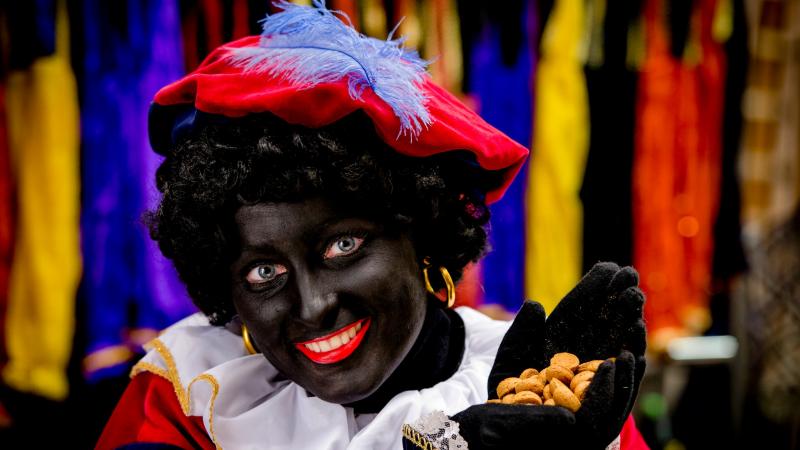
Across the Netherlands and Belgium, celebrations in which Saint Nicholas rolls into town surrounded by a host of “Black Petes” have come under increasing pressure year by year from complaints about racism. Pete is usually played by a white person who paints his face pitch black, dons a frizzy wig and gives himself bright red lips — stereotypes that disappeared from most countries decades ago.
A Black Pete taking part in the festivities
Sint-Niklaas with a church and statue honoring the saint has long been one of the focal points of the celebrations. A grand entrance this Sunday is expected to bring tens of thousands of kids flocking to the “home of the saint.”
Yet even in this bastion of saintly tradition, questions are starting to be asked about Black Pete.
Wouter Van Bellingen remembers how, as a black kid growing up in mostly white Sint-Niklaas, he used to be taunted with chants of: “Look, there goes Black Pete.”
“Kids can be hard when it comes to that,” said the former Sint-Niklaas alderman and current director of the region’s Minorities Forum. “I retorted with ‘there goes White Pete.’ I always had my answer.”
Around this time of year, Saint Nicholas visits hundreds of villages in Belgium and Holland, arriving by steamer or on his white horse to the delight of shrieking kids across the two countries. The Black Petes do everything from carrying presents to throwing sweets at the kids and generally prancing about until Saint Nicholas day on Dec. 6.
The Dutch cheese capital of Gouda has come up with a strategy for reconciliation. Black Petes will walk side-by-side with yellow-colored “Cheese Petes,” a nod to the city’s most famous products but also a concession to critics of Black Pete. In another sign of changing times, the daily Dutch children’s television report on Saint Nicholas’ travels also featured White Petes on Thursday night.
Black Pete has evolved over the years. A quarter century ago, Black Pete was a scary character, carrying a big bag to hold naughty kids and a whip to punish the disobedient. Promoting him in recent years as a happy-go-lucky sidekick full of quirky madness has helped him to compete in popularity with Saint Nicholas himself.
“The last few years, Pete is at least as popular. Kids cling to him, ask him questions, hold his hand,” said Raf Rumes, the secretary of the Flanders Saint Nicholas Guild.
In another new touch, almost half of the Petes greeting kids in this town’s Saint Nicholas “mansion” — a yearly holiday attraction — are played by women. At the fun house, which reopened this week for a month-long run, children squealed as female Petes showed them Saint Nicholas’ dining room and sleeping quarters for all of the Petes.
But efforts at softening Pete’s image have failed to subdue bad blood between the pro- and anti-Black Pete camps in the Netherlands, where resentments over immigration have simmered for years. Liberals want to abolish the tradition, while the right-wing firebrand Geert Wilders and his anti-immigration Freedom Party have proposed legislation that would keep Pete black — by law.
“There is a war underway against Black Pete,” said Martin Bosma, the party’s culture spokesman. “Ministers and mayors are working to give this loyal helper another color. That must not happen. Our culture should not be damaged from on high. This law must protect Black Pete.”
Last year, more than 2 million people endorsed a Facebook petition to keep Zwarte Piet’s image unchanged. That’s nearly one-eighth of the entire Dutch population, indicating the depth of emotion over the issue.
But Van Bellingen insists democracy is not about numbers alone.
“It is about the will of the majority and the rights of the minority,” he said. “As a majority you have to be sensitive and show empathy for things that are hurtful to a minority.”
Van Bellingen agrees with Rumes that children should take center stage in the festivities — just without Black Pete.
“Saint Nicolas is a great celebration in itself,” he said. “Only, I think you need to get rid of Black Pete to turn it into a party for everyone.” – AP
A recent statement by the FW de Klerk Foundation in Cape Town after the Constitutional Court’s finding in the Renate Barnard affirmative-action case, said that “[the judgement] is, in effect, a prescription for, and validation of, harmful discrimination against millions of South African citizens for an indefinite period, on no basis other than their race – and with no reference to their individual merits, circumstances or concerns”.
Legalised “positive discrimination” against South African whites is now a fact of life, as is the growing racial nationalism of the country’s blacks. “Africa for the Africans” is the underlying slogan in South Africa, by which we must understand “African” in a racial sense. Many of South Africa’s radicalised black intellectuals and celebrities affirm that every African has the right to cross the border and settle in South Africa, but that whites “belong to Europe”.
Buy Dan Roodt’s new ebook essay for only $3 or R30.
In essence, what black racial nationalists assert is that Afrikaners have not naturalised after 360 years in the country. This might have been dismissed as simple talk by blacks, if it were not supported by the courts and the political system in South Africa which effectively exclude the Afrikaner minority of all political power and influence. Outside the Western Cape, there is not even a single municipality where Afrikaners have any say in how their taxes are spent, let alone a province or the central government.
Objectively speaking, Afrikaners have been disarmed, disenfranchised, culturally marginalised and now find themselves in the position summed up by the Canadian political scientist, Heribert Adam, as an “internal diaspora” in South Africa. Being an internal diaspora is but a few nuances removed from having the status of internal refugees.
Since 1994, criminal, political and social violence has been constantly rising in South Africa and Afrikaners have been victims of so-called “farm murders” and attacks during which they are tortured and executed in dehumanising ways reminiscent of ethnic war and ethnic cleansing. In the cities too, house robberies and interracial attacks are rising. Together with legislation all but prohibiting them from holding state and corporate jobs, it is clear that the only rational choice for Afrikaners is to leave as many have already done, emigrating to Australia, New Zealand and other countries in the British Commonwealth.
With the benefit of hindsight, both South Africa and the ex-Rhodesia were deliberately brought under the control of radical black-nationalist movements that saw no long-term future for whites in Southern Africa, notwithstanding the posturing of Nelson Mandela before the world media, which was simply meant to ensure a smooth transfer of military and police power to the ANC and the South African Communist Party.
Over the past decade or two we have seen many countries destabilised by the Western drive for “democracy”, which is usually an ill-concealed strategy to strip the target countries of their mineral wealth and other assets. In that respect, South Africa is no different to Afghanistan, Iraq, Libya, Pakistan, Somalia, and Yemen where the USA is currently fighting wars. America also has military personnel deployed in other states, including Algeria, Bahrain, Djibouti, Egypt, Israel, Jordan, Kuwait, Lebanon, Morocco, Oman, Pakistan, Qatar, Saudi Arabia, Tunisia, and the United Arab Emirates.
While Europe normally pays obeisance to the USA in its global strategy and foreign adventures, lately also seen in Ukraine where Russian commentators have accused the EU of being a “lapdog” of the USA, the Old Continent carries a heavy responsibility for the destabilisation of Southern Africa. Instead of finding a compromise between the various peoples and interest groups in this part of the world, European states have consistently supported the most radical, anti-white, quasi-Marxist revolutionary groups. The rise of Malema and the Economic Freedom Fighters in South Africa portend exactly the same future for South Africa as the present Zimbabwe, with the confiscation of white-owned farms, urban property and other assets.
As in Gabriel García Márquez’s famous novel, Chronicle of a Death Foretold, we know exactly what the outcome is going to be: the ethnic cleansing of Afrikaners from South Africa, with or without even more violence than we are experiencing at present from the marauding, anomic killers that prosper under the ANC government’s policy of laissez-faire and a gradual descent into general lawlessness.
At least five European states may be held accountable for Afrikaners’ becoming a stateless people: Sweden, Norway, the Netherlands, (East) Germany and our former colonial power, the United Kingdom. They financed and supported, also through propaganda and diplomatic means, the African National Congress and South African Communist Party, knowing full well that these were radical, revolutionary movements that would ultimately “chase the whites into the sea” as had occurred in several other African states, notably the Belgian Congo (currently the DRC), Algeria, and the Portuguese colonies such as Mozambique and Angola.
It is telling that, after finally seeing the writing on the wall, albeit 20 years too late, the FW de Klerk Foundation has just launched an appeal to the “international community” in trying to stem the devastating effects of permanent affirmative action upon a politically powerless minority. According to the FW de Klerk Foundation, “We must make it clear that we are not prepared to accept a status as second-‐class citizens.”
Clearly, De Klerk merely followed European and particularly British dictates twenty years ago, in the optimistic belief that there would be some kind of Western or European “veto” in the future if things had to go wrong. However, with so many countries being destabilised by American wars, the international community would simply regard South Africa as yet another casualty of internal divisions without acknowleding the key role played by Europe in setting what used to be an organised Western-style industrial state on the road to radicalism, revolution and ethnic cleansing.
There is an expression in Afrikaans, gedane sake het geen keer, which is more or less equivalent to the English “no use in crying over spilt milk”. Afrikaners will never rule South Africa again and the country is living through a miniature “decline of the West”, with long-forgotten African beliefs and superstitions displacing Christianity and even the secular, scientific thought of the European Enlightenment. Mbeki’s so-called AIDS denialism was but one, highly publicised challenge to science which is also taking place in many other fields.
South Africa, like Zimbabwe, has been broken and it will never be fixed, unless there takes place such a vast conceptual revolution in the world which makes possible another basis for political power besides sheer numbers and demography, but there are very few signs of such a development. In truth, no-one cares about the fact that Zimbabwe has gone from bread basket to basket case, and neither does anyone care that South Africa is slouching towards the same fate.
The only question that remains is: What is to become of the Afrikaner people? We started life out here in this colony almost four centuries ago as either refugees from Catholic France or as indentured employees of the Dutch East India Company. Today and once more, we have become at best a stateless people or “minority at risk”, holding South African passports but without any say in government, in our schools, universities, municipalities or other institutions from which we are being increasingly displaced. Everywyhere, we are subjected to a rapidly intensifying racial quota system and our children hardly have the right to study, let alone to find work within the state or corporate sector. At worst, we are already internal refugees and unlike the Portuguese of Angola or Mozambique, or even the white Rhodesians, we do not have the luxury of holding European passports. In a certain sense, having destroyed or at least destabilised our heimat, Europe does not want us back.
The behaviour of Europe could perhaps be compared to that of a man burning down his brother’s house and then refusing him shelter afterwards. Being the victims of European and American geopolitical scheming and social engineering, we do not have any form of recourse as to the consequences of their destructive designs. It was also cleverly done by means of indigenous proxies or “exiled” ones, so it is going to be difficult to prove European mischief in destabilising South Africa.
Even though we speak a variant of seventeenth-century Dutch and Low German, that former lingua franca of Northern Europe from 1300 to 1600 when the Hanseatic League held sway, we have long since ceased to think of ourselves as Europeans. We named the standardised form of our language “Afrikaans” in honour of our adopted continent, that same continent which is now rejecting us in the name of the slogan, “Africa for the Africans”, understood in a racial and cultural sense. The paradox is that the anglicised or americanised African speaking English, but racially African, is able to stigmatise the white Afrikaner as a foreigner, an interloper, despite the fact that our cultural roots in this place are deeper and more ancient than his.
However, Europe too, although it does not seem to accept the principle of “Europe for the Europans”, also enthusiastically supports the notion of “Africa for the Africans”. Most European companies apply discrimination against indigenous whites with alacrity, as it is the law of the land.
Given the continuing African population explosion, with the continent’s population set to rise to 2,5 billion in the next 30 years, the demographic pressure on us is going to be relentless, added to all the other pressures such as the violence and institutionalised discrimination. What kind of racial quota do you get by the time that you constitute only one or two percent of the population? A percent or nothing?
During the call for sanctions against South Africa during the 1980s, Mrs. Margaret Thatcher opposed it on the basis that up to a million whites from here had British passports and could therefore swell the ranks of British unemployed. Presumably the same million whites of British descent could still return to the United Kingdom, like the Portuguese from Africa did or the French pieds noirs from Algeria. But what about us, descendants of the French Huguenots, the Dutch, the Flemish and the Northern Germans whose forgotten trading language from centuries gone by we still speak, write and school our children in?
If all else goes wrong, as increasingly seems likely, do we not have the same right of return as the British, the Portuguese, the pieds noirs or the Belgians, even though we are technically “non-Europeans”?
Will Europe, as it welcomes the Syrian, Iraqui, Afghan and other refugees from destabilised countries where the Anglo-Saxon oil wars have played themselves out, reject us, despite being its own flesh and blood? Not only that, but we are truly the victims of the European political junkyard dumped on South Africa, with its Swedish theory of the melting pot, of multiculturalism, of communism, of white guilt and the rest.
In more senses than one, Afrikaners are a problem of Europe’s making.
In just three months, on November 30, the Swiss will vote in a federal referendum on the future of the country’s gold reserves.
The referendum has arisen through a popular initiative called ‘Save our Swiss gold initiative’. In Switzerland, citizens can propose changes to the Swiss constitution through a mechanism called a popular initiative, even if parliament is against the proposal.
The ‘Save Our Swiss Gold’ initiative is set to highlight the important issue of sovereign gold reserves and who has possession and controls them. It may lead to an important debate about each country’s national patrimony and their gold reserves.
The ‘Save Our Swiss Gold’ initiative is proposing the following:
– rules to prevent the Swiss National Bank (SNB) selling any more of the country’s gold reserves
– to direct that the SNB must keep a minimum of 20% of its reserves in gold, and
– to require that all Swiss gold must be stored in Switzerland.
This would require repatriation of Swiss gold since some of the Swiss gold reserves are stored abroad.
The Swiss National Bank (SNB) are against the proposal but were forced last year, in reaction to the popular campaign, to reveal the storage locations of the Swiss gold.
In April 2013, Thomas Jordan, SNB President, confirmed that 70% of Switzerland’s gold is in Switzerland, 20% is at the Bank of England, and 10% is stored with the Bank of Canada, and that this mix of holdings had been in place for more than a decade.
Since the Swiss hold a total of 1,040 tonnes of gold reserves, this would mean that there are 104 tonnes of Swiss gold at the Bank of Canada and 208 tonnes in the Bank of England. Jordan’s explanation of the foreign gold storage was that it provided “adequate regional diversification and good market access”.
Since the Bank of England specialises in the custody of gold on behalf of numerous foreign central banks, it’s not surprising then that the SNB stores gold at the Bank of England.
What is surprising is that the SNB still holds gold at the Bank of Canada, since the Bank of Canada is a legacy custodian of other countries’ gold and appears to have stopped storing other nations sovereign gold in recent years.
When the Bank of Canada was asked earlier this year as to how many foreign central banks it acts as gold custodian for, it confirmed that it currently acts as gold custodian for only four foreign central banks, but that due to confidentiality, it was unable to disclose the identity of the national account holders.
However, its known from other sources that both the Netherlands and Sweden also hold some of their gold reserves at the Bank of Canada.
The Federal Reserve Bank of New York holds 1,536 metric tons of German gold, nearly half of Berlin’s reserves.
This enormous hoard of gold is stored in the fifth subfloor of the bank’s building on Liberty Street, 25 meters
80 feet) below street level, and 15 meters below sea level. Or is it? The Germans want to know and
want it back, as do the Swiss and other nations.
The Dutch central bank, De Nederlandsche Bank, has stated previously that most of its gold reserves are held at the Federal Reserve Bank in New York, the Bank of England, and the Bank of Canada, with less than 10% stored in the bank’s own headquarters in Amsterdam.
The Swedish Riksbank has also stated recently that its gold is stored in a number of foreign locations, such as the Federal Reserve, the Bank of England but also the Bank of Canada.
The identity of the 4th foreign central that stores gold at the Bank of Canada is unclear, but it may be the Bank of England or the Federal Reserve, since both banks historically held gold accounts with the Bank of Canada.
Given that Canada sold nearly all of its own substantial gold holdings a number of years ago, it seems like an anomaly that the Bank of Canada in Ottawa is still holding gold on behalf of other countries. Most countries that had held gold in Ottawa repatriated it long ago.
Citizens of Switzerland, the Netherlands and Sweden should be concerned that some of their nation’s gold is in custody with a bank that is no longer a specialist in gold custody and that did not even see fit to maintain its own gold reserves.
They should also be concerned about the secrecy and lack of transparency regarding their gold, especially given that the Bank of Canada’s remaining custody gold has recently been moved to an unknown destination.
The Bank of Canada’s headquarters on Wellington Street in Ottawa is currently undergoing an extensive multi-year renovation which required the Bank to vacate the building last year, and empty it’s entire contents, including the gold stored in the subterranean vault.
Whatever gold was still in the vault, that runs from Wellington Street on one side of the building out as far as Sparks Street on the other side, has now been relocated elsewhere.
Where the gold has been moved to is unknown since the Bank of Canada won’t comment.
The upcoming Swiss gold referendum will be very interesting and will highlight and focus minds on why the SNB vigorously defends the need to keep some of its gold reserves in Canada, especially given that the Ottawa gold is now on the move.
Owning allocated and segregated physical coins and bars is best in Hong Kong, Singapore and Zurich, investors say.
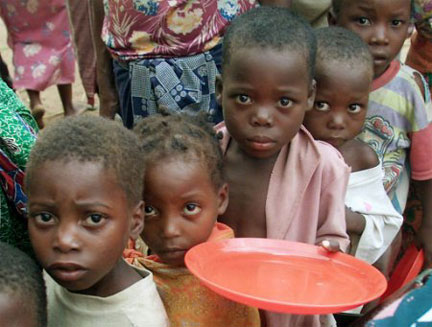
Africa’s population is set to double to more than 2.4 billion over the next few decades due to improved health care and medicines, a new study found.
Sub-Saharan Africa – the world’s poorest region – will record the largest amount of population growth of any area in the world between now and 2050, according to the Population Reference Bureau (PRB).
But the massive baby boom could put huge strain on resources and fledgling economies in some of the world’s most deprived areas, the PRB warned.
And the projected growth in population assumes that family planning will become more widespread in regions where, for religious or cultural reasons, contraception has not been widely adopted.
The 10 countries worldwide with the highest fertility are all in sub-Saharan Africa.
Today, women in sub-Saharan Africa average 5.2 children, a rate that rises as high as 7.6 in Niger.
And improved access to medicine and health care mean millions more of these children will now survive to adulthood.
Wendy Baldwin, the organisation’s president and CEO, said: “Nearly all of that growth will be in the 51 countries of sub-Saharan Africa, the region’s poorest.
“Rapid population growth makes it difficult for economies to create enough jobs to lift large numbers of people out of poverty.”
In addition to high birth rates, the region’s population is also quite young, with 43 percent of the population below age 15.
Carl Haub, senior demographer and co-author of the data sheet, said: “Given its youthful population, future population growth in Africa will depend upon the degree to which the parents of tomorrow use family planning.
“The projections that we cite assume that family planning will become more widespread. If not, Africa’s population will grow more rapidly, further constraining efforts to address poverty, create jobs, and protect the environment.”
This year’s Data Sheet provides detailed information on 20 population, health, and environment indicators for more than 200 countries, and has a special focus on wealth and income inequality.
Developing countries tend to have wide income gaps between rich and poor that are associated with dramatic differences in fertility and health.
In Uganda, women from the poorest fifth of families have twice as many children as those from the wealthiest fifth.
And children from the poorest families are much more likely to die before turning 5 than their counterparts in the wealthiest families.
PRB’s 2013 World Population Data Sheet shows the stark contrasts between rich and poor countries, illustrated by comparing Niger and the Netherlands.
The demographic divide: Niger and Netherlands
Niger Netherlands
Population (2013): 16.9 million 16.8 million
Projected Population (2050): 65.8 million 17.9 million
2050 Projected Population as a Multiple of 2013: 3.9 1.1
Lifetime Births per Woman: 7.6 1.7
Annual Births: 845,000 176,000
Annual Deaths: 195,000 141,000
% of Population Below Age 15: 50% 17%
% of Population Ages 65+ (2013): 3% 16%
% of Population Ages 65+ (projected 2050): 3% 27%
Life Expectancy at Birth (all): 57 years 81 years
Infant Mortality Rate (per 1,000 live births): 51 3.7
Annual Number of Infant Deaths: 43,000 650
Even though the two countries have almost the same population size today, Niger is projected to nearly quadruple its population from about 17 million today to 66 million in 2050. The Netherlands’ population will likely grow very slowly from 17 million to 18 million over that same time.
At the root of this “demographic divide” are differences in the average number of births per woman and the share of the population in their childbearing years.
Niger’s total fertility rate of 7.6 lifetime births per woman is more than four times the Netherlands’ rate of 1.7 per woman.
One-half of Niger’s population is younger than age 15, compared with 17 percent of the Netherlands’ population. – Daily Mail
Ever since Nelson Mandela died, but even before, one was utterly flabbergasted before the intensity of media fervour pouring out en hommage to the Big Man. In Africa, of course, there are all kinds of theories about Big Men, some more politically correct than others. The tribal elder meets the Soviet personality cult, and we get Idi Amin Dada. Or Charles Taylor. Or Robert Mugabe.
If there is one thing I can stand even less than African Big Men, it is British journalists convulsing on the ground in effusive praise of them. Who still remembers the blasts of praise from Fleet Street when Mugabe assumed power in the ex-Rhodesia? For much of the past ten days while South Africa lit the long-awaited Big Candle, visible from outer space without a doubt, we had to endure near-hysterical outpourings exalting the deceased ex-terrorist. One such scribe from the island north of the Continent – I forget which, there were so many this week – wrote: “Mandela could have been president for life but he chose to stay a single term, for the sake of democracy in Africa!”
Democracy in Africa. Oh, yes. If Mandela’s successor at the helm of this decaying country, Thabo Mbeki, were to be believed, democracy was invented in Africa. No less. The point is that there is now such an Afrocentric phantasmagoria, cultivated in Britain and the United States, that anything is now possible, even Mbeki’s “African century”. The notion that Africa will come to dominate the globe economically, politically and militarily, was first articulated by another African Big Man, born Joseph-Desiré Mobutu but whose full regal appellation afterwards became Mobutu Sese Seko Kuku Ngbendu wa Za Banga.
Novelist V.S. Naipaul wrote somewhat ironically about Mobutu’s dreams of impoverished Europeans beseeching African countries for much-needed aid in 2000. Yet the notion of Nelson Mandela being “the greatest leader of the twentieth century” and voted as the most respected global leader in at least one poll. must inspire some doubt in Naipaul himself. Contemplating the “transformed” inner city of Johannesburg in our postapartheid paradise, Naipaul wrote in The masque of Africa:
It sent my mind back to other places of dereliction and ruin I had seen: the wartime rubble of East Berlin kept as a monument in the communist days. But it seemed easier even in the bad days for that part of East Berlin to be rebuilt than it would be for the half-life of this part of Johannesburg to be restored to something like its original meaning. Where would one begin? One would have to begin with the idea of the city, the idea of civilisation; and already, before one had even begun, one would be swamped by protest.
There were further discoveries to be made within that new slum. A sturdy old warehouse had been given over to new merchandise, which would have been like a parody of what had been here. It was a market of witchdoctors’ goods, and it was extensive. These were the muti goods that witchdoctors required their customers to get, to be used by the witchdoctor as he pleased, usually to make medicines, which the unfortunate bewitched man or woman had to drink.
I have often thought that Mandela had bewitched a good portion of the Anglo-American ruling class that in turn infected the stupid Europeans who are progressively losing the capacity for independent thought. All this talk of “Madiba magic” might be code for some supernatural, Harry Potter-like influence.
As everone knows, some forms of muti are taken as a cure for an evil spell, while others are used precisely to bewitch the victim. A black man who has designs on a woman who is rejecting him could buy some muti from a sangoma to ensure that she falls in love with him.
In Europe, Nietzsche and others wrote about the “twilight of the idols”. However, in Africa the idols are thriving, with the messianic Mandela being the biggest idol of them all. It seems only a few cantankerous Christians still refuse to bow to him, but not the Clintons, the king of the Netherlands or Barack Obama. Even George W. Bush came as a pilgrim to South Africa this week.
During his speech at Soccer City on the outskirts of black Soweto, Obama cast himself in the role of Mandela’s understudy, a humble disciple to the famous Xhosa.
I suppose in the days of the Roman Empire, people were also nonplussed about the seemingly inexorable rise of a strange new cult, Christianity. In the face of global grief over Mandela’s “exchanging the temporary for the eternal”, as the local Afrikaans saying goes, most mainstream conservatives have joined in eulogizing Mandela. British PM David Cameron, who had wanted to “hang Mandela”, together with other Young Conservatives, reacted to Mandela’s death with:
A great light has gone out in the world. Nelson Mandela was a hero of our time.
The normally truculent George W. Bush who had unleashed a war on other terrorists had only kind words for the man who had co-authorized the Church Street and Amanzimtoti bombs:
President Mandela was one of the great forces for freedom and equality of our time. He bore his burdens with dignity and grace, and our world is better off because of his example.
How do we explain such empathy, nay admiration, for a card-carrying member of the South African Communist Party in so-called Western conservative leaders? After all, I cannot recall similar expressions of sorrow when Georges Marchais of the French Communist Party or the East German stalwart, Erich Honecker, expired in 1997 and 1994, respectively.
The answer is that, unlike the venerable European leftists Marchais and Honecker, who had also waged a life-long struggle against fascism and racism – both leaders were among Mandela’s staunchest allies – Comrade Mandela assuages white guilt.
Susan Sontag’s notorious adage, that “the white race is the cancer of human history”, has become almost an official doctrine in the United States and Great Britain, eagerly emulated by the hapless Europeans. Few people have written about this phenomenon, except French “new philosopher” Pascal Bruckner who published two books about it, aptly entitled The tears of the white man: compassion as contempt and The tyranny of guilt: an essay on Western masochism.
Throughout the past week, here in South Africa and elsewhere, whites indulged in moral self-flagellation. A Dutch journalist, resident in South Africa, declared apropos of Mandela as symbol: “We had 40 years of apartheid, but 400 years of colonialism.” I daresay, four hundred years will not be enough to atone for the sins of colonialism and apartheid.
Probably I have referred to this process before, but one of the most repulsive aspects of white, Western guilt, is how South African whites in general, and Afrikaners in particular, have been made into literal scapegoats for it. Every time one of us gets murdered, raped or tortured under the mayhem that Mandela’s ANC regime has brought to South Africa, the West’s burden is proportionately leavened.
For all the odes to Mandela’s “wisdom”, sense of politics and so on, most of his public pronouncements consist of commonplaces and homilies befitting a school boy of very young age. His listeners melt away in awe when he says: “Let bygones be bygones.” His theatrical, even cheap and calculated trick of putting on the Springbok rugby jersey in 1995 is praised as a stroke of genius.
Buy Dan Roodt’s book through Amazon.com
Many Afrikaners have experienced this from Western whites. To them, nothing that we can say, write or compose is even remotely interesting. The handful of modern Afrikaner composers are arguably among the most creative and interesting in the world, yet their music is almost completely unknown. Afrikaans poetry is arguably among the best, even compared to that in much larger languages, yet besides Afrikaners and a few Flemings, no-one has ever taken cognisance of its existence. White guilt excludes the recognition of white talent, especially in the ranks of other “guilty” whites.
Once a young, blonde woman from here recounted to me how she was sent to a European country on a scholarship, together with a black counterpart. Although attractive, intelligent and educated, her European hosts evinced a degree of disinterest in her bordering on rudeness. Despite having been born and bred in Africa, she was white and therefore deemed to be just some displaced European like themselves. The exact opposite behaviour was de rigueur when it came to her fellow black student. She was seen as an object of immense fascination and hidden wisdom, almost like Mandela. Every white European in her presence smiled broadly, addressed her in overly polite terms and posed unending questions about her past and her upbringing. In the same way, the fact that Mandela had herded cattle as a boy according to Xhosa custom arouses far more curiosity than the pedestrian upbringing of some white in Pretoria who learned the cello and read Greek myths and Grimm’s fairytales as a child.
It is as if whites have taken on the behaviour of blacks described by black revolutionary, Frantz Fanon in Black skin, white mask:
The black man has two dimensions. One with his fellows, the other with the white man. A Negro behaves differently with a white man and with another Negro. That this self-division is a direct result of colonialist subjugation is beyond question…
After his organisation had placed bombs on city sidewalks, in bars and restaurants and killed thousands of blacks in internecine power struggles, including by the infamous necklace method, Mandela was praised for preaching moderation and “reconciliation”. Mandela presided over hordes of sadists wantonly looting, burning and killing their fellows. Such incidence of violence and destruction was, as usual, reinterpreted and recoded by guilt-complexed white journalists and pundits as being pleas for democracy and togetherness. Or free housing, affirmative action and racial quotas in sport, all of which South African blacks deserve in copious amounts, as liberals and leftists clamorously assure us. Of course, riots, violence and sadism continue unabated in South Africa, but because there is now a black government and the perpetrators of such violence are black too, any criticism of such behaviour is expressed in muted tones, if at all.
The Western world expected of South African whites to commit political suicide, which they meekly did. De Klerk and his National Party’s vague dreams of power-sharing came to nought and the former so-called Afrikaner leaders are too embarrassed to admit their abject failure in securing any kind of reasonable future for their constituents.
The corollary of white surrender in South Africa has been the sudden birth of a ready-made black state, a kind of African dream. Whites have been simply pushed aside and most of the state, industrial and mining apparatus taken over by blacks and those communist whites having clearly demonstrated their loyalty to the ANC and SACP through participation in terror and sabotage.
Through the sheer effects of the vast propaganda campaign conducted around Mandela and the apartheid stereotype, many people assume that prior to 1994 South Africa had been as backward as Burkina Faso or Malawi where locals subsist on slightly more than a dollar a day. It is routinely supposed by outsiders that under white rule there were hardly any schools or universities, except ones reserved for whites where they were taught some form of Nazi/racist doctrine. Presumably the roads, multi-storey buildings, concrete bridges and highways, hospitals and more than twenty universities were constructed by Mandela himself or those in his immediate entourage. After all, as the BBC journalists and others in the know assure us, he was the “father of modern South Africa”. A miracle worker, indeed.
Many whites in Europe and North America feel extremely uncomfortable about the fact that Africa is so backward and poor – “underdeveloped” – compared to other continents and regions of the world. European colonialism is usually blamed for this state of affairs, except that it has endured under African rule since the early nineteen-sixties. Also, countries like Haiti, Liberia and Ethiopia that have been independent of white rule for centuries, have not fared any better. Both Liberia and Ethiopia are classified among the poorest countries in the world, with Haiti – “the world’s first black republic” as Thabo Mbeki called it – being not only among the world’s poorest, but also the poorest country in the western hemisphere. Eighty percent of Haitians live under the poverty line and fifty-four percent in abject poverty. According to the Red Cross, seven out of Haitians survive on less than US$2 per day.
However, thanks to the “miracle” brought by Mandela and his backers in the ex-Warsaw Pact countries, as well as the UK, the USA, Sweden, Norway and the Netherlands, everyone may now point to a successful “black state”, the Republic of South Africa. Even the names of towns and cities founded by Afrikaner pioneers are changed to Bantu ones to make them “more African”, completing the illusion of black engineering, scientific, architectural, financial and economic success.
It is no wonder that FW de Klerk is so popular in the West and was cheered in Soweto this week. He had his own people subjugated and their hard-earned assets taken away so that not only South African blacks could feel better about themselves, but in order that the white man shedding tears over his guilt in Western Europe and North America could breathe a sigh of relief.
In a real sense, Mandela and his myth are the muti of the West. But his fame and glory come at a terrible price: the disenfranchisement of the white minority, the hijacking of their public and private assets, as well as their ultimate expulsion from their fatherland as in the Zimbabwean example.
Unless South African whites are able to shake off the stupor in which they find themselves as a result of their decades-long brainwashing into left-extremist illusions by the viciously lying Western media, their ultimate fate will be far more tragic than that of their Zimbabwean counterparts. as many more will be killed than are already dying in the ubiquitous farm murders and suburban house attacks.
The indigenous Afrikaners are now seen as foreigners in the country they had built, together with – ironically – the illegal immigrants from other African countries who are also randomly massacred by South African blacks in so-called “xenophobic attacks”.
All those Africans elsewhere on the continent who cheer Mandela for his “victory over the hated whites” should be aware that Mandela’s followers would kill you too, if ever you set foot here.
While the West and its media perverts will maintain its silence over such atrocities.
Lodewijk Asscher, deputy prime minister of the Netherlands, this month warned that migration from eastern Europe threatened his country’s wages and social welfare policies.
In his home country Bulgaria, Viktor, a logistical engineer, earned €350 a month as head of an emergency response unit at the national railway company. In the Netherlands, he works as a handyman, making up to €100 cash a day – less than his Dutch counterparts – and paying no taxes or social insurance.
The Netherlands, Britain and several other western European countries have maintained work permit requirements for Bulgarians and Romanians since they joined the EU in 2007. But even with that restriction, there has been a steady rise in immigration from those countries. Those requirements will expire on January 1, intensifying fears about a further rise in immigration and what this could mean for wages and services.
Mr Asscher compared the situation with a “Code Orange”, the warning Dutch authorities issue when high water levels threaten to overwhelm the dikes.
Sitting in his sister Maria’s smoky kitchen in a heavily eastern European neighbourhood near Amsterdam, an immigrant Viktor however said such concerns are overblown. “There are only seven million people in Bulgaria, and two million have emigrated since the fall of communism. Most of the people who want to leave have left already,” he said.
The Netherlands once boasted of its history as an asylum for immigrants, such as the refugee Jews and Protestants who flocked there in the 16th century.
But over the past decade, it has been wracked by debates over assimilation, with the rightwing populist Geert Wilders denouncing the country’s Muslim immigrants, mainly ethnic Moroccans and Turks. More recently he has turned his fire on immigrants from eastern and central Europe, setting up a controversial website last year to solicit complaints about their behaviour.
Such attacks play on fears that eastern Europeans are prone to crime and compete for Dutch jobs, driving down wages, particularly for unskilled labour.
With the Netherlands in the midst of a year-long recession and unemployment up from 4.4 per cent in 2010 to 7 per cent, such concerns have sharpened.
The government, a coalition between the centre-right Liberals of Prime Minister Mark Rutte and Mr Asscher’s centre-left Labour party, has mainly played down the immigration issue. But with polls showing the Socialists and the Freedom party pulling ahead, they are starting to feel the pressure.
The numbers of eastern Europeans in the Netherlands have indeed grown rapidly since EU expansion. Since 2005, the official Polish-born population in this country of 17m has more than doubled to 110,000, while the Bulgarian and Romanian communities have quadrupled to a combined 30,000.
Such figures count only those immigrants who have officially registered as residents; unofficial residents may add another 50 per cent to those figures.
Most economists think such immigration is a boon to the economy. A recent study by the Dutch think-tank SEO Economic Research found that labour migration from eastern Europe was mainly temporary, and that it had little or no effect on local employment or wages while contributing a net €1,800 a head to the government treasury.
But that study assumed that employers who hire foreign workers observe Dutch labour law, including the national sector-wide wage agreements between employers and unions.
“On the big energy plant construction projects we researched in the north, we found that scarcely any firms were sticking to the wage agreements,” said Herman Pol, an organiser for the main Dutch metalworkers’ union. Contractors, he said, typically won bids with offers that required them to undercut wage norms by several euros an hour.
Europeans are braced for a new age of austerity as governments across the region take action to eliminate unsustainable budget deficits
There is no realistic chance that the government will maintain work permits for Bulgaria and Romania after January 1, as it would explicitly violate EU law.
“The end of the work permission won’t be a big difference,” said one immigrant, who plans to return to Bulgaria in a year or two anyway. “Whether you have a permit or not, the main question is, where can I work?” – FT
Prince Friso of the Netherlands will be buried Friday in the municipality of Baarn, the royal house said Tuesday in the Hague.
The younger brother of King Willem-Alexander died Monday at the age of 44, one and a half years after he was buried by an avalanche in Austria and fell into a coma.
Friso’s mother, Princess Beatrix, was born at Soestdijk Palace in Baarn, and Friso went to school in the small town near Utrecht.
The Dutch royal family gathered at the Huis ten Bosch palace in the Hague, where Friso lay.
There were broadcast images of Beatrix, Willem-Alexander and Queen Maxima in front of the palace. Friso’s widow, Princess Mabel, and her daughters Luana, 8, and Zaria, 7 were seen in the palace gardens.
Dutch citizens came to the palace to leave flowers, and thousands also posted messages of condolence online.
“It is a small token of compassion,” a young man said as he handed over a bouquet of lilies to a palace official.
An elderly lady said about Friso’s death: “We all had expected this, of course. But it still came suddenly.”
The prince died of complications following the severe brain damage he suffered in February 2012, when he was buried under an avalanche while skiing in Lech, the Austrian resort where the Dutch royals traditionally spend their winter holidays.
The town of Lech announced that it would honour Friso in its annual mass on the Catholic Assumption holiday on Thursday, an event that takes place on an Alpine mountain pasture. – Sapa-dpa
Scholars, campaigners and lawyers can for the first time readily access more than 2,200 documents from a largely unknown archive housed at the United Nations that documents thousands of cases against accused World War II criminals in Europe and Asia.
The unrestricted records of the United Nations War Crimes Commission were put online in early July by the International Criminal Court after an agreement with the U.N., a move spurred by British academic Dan Plesch, who has been leading the push for greater access to the archive. The documents relate to more than 10,000 cases.
Plesch said Friday that following his research at the archive in New York he was invited to give a guest lecture on the War Crimes Commission at the International Criminal Court in The Hague, Netherlands, in March 2012 by Hans Bevers, the head of the prosecutor’s research office. Bevers suggested the ICC might be interested in obtaining the archive and Plesch said he put him in touch with the U.N. office that manages the archives.
“It was a happy coincidence of him doing research here, him doing research there, and the ICC wanting to put as many archives as possible online,” U.N. chief archivist Bridget Sisk said Friday.
“Our goal is to make available as widely as possible open archives of the organization,” she said. “The collaboration with ICC adds to the world’s permanent war crimes tribunal the historical record in international criminal justice.”
U.N. spokesman Martin Nesirky said putting the unrestricted part of the archive online “will greatly enhance the availability of these materials to those engaged in research into the development of international criminal law, as well as to researchers from other academic disciplines.”
The War Crimes Commission was established in October 1943 by 17 allied nations to issue lists of alleged war criminals – ultimately involving approximately 37,000 individuals – and examine the charges against them and try to assure their arrest and trial.
The commission was shut down in 1948, three years after the now 193-member United Nations officially came into existence. In 1949, the U.N. Secretariat drew up rules making the archive available only to governments on a confidential basis. In 1987, limited access was granted only to researchers and historians.
Plesch and his colleagues continue to seek access for researchers to the still restricted sections of the files, which he said contain some 30,000 sets of pre-trial documents submitted to the commission by national and military tribunals to judge whether the case should be pursued.
“These files contain details of many charges of crimes that are not being prosecuted extensively today, including rape and forced prostitution, and crimes by ordinary soldiers,” Plesch said.
He said that following representations by his team to the U.S. State Department, the U.S. Holocaust Memorial Museum, which is a federal agency, is pursuing access to the commission’s entire archive – hundreds of thousands of pages in 400 boxes.
The International Criminal Court said more than 2,240 documents, totaling 22,184 pages, with search data for each document, have been added to the ICC Legal Tools Database.
The records include meeting minutes and other documents from the commission and its subordinate bodies as well as “a small but wide-ranging portion of the war crimes trial reports sent to the commission by national authorities” from Australia, Canada, China, Czechoslovakia, France, Greece, the Netherlands and Norway, the ICC said.
Research on the War Crimes Commission conducted by Plesch and colleague Shanti Sattler will be presented at a conference Sept. 10-11 at the University of London’s School of Oriental and African Studies where Plesch heads the Center for International Studies and Diplomacy. The conference is supported by the International Bar Association and will be chaired by South African Judge Richard Goldstone.
A Dutch political party has demanded action from the Dutch Cabinet in support of the retention of Afrikaans street names in Pretoria.
“The Netherlands Embassy situated in Queen Wilhelmina avenue should refuse to accept a new name,” the “De Partij voor de Vrijheid” (the Party for Freedom), PVV, said in a statement issued in The Hague on Wednesday.
The suggestion was contained in a parliamentay question to Dutch deputy minister Halbe Zijlstra on Wednesday.
Zijlstra was asked if he was aware of the planned name changes and whether he thought the plans were a “slap in the face of the Dutch royal family”.
The PVV said the ANC planned to change 27 Pretoria streetnames, including Beatrix street and Queen Wilhelmina avenue.
Many of the names were a reminder of the anti-colonial struggle of the independent Boer republics against the British empire, the statement said.
“The name Queen Wilhelmina avenue is an ode to the young queen who in 1900 dispatched a Dutch warship to fetch a beleaguered President Kruger,” PVV parliamentarian Martin Bosma said.
Other street names commemorating historical characters were “Voortrekkers” with Netherlands backgrounds who helped establish Pretoria, the PVV politician said.
The PVV is a minority rightwing partner in the current governing Dutch coalition, led by the controversial politician Geert Wilders. – Sapa
PRAAG supports the call by the Dutch Freedom Party for Dutch and Afrikaner people to stand together in defending their shared cultural heritage as embodied in Pretoria’s street names.
Queen Wilhelmina is remembered for her courageous support for the Boers during the Second War of Independence when colonial Britain destroyed our country and let our women in children die in concentration camps. Similarly, Queen Beatrix did much to enhance the standing of Afrikaans culture in the Netherlands and we recall her reign as a time when warm relations existed between our two nations.
Through its name changes the ANC is embracing the worst aspects of the British colonial tradition. For the first time in history an indigenous Western nation, the Afrikaner, is being oppressed and culturally humiliated by a colonial organisation like the ANC.
We appeal to all Afrikaners and Dutch people to resist the new Lords in Munitoria and the Union Buildings.
This website uses cookies to improve your experience. We'll assume you're ok with this, but you can opt-out if you wish. Cookie settingsACCEPT
Privacy & Cookies Policy
Privacy Overview
This website uses cookies to improve your experience while you navigate through the website. Out of these cookies, the cookies that are categorized as necessary are stored on your browser as they are essential for the working of basic functionalities of the website. We also use third-party cookies that help us analyze and understand how you use this website. These cookies will be stored in your browser only with your consent. You also have the option to opt-out of these cookies. But opting out of some of these cookies may have an effect on your browsing experience.
Necessary cookies are absolutely essential for the website to function properly. This category only includes cookies that ensures basic functionalities and security features of the website. These cookies do not store any personal information.
Any cookies that may not be particularly necessary for the website to function and is used specifically to collect user personal data via analytics, ads, other embedded contents are termed as non-necessary cookies. It is mandatory to procure user consent prior to running these cookies on your website.