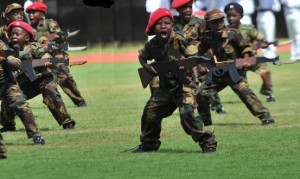
Obama okays military aid to countries with child soldiers

childsoldierAmid the hoopla of the government shutdown, the White House quietly passed a bill Monday that overrides a law banning military aid to countries that use child soldiers.

The Child Soldiers Prevention Act of 2008 prohibits the U.S. government from providing military assistance to countries that directly use, or support the use of, child soldiers. Built into the law is an option allowing the U.S. president to override the ban if he/she deems it necessary.

On Monday, President Obama issued complete waivers to Yemen, Chad, and South Sudan, opening up those countries to U.S. military aid despite their known use of child soldiers, declaring in a written memorandum it is “in the national interest of the United States” to override the ban.

Obama also granted partial waivers to the Democratic Republic of the Congo and Somalia to allow “International Military Education and Training” and “nonlethal” defense for both countries and “provision of assistance under the Peacekeeping Operations authority for logistical support and troop stipends” in Somalia. According to Think Progress writer Hayes Brown, these waivers open the door for military aid for ongoing “peacekeeping” operations in both these countries.

“Obama is becoming an expert at waiving human rights laws,” writes Ken Hanly in Digital Journal. “He waived part of a law last month that banned the US from supplying lethal aid to terrorist groups so he could send aid to Syrian rebels. In the case of Egypt, Obama has refused to call the coup by the armed forces a coup and by doing so does not run afoul of a law that would ban aid to a country where there had been a military coup.”

“Human rights are to be promoted but only insofar as they do not conflict with US national interest as understood by the president,” he added.

Meanwhile, the U.S. government has come under criticism for filling its own military ranks with hundreds of thousands of teenagers, including 17-year-olds who can enlist with parental consent. – wakeupfromyourslumber.com

Charles Taylor’s victims hail war crimes verdict

Charles Taylor in 1990

Victims of the bloody regime of Liberian warlord Charles Taylor spoke of their relief after his 50-year jail term for war crimes and crimes against humanity in Sierra Leone was upheld by an international court on Thursday.

The final verdict handed down by the UN-backed Special Court for Sierra Leone (SCSL) draws a line under a seven-year trial of the 65-year-old former Liberian president, sentenced in May last year for “some of the most heinous crimes in human history”.

“As a government, we believe that justice has been done and impunity is over,” Sierra Leone government spokesman Abdulai Bayraytay told AFP.

“The message for sitting heads of state not only in Africa but beyond is that when you are in power you must exercise it judiciously, have respect for the rule of law and human rights and uphold the dignity of others.”

Around 100 people, including human rights activists and survivors of the Sierra Leone civil war, watched a live broadcast of the ruling in the capital Freetown.

For Sullay Turay, who lost a hand and a foot to Taylor-backed rebels, the outcome “showed that no matter what you do, justice will finally catch up with you and this is what has happened in Taylor’s case.”

The former warlord, who was jailed initially for 50 years for arming rebels during Sierra Leone’s brutal 1990s civil war, is likely to spend the rest of his life behind bars, possibly in a British jail.

He sparked a 13-year civil war in his own country when he led a rebellion in 1989 to oust President Samuel Doe which deteriorated into one of Africa’s bloodiest conflicts.

His National Patriotic Front of Liberia (NPFL) earned a reputation for extreme violence, conscripting child soldiers and terrorising citizens of certain ethnic groups.

After taking Monrovia, Taylor was elected president in 1997, but violence again erupted in 1999 when another rebellion started and he lost control of much of the country, fleeing in 2003 to Nigeria.

The conflicts resulted in 270,000 deaths, with many civilians displaced and several thousand becoming victims of atrocities, according to the United Nations.

As Liberia’s president from 1997 to 2003, Taylor supported Revolutionary United Front rebels in neighbouring Sierra Leone by supplying them with guns and ammunition as they waged a campaign of terror during a civil war that claimed 120,000 lives between 1991 and 2002.

He was finally arrested and transferred to The Hague in 2006, where he was convicted in 2012 of aiding and abetting the rebels during the conflict, known for its mutilations, drugged child soldiers and sex slaves, trial judges found.

“Full justice has now been done and the victims should move on with their lives. The violations they suffered have been addressed through the judicial process,” said Ibrahim Tommy, chairman of the Centre for Accountability and the Rule of Law campaign group.

“The government now should work to strengthen the justice system and work for the socio-economic prosperity of the victims.”

Some victims of the conflict remain bitter and voiced frustration that Taylor had not received the 80-year sentence requested by the prosecution.

“Let Taylor rot in jail. I only wish he would have served his sentence in an African prison to suffer the more,” said Freetown taxi driver Andrew Lebbie.

But there was also a note of reconciliation among the crowd gathered for the ruling in Freetown.

“Forgiveness is all I would ask for. The court should have tempered justice with mercy,” said vicar Sam Fergusson.

But Taylor has never been charged for his role in Liberia’s bloody history, only that in neighbouring Sierra Leone. – AFP

Congolese warlord appeals

Thomas Lubanga

The International Criminal Court’s first convict, Congolese warlord Thomas Lubanga, on Wednesday appealed his 14-year sentence for using children in his rebel army, his lawyers said.

Former militia commander Lubanga, 51, was sentenced in July for his part in a war in the eastern Democratic Republic of Congo, where aid groups say 60,000 people have been killed in conflicts since 1999.

“The defence gives notice of appeal and asks for an acquittal,” Lubanga’s lawyers said in a document filed with The Hague-based court.

He was convicted in March of war crimes in the central African country, specifically for enlisting and using child soldiers in 2002-03, in what was the ICC’s first verdict since starting work a decade ago.

Lubanga, who has been detained in The Hague since 2006, is the founder of the Union of Congolese Patriots (UPC) and commander of its military wing the Patriotic Forces for the Liberation of Congo (FPLC).

He has pleaded not guilty to two counts of war crimes.

The ICC, the world’s only independent permanent tribunal to try genocide, war crimes and crimes against humanity has issued four arrest warrants for crimes in DR Congo since starting work in 2003.

Two militia leaders, Germain Katanga, 34 and Mathieu Ngudjolo Chui, 41, who fought against Lubanga, are currently facing trial on similar charges.

Former UPC leader Bosco Ntaganda, a Lubanga ally, is yet to be arrested to face the ICC on war crimes charges.

The ICC is investigating seven cases, all based in Africa. – AFP

Obama ignores black child soldiers

U.S. President Barack Obama, for the third year in a row, has waived almost all U.S. sanctions that would punish certain countries that use child soldiers. Most of the countries are in Africa and child soldiers are mostly black.

Late Friday afternoon, Obama issued a presidential memorandum waiving penalties under the Child Soldiers Protection Act of 2008 for Libya, South Sudan, and Yemen, penalties that Congress put in place to prevent U.S. arms sales to countries determined by the State Department to be the worst abusers of child soldiers in their militaries. The president also partially waived sanctions against the Democratic Republic of the Congo to allow some military training and arms sales to that country.

Human rights advocates saw the waivers as harmful to the goal of using U.S. influence to urge countries that receive military assistance to move away from using child soldiers and contradictory to the rhetoric Obama used in his speech.

“After such a strong statement against the exploitation of children, it seems bizarre that Obama would give a pass to countries using children in their armed forces and using U.S. tax money to do that,” said Jesse Eaves, the senior policy advisor for child protection at World Vision.

The Obama administration doesn’t want to upset its relationships with countries that it needs for security cooperation, but the blanket use of waivers is allowing the administration to avoid the law’s intent, which was to use force the U.S. government to put a greater priority on human rights and child protection when doling out military aid, he said.

“The intent in this law was to use this waiver authority only in extreme circumstances, yet this has become an annual thing and this has become the default of this administration,” Eaves said.

The Romney campaign has made Obama’s record on human rights a feature of its foreign-policy critique, with top advisors accusing the president of deprioritizing the issue, often in sweeping terms.

“Barack Obama has broken with a tradition that goes back to Woodrow Wilson about human rights and values animating our foreign policy. This administration has not been an effective voice for human rights,” said Romney campaign senior advisor for foreign policy Rich Williamson, who also served as George W. Bush‘s special envoy to Sudan, told The Cable in July.

Bush signed the child-soldiers law in 2008. It prohibits U.S. military education and training, foreign military financing, and other defense-related assistance to countries that actively recruit troops under the age of 18. Countries are designated as violators if the State Department’s annual Trafficking in Persons report identifies them as recruiting child soldiers. The original bill was sponsored by Sen. Dick Durbin (D-IL).

Obama first waived the sanctions in 2010, the first year they were to go into effect. At that time, the White House failed to inform Congress or the NGO community of its decision in advance, setting off a fierce backlash. A justification memo obtained by The Cable at the time made several security-related arguments for the waivers. Sudan was going through a fragile transition, for example. Yemen was crucial to counterterrorism cooperation, the administration argued.

But NSC Senior Director for Multilateral Affairs Samantha Power told NGO leaders at the time that the waivers would not become a recurring event.

“Our judgment was: Brand them, name them, shame them, and then try to leverage assistance in a fashion to make this work,” Power said, saying the administration wanted to give the violator countries one more year to show progress. “Our judgment is we’ll work from inside the tent.”

But the next year, in 2011, Obama waived almost all the sanctions once again, using largely the same justifications, except that the administration argued that the law didn’t apply to South Sudan because it wasn’t a country until July 2011. Rep. Jeff Fortenberry (R-NE) tried to pass new legislation to force Obama to notify Congress before issuing the waivers.

Fortenberry called the decision an “assault on human dignity,” and said, “Good citizens of this country who do not want to be complicit in this grave human rights abuse must challenge this administration.”

This year, the State Department held a briefing for NGO leaders and human rights activists to answer questions about the waivers and try to ally their concerns.

“They are addressing the concerns of the legislation in a more pragmatic and useful way than in the past, but they still have a ways to go and this was a clear missed opportunity,” Rachel Stohl, a senior associate at the Stimson Center who attended the briefing, told The Cable. “You want the waivers to be used very sparingly but some of these countries get the waiver every year.”

Stohl rejects the administration’s argument that countries like South Sudan are so fragile that they can’t be leaned on to do better on human rights.

“I would argue that this is exactly the right time to make clear what the parameters are,” she said.

Jo Becker, advocacy director for the children’s rights division at Human Rights Watch, told The Cable that where the United States has used some pressure, such as in the DRC, where there was a partial cutoff of military aid last year, there was a positive effect.

“After years of foot-dragging, Congo is close to signing a U.N. action plan to end its use of child soldiers,” she said. “But in other countries with child soldiers, including South Sudan, Libya, and Yemen, the U.S. continues to squander its leverage by giving military aid with no conditions.”