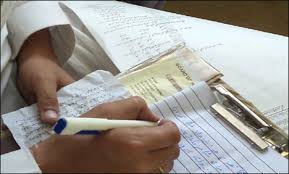
Extent of black matric cheating exposed

Basic Education Minister Angie Motshekga has revealed the extent to which teachers helped matric pupils cheat in last year’s exams.

Motshekga yesterday disclosed some of the evidence given during hearings into group cheating at some KwaZulu-Natal and Eastern Cape matric exam centres, where only black schools are implicated.

She said teachers and principals who encouraged group copying, would be criminally charged.

The continuing investigation will now focus on teachers, principals and invigilators.

A KwaZulu-Natal pupil wrote on an exam answer sheet: “We can now continue.”

This, according to Motshekga, “clearly indicated . that someone was dictating answers to them”.

She said that in other instances teachers had simply walked into exam rooms and told invigilators to leave so that they could help their pupils.

“The papers are opened at the school, so teachers would not have had sight of the paper before. So, I think, as the teacher looked at the paper, she found there was a section she had not taught the class and quickly rushed to the exam room to dictate it to them.”

A KwaZulu-Natal pupil admitted during the hearings to cribbing.

Motshekga said the exam results of pupils found guilty of group copying would be nullified.

The department launched the investigation into cheating allegations involving 153 exam centres in Eastern Cape, KwaZulu-Natal and Gauteng earlier this year.

More than 3000 pupils implicated in group copying will sit for this year’ s exams in October and November.

Only one KwaZulu-Natal pupil, among a group of 2307, was cleared of cheating charges; 56 confessed.

Of the 720 implicated in Eastern Cape, 26 were cleared and 17 confessed.

Former acting director-general of the Department of Basic Education Paddy Padayachee said security would be improved.

Source: timeslive

Black teachers help students to cheat

A “significant number” of matriculants have admitted that invigilators and teachers helped them cheat in last year’s final exams, the Department of Basic Education said yesterday.

In January, multiple pupils gave suspiciously similar answers (complete with identical spelling errors) at 58 examination centres in the Eastern Cape and KwaZulu-Natal.

It was claimed that invigilators, including teachers and headmasters, had read out answers at the front of the exam venues for pupils to write down.

Spokesman Elijah Mhlanga said yesterday that the department had completed its investigation at half of the regions in the Eastern Cape.

“We have received confessions from a significant number of learners, who have indicated that they were assisted by adults invigilating or by their teachers and principals.”

The disciplinary hearings are expected to be finalised next week.

Source: timeslive.co.za

SA matrics ‘still perform at lower levels in maths’: Umalusi

MATRIEKEKSAMEN 007While a general dumbing down of the school curriculum has ensured rising pass rates for South African matrics, the standards body Umalusi says that “in some of the key subjects such as mathematics the majority of learners still perform at lower levels”.

In statement released last night, Umalusi further expressed its concern about the quality of markers in the matric examinations.

While the setting and moderation of question papers seem to have stabilised, the quality of marking still poses a significant challenge in many subjects. In this regard we must reiterate our call that those who wish to mark exams should take a competency test on the subject they wish to mark. Markers with limited subject knowledge tend to disadvantage top learners who produce innovative and original responses to questions. This is particularly the case in open-ended questions where innovative and creative responses are provided by the learners.

One of the easiest subjects in which to obtain a pass, apart from the mandatory “Life Orientation” is in an African Home Language. According to Umalusi:

While progress has been made in ensuring that African Home Languages are assessed at an appropriate level, there remain some significant challenges to be addressed. These challenges must be addressed without delay in order to ensure that these languages occupy their rightful place in our constitutional order.

Average is just not good enough; we must set our sights higher!

The Umalusi Council expressed its satisfaction that ” the system is stabilising well and has reached a significant level of maturity as evidenced by the high percentage of subjects whose raw marks were accepted after the moderation process”.

However, in about 50% of subjects, “raw marks”  were adjusted during a standardisation process which may not exceed 10%.

Maths and science ‘too hard’

The steady decline over the past five years in the number of matric pupils studying science has education experts worried.

The number of pupils studying science fell from 229934 in 2008 to 182083 this year.

Though there has been a slight increase in the number of matrics doing maths – from 229371 last year to 230194 this year, this is well below the 2008 figure of 317270.

Enrolment in maths literacy courses has increased from 283000 in 2008 to 297074.

Minister of Basic Education Angie Motshekga said in Pretoria yesterday that it would seem that many pupils have switched from maths to maths literacy to increase their chances of passing the final exams.

“It is an area of great concern to us.

“Despite the fact that we want to encourage pupils to enrol for mathematics, we have more pupils going for maths literacy,” she said, adding that maths had a higher failure rate than other subjects.

Motshekga said she had asked that a maths and science summit be convened to find ways in which pupils’ interest in these subjects could be increased.

Education analyst Professor Graeme Bloch said it was disturbing that, even with high-profile science projects such as the Square Kilometre Array radio telescope in the Karoo making national headlines, children did not want to be scientists.

“We have a problem and we need a complete rethink,” he said.

“It might be teaching issues, but they would not be easy to solve.

“We need to start asking deep questions and we need community engagement on this matter,” Bloch said.

This year has been particularly challenging for education. Schools have been closed for months in Northern Cape because of service delivery protests, and the Limpopo textbook fiasco has crippled education in that province.

“It has been a very dramatic year … but we are confident,” said Motshekga.

“With the support and mitigating efforts we put in place, we should be able to get children through matric safely without having to sacrifice my head,” she said.

She said all the provinces were ready for the exams and that many schools have installed CCTV camera systems, hi-tech access control and alarm systems to avoid security breaches.

Many past matric results have been compromised by the leaking of examination papers.

A total of 527335 full-time and 120352 part-time pupils will sit for the National Senior Certificate final examinations, which begin on Monday. – timeslive.co.za