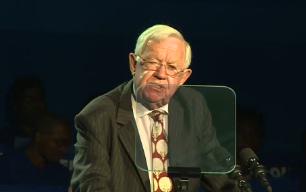
Sparks backtracks furiously

Allister Sparks, notorious Boerhater, has apologised and blamed “senility” for his comments on Hendrik Verwoerd, in a bid not to push away more black DA voters.

Speaking at the DA congress in Port Elizabeth, he named apartheid architect Hendrik Verwoerd among “smart politicians” he had encountered in his 64 years as a journalist and analyst.

Yesterday, Sparks tried to cover his tracks: “In truth, Verwoerd and his policies appalled me.”

On the BDLive website , he explained the “context” of his senile remarks.

“I recognised that Verwoerd was a formidable figure. His dominance of his own party was total, to the extent that National Party MPs would hiss with outrage if any opposition MP ventured even a mild interjection. They hung on to his every word as he spelt out the details of his grand scheme of separating the races into ‘separate countries’.

“And he was clever, which is what I meant when I called him ‘smart’.”

Blacks took to social media to complain about Sparks’ vile racism, something the über-liberal Sparks hardly expected as he probably believed his own rants about “white racists” exonorated him from black criticism.

Forget the maths, South Africa needs more Marxism at school

The road to success is paved with comic-book Marxism.

Over the last few days, South Africa’s “minister of basic education” – yes, we have such a thing – announced a few statistics that people found alternately shocking or “hilarious”. Everything in South Africa is “hilarious”: even the vicious murders and rapes we read about every day. As a society, South Africa has lost its way and all it can say is: “It’s hilarious,” meaning you should laugh about it. Every true “New South African” as the species self-identifies, is a sadist.

roodt_fbfotoNow, I can imagine that if the minister of “basic education” – or any other type of education – in another country announced that the average grade or mark in Grade 9 mathematics was 10%, there would be some kind of concern, if not an outcry. Even though we published the “hilarious” news on our website yesterday already, the national Business Day newspaper saw fit to carry it on its front page today. It gets worse: only 3% of Grade 9 pupils actually receive 50% or more for mathematics as we reported on Afrikaans praag. This is real progress, we are confidently assured.

As I commented previously, the provincial MEC for education in Kwazulu-Natal province actually ascribed poor academic prowess in maths to – you guessed it! – apartheid and poor old Dr. Verwoerd who was stabbed to death by Tsafendas:

Senzo Mchunu, MEC for Education in Kwazulu-Natal, declared in late July: “One of the points we found was a problem in Maths and Science. It was Verwoerd who made the subjects difficult because he thought blacks would be a threat to him.”

So there you have it: Dr. Verwoerd “made maths difficult”. That is why I think maths should be completely scrapped in most schools in South Africa and be replaced by courses in Marxism. As it is, knowledge of Karl Marx and the class struggle is what gets you into South African universities these days where the revolution has seen to it that all humanities faculties have been taken over by cultural and other Marxists, with the sciences not lagging far behind.

If you think I am making this stuff up, well, I hate to disillusion you. The worst of all is: if you dare question this kind of “logic”, you immediately get vilified as a “racist” or “white supremacist”, usually by other white people who have seen the light and also disdain anything male, European or mathematical.

Other school subjects preparing pupils for both undergraduate and graduate courses would be: whiteness and gender studies. Not only could you blame Verwoerd for “making maths difficult”, you could blame all dead white males for the calamity of inventing it in the first place: Leibniz, Fermat, Pascal, Von Neumann, Turing and others come to mind. Even Pythagoras and Euclid could be blamed for putting New-South African pupils through the stress of maths when they could be learning about Nelson Mandela and why being a man or a woman is just a “social construct”.

Get rid of calculus and replace it with class. And, of course, race: the ultimate obsession of the rabid cultural Marxists who are turning South Africa into a kind of B-movie version of Stalin’s Soviet Union in the 1930s. Except the Russians did not quite give up mathematics, and eventually developed a space programme.

South Africa also has a space programme of sorts: it consists of hurling projectiles into space, usually while standing on a freeway bridge with motorists passing underneath. Recently an Afrikaner woman, Irene Myburg, was killed by a rock hitting her full in the face in the passenger seat while being driven to Pretoria. In another incident just a few days ago, a rock was also thrown at ex-rugby player Hannes Strydom while driving down a deserted street in Pretoria. Unlike Irene Myburg, he survived the attack from our version of NASA “scientists”, equipped with large stones.

marx_for_beginnersHowever, South Africa has lots of “talented” cartoonists, such as Zapiro, who could convey the basic tenets of cultural Marxism to school children in comic books, a bit like those “Marx for beginners” or “Lenin for beginners” books that used to be popular a few decades ago. Marcuse, Adorno and Horkheimer could be immortalized in ink drawings and a few anti-white and anti-male slogans, supplanting “Verwoerdian” difficult mathematics.

As it is, the most successful people in South Africa are the so-called “tenderpreneurs” who do business with the state and get contracts via their cronies in government. Being a staunch advocate of affirmative action counts for a lot more in those circles than any actual engineering or technical expertise, so it makes sense for any would-be rand billionaire to study Marxism instead of algebra.

The road to success is paved with comic-book Marxism. I am sure our esteemed minister of “higher education”, Dr. Blade Nzimande, already understands it better than I, “damaged” as I was by an “apartheid education” which included Afrikaans, French, Latin and mathematics, could remotely attempt to do.


BBC discovers Afrikaans is spoken in Orania!

‘We sleep with the doors unlocked. You can walk in the street at 3am without any fear’

In the sparsely populated Karoo desert in the heart of South Africa’s Northern Cape, the spirit of Afrikaner independence lives on.

I spent a few days in Orania, a town established in 1991 where no black people live.

I was part of a BBC crew, including Zimbabwean journalist Stanley Kwenda, who were accredited to visit.

And during that time, Stanley and I were the only black people in the town of 1,000 – an unusual experience in modern South Africa.

It is an Afrikaner-only town, where only Afrikaans is spoken, because of fears about “diluting culture”.

“We do not fit in easily in the new South Africa. It [Orania] was an answer to not dominating others and not being dominated by others,” says Carel Boshoff Jr, the community leader.

Mr Boshhoff inherited the town from his father Carel Boshoff Snr, an Afrikaner intellectual and son-in-law of the former South African prime minister, assassinated in 1966, Hendrik Verwoerd.

The town was founded by Mr Boshoff Snr as a registered company shortly before white-minority rule ended in the rest of the country.

Mr Verwoerd’s grandson tells me that his people were faced with a tough question about their future when the black government was elected in 1994.

“In terms of Afrikaners who had been standing very close to the state, when the policies such as black economic empowerment and affirmative action came into place, Afrikaners needed to seriously think about their future. It wouldn’t make sense not to,” he said.

Black Economic Empowerment (BEE) was introduced to encourage more black participation in business.

Orania has also proved to be the answer for those Afrikaners who felt displaced in the land their people had ruled for many decades.

“I see nothing wrong with apartheid,” says Martin Kemp, one of the older residents.

“Of course you get the petty apartheid: ‘You use this toilet I use that toilet’, I don’t think that was necessary but the real apartheid as Dr Verwoerd saw it, there was nothing wrong with it,” he said.

We were taken on a guided tour of the town’s facilities by John Strydom, a retired doctor.

The town’s leaders insist that Orania is misunderstood. “We are not against black people. We are for ourselves,” is their message.

However, black people cannot live here.

Prospective residents are screened by the town council using a strict criterion, which includes first and foremost being an ethnic Afrikaner.

It is not enough to simply speak Afrikaans, as is the case with many black and mixed-race South Africans.

Eerie place

As we sat down with Mr Boshoff for a cup of what the cafe described as “proper Boere [Afrikaner] tea… strong”, I took in some of the surroundings.

Near the entrance of the gated community was a statue of Mr Verwoerd, one of a few of the apartheid-era prime ministers, and the Orania flag – with similar colours to the old republic’s orange, white and blue horizontal stripes – which hung proudly.

The town was quiet; the sound of birds and rustling leaves interrupted by a few cars passing by. It is an eerie place for an outsider.

  • Afrikaners are descendants of Dutch, German and French settlers who arrived in the 17th Century
  • The Dutch, who arrived in 1652, took over land from local people and put them to work as farm workers
  • Afrikaners dominated South Africa for many decades and introduced the apartheid system which was based on racial segregation
  • Orania was established in 1991, by Afrikaner intellectual Carel Boshoff Snr
  • The town is built on 8,000 hectares of farmland along the Orange River

The town boasts amenities such as shops, hair salons, a library, a post office, a hotel, a couple of schools – and churches, a lot of churches.

But beneath the surface of this solitude lurks a fear that leads people to abandon high-paying jobs in the city for lowly jobs in this arid land.

“The levels of crime and violent crimes in South Africa are definitely pushing powers that bring people to Orania. Many of them have been victims of crimes,” says Mr Boshoff.

South Africa is considered to be one of the most violent societies in the world, with one of the highest murder rates.

Official statistics suggest that most crimes actually happen in poor communities between people known to each other, but this has not stopped the fear of crime in other communities.

‘Little giant’

As a result, Orania officials say the town has had an annual growth rate of nearly 10% since its inception.

The Afrikaner community’s totem is the “the little giant”, a man with rolled-up sleeves who features in the flag and the local money, the Ora which is pegged to the South African rand.

The people do their own work from gardening to plumbing, bricklaying and waste-collection – jobs usually done by black labourers in the rest of the country.

“We sleep with the doors unlocked. You can walk in the street at 3am without any fear” – Quinton Diedrichs Bar owner

“It takes some adjusting to. It is more difficult for some people because they are used to how things were done in South Africa, they are not used to manual labour,” says Mr Strydom.

The locals explain that one of the goals in Orania is to help create a generation of pure Afrikaners untouched by the “outside world”.

Bizarrely, the town’s existence is protected by South Africa’s constitution through a clause that ensures the right to self-determination – introduced to reassure those worried about the transition to democracy.

With its old Cape-Dutch styled houses it is like stepping back in time, but some families fear this place could eventually be too small for their children.

‘Respect’

George van Staden moved from Johannesburg recently after he was offered a job in Orania.

Mr Van Staden says his two children are enjoying life in the countryside but he and his wife are preparing them for a world where there is not just one race or culture.

“There is no tertiary institution here for example. They need to be equipped to handle the outside world,” says Mr Van Staden.

“I teach them that there is no difference in skin colour. I teach them if they respect the people in Orania they must also respect the people outside Orania,” his wife Tisha adds.

Another couple, Theunie and Annelize Kruger, say they are still adjusting to Orania’s rules, which include getting permission from the town council before receiving visitors.

“We understand it but it’s a bit frustrating at times,” Mr Kruger says.

‘Defend with our lives’

At the local bar, framed newspaper articles hang on the wall and Afrikaner memorabilia adorns the place.

The owner, Quintin Diedericks, is well-travelled but became disillusioned with South Africa and moved to Orania with his wife, a beauty therapist, about four years ago.

“It’s very safe here. We sleep with the doors unlocked. You can walk in the street at 3am without any fear. You don’t have that where you live,” he tells me.

He blames FW de Klerk, the last Afrikaner to rule South Africa, for the plight of his people.

“We can’t get jobs. It’s like we are being punished for the past” – Drinker in an Orania bar

“He gave away the country for nothing. We had the army,” he says and stops abruptly, beginning to shake his head.

Inside the dimly-lit pub, a game of rugby is on the TV, apart from a few odd glances, no-one seems to pay much attention to Stanley or me.

A few more locals do come over to our table and conversation is polite and largely politically correct, much like in the rest of South Africa.

The pernicious issue of jobs and pro-black policies rears its head.

One local explains it as “reverse racism”.

“We can’t get jobs. It’s like we are being punished for the past,” he says.

They seem oblivious to the oppression of black South Africans during apartheid. For them it was a system that gave order.

“It [apartheid] didn’t affect me. So many people get aggravated now for things they didn’t even witness. It’s over, move on,” says Yolandie Jonk, 29, a call centre agent.

As the sun sets, the bronze busts of Afrikaner leaders spanning over many decades – Paul Kruger, JBM Herzog, DF Malan, JG Stridom and, of course, Mr Verwoerd – look protectively over the town.

Held in disdain elsewhere, they are Orania’s heroes – yet it is difficult to see how the community will be able to remain so completely isolated in such an inter-connected world.

But as one pub drinker put it – being an Afrikaner in Orania is “something we will defend with our lives if we need to”. – By Pumza Fihlani, BBC News, Orania

You can hear a BBC World Service programme about Orania on Tuesday 7 October .

Verwoerd’s echo from a dead man talking

Hendrik Verwoerd
Hendrik Verwoerd

by Joseph Secrève

What do Hendrik Verwoerd and Ray Jasper have in common?

At first glance this question may seem a bit peculiar, with Verwoerd being the well-known and much maligned ‘father of apartheid’ and Ray Jasper being the black rap musician who was executed by lethal injection in the state of Texas a week ago.

One could start by saying that both were born in the Netherlands and both were killed in their adopted countries. Verwoerd was assassinated because of his firm belief in ethnically homogeneous nations, and Jasper was put to death because of, well, what appears to be the same belief. Jasper was convicted for slashing the throat of a record producer in 1998, but due to a technicality in Texas law, he maintained throughout his stay that he was not deserving of death but of life imprisonment. Instead, he blamed an all-white judge and jury for being racist at his trial, which according to him helped overturn the possibility of a life sentence into a death sentence.

In Texas, a murder alone carries a life sentence. However, a murder along with another related felony, such as theft of the victim’s property leads to a death sentence. This catch in the legal system is why Jasper had pleaded for life instead of death.

But there’s more: In an exchange of letters to blogger Hamilton Nolan, Jasper revealed a more profound side of himself, one that would not typically be associated with the stereotype of a homicidal rap musician. The content of the letter, albeit slightly incoherent at places, does reveal some poignant insights, and perhaps unwittingly touches on an important topic regarding race relations.

These following excerpts are quoted from Jasper’s letter:

“When I walked into prison at 19 years old, I said to myself ‘Damn, I have never seen so many black dudes in my life’. I mean, it looked like I went to Africa. I couldn’t believe it. The lyrics of 2Pac echoed in my head, ‘The penitentiary is packed/ and its filled with blacks’.

It’s really an epidemic, the number of blacks locked up in this country. That’s why I look, not only at my own situation, but why all of us young blacks are in prison. I’ve come to see, it’s largely due to an identity crisis. We don’t know our history. We don’t know how to really indentify with white people. We are really of a different culture, but by being slaves, we lost ourselves.

You take the identity crisis, mix it with capitalism, where money comes before empathy, and you’ll have a lot of young blacks trying to get money by any means because they’re trying to get out of poverty or stay out of poverty. Now, money is what they try to find an identity in. They feel like if they get rich, legal or illegal, they’ve become somebody. Which in America is partly true because superficially we hail the rich and despise the poor.

A French woman who moved to America asked me one day, ‘Why don’t black kids want to learn?’ Her husband was a high school teacher. She said the white and Asian kids excel in school, but the black and Hispanic kids don’t. I said that all kids want to learn, it’s just a matter of what you’re trying to teach them. Cutting a frog open is not helping a black kid in the ghetto who has to listen to police sirens all night and worry about getting shot. Those kids need life lessons. They need direction. When you have black kids learning more about the Boston Tea Party than the Black Panther Party, I guarantee you won’t keep their attention. But it was the Black Panther Party that got them free lunch.”

Interestingly enough, this dilemma was one of the most important motives behind the Verwoerdian system of racial segregation. Because of the stark differences in culture, Verwoerd foresaw the dangers of having people from a different kith and kin enter an urbanised world that was not a reflection of their lifestyle. With this alienation comes frustration, as age-old customs have to compete with modern laws. The social breakdown and violence in South-Africa’s east coast cities in the early fifties could attest to this. The old customs are not valid anymore and the modern urban laws are too distant and incongruent to properly solidify into their character. The cost of reconciling these contradictory systems could easily lead to personal distress, apathy and hatred.

This might help explain the pathos mentioned by Jasper, and he raises an important issue in this piece. Slavery has been abolished in the West for over 150 years, yet it appears as if certain population groups still haven’t been able to unshackle the leg irons of history. Something is depriving them of their sense of freedom. Racial discrimination is often cited as the culprit, but in reality this discrimination is only a palpable manifestation of a deeper rift. This conflict is best described by historian Oswald Spengler, a phenomenon he named historical pseudomorphosis.

“By the term ‘historical pseudomorphosis’ I propose to designate those cases in which an older alien Culture lies so massively over the land that a young Culture cannot get its breath and fails not only to achieve pure and specific expression-forms, but even to develop fully its own self-consciousness. All that wells up from the depths of the young soul is cast in the old moulds, young feelings stiffen in senile practices, and instead of expanding its own creative power, it can only hate the distant power with a hate that grows to be monstrous.”

Hence the importance to develop a stable identity that ties in with a people’s history. As Verwoerd once stated, no nation can achieve greater heights for itself by treading on the corpse of a fellow nation. He recognised a fundamental truism that all major cultural achievements arise from within.

Should African Americans be taught the finer details of their history though, similar thoughts as expressed by Jasper would undoubtedly come to the fore. Not many people today realise that the most important black consciousness and civil rights leaders were not in favour of integrating with whites either. Frantz Fanon, Malcolm X, Marcus Garvey and others resented the idea of mixing races. Malcolm X’s mentor Elijah Muhammad even stated that he “would take his hat off for any white man who wants to stay white”, emphasising his sense for maintaining one’s own culture, black and white. The fact that Garvey and Muhammad were also fervent admirers of Hitler and the Nazi’s has been kept out of modern-day historical teaching, as well as Malcolm X’s attempt to garner support from the Ku Klux Klan to help resist racial integration.

The status of ethnic integration being hailed as a noble and universal virtue has thus far had a very short shelf life, and doesn’t appear to strike a chord with most people dealing with its full complexities. In fact, it has rather led to situations where one group wants to rule over another, and as the self-esteem of an upwardly mobile minority group improves, so does its will to inflict harm upon the shrinking majority group. The news coverage of Trayvon Martin versus Antonio West serves as a case in point. Not to mention many leading Ivy League scholars who would stop at nothing short of an all-out witch hunt against the white population. Harvard professors Noel Ignatiev, Randall Kennedy and president Obama’s friends Charles Ogletree and Derrick Bell can’t spew enough anti-white hatred, regardless of the fact that they hold positions that would not have been possible without the founders of Puritain America.

Interestingly enough, Jasper also offers a tentative way out of this:

“How many black kids would change their outlook if they knew that they were only considered 3/5’s of a human being according to the U.S Constitution? That black people were considered part animal in this country. They don’t know that. When you learn that, you carry yourself with a different level of dignity for all we’ve overcome.”

Quite ironic that a rap musician on death row calls upon the dignity of people, whereas the nouveau academic elite embrace malevolent principles that would have made Stalin blush.

Just as Verwoerd mentioned, once Mandela became president, the entire West would fall victim to the pernicious ideology of Communism.

Either way, this does not portend well for the future.

Apartheid protected us from Africa’s ‘dark eye’

by Dan Roodt

In response to my letter originally published in Business Day and available as a column here, Apartheid evil is hype, there has been at least three irate replies (see underneath) and one of support, Apartheid better than nightmare of ANC rule. Dr. Wilmot James of the DA even wants me to “apologise” for “denying him his history”.

I find this rather strange as his party is more or less the successor of the National Party. Especially in Dr. James’s Western Cape, many ex-NP members and therefore apartheid “perpetrators” still hold office or are otherwise to be found in positions of influence within the DA. If they were really “war criminals” deserving a Nuremberg trial, would they have been so readily accepted by Dr. James as colleagues?

Every departure from orthodoxy is normally treated with disdain, if not outrage. However, given the increasing crisis in our country, it is high time that we went back to the drawing board and revisited some old political themes that have kept us busy for over a hundred years, if not more.

Apartheid revisionism should not threaten anyone as I am sure not even die-hard supporters of apartheid wish to return to the system pertaining in the 1960s. But we still need to understand our recent history, as opposed to mere propaganda and exaggerations. We could do with a bit more of the French penser à contre-courant.

Anti-apartheid author Nadine Gordimer referred somewhere to the “Manichean poison that she was forced to imbibe” in her works. But is this not true of the entire anti-apartheid movement? In order to succeed and to persuade the Scandinavians to donate millions to the ANC, the old system needed to be painted in starkly moral terms, as a Manichean conflict between good blacks and evil whites/Afrikaners.

The reality was of course much more complex and murky than that. And these days, as they say, we are getting mugged by reality in many ways, sometimes literally.

At least Mrs. Louise Asmal admits that “apartheid’s crime against humanity had nothing to do with death camps and mass graves”. If we can all agree to that, the type of apartheid revisionism that Hermann Giliomee and I have been advocating has already largely succeeded. In this, Mrs. Asmal has been preceded by Judge Albie Sachs who similarly told me a few years ago in Pretoria that “comparisons between apartheid and Nazism were not helpful”. Now we just need to persuade Archbishop Tutu and his former Truth Commission of the same thing, and there might be enough common ground to talk to one another.

Being an alumnus of Wits, I had a very sparse education, especially on apartheid theorists. I do not think anyone at Wits has ever read anything by Afrikaner politicians or theorists besides the out-of-context quote from Verwoerd on Bantu Education, the true purport of which Giliomee has so magnificently elucidated in his recent articles. Fortunately for me, I was given a lot of old political books a few years ago that originated from the late Otto Krause’s library, so at least I learned something about the political thinking prior to 1994.

No serious apartheid theorist, at least since the Second World War, has ever claimed, as Mrs. Asmal puts it, “that the white man was inherently superior to the black, and hence somehow acquired a right to rule over him and train him up to be a servant to his white master”. This is precisely the kind of crude reductionism which is as “unhelpful” as the oft-repeated truism that apartheid was a form of Nazism.

Verwoerd, if anything, erred in his assessment of blacks’ capacity for rapid and autonomous development. In this respect Verwoerd was far closer to Steve Biko’s type of thinking around black self-sufficiency than to traditional colonial ideas of European superiority that Churchill, among others, believed in.

According to Giliomee in Reconsidering Verwoerd and Bantu Eduction, Verwoerd was appalled that the Congo had become independent without any trained administrators. He defended his educational policy by saying: “We shall have to negotiate frequently in future with blacks about many things, including educational matters and policy issues. It would be better to negotiate with people with a good grounding and properly trained.”

So Verwoerd, unlike the myth that has been created by anglophone liberals and leftists, really was a “champion of education for black South Africans” (see below, the letter by Marius Roodt of Boksburg).

Admittedly, there existed unfair or even draconian measures under apartheid which have been enumerated many times, such as petty segregation, influx control and group areas, to which Dr. Wilmot James alludes. However, I am sure we could find similar, if not worse, excesses in the current system. Many informal settlements or slums have been forcibly cleared or relocated under the ANC government, just like Sophiatown, District Six or Fordsburg. Many Afrikaners have lost their family farms due to land reform. Each such event must be analysed on its own merits, instead of attributing it simply to the blind ideological fervour of the previous government. PW Botha once explained to me that he had only decided to move District Six during his tenure as Minister of Community Development after pleading at length with the landlords to maintain their properties and to stop a slum culture from developing there.

Ultimately, apartheid was an African political system adapted to African conditions, often in response to intense violence and the constant threat of political instability, especially during the Cold War. If we compare South Africa to Mocambique, Angola, Tanzania or even Zimbabwe, we can see that we have been spared the worst of an African-style socialist revolution. At least until now.

There is a uniquely African horror which apartheid protected us from and which is again manifesting itself in the form of farm murders, child rape, xenophobic killings and our slide into mayhem. Conrad painted it in Heart of Darkness, as well as Coetzee in Disgrace. Laurens van der Post gave an interesting lecture to the Psychological Club of Zurich on 3 March 1954, which was subsequently published by The Hogarth Press, entitled The Dark Eye in Africa.

To us as Africans, it is of no use to repeat the moralisms and platitudes of the foreign-born, Scandinavian-financed anti-apartheid movement, even if they do represent the dominant ideology now. We need to find our own truth, commensurate with our unique reality.

LETTER: Roodt must apologise

Business Day, 12 September 2012

I WAS appalled to read Dan Roodt’s ignorant and insensitive revisionist rantings (Apartheid evil is hype, Letters, September 10).

Evil is surely not reducible simply to the existence of death camps. It did not start there but the National Party’s apartheid policies systematically and deliberately stripped black people of their assets.

Mr Roodt’s “refined” Hendrik Verwoerd created Bantustans that became the impoverished dumping grounds for so-called surplus black people. In urban areas, the act of seeking a livelihood was regulated by influx control, pass laws and routine time in jail — and for black people in their thousands.

Mr Roodt’s “cultured” Dr Verwoerd shut down the great Jan Hendrik Hofmeyr’s feeding schemes for all (including black) children introduced during the war, closed the mission schools that educated individuals like Nelson Mandela and criminally, deliberately and shamefully invested a mere pittance in the education of black children.

His colleague, the equally “cultured” Dr Eben Donges passed laws that split up families (the Population Registration Act classified half my family white and the other half coloured), criminalised sex and marriage across the colour line and enacted the Group Areas Act that saw my father lose the house he built with sweat and labour not once, but twice.

Mr Roodt’s beloved John Vorster passed one law after the other to put anyone with a moral conscience in jail without trial (I spent five days of hell in the Bellville Police Station and three weeks in Victor Verster Prison under the Internal Security Act, a picnic compared to what my brother-in-law and others had to endure at the hands of Jeff Benzien’s torture) and unleashed his security police and the death squads on those who had the courage to resist apartheid. That many South Africans nevertheless made a success of their lives was despite apartheid.

This is personal you see. With his pen Mr Roodt denies me my history. With his pen Mr Roodt denies millions of South Africans their history. Shame on you. You owe all of us an apology. All because you thrive on attention, howsoever perversely it is obtained.

Dr Wilmot James

Federal Chairperson: Democratic Alliance.

LETTER: What gall, Mr Roodt!

Business Day, 12 September 2012

WHERE does Dan Roodt (Apartheid evil is hype, Letters, September 10) get the gall to write as he does? Has he no idea of what apartheid meant to most South Africans?

Apartheid’s crime against humanity had nothing to do with death camps or mass graves. Apartheid’s crime against humanity was to proclaim that the white man was inherently superior to the black, and hence somehow acquired a right to rule over him and train him up to be a servant to his white master.

Dr Verwoerd, when he was native affairs minister in 1954, asked in the senate: “What is the use of teaching a Bantu child mathematics when it cannot use it in practice?” (Note the demeaning use of “it”). He was quite clear that Africans could never aspire to equality with “Europeans”; therefore their education should give them no hope of bettering themselves.

Perhaps Mr Roodt may now admit to being rather more of a buffoon than my late husband.

Louise Asmal

Via e-mail

LETTER: SA now a better place

Business Day, 12 September 2012

DAN Roodt (Apartheid evil is hype, Letters, September 10) makes the quite staggering claim that apartheid should not be classified as a crime against humanity. Any right-thinking person cannot deny that apartheid was exactly that! Black South Africans were stripped of their citizenship, forced to undergo schooling in a language not of their choice, removed from areas where they had made their homes, barred from numerous professions, and prevented from attending the university of their choice, along with numerous other indignities and infringements on their rights.

He also makes the mind-boggling assertion that Hendrik Verwoerd was actually a champion of African education. However, in 1966, the last year of Dr Verwoerd’s premiership, only 1,547 Africans wrote matric, of whom 56% achieved a pass. This is compared to 2010, when nearly 450,000 black South Africans wrote matric, with a pass rate of 63%.

For such an avowed crusader of education for black South Africans Dr Verwoerd had quite a patchy record in this regard. While he was prime minister, the ironically named Extension of University Education Act was passed, which forced black South Africans to attend “bush colleges” rather than the established universities of the major cities, which were restricted to whites. He was also quoted as saying in 1953: “There is no place for (the Bantu) in the European community above the level of certain forms of labour.… What is the use of teaching the Bantu child mathematics when it cannot use it in practice?” He was also quoted as saying that the aim of Bantu education was to keep “the Bantu child a Bantu child”. In the 1960s the average spend by the government on a white pupil was at least 10 times of that of a black pupil.

Dr Verwoerd was a great many things, but a champion of education for black South Africans he was not.

Harking back to a bygone “golden era” of apartheid (even Julius Malema has been guilty of this recently) is dangerous. This country has a great many obstacles to overcome, but headway is being made. The increase in literacy, the phenomenal number of houses built, the electrification of millions of homes, and the constitution are all major achievements and evidence of a better SA. This country has major problems, but there is absolutely no doubt that this is a better place than it was under the leadership of Dr Verwoerd.

However, we must remain vigilant.

The dumping of textbooks in Limpopo was inexcusable and the current crisis in education is, along with a number of other issues, a warning sign for our country.

We should work together to ensure that SA becomes a success, and that all races feel at home in this great country. A successful SA will ensure that claims that this country was better under apartheid will be rightly scoffed at.

Marius Roodt (no relation)

Boksburg