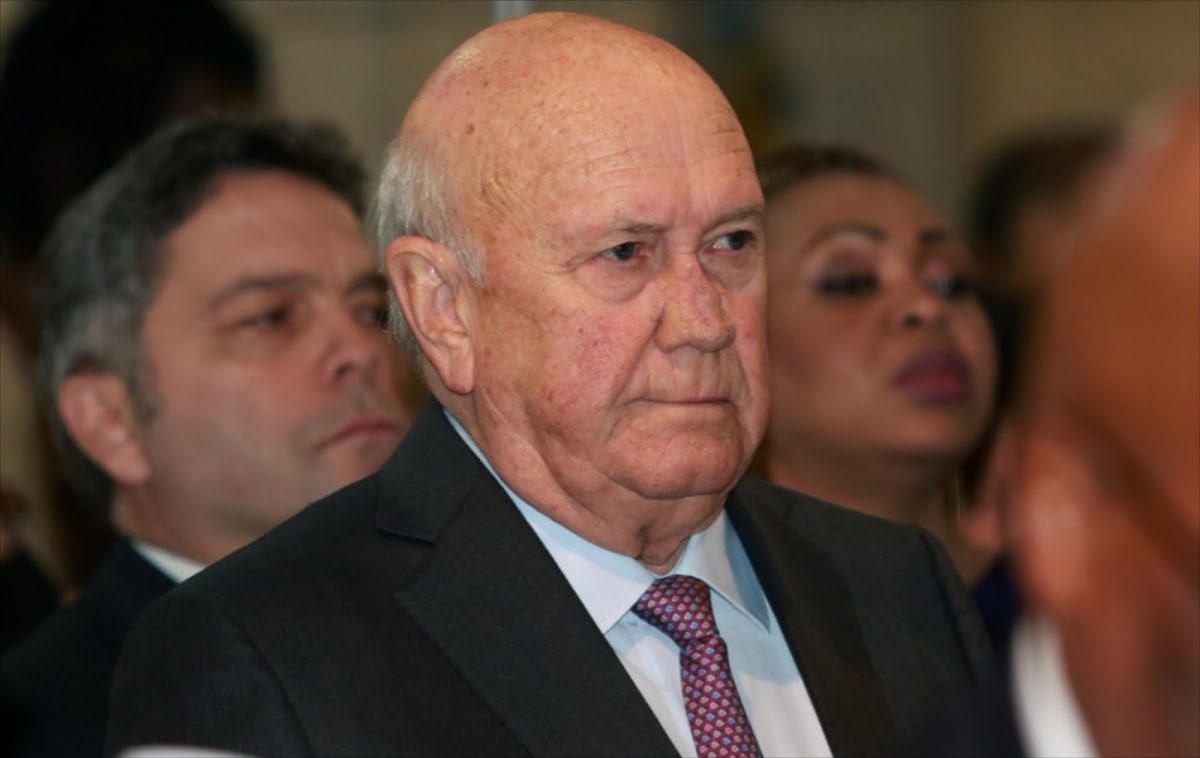
FW de Klerk Foundation kow-tows to its critics after ‘apartheid statement’

The FW de Klerk Foundation has completely retracted its previous statement that characterising “apartheid” as a “crime against humanity… was, and remains, an ‘agitprop’ project initiated by the Soviets and their ANC/SACP allies to stigmatise white South Africans” (see below).

It seems that the statement had been sent out by the Foundation’s CEO, Dr Dayne Morkel. However, the chairman of the board, Dr. Theuns Eloff, said that “no-one would be fired or resign”.

“It was a mistake to issue that statement, and I believe that the mistake was made because of an error in judgement and some emotionality over the attacks by the EFF,” said Eloff.

In another statement issued on 17 February by his foundation, De Klerk apologised profusely and stated:

“I have taken note of the vehement reaction to our response to the EFF’s attack on me at the State of the Nation address on Thursday night.

“I agree with the Desmond and Leah Tutu Foundation that this is not the time to quibble about the degrees of unacceptability of apartheid. It was totally unacceptable.

“The FW de Klerk Foundation has accordingly decided to withdraw its statement of 14 February unconditionally and apologises for the confusion, anger and hurt that it has caused.”

The original statement issued on 14 February reads as follows:

Last night at the opening of SONA, FW de Klerk, former President and Nobel Peace Laureate, and his wife Elita had to endure wave after wave of vitriolic attacks by Julius Malema and EFF members of Parliament, clad in their trademark red boiler suits. They claimed that his hands were dripping “with blood”, including the blood of those who had been slaughtered at Boipatong. Worst of all, FW de Klerk had denied – in a TV interview the previous week – that apartheid was “a crime against humanity.” Their demands that he should be removed from the chamber were rejected by the Speaker, Thandi Modise. De Klerk – who will turn 84 next month – sat impassively in the public gallery as he watched the spectacle below.

De Klerk has repeatedly acknowledged the grave injustices committed under apartheid and has sincerely apologised on a number of occasions to those who suffered under previous governments. These were more than empty words: he dedicated his entire presidency to the abolition of apartheid and the negotiation of a new Constitution that would entrench the rights of all South Africans regardless of race. He oversaw the process that culminated in the repeal of all the remaining apartheid laws.

But was apartheid a crime against humanity?

First we have to look at the origins of the charge: In November 1966 the UN General Assembly declared apartheid to be a crime against humanity – and in 1973 it adopted the Convention on the Suppression and Punishment of the Crime of Apartheid.

Both the Resolution and the Convention were political initiatives of the Soviet Union – which had itself committed atrocious crimes against humanity that involved the killing of millions of people. In 1976, when the Convention came into force, 23 of the 31 signatories were, according to Freedom House in New York, “not free”. Six were partly free – and only two were free. Ironically, South Africa was classified as “partly free” – and had a better human rights score than 27 of the signatories.

The 109 states that subsequently joined the Convention included none of the core democracies. According to the United States delegate:

“Deplorable as it is, we cannot, from a legal point of view, accept that apartheid can in this manner be made a crime against humanity. Crimes against humanity are so grave in nature that they must be meticulously elaborated and strictly construed under existing international law…”

The idea that apartheid was ‘a crime against humanity’ was, and remains, an ‘agitprop’ project initiated by the Soviets and their ANC/SACP allies to stigmatise white South Africans by associating them with genuine crimes against humanity – which have generally included totalitarian repression and the slaughter of millions of people.

By contrast, some 23 000 people died in South Africa’s political violence between 1960 and 1994 – of whom fewer than 5 000 were killed by the security forces. Most of the rest of the deaths occurred in the conflict between the IFP and the ANC. In Kenya, the British interned more than 320 000 people during the Mau-Mau uprising and hanged more than a thousand Mau-Mau members. In Algeria, the French killed more than 140 000 people in a war that claimed some 700 000 lives.

None of this is meant to whitewash the injustices that were undoubtedly committed under apartheid. However, we need a balanced understanding of the past – not one based on a simplistic black/white, good/evil framework – but on a framework that reflects the infinite shades of grey that actually characterise history.

John Allen, a close associate of Archbishop Desmond Tutu, acknowledges in his book “Rabble Rouser for Peace” that “no evidence was ever forthcoming (at the TRC) implicating De Klerk in violence.” This was despite the fact that Truth and Reconciliation Commission (TRC) clearly had an agenda to incriminate De Klerk. He writes of the TRC’s “frustration” at its failure to “pin responsibility for violations of human rights on De Klerk” and acknowledges “the embarrassing weakness of its finding against him.”

As for Boipatong, the TRC’s amnesty committee found in November 2000 that the IFP supporters who perpetrated the Boipatong killings in June 1992 had acted alone.

It is ironic that Julius Malema who launched the vitriolic attack on De Klerk, threatened to commit a real crime against humanity when he said on 7 November 2016 that “We are not calling for the slaughtering of white people – at least not now.”

In a way, an attack by Julius Malema and the EFF, is the sincerest form of compliment. We have seen his kind before: those who wear colour-coded uniforms; who use bully boy tactics to disrupt democratic processes; who whip up race hatred and call their leaders “Führer, or Duce, or Commander in Chief”. The words of a WB Yeats, (whom Malema would not doubt regard as a ‘colonialist’), came to mind while watching the EFF debacle in Parliament:

“Things fall apart; the centre cannot hold; Mere anarchy is loosed upon the world,

The blood-dimmed tide is loosed, and everywhere The ceremony of innocence is drowned;

The best lack all conviction, while the worst

Are full of passionate intensity.”

Issued by the FW de Klerk Foundation, 14 February 2020

Majority of white South Africans disagree ‘black poverty due to apartheid’

Buried in a recent report from the Institute for Justice and Reconciliation, is an indication that the media and educational inisitutions have largely failed in brainwashing white South Africans about the country’s past. A majority of whites (54,3%) disagree with the statement that “many black South Africans are poor today as a result of apartheid’s legacy”. A significant proportion of whites (37,7%) disagree that “apartheid was a crime against humanity”.

reconciliation_table23

Table 23 summarises youth and adult agreement (across historically defined race groups) with three historical truths about the nature and  legacy of apartheid.

‘Concerning’


According to Kim Wale, author of the 2013 SA Reconciliation Barometer Survey, “It is positive to note that across these three questions South Africans report high agreement with historical truths, but it is concerning to note that white South Africans are much less  likely to agree with the rest of South Africa. Youth are slightly more likely than adults to agree with historical truths by 3–4%. In terms of  the statement that apartheid was a crime against humanity, 76.4% of  South Africans agree, but only 52.8% of white South Africans agree  compared to 70.4% coloured, 77.1% Indian/Asian and 80.9% black South Africans who agree with this statement. In terms of the  statement that the apartheid government wrongly oppressed the  majority of South Africans, about half of white South Africans agree with this statement and almost 40% disagree compared to 72.1% of South Africans who agree and 23.7% who disagree with it.

Black poverty in South Africa

She went on to say: “When South Africans are asked whether they agree that many black South Africans are still poor today because of the lasting effects of apartheid, almost 70% agree that the poverty of the present is linked to the injustice of the past. However, less than half as many white South Africans agree (33.4%) with this statement. White youth are 5.6% more likely than white adults to agree with this statement which provides some hope that the younger generation of white South Africans may recognise the effects of the past on the poverty of the present. This is important as if South Africans do not agree on the connection between economic exclusion and our historical legacy, they are not likely to agree with the need to address that legacy.”

White resistance to affirmative action in South Africa is growing, especially amid widespread reports of government corruption and the ostentatious lifestyle of the country’s politically connected black elite. – praag.org and IJR report

Apartheid protected us from Africa’s ‘dark eye’

by Dan Roodt

In response to my letter originally published in Business Day and available as a column here, Apartheid evil is hype, there has been at least three irate replies (see underneath) and one of support, Apartheid better than nightmare of ANC rule. Dr. Wilmot James of the DA even wants me to “apologise” for “denying him his history”.

I find this rather strange as his party is more or less the successor of the National Party. Especially in Dr. James’s Western Cape, many ex-NP members and therefore apartheid “perpetrators” still hold office or are otherwise to be found in positions of influence within the DA. If they were really “war criminals” deserving a Nuremberg trial, would they have been so readily accepted by Dr. James as colleagues?

Every departure from orthodoxy is normally treated with disdain, if not outrage. However, given the increasing crisis in our country, it is high time that we went back to the drawing board and revisited some old political themes that have kept us busy for over a hundred years, if not more.

Apartheid revisionism should not threaten anyone as I am sure not even die-hard supporters of apartheid wish to return to the system pertaining in the 1960s. But we still need to understand our recent history, as opposed to mere propaganda and exaggerations. We could do with a bit more of the French penser à contre-courant.

Anti-apartheid author Nadine Gordimer referred somewhere to the “Manichean poison that she was forced to imbibe” in her works. But is this not true of the entire anti-apartheid movement? In order to succeed and to persuade the Scandinavians to donate millions to the ANC, the old system needed to be painted in starkly moral terms, as a Manichean conflict between good blacks and evil whites/Afrikaners.

The reality was of course much more complex and murky than that. And these days, as they say, we are getting mugged by reality in many ways, sometimes literally.

At least Mrs. Louise Asmal admits that “apartheid’s crime against humanity had nothing to do with death camps and mass graves”. If we can all agree to that, the type of apartheid revisionism that Hermann Giliomee and I have been advocating has already largely succeeded. In this, Mrs. Asmal has been preceded by Judge Albie Sachs who similarly told me a few years ago in Pretoria that “comparisons between apartheid and Nazism were not helpful”. Now we just need to persuade Archbishop Tutu and his former Truth Commission of the same thing, and there might be enough common ground to talk to one another.

Being an alumnus of Wits, I had a very sparse education, especially on apartheid theorists. I do not think anyone at Wits has ever read anything by Afrikaner politicians or theorists besides the out-of-context quote from Verwoerd on Bantu Education, the true purport of which Giliomee has so magnificently elucidated in his recent articles. Fortunately for me, I was given a lot of old political books a few years ago that originated from the late Otto Krause’s library, so at least I learned something about the political thinking prior to 1994.

No serious apartheid theorist, at least since the Second World War, has ever claimed, as Mrs. Asmal puts it, “that the white man was inherently superior to the black, and hence somehow acquired a right to rule over him and train him up to be a servant to his white master”. This is precisely the kind of crude reductionism which is as “unhelpful” as the oft-repeated truism that apartheid was a form of Nazism.

Verwoerd, if anything, erred in his assessment of blacks’ capacity for rapid and autonomous development. In this respect Verwoerd was far closer to Steve Biko’s type of thinking around black self-sufficiency than to traditional colonial ideas of European superiority that Churchill, among others, believed in.

According to Giliomee in Reconsidering Verwoerd and Bantu Eduction, Verwoerd was appalled that the Congo had become independent without any trained administrators. He defended his educational policy by saying: “We shall have to negotiate frequently in future with blacks about many things, including educational matters and policy issues. It would be better to negotiate with people with a good grounding and properly trained.”

So Verwoerd, unlike the myth that has been created by anglophone liberals and leftists, really was a “champion of education for black South Africans” (see below, the letter by Marius Roodt of Boksburg).

Admittedly, there existed unfair or even draconian measures under apartheid which have been enumerated many times, such as petty segregation, influx control and group areas, to which Dr. Wilmot James alludes. However, I am sure we could find similar, if not worse, excesses in the current system. Many informal settlements or slums have been forcibly cleared or relocated under the ANC government, just like Sophiatown, District Six or Fordsburg. Many Afrikaners have lost their family farms due to land reform. Each such event must be analysed on its own merits, instead of attributing it simply to the blind ideological fervour of the previous government. PW Botha once explained to me that he had only decided to move District Six during his tenure as Minister of Community Development after pleading at length with the landlords to maintain their properties and to stop a slum culture from developing there.

Ultimately, apartheid was an African political system adapted to African conditions, often in response to intense violence and the constant threat of political instability, especially during the Cold War. If we compare South Africa to Mocambique, Angola, Tanzania or even Zimbabwe, we can see that we have been spared the worst of an African-style socialist revolution. At least until now.

There is a uniquely African horror which apartheid protected us from and which is again manifesting itself in the form of farm murders, child rape, xenophobic killings and our slide into mayhem. Conrad painted it in Heart of Darkness, as well as Coetzee in Disgrace. Laurens van der Post gave an interesting lecture to the Psychological Club of Zurich on 3 March 1954, which was subsequently published by The Hogarth Press, entitled The Dark Eye in Africa.

To us as Africans, it is of no use to repeat the moralisms and platitudes of the foreign-born, Scandinavian-financed anti-apartheid movement, even if they do represent the dominant ideology now. We need to find our own truth, commensurate with our unique reality.

LETTER: Roodt must apologise

Business Day, 12 September 2012

I WAS appalled to read Dan Roodt’s ignorant and insensitive revisionist rantings (Apartheid evil is hype, Letters, September 10).

Evil is surely not reducible simply to the existence of death camps. It did not start there but the National Party’s apartheid policies systematically and deliberately stripped black people of their assets.

Mr Roodt’s “refined” Hendrik Verwoerd created Bantustans that became the impoverished dumping grounds for so-called surplus black people. In urban areas, the act of seeking a livelihood was regulated by influx control, pass laws and routine time in jail — and for black people in their thousands.

Mr Roodt’s “cultured” Dr Verwoerd shut down the great Jan Hendrik Hofmeyr’s feeding schemes for all (including black) children introduced during the war, closed the mission schools that educated individuals like Nelson Mandela and criminally, deliberately and shamefully invested a mere pittance in the education of black children.

His colleague, the equally “cultured” Dr Eben Donges passed laws that split up families (the Population Registration Act classified half my family white and the other half coloured), criminalised sex and marriage across the colour line and enacted the Group Areas Act that saw my father lose the house he built with sweat and labour not once, but twice.

Mr Roodt’s beloved John Vorster passed one law after the other to put anyone with a moral conscience in jail without trial (I spent five days of hell in the Bellville Police Station and three weeks in Victor Verster Prison under the Internal Security Act, a picnic compared to what my brother-in-law and others had to endure at the hands of Jeff Benzien’s torture) and unleashed his security police and the death squads on those who had the courage to resist apartheid. That many South Africans nevertheless made a success of their lives was despite apartheid.

This is personal you see. With his pen Mr Roodt denies me my history. With his pen Mr Roodt denies millions of South Africans their history. Shame on you. You owe all of us an apology. All because you thrive on attention, howsoever perversely it is obtained.

Dr Wilmot James

Federal Chairperson: Democratic Alliance.

LETTER: What gall, Mr Roodt!

Business Day, 12 September 2012

WHERE does Dan Roodt (Apartheid evil is hype, Letters, September 10) get the gall to write as he does? Has he no idea of what apartheid meant to most South Africans?

Apartheid’s crime against humanity had nothing to do with death camps or mass graves. Apartheid’s crime against humanity was to proclaim that the white man was inherently superior to the black, and hence somehow acquired a right to rule over him and train him up to be a servant to his white master.

Dr Verwoerd, when he was native affairs minister in 1954, asked in the senate: “What is the use of teaching a Bantu child mathematics when it cannot use it in practice?” (Note the demeaning use of “it”). He was quite clear that Africans could never aspire to equality with “Europeans”; therefore their education should give them no hope of bettering themselves.

Perhaps Mr Roodt may now admit to being rather more of a buffoon than my late husband.

Louise Asmal

Via e-mail

LETTER: SA now a better place

Business Day, 12 September 2012

DAN Roodt (Apartheid evil is hype, Letters, September 10) makes the quite staggering claim that apartheid should not be classified as a crime against humanity. Any right-thinking person cannot deny that apartheid was exactly that! Black South Africans were stripped of their citizenship, forced to undergo schooling in a language not of their choice, removed from areas where they had made their homes, barred from numerous professions, and prevented from attending the university of their choice, along with numerous other indignities and infringements on their rights.

He also makes the mind-boggling assertion that Hendrik Verwoerd was actually a champion of African education. However, in 1966, the last year of Dr Verwoerd’s premiership, only 1,547 Africans wrote matric, of whom 56% achieved a pass. This is compared to 2010, when nearly 450,000 black South Africans wrote matric, with a pass rate of 63%.

For such an avowed crusader of education for black South Africans Dr Verwoerd had quite a patchy record in this regard. While he was prime minister, the ironically named Extension of University Education Act was passed, which forced black South Africans to attend “bush colleges” rather than the established universities of the major cities, which were restricted to whites. He was also quoted as saying in 1953: “There is no place for (the Bantu) in the European community above the level of certain forms of labour.… What is the use of teaching the Bantu child mathematics when it cannot use it in practice?” He was also quoted as saying that the aim of Bantu education was to keep “the Bantu child a Bantu child”. In the 1960s the average spend by the government on a white pupil was at least 10 times of that of a black pupil.

Dr Verwoerd was a great many things, but a champion of education for black South Africans he was not.

Harking back to a bygone “golden era” of apartheid (even Julius Malema has been guilty of this recently) is dangerous. This country has a great many obstacles to overcome, but headway is being made. The increase in literacy, the phenomenal number of houses built, the electrification of millions of homes, and the constitution are all major achievements and evidence of a better SA. This country has major problems, but there is absolutely no doubt that this is a better place than it was under the leadership of Dr Verwoerd.

However, we must remain vigilant.

The dumping of textbooks in Limpopo was inexcusable and the current crisis in education is, along with a number of other issues, a warning sign for our country.

We should work together to ensure that SA becomes a success, and that all races feel at home in this great country. A successful SA will ensure that claims that this country was better under apartheid will be rightly scoffed at.

Marius Roodt (no relation)

Boksburg