Soweto — the true story of 16 June 1976

June 16, 1976 was a normal working day. It was cold and cloudless sunny winter weather. At the time I was working as a social-worker supervisor for the West Rand Development Council in Soweto and my office was in Diepkloof, which is located near Baragwanath Hospital. The hospital is located on the outskirts of Soweto. There were quite a few white social workers working in Soweto at the time, as well as many black social workers under our supervision. They had offices in their respective areas in and around Soweto. Our direct head was Dr. Melville Edelstein who was also the first person and the first white person to be killed in Soweto on June 16.

There were quite a few black social workers under my supervision whose offices were in Klipspruit, Chiawelo, Dlamini, Pimville, Senoane, Orlando East and Orlando West, Dube, Jabulani, Morocco and Jabavu.

As usual, I was at my office in Diepkloof at eight am on June 16, 1976. After completing some administrative tasks, I drove to Jabulani around 10:30 am to deliver a cheque to that office. At that point, everything was quiet and everyone seemed to be going about their business normally. Around 11 am on my way back to my office in Diepkloof I drove through Jabavu. I noticed black children in their school uniforms (black dresses, grey long pants and white shirts) running along the roads and in between the houses. They did not carry posters or give any indication why they were running. Further on to my right I saw a small brown sedan with four white officers inside who looked like South African policemen in their blue uniforms. They were travelling in the same direction as me,  at a high speed. The situation seemed tense. Fortunately I wore a black leather jacket that stood high against my neck, with black leather gloves and dark glasses. Because I was driving against the sun, no one from outside could see that I was a white woman. We were always instructed not to stop anywhere. I was thus able to reach my office in Diepkloof in one piece through the unruly mass of school children.

After returning to my office, I immediately went to the Chief Village Management’s office and told the manager what I had seen. After a short while he told me to leave the area immediately. He asked another Village Manager to escort me out of Soweto. It was 12 noon and I went to my apartment in Hillbrow. Because there were no cell phones at that time, I had no idea what was going on in Soweto. I didn’t have a TV or a radio either. From then on I was never able to return to my office in Diepkloof. I subsequently reported to the salary office in Eloff Street Extension, Johannesburg.

At around 5 pm, a Soweto work colleague visited me and told me Soweto was burning and that there was total chaos everywhere. On that same morning this colleague who worked in Zola was also instructed to leave the area by midday. Needless to say, he could never return again to his Zola office. The orderly system where white village managers had successfully managed the city of Soweto for many years ceased to exist from 16 June 1976. If a Soweto resident wanted to see a white official who had been replaced by a black village manager, a fee would have to be paid to the new black official just to make an appointment! This fee went into the official’s pocket.

During the riots, the Zola office was completely destroyed. Roving black mobs came with chains, surrounded the buildings and the large built-in safe was removed in the plundering. In addition the mob carried away all the roofing sheets and bricks. Some years later we drove past what had been a large, well-maintained edifice, with a vegetable market and parking, and now there was just grass. They had removed everything.

The formerly neat Diepkloof offices and the complex remained standing, but the library building was occupied by blacks who made it their headquarters. The buildings had deteriorated. Other town offices in Soweto were also looted and destroyed. Before the riots, rumours among whites working in Soweto had circulated that one day there would be trouble, but we had no indication when it was expected and what form it would take.

Arrogance and insubordination increased. One black social worker whose office was also in Diepkloof proved this point. She was never on time at 8 am, and sometimes only arrived at 10 am. Her black clients, mostly elderly people,  had been patiently waiting in the sun outside for hours for her arrival. I spoke to her on numerous occasions about her tardiness and discussed the matter with Dr. Edelstein. He did nothing about it. One morning she informed me she didn’t have a car like me, so could not arrive on time. At that point, she was on the same salary scale as me, while no tax was deducted from her annual bonus. Tax was deducted from my bonus. When I asked why she didn’t buy a car, she replied because she was black and nobody would sell her a car. I told her this was nonsense — she was playing the race card. But she turned around and left the office.

Dr. Melville Edelstein, with his family

Until his death, the 56-year old Dr. Edelstein had worked for eighteen years firstly in Soweto as a social worker/philanthropist and later as Chief Social Worker at the West Rand Development Council. He obtained his doctor’s degree from the left-liberal University of the Witwatersrand studying and researching the black youth in Soweto. He devoted his life to the upliftment of Soweto’s black youth and he could see nothing wrong with them. His daughter later said that “he loved the people of Soweto almost like he did his own family”. He attended his synagogue every morning before going to his office in Jabavu. On the morning of his death, he opened a project / program at the Protected Workshop in Orlando East. When he heard that there were problems at the Jabavu office,  he rushed back there despite warnings and pleas from myself and his other colleagues not to return. At his office he was met by the riotous young blacks who caught him under his desk. Despite the pleas of a black lady social worker not to attack Dr. Edelstein, they shouted at him “bleddy white k..…r, today you are going to die”.  They dragged him from under his desk and brutally killed him, smashing his head to a pulp and assaulting him with knives.

Jou bleddie wit k*****, vandag vrek jy. You bloody white k***** [n*****], today you are going to die [like an animal]

To my knowledge, he was known to these black thugs as he had worked with them daily for many years. In the media it was reported that had they known who he was, they would not have killed him. A note left behind on Dr. Edelstein’s body read  “preserving Afrikaans is the most dangerous drug for our future”. The black youth who killed him knew that he was not Afrikaans.

The “forcing students to learn Afrikaans” story is totally untrue. Afrikaans as a subject in the black schools was voluntary and no student was forced to take Afrikaans as a subject. White Afrikaans teachers in the black schools offered their respective subjects in English. All reports, interviews and so forth conducted by Village Managers or Social Workers or any other official in Soweto were conducted in English.

Because of the shortage of qualified black teachers, white women teachers were sent to the schools. Most of them were Afrikaans speakers, but all of course spoke English. Many of them were already teaching in English. The story that was spread around the world that Afrikaans was “forced” on black pupils is absolute nonsense. No one was forced to learn anything other than what they chose to learn. Afrikaans as a subject was listed with other subjects from which to choose. If you didn’t want to learn Afrikaans, no one forced you to do so.

It should be remembered that before the National Party came to power in 1948, there was no formal education system for blacks. So those in South Africa and overseas who complain about “Bantu education” should remember that for thousands of years while they lived in Africa, none of the black tribes created an education system. It was the whites who brought modern education to South Africa. Firstly it was the British and German missionaries who opened a few schools, then white farmers set up schools on their farms for the children of their workers, but until the Verwoerd government came to power, there was no formal education whatsoever for blacks. So those black critics who complain about Bantu education, we ask: what education system did you create for your own people? The answer is none.

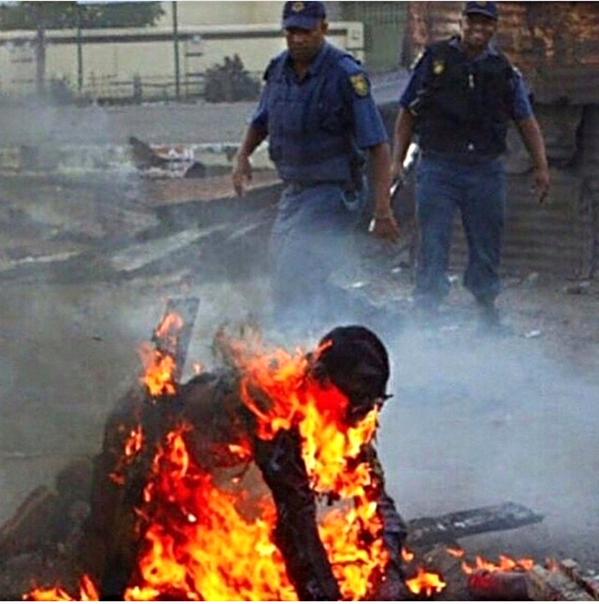
Protests against education in Afrikaans broke out at seven Soweto schools. In six of them however no subjects were taught in Afrikaans. Before long, 20 000 students went on a rampage through the streets, burning, destroying, killing and looting. Other whites working in Soweto, including women, were surrounded and assaulted. One white official (J.N.B. Esterhuizen) was stopped in his car and hacked to death! Police detachments were sent in to restore order but achieved little. They were attacked by stone-throwing crowds which also set police dogs alight.

At one of the riot scenes, a large group surrounded and closed in on a few policemen. The police opened fire and several hundred rioters, including rioting children, were shot in the mayhem which spread to the rest of the country and continued for months. (Die Burger, 16 June 2000).

This gratuitous violence gave the world the opportunity to brand South Africa as a “brutal police state” and a host of new international punishment measures were imposed on the country, which sanctions lasted until the late eighties. All of this is based on a false story, sent around the world by an antagonistic media. Will the truth of this day 16 June in South Africa ever prevail, and will the truth about the real George Floyd ever prevail as America’s racial hysteria sends out an inflamed message to the world?

—Salomé Oosthuizen
Xenophobia rules Soweto

The Mozambican man cowered, trying to protect his head, as the blows pounded his body on Tuesday.

The suspected thief, known only as Johannes, begged the growing crowd of angry residents of Snake Park, Soweto, to stop assaulting him.

But he and his alleged accomplice found no mercy from this impoverished community.

Its residents are “sick and tired of being victims” of crime.

“Today, we’re going to kill these Mozambican thieves,” said Sipho Ngwekazi licking his lips.

Almost to make his point, the unemployed 23-year-old pointed to a towering mine dump that looms over Block 1 in Snake Park.

“That’s where we’ll dump their bodies,” he vowed. “You’ll see what mob justice is all about.”

He and the rest of the mob were following as the two, the other called Petrus, were dragged to a house in Block 9, where they were believed to be hiding stolen TVs.

Their hands were tied with wire, their faces bloodied, as they were dragged for several kilometres in the searing heat.

“If you don’t give us the TVs, we’re going to burn you. That’s how we’ll kill you,” warned some residents.

“We have to take the law into our own hands. The police don’t care. They will just release them,” said Lindiwe Jonas, a resident of Block 2.

“Yes, we have to teach them a lesson… we will burn rope in the hands they used to steal from us,” said her friend, Esther Letswalo. “This is why we don’t want foreigners here in our community.”

A patrolling Dobsonville police van tried to follow the crowd through Snake Park’s dusty alleys.
Police back-up was called.

As the crowd bayed for his blood, Johannes, his shirt bloodied, and his one eye swollen and sealed shut, seemed to plead with the police to intervene as the crowd tried to get to him. The police then encircled him, probably because there were journalists present.

“We are taking them with us,” an armed policewoman informed the crowd. “We can’t allow mob justice.”
The police put the two men in their van and drove off.

The community roared, incensed.

“The law is useless,” spat one resident, who didn’t want to be named. “The police will just release them. They get away with it.”

Later a small group of residents threatened to burn the shacks of the men they suspected of being thieves.

Instead, they darted inside one of the men’s homes, where they were seen stealing jewellery.

Source: The Star

ANC to march on Eskom

The ANC in Johannesburg will lead a march of Soweto residents to Eskom offices in Diepkloof on Thursday. The march follows last Friday’s power cuts in Soweto which lasted for more than ten hours.

Meanwhile, many of Soweto’s resident feel entitled to free electricity as it was one of the things promised to them when the country gained democracy in 1994, a local told News24.

The man, who refused to be named, said the late former president Nelson Mandela’s promise of a better South Africa with free education, free electricity, free water and sanitation had not been realised.

“It’s sad he died without having had implemented those things,” the man told News24 on Wednesday.

He was speaking just days after the area of Orlando in Soweto had erupted in protests, with locals rejecting Eskom’s move to install prepaid electricity meters in the area.

Many of the locals have demanded a flat rate of R400, which would be less than they should be paying for power consumption.

One unemployed woman who owns a house in Orlando, Soweto, admitted to not paying the monthly bills which she received.

She did not want the prepaid meter to be installed in her yard either because it would probably mean paying for electricity.

Sowetans attack Eskom for blackouts

Eskom is under attack – by the City of Joburg and the regional ANC over the almost week-long spate of power outages in Soweto.

The council has slammed the power utility for inefficiency and for failing to deliver on its mandate.

The City of Joburg claimed areas supplied by its own utility, City Power, still had power, but those Eskom supplied did not.

“This is why new housing and business developments such as RDP houses, flats and hotels have power in the township, while the large part of Soweto supplied by Eskom has been cut off,” said Matshidiso Mfikoe, the city’s mayoral committee member for Environment and Infrastructure Services.

She accused Eskom of being “insensitive” and showing “complete and utter disregard” for the people of Soweto.

But Eskom spokesman Khulu Phasiwe said there was “nothing sinister” about the power outages.

He attributed the blackouts to load shedding and then, when the power was due to be switched on again, overloading that caused the transformer to trip.

“When you have in some houses four or five backrooms using stoves at the same time, there is absolutely no way that the power will hold.

“We can’t control unplanned outages resulting from overloading,” Phasiwe said.

Eskom has been involved in a long-running battle with Soweto consumers over unpaid bills. Phasiwe said Soweto owed Eskom about R8 billion, of which R4bn was overdue.

“Some 84 percent of residents have not been paying their debt. Ideally, you should be having 16 percent not paying and 84 percent paying,” Phasiwe pointed out.

A key dispute – related to the outstanding billing problem – is the installation of prepaid electricity meters in Soweto. Both Eskom and City Power are installing meters for their customers. There have been ongoing protests across Soweto against their installation. Last week, Orlando West residents blockaded streets in protest against Eskom’s prepaid meters.

Mfikoe accused Eskom of changing the payment system unilaterally. She suggested it was inconceivable that the prolonged outages could occur without notice “in the township internationally renowned as home to two Nobel peace laureates, Dr Nelson Mandela and Archbishop Emeritus Desmond Tutu”.

Source: IOL

Sowetans riot after power cuts

Residents of Orlando West, Soweto, who included pensioners, burnt tyres and protested against Eskom power cuts on Wednesday.

Johannesburg metro police spokesman Chief Superintendent Wayne Minnaar said the Klipspruit Valley and Khumalo Roads were affected.

”The protesters started at around 7am and are obstructing these roads, we advise motorists to use alternative roads such as Chris Hani Baragwanath and Elias Motsoaledi Roads,” Minnaar said.

The protesters placed rocks and burning tyres on the roads, preventing traffic flow in the area.

On Monday, hundreds of residents in the neighbouring Diepkloof protested over housing, obstructing the area between Chris Hani Baragwanath Hospital and the N12.

Looting black mother kills infant by falling on him

A black mother from Soweto was busy looting say witnesses when her baby – who was strapped to her chest – died.

She said she did not notice there was anything wrong with him until neighbours alerted her.

The black mother, Zanele Majozi, 19, was allegedly running out of a vandalised shop in Kagiso with a bottle of cooldrink over the weekend when neighbours noticed blood on her top, where her one-month-old baby’s face was resting.

They said the baby’s tiny hand was facing the wrong way around. They told Majozi to unstrap him. When she did, they saw he was dead.

“She screamed, cried and collapsed. She would hold the baby to her chest crying and then fall on the ground, on top of the baby. She would get up, cry again then collapse on top of the baby again,” said a witness, Phindile Shabangu.

Shabangu, Gugu Maphumulo and a 22-year-old man who declined to give his name said they saw Majozi approach with the mob.

Shabangu said when the mob arrived at the shop, the men broke down the door. The women, some of them in their nighties, started screaming in excitement.

The baby against her chest, Majozi disappeared into the shop with the looting mob, they said.

Later, Maphumulo saw her running out of the shop. A few moments later, she saw Majozi crying and collapsing on top of her dead child.

The 22-year-old man said Majozi was aware that something was wrong with her baby’s arm. But it was his mother who noticed that the baby, bleeding from his nose and ears, was dead.

Shabangu said she and the other women followed Majozi to the clinic to beat her for being an irresponsible parent after they cleaned the shop and hid the remaining goods.

The xenophobic looting of foreign-owned shops appears to be spreading across Johannesburg with two men killed in Langlaagte on Sunday night and a spaza shop set alight in Alexandra this morning.

Ethnic tensions flared last week while looting spread across several townships following the shooting of 14-year-old Siphiwe Mahori in Snake Park, Soweto by a Muslim foreign national.

Newborn baby eaten by dogs

A passerby found a black newborn baby being dragged by two dogs in Zondi, Soweto, on Sunday, Gauteng police said.

The passerby notified the police who found that the baby’s head had already been eaten by the dogs, Warrant Officer May Makhubela said.

The baby’s mother was unknown.

An inquest into the incident was opened and the baby’s body taken to a mortuary.

Motorists attacked by black mob in Soweto

Motorists who were attacked by riotous residents in Nancefield, Soweto, have told of their harrowing experience at the hands of a black mob that pelted them with bricks.

On Wednesday night, a female motorist got lost after dropping off a friend she attends church with and found herself in the middle of a violent mob.

In another case, a brick from the crowd hit the driver on the shoulder and someone punched him through the vehicle’s broken window.

Patrick Dama said he also felt someone trying to drag him out of the vehicle.

Dama and his passengers escaped, but his taxi, which was his only source of income, was torched. The protesters shattered his dreams.

“I did not do anything to them. We are not Eskom, we are just people who were coming from work,” the heartbroken man said.

Dama was travelling with three clients when he saw rocks on the road, but he did not think much of it.

He then saw people gathered further along the road and reversed.

Dama was suddenly attacked by people who had been hiding in the bushes.

“I just heard a brick hitting the windscreen and another one shattering my windscreen,” said Dama.

He said the minibus could not get into gear when he reversed. It stalled, and he and his passengers ran for it.

They met up with police, who accompanied them back to the vehicle, but it was gone.

The following morning, Dama found that his vehicle had been torched.

He looked at its charred remains with a heavy heart.

“I made a living with it. It was not insured because I did not have enough money. I had spent a long time looking for a job, that is why I started this transport business with my uncle. This is a messed-up situation,” he said.

A Pretoria resident got lost in the Nancefield area after dropping off a friend at the University of Johannesburg campus.

She was driving on a dark road that was barricaded with rocks when she heard people shouting.

Her car was pelted with rocks and bricks, but she drove on, hitting debris on the road.

Finally, she hit the pavement, two tyres burst, the car veered out of control and stopped. She got out and started running.

Police officers and a passer-by helped her.

According to Warrant Officer Kay Makhubela, in another incident, two men were taken out of their smashed-up vehicles and stripped to their underwear by the protesters, who also took their phones.

Source: IOL

Wife hacked to death

A black man from Soweto allegedly stuffed a cloth in his wife’s mouth so that she would not make any sound as he hacked her to death with an axe last week.

Andrew Letsholo allegedly struck his wife Palesa three times with an axe in their marital bed and left her there.

When the domestic worker and a neighbour discovered the body hours later, they were severely traumatised.

The helper, who had been working at the house for only three weeks, quit her job immediately and the neighbour’s health has taken a dip since the gruesome discovery.

A relative, who spoke on condition of anonymity, said when Letsholo left his house that morning, he told the helper that Palesa was ill.

Palesa’s mother Portia Nkosi found policemen all over the yard when she arrived.

After pushing past relatives, she was shocked at what she saw. Her daughter’s body lay lifeless on a bed, a hole in her forehead.

“I was confused. I still am confused. I walk around aimlessly, I don’t know how to feel,” she said.

Source: IOL

‘East Germany and the ANC shared a special bond’ – Deutsche Welle

Christine Müller
Christine Müller

East Germany and the African National Congress shared a special bond: not only the government, but also the public in the communist state supported the anti-apartheid movement in South Africa.

Heavily armed police forces pushing along black children and teenagers, beating them with clubs, shooting with live ammunition. The disturbing images of the Soweto Uprising shocked the world in June of 1976.

Some 15,000 students in the South African township protested against a new rule that said they’d only be able to take exams in Afrikaans, the language of most white South Africans. They accused the apartheid regime of massively limiting their access to education.

Authorities said 575 people died in the dispute, but the protesters themselves said the number of victims was much higher. Years of unrest followed and led to international protest.

Soweto as catalyst

For Christine Müller from Leipzig, then in communist East Germany, the Soweto uprising was a “defining moment.” She still remembers the effect the pictures had on her. “This rage enveloped me, because I felt so helpless,” Müller told DW. “I thought that we needed to do something immediately.”
Christine Müller

Christine Müller says seeing the pictures from Soweto made her feel ‘helpless’
She researched the topic and looked for fellow supporters. For decades, she worked in church groups that advocated solidarity with the anti-apartheid movement. Today, Müller is the head of the “One World” working group at the Protestant Church of Saxony. For Müller, her involvement is an expression of her Christian faith.
“‘Apartheid’ means exclusion,” she said. “And that’s not just about the victims of racism in South Africa, but more generally about the excluded, who don’t get a piece of the pie when it comes to wealth and power.”

Involuntary union of church and state

East German stamp exalting African wars of liberation

In East Germany, the Protestant church was a main source of political opposition. But the authoritarian government was also involved in the fight against apartheid. That made for an unusual alliance.
The communist leadership in East Berlin described its support for liberation movements as anti-imperialistic solidarity. But East Germany also had pragmatic goals at heart: the government wanted to raise its country’s profile on the world stage. Until the 1970s, it lacked diplomatic ties to western nations because democratic West Germany regarded itself as the only legitimate successor state to the wartime regime. West Germany’s Hallstein Doctrine of 1955 considered it an “unfriendly act” when other countries established diplomatic relations with the East.

Together with the US and Britain, West Germany was among the countries with the strongest ties to the apartheid regime in Pretoria. The West German Protestant church (EKD) was largely mute on the issue. Support for the African National Congress (ANC) and its imprisoned member Nelson Mandela tended to come from leftist groups. That led to angry disputes within the church.

In contrast, the East German government generally regarded any independent social movements as a threat. That didn’t make the anti-apartheid efforts of grassroots groups, or of the East German government, any less worthy, historian Ilona Schleicher said. In the face of the situation in Soweto and other examples of brutal violence against blacks, political persuasion and worldview weren’t of any importance, she said: “Every human being, no matter whether they oppose their state or not, reacts the same to those pictures if they’re really human: with compassion, solidarity and the desire to help.”

Fighting for democracy under communism

But the lack of democracy in East Germany cast a shadow over its anti-apartheid stance, Schleicher said: “They were fighting for something they didn’t have in their own country.” She experienced the anti-apartheid movement as the wife of an East German diplomat in southern Africa. That influenced her stance. “As a working-class child, I grew up with the promises of socialism,” Schleicher told DW. “For me, everything in East Germany looked right. The realization that many things were not in fact right in our country only came to me much later, and also because of the experiences we had abroad.”

On the ground in South Africa, she saw that the liberation fighters didn’t care about who helped them or what their motivation was. “What counted was the actual support.” The ANC profited from East German support in various ways. Instructors and teachers worked in ANC training centers in Tanzania and universities in East Germany accepted black South African students. To make this possible, the official Solidarity Committee collected donations in the population.

When the ANC began using violence against its oppressors in the 1960s, East Germany continued to support it. The Solidarity Committee sent paramilitary equipment including camouflage fabric, binoculars and rubber boats. And instructors trained more than 1,000 resistance fighters in Africa, but also in a secret military camp in the East German village of Teterow.

Apartheid support in West Germany

At the same time in West Germany, companies like Daimler-Benz, Siemens and Deutsche Bank invested in South Africa, and thus provided a form of support to the apartheid regime and its violations of human rights – knowing that they had the West German government on their side.

ANC supporters in the East did experience a crisis of conscience, Müller said: “That was the problem for many of my fellow Christians who said ‘We can’t support our government’s anti-imperialistic politics.'” That’s why she was even happier when the apartheid laws were abandoned in 1990, the year East Germany itself ceased to exist, and in 1994, when Nelson Mandela was elected as the first black president. Müller said that was a nice affirmation for her efforts, even though things are far from perfect in South Africa. – Deutsche Welle

Soweto man arrested for murder in Houghton

Handgun_.45 semi-autoPolice have made a breakthrough in arresting a suspect (40) linked to the murder of Lawrence Moepi who was killed in the parking lot of his auditing firm in Houghton on the 18 October 2013. A suspect who was arrested in Soweto on Saturday morning is due to appear at the Johannesburg Magistrate Court on Monday on charges of murder.

A breakthrough came following an investigation by the provincial investigation team who are also following several leads to arrest the second suspect. Moepi was allegedly followed into the parking lot of his then auditing firm, Sizwe Ntsaluba Gobodo, and fatally shot whilst he was getting out of his sedan. The suspects fled the scene in a VW sedan. An investigation is continuing to establish the motive for the killing. – South African Police Service

Sowetan grandfather held for raping granddaughter

rape_girls_feetA 77-year-old man has been arrested for allegedly raping his grandchild in Klipspruit, Soweto, police said on Thursday.

The one-year-old’s mother discovered the child had been sexually abused while bathing her on Wednesday afternoon, said Captain Mpande Khoza.

“The child’s mother said her father was a suspect because he used to rape her when she was 12. She’s now 18.”

She had left the child in the care of her mother. Khoza said the man was a Mozambican, but had a South African identity document.

He would appear in the Protea Magistrate’s Court on Friday. – Sapa

Soweto teacher arrested for raping his 10-year old pupil

boy-sad_300A teacher has been arrested for allegedly raping a 10-year-old pupil in Mapetla, Soweto, on Thursday, police said.

The 44-year-old man allegedly told two boys to stay behind after school on Wednesday as punishment for damaging school books, Captain Mponde Khoza said.

He ordered the boys to lie on the floor of a classroom, then let one boy go.

“He then ordered the remaining boy to take his pants off while the teacher was sitting half-naked on a chair.”

He allegedly raped the boy and let him go home, Khoza said. The boy told his mother what had happened after he arrived home late. The teacher was arrested on Thursday morning. He would appear in the Protea Magistrate’s Court on Friday, said Khoza.

Soweto woman held over stolen car

Toyota-Yaris_2007_800x600_wallpaper_02A woman was arrested in Zola, Soweto, on Thursday morning after police received a tip-off that a stolen car was parked in her yard, Gauteng police said.

The car, a blue Toyota Yaris, was reported stolen in Middelburg, Mpumalanga, earlier in the week, Warrant Officer Kay Makhubela said.

The car was recovered and the 28-year-old woman would appear in the Protea Magistrate’s Court on Friday. – Sapa