Stellenbosch promises to ‘remove racists’

Rector and vice-chancellor Professor Wim de Villiers promised Parliament’s portfolio committee on higher education and training on Tuesday Stellenbosch University would root out “racists”.

Stefan Lang, the outgoing SRC chairman, having to rush through his address in order to provide committee members the chance to respond to the university’s presentation, reiterated that the SRC was focussed on “celebrating diversity”, a euphemism for black monoculture.

“Our vision is to create a welcoming ethos and anything that is against that must be removed,” he said.

“Our journey is imperfect, incomplete but we remain steadfast,” said De Villiers.

De Villiers, along with the rest of Stellenbosch University’s management were called before the Portfolio Committee to respond to allegations of racism made in an online documentary called “Luister” recently.

The 35-minute video has been trending on social media since its release last month.

“I watched ‘Luister’ with my wife… it was uncomfortable and upsetting,” said De Villiers. “I do not enjoy knowing that students – my students – are suffering. It is painful.”

The student movement, Open Stellenbosch, was first to post the film online. It documented 34 students and a staff member’s accounts of racism on campus. De Villiers said he would not “attempt to defend the indefensible”.

“It’s wrong. Racism, discrimination, human rights violations, exclusion and marginalisation are wrong,” he said.

However, De Villiers pointed out certain “nuances” omitted from “Luister” and in the dialogue that followed thereafter. Among these, De Villiers said clarification on off-campus incidents had not been made and that Elsenburg, a campus mentioned in the documentary, was in fact not part of Stellenbosch University.

The “activist group” Open Stellenbosch on Tuesday embarked on a protest march to coincide with university management appearing before MPs to account for the institution’s transformation policies.

The group has bemoaned the university’s use of Afrikaans as a medium of instruction, charging that this was devised to safeguard Afrikaner culture at the expense of black students.

Last week a documentary titled Luister, which captured black students’ plight at the university, caused ripples in Parliament and the government. Following its airing, the university’s management was ordered to appear before Parliament’s committee on higher education to explain themselves.

Source: IOL/ Business Day
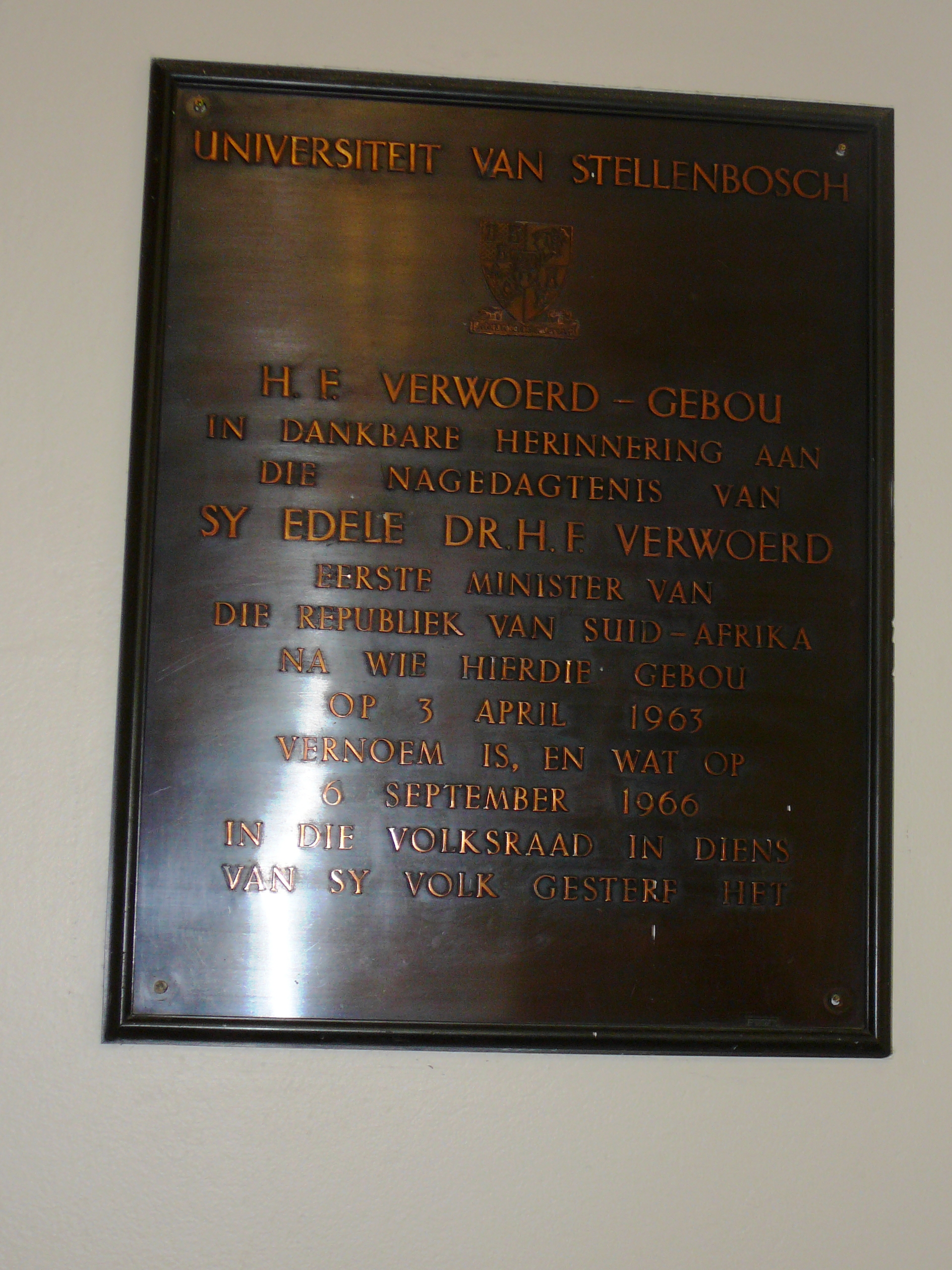
Letter: Verwoerd deserves respect and recognition at Stellenbosch

Professor Wim de Villiers
Rector
University of Stellenbosch
Private Bag X1
Matieland
7602

Dear Dr de Villiers

I am an old Matie who was taught by your father Sakereg (Law of Property) and Romeinse reg (Roman Law) in the late 1960s. I am writing to you in order to express my displeasure at your recent decision to remove a plaque commemorating a former graduate and professor of Sociology and Social Work at the university, Dr Hendrik Frensch Verwoerd.

During his term of office as prime minister, the South African economy grew at an average rate of 6% per annum compared to the current rate of 1.3%. Inflation was 2% per annum and black unemployment was 5% compare to the official figure of 26.4%, Cosatu’s figure of 36% and a fairly recent study of UNISA which gave an estimate of 40%. During the era of Verwoerd the Gini co-efficient which measures the distribution of each country’s national income, a measurement established in 1912 and recognised by the United Nations and other international organisations, the ratio was at the average of .45. To-day as a result of the corruption, incompetence, mismanagement and greed of the ANC, South Africa has the worst ratio in the world at .70.

During Dr Verwoerd’s premiership the average number of murders was 60 per annum and that figure includes the Sharpeville deaths of 69. According to the United Nations Statistical Year Book since 1994 an average of 20,000 persons have been murdered annually. Dr Verwoerd had an unblemished character and an impeccable record of public service, which may be compared to the current president who has over 700 criminal charges outstanding against him.

Dr Verwoerd was a devout conservationist and innate lover of nature. When the Transvaal Roads Department wanted to remove a giant harpephyllum tree which lay in the path of the proposed national road near Zoutpansberg, he instructed the department to build the road around the tree. When some shady businessmen tried to privatise the western half of the Kruger National Park for cattle ranching, he intervened immediately and forbad any changes to the boundaries of the park.

Dr Verwoerd was not the architect of apartheid, which was also known as separate development. That honour falls to Sir Harry Smith, governor of the Cape Colony, who created the first Bantustan of British Kaffraria on 23 December 1847. 80% of the so called apartheid laws were enacted by the Dutch and British colonial governments, such as the Cape Dutch laws of 1685 and 1743 which prohibited miscegenation amongst the different races. A further 10% of these apartheid laws were promulgated by the Botha/Smuts administrations, such as the Natives Land Act of 1913. The National Party was responsible for less than 10% of these laws, most of which made de jure what were already de facto customary laws. All these laws were drafted not with malice, but as a means for protecting the vital interests of the indigenous population, for the maintenance of their tribal hierarchies and to shield them from the depredations of the international bankers.

By tampering with our heritage nothing positive will be achieved. Pandering to the politically correct dictates of the liberal left is a soulless exercise which will only make matters worse in the long run, when demands may well be made to abolish Afrikaans as a language of tuition. Dr Verwoerd made a notable contribution to the development of our country. All the people of South Africa experienced an unparalleled period of peace and prosperity, and for that singular accomplishment he deserves recognition.

Did the alumni have any input in your decision? If not, why were they not consulted? It is our university just as much as it is yours; or is it simply a case of that we may make donations, but may not have any say in the philosophy and traditions of the university.

Yours sincerely

S M GOODSON

The writer of this letter is a graduate and member of the Convocation of the University of Stellenbosch. The original version of the letter was posted to Professor de Villiers on 6 May 2015. To date neither an acknowledgement nor a response has been received.