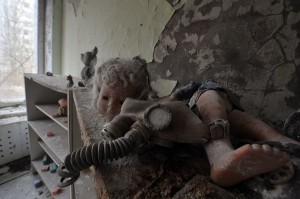
 The 1986 Ukrainian nuclear disaster of Chernobyl was in nuclear weapons-equivalent terms a very large-sized nuclear device, probably releasing 130 kilograms of very highly enriched uranium and plutonium, as well as other long-lived deadly nuclides.
In very approximate terms this was equivalent to about 15 times the radiological inventory of the 1945 Hirsoshima A-bomb. Economic damage to date from the Chernobyl disaster which requires a 2827 square kilometer total exclusion zone, is variously estimated at $350 – $500 billion, with at least 30 000 fatalities to date across Europe.
Despite the Ukraine having known, proven and published natural gas reserves able to cover about 185 years of national gas consumption, for conventional gas reserves, and about 600 years when probable unconventional gas reserves are included, the country was designated by the Soviet Union as needing intensive development of nuclear power. From the late 1960s, nuclear power was developed on a massive basis.
As of 2009, according to the World Nuclear Association, total electricity production was about 50% nuclear and this nuclear supply amounted to about 87 billion kWh. Only 20% of Ukraine’s power supply was gas-based, with 4 billion kWh net exported. Ukraine’s hydropower resources, which have been treated like gas as “poor cousins”, but are large, contributed about 9.3% of electricity generation in 2009, according to the WNA.
All of Ukraine’s remaining 15 civil-type reactors still in service are Russian VVER types, two being 440 MW models, and the other 13 larger 1000 MW units. All of these reactors are potentially “dual use”, due to their original format – exactly like US Westinghouse industry standard 900 MW reactors – derived from Soviet nuclear submarine and nuclear ship reactor models, the design requirements of which demand very high power densities without consideration of plutonium production during their service lifetimes, or the reprocessing of “reactor core pollutants”. Being semi-military design, spunoff plutonium was regarded as a bonus rather than handicap.
The original Soviet design lifetime for VVER reactors was 30 years. The more-dangerous or “naked reactor” Soviet design format, called RBMK, as used at Chernobyl, have since 1997 all been closed down in the Ukraine, but not fully decommissioned.
As many as 15 new reactors of around 1000 MW capacity each with much higher safety standards were “proposed and part funded” in a 2006 Ukrainian energy plan, but none of these reactors were ever completed, although some are in part-completed condition. Significantly, reactor development strategies published by Ukraine’s Energoatom, the state semi-private atomic energy corporation, envisage the possible replacement of unfinished PWR-type reactors by Canadian CANDU heavy water reactors – the type utilized by both Pakistan and India to “brew” sufficient weapons grade plutonium to clandestinely produce their atomic weapons. Reasons for possibly using CANDU reactors notably included the ability of these reactors to operate on the low-clarke or low quality of uranium ore reserves in Ukraine.
Since independence from the USSR in 1991 attempts were made to “close the nuclear fuel cycle”, that is to fund, build and operate nuclear fuel reprocessing facilities and long-term nuclear waste disposal facilities, rather than continue simply storing used fuel rods and nuclear wastes on site – as at Fukushima. This failed civil-sector attempt to reduce the very large residual nuclear pollution resulting from the Chernobyl disaster (1986) and accumulated “temporary measures” for used fuel rod and waste disposal, has been joined by explicitly military-nuclear attempts at reducing the quantities of weapons-capable nuclear material in Ukraine.
In 2013, a four-year Ukraine-NATO project started with the aim of cleaning up radioactive waste at 9 military facilities in the country, with a 25 million euro budget.
Collected and regrouped wastes were scheduled to be buried in the Chernobyl total exclusion zone. Since 2011, very high-level military nuclear wastes originating in Ukraine are scheduled to be “repatriated” to Russia, for burial in Russia’s central dry storage facility. This program which was never funded is now evidently on hold, since late February 2014
A new facility for treatment solid radioactive waste is under construction at the site of Zaporozhe nuclear power plant, to be commissioned in 2015. It will be fitted with a state-of-the-art nuclear waste incinerator of Danish design but this program has suffered from lack of political commitment inside the country, and lack of funding from EU sources. The completion date is only “indicative” and the program is also now on hold.
The Nuclear Threat Initiative (NTI), and its linked World Institute for Nuclear Security (WINS) has tracked the heavily-funded but semi-secret US-Russian Cooperative Threat Reduction project started in 1991 and aimed at repatriating thousands of nuclear warheads and military-nuclear materials, both short-range and long-range, that the USSR had spread between Russia, Belarus, Ukraine and Kazakhstan. While Belarus and Kazakhstan agreed in short order to give up their nuclear weapons, Ukraine initially refused.
In 1992, however, the Ukrainian government recognized it lacked both the resources and the technical know-how to maintain its status as a nuclear-armed nation, and its “inherited” nuclear weapons were literally two-edged swords. It then engaged to repatriate its entire stock – but also demanded financial compensation terms that Russia refused. As cited in interview with Associated Press, former Ukrainian president Leonid Kravchuk said that Russia “….threatened us with all kinds of economic sanctions, they wanted to get this issue over with fast”.
The financial haggling with Ukraine has continued although it is denied or qualified as unimportant by both sides, and by US observers. The haggling led to Russian general Alexander Lebed, in 1997, stating that Ukraine’s military was unable to account for dozens of “compact” or small-sized short-range nuclear devices.
The general gave differing figures regarding the count of lost or stolen weapons, but the Kremlin dismissed his allegations. Leading US politicians cited by NTI claim that the simple absence of “no nuclear detonations by terrorists or organized crime” is the proof that Lebed was being too pessimistic and the program has worked.
Ukraine is therefore a deadly storehouse of dangerous reactors, including the crippled Chernobyl reactor which as yet, to date, does not have a final entombment sarcophage.
Nuclear wastes, in Ukraine, are widely dispersed and poorly accounted for. The country could or might have a certain number of operational or repairable smaller-sized nuclear warheads, the radioactive materials of which also makes them prime assets for the production of “dirty bombs”, that is non-explosive nuclear waste-dispersing weapons.
This is serious business, so Washington’s diplomatic suicide-run to derail nuclear cooperation with Russia through START should raise alarms for anyone genuinely concerned about moving the globe towards a peaceful future.
Source: 21stcenturywire.com

 Ukraine’s volatility exacerbates the risk for the country’s 15 Soviet-style nuclear reactors, warn German experts. They demand more attention for the country where the world’s worst nuclear accident took place.


