
America’s infrastructure crisis: Israel, Iran and the growing pressure on Washington

America’s nationwide aviation shutdown has exposed serious weaknesses in its ageing infrastructure. Meanwhile, Israel’s Mossad chief has travelled to Washington as Benjamin Netanyahu presses Donald Trump to resume military action against Iran.

The nationwide grounding of US flights has exposed serious weaknesses in America’s ageing infrastructure, while a high-level visit by Israel’s Mossad chief to Washington has highlighted the growing pressure on Donald Trump to resume military action against Iran.

The United States experienced one of its most significant aviation disruptions in decades on Friday, November 13, when the Federal Aviation Administration (FAA) ordered a nationwide ground stop following a breakdown in its air traffic communications network.

The shutdown lasted almost five hours and affected more than 20,000 flights. Seventeen of the FAA’s 22 en-route air traffic control centres experienced communications problems, disrupting the systems used to coordinate aircraft movements and radar information.

Although flights subsequently resumed, the incident exposed the vulnerability of critical American infrastructure and raised fresh questions about the country’s ability to maintain and modernise essential technological systems.

An ageing system brought to a standstill

US Transportation Secretary Sean Duffy attributed the disruption to a technical failure during routine maintenance work carried out by L3Harris, a longstanding contractor responsible for operating the FAA’s telecommunications network.

The work involved replacing ageing copper telecommunications lines with fibre-optic connections. According to Duffy, a router associated with the upgrade began generating an extraordinary number of connection attempts, overwhelming other routers in the network.

Officials reported more than 1,000 connection attempts every four to five seconds.

The resulting instability affected communications between air traffic controllers and aircraft, as well as radar feeds. The FAA consequently decided to ground departing flights nationwide as a precautionary measure.

Duffy said investigators were examining whether the incident resulted from human error, faulty installation or defective equipment. No definitive technical cause had yet been established.

The administration also stated that there was no indication of a cyberattack or deliberate hostile action.

The incident nevertheless highlighted a wider problem: parts of America’s air traffic control infrastructure remain dependent on equipment and telecommunications systems that are decades old.

Congress has already approved substantial funding for modernisation, but the transition has been slow and technically complicated.

The episode raises questions about the resilience of infrastructure that is essential not only to commercial aviation but also to the functioning of the world’s largest economy.

Netanyahu presses Trump over Iran

While Washington was dealing with the aviation crisis, another development was unfolding in the relationship between the United States and Israel.
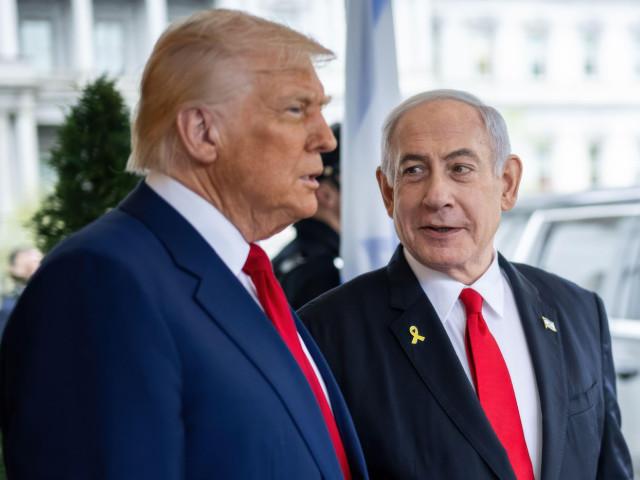
President Trump and Israeli prime minister Benjamin Netanyahu

According to a report by Axios on November 13, Mossad director Roman Gofman was in Washington for discussions with senior Trump administration officials concerning the war with Iran.

Gofman was reportedly scheduled to meet CIA director John Ratcliffe and was also expected to travel to Miami for discussions with White House envoy Steve Witkoff.

The visit coincided with renewed pressure from Israeli Prime Minister Benjamin Netanyahu for the United States to resume military operations against Iran.

Trump has so far resisted this pressure, although his position on the conflict has fluctuated. Reports have described disagreements over whether to continue diplomatic efforts or return to a more extensive military campaign.

The Israeli government considers Iran’s military and nuclear capabilities an existential security concern. Washington, meanwhile, must weigh the consequences of renewed hostilities, including the possibility of a wider regional conflict, disruption to energy markets and further American military commitments.

The presence of the Mossad director in Washington therefore illustrates the extent to which intelligence and military cooperation form part of the relationship between the two countries.

It also raises an important question about the degree of influence Israel exercises over American strategic decision-making.

Intelligence cooperation and political pressure

The relationship between American and Israeli intelligence agencies has traditionally been close. Cooperation between the CIA and Mossad covers a range of regional security issues, including Iran, counterterrorism and intelligence gathering.

However, cooperation does not necessarily imply agreement over every strategic decision.

The reported Washington visit comes at a particularly sensitive moment. Israel wants to prevent Iran from consolidating its regional military position, while the Trump administration faces the economic and political consequences of prolonging a costly conflict.

The question is whether American foreign policy is being determined primarily by Washington’s assessment of its own national interests or increasingly by the strategic priorities of a close regional ally.

This is a legitimate subject for public debate, particularly when decisions about war and peace are involved.

There have also been allegations and speculation in political circles about possible intelligence leverage, blackmail and pressure exerted on American political leaders. However, no independently verified evidence has established that Mossad is blackmailing Trump or that Israeli intelligence has been responsible for the recent American infrastructure disruptions.

Such allegations should not be confused with the documented diplomatic and political pressure surrounding the Iran conflict.

Is America becoming more vulnerable?

The FAA incident and the renewed diplomatic activity surrounding Iran are separate developments. There is currently no evidence connecting the aviation shutdown to Israel, Mossad or the conflict in the Middle East.

Nevertheless, both events illustrate different aspects of the challenges confronting the United States.

On the domestic front, an advanced industrial economy remains dependent on ageing infrastructure that can be disrupted by relatively isolated technical failures.

On the international front, Washington faces competing strategic priorities and pressure from allies whose regional objectives do not necessarily coincide with American interests.

The United States possesses enormous military, technological and economic resources. Yet the ability to project power abroad ultimately depends on the reliability of institutions and infrastructure at home.

The question facing Washington is therefore not simply whether it should resume military action against Iran. It is whether American foreign policy can remain independent, coherent and sustainable while the country struggles to modernise the systems upon which its own security and prosperity depend.

For a country that has long presented itself as the guarantor of international stability, these are questions that cannot easily be ignored.

PRAAG — November 15, 2026

US headed for a collision with Israel

Patrick J. Buchanan says the US is headed for a collision with Israel as serious as Suez ’56, and they are about to see what Barack Obama is made of.

In November 1956, President Eisenhower, enraged he had not been forewarned of their invasion of Egypt, ordered the British, French and Israelis to get out of Suez and Sinai. They did as told.

How far we have fallen from the America of Ike and John Foster Dulles has been on painful display this March.

An Israeli leader told a joint session of Congress that President Obama’s nuclear deal with Iran is stupid and dangerous and must be rejected. Congress gave him 40 ovations.

Bibi Netanyahu then went home and told the world there will be no Palestinian state, and was re-elected in a smashing victory.

“Perhaps it’s time for Americans, especially those in the White House, to recognize this new reality of Israeli politics,” says The Wall Street Journal. We should restore “Israeli confidence in U.S. support.”

Excuse me? Who is the senior partner here? Who needs whom more?

Israel is entitled to choose its own leaders, who are entitled to make their own policy. But that goes for us as well.

We are today headed for a collision with Israel as serious as Suez ’56, and we are about to see what Barack Obama is made of.

The days of self-delusion are over. For was there ever a doubt where Bibi stood? In 1994, he denounced the Oslo Accords in a speech interrupted by chants that Prime Minister Yitzhak Rabin was a “traitor.”

Did anyone think Bibi, who opposed Ariel Sharon’s withdrawal of Israeli settlers from Gaza, was going to withdraw tens of thousands of Jewish settlers from Judea and Samaria, share Jerusalem with a Palestinian state, or allow the return of Arab refugees to what Bibi says is the “Jewish state”?

“Arab voters are coming out in droves to the polls. Left-wing organizations are busing them out,” said Bibi on his Facebook page in Hebrew, according to a translation by Haaretz.

That’s the real Bibi. We have clarity now.

What should Obama do?

Drop the petulance, call and congratulate Bibi on his election and tell him we are proceeding with the Iran deal — if we conclude it accords with our interests. And if he attempts to sabotage or scuttle the deal, he should expect political and economic retaliation.

Bibi is looking out for Israel first. America needs a president like Ike who will start looking out for America first.

It appears we are at a moment of truth worldwide.

[…]

The Chinese are launching an Asian Infrastructure Investment Bank as a rival to the U.S.-dominated World Bank. Despite our pleas, Britain, France, Italy and Germany are rushing to sign on as charter members. South Korea and Australia may follow.

Our allies are looking to pick up contracts for the construction projects for the new Chinese “silk road” from Asia to Europe.

The AIIB will have $50 billion in startup cash, a pittance to a China sitting on a hoard of $3 to $4 trillion in cash reserves, from decades of huge trade surpluses run at the expense of the United States.

Virtually all our Asian allies do a larger share of their trade with China than with us. They want to buy from and sell to China, and stay in Beijing’s good graces. But if menaced by China, they want the United States obligated by treaty to come and fight for them.

One understands why this is in their interests. But why is it in ours?

Nor is the Middle East any different.

Mossad contradicts Bibi’s bom

Israeli PM Benjamin Netanyahu’s 2012 statement at the UN, in which he warned the world of Iran being too close to making a nuclear bomb, allegedly contradicted his country’s intelligence assessments, according to leaked spy documents.

The Mossad shared the information with South Africa’s State Security Agency a few weeks after the prime minister’s UN speech.

Netanyahu famously declared to the United Nations General Assembly in September 2012 that Iran was 70 percent of the way to completing its “plans to build a nuclear weapon,” and drew another “red line” at 90 percent, claiming Tehran’s first bomb would be ready “by next spring, at most by next summer.”

However, leaked Mossad documents suggest the country was much further from such development.

According to Spy Cables – a cache of hundreds of leaked secret intelligence papers from all over the world, published by Al Jazeera’s Investigative Unit in collaboration with the Guardian newspaper – at the time of Netanyahu’s statement, Israel’s intelligence service concluded that Iran was “not performing the activity necessary to produce weapons,” estimating that Iran had 100 kilograms of uranium enriched to a level of 20 percent.

“Even though Iran has accumulated enough 5 percent enriched uranium for several bombs, and has enriched some of it to 20 percent, it does not appear to be ready to enrich it to higher levels. It is allocating some of it to produce nuclear fuel for the TRR [Tehran Research Reactor], and the amount of 20 percent enriched uranium is therefore not increasing,” said the secret report.

In an article by Press TV, an American foreign policy analyst said that US President Barack Obama is “under pressure” to reach an agreement with Iran over Tehran’s nuclear energy program.

“It’s quite obvious to everyone that Mr. Obama would like to have a deal with Iran,” said James George Jatras, a former US diplomat and adviser to the Senate Republican leadership.

“He’s under a lot of pressure to try to bring negotiations to a conclusion that he can defend domestically,” Jatras said Sunday during a phone interview with Press TV.

“I doubt very much that the United States would walk away from the negotiations because this is such a strong priority for Mr. Obama who otherwise has very little to show in the realm of foreign policy,” he added.

US Secretary of State John Kerry and Iranian Foreign Minister Mohammad Javad Zarif began a new round of talks in Geneva on Tehran’s nuclear program on Sunday.

Israel approves plan to build 1 000 settler homes in E. Jerusalem

The Israeli government has approved plans to build over 1,000 new settler homes in East Jerusalem. It will expand two existing Israeli settlements on part of the territories seized in 1967.

An official in Prime Minister Benjamin Netanyahu’s office declined to comment on the possible political and diplomatic impact. He said on Monday that “The government has decided to advance the planning of more than 1,000 units in Jerusalem – roughly 400 in Har Homa and about 600 in Ramat Shlomo,” as cited by Reuters.

Israeli settlements in East Jerusalem

He also said that plans would be “advanced for infrastructure projects in the West Bank that will include roads for the Palestinians.”

However, Palestinians regard the holy city of Jerusalem as a future capital of their state and strongly oppose any Israeli expansion. According to Reuters, in a statement the Palestinian chief negotiator Saeb Erekat said that “We strongly condemn the latest Israeli announcement to expand its illegal settlements in and around occupied East Jerusalem, the capital of the State of Palestine.”

“This announcement amounts to evidence of an intent to further commit crimes defined by, and punishable under international law,” he added.

The new plan isn’t welcomed by some Israeli politicians. Israeli Finance Minister Yair Lapid of the centrist Yesh Atid party told Reuters the settlement building “should not be promoted now because there is a crisis with the US and the world.”

“There is never a good time to do such things, now more than ever as Jerusalem is burning,” Lior Amichai of the settlement watchdog Peace Now told AFP. He added that it was unclear at what stage the Israeli plans were, or how close they were to construction.

The international community hasn’t shown any support for Israeli settlement building. Relations with Israel’s traditional ally the US have also become strained over public criticism of US foreign policy by Israeli officials.

Palestine warns about increasing tension

The latest Israeli moves come after Palestinian Authority President Mahmoud Abbas sent an “urgent letter” to US President Barack Obama concerning the “dangerous Israeli escalation” in East Jerusalem on Sunday night, reported the Jerusalem Post.

According to a statement released by the president’s office in Ramallah, Abbas warned that a “wider explosion that cannot be controlled,” could be triggered by Israel’s recent measures, including the suggestion to allow Jews to pray at the Temple Mount compound.

The Palestinian President also blamed the Israeli government for the “dangerous escalation”; the recent clashes between Israeli security forces and Palestinian rioters in East Jerusalem this weekend. Hundreds of Palestinians marched in several neighborhoods of the city, throwing stones and firecrackers at Israeli police, and 18 arrests were made, according to Haaretz.

Last week’s clashes marked a new wave of tension that has been running high since June. That’s when three Israeli teenagers were abducted and killed by Palestinian militants in the West Bank, and Israeli extremists responded with the abduction and killing of a Palestinian teenager in East Jerusalem. The riots contributed to the 50-day Gaza war that claimed the lives of over 2,000 people, most of them Palestinians.

It is a sidestep by Netanyahu’s office, as the ultranationalist Jewish Home party and its leader Economy Minister Naftali Bennett, has been pressing the Prime Minister to call for 2,000 new building tenders.

When genocide is permissible by Yochanan Gordon

In this controversial text first published by Times of Israel, an American Jew argues that genocide of the Palestinians would be justified if that were the price of ‘restoring quiet’ in Israel

Judging by the numbers of casualties on both sides in this almost one-month old war one would be led to the conclusion that Israel has resorted to disproportionate means in fighting a far less- capable enemy. That is as far as what meets the eye. But, it’s now obvious that the US and the UN are completely out of touch with the nature of this foe and are therefore not qualified to dictate or enforce the rules of this war – because when it comes to terror there is much more than meets the eye.

Yochanan Gordon
Yochanan Gordon

I wasn’t aware of this, but it seems that the nature of warfare has undergone a major shift over the years. Where wars were usually waged to defeat the opposing side, today it seems – and judging by the number of foul calls it would indicate – that today’s wars are fought to a draw. I mean, whoever heard of a timeout in war? An NBA Basketball game allows six timeouts for each team during the course of a game, but last I checked this is a war! We are at war with an enemy whose charter calls for the annihilation of our people. Nothing, then, can be considered disproportionate when we are fighting for our very right to live.

The sad reality is that Israel gets it, but its hands are being tied by world leaders who over the past six years have insisted they are such good friends with the Jewish state, that they know more regarding its interests than even they do. But there’s going to have to come a time where Israel feels threatened enough where it has no other choice but to defy international warnings – because this is life or death.

Most of the reports coming from Gazan officials and leaders since the start of this operation have been either largely exaggerated or patently false. The truth is, it’s not their fault, falsehood and deceit is part of the very fabric of who they are and that will never change. Still however, despite their propensity to lie, when your enemy tells you that they are bent on your destruction you believe them. Similarly, when Khaled Meshal declares that no physical damage to Gaza will dampen their morale or weaken their resolve – they have to be believed. Our sage Gedalia the son of Achikam was given intelligence that Yishmael Ben Nesanyah was plotting to kill him. However, in his piety or rather naiveté Gedalia dismissed the report as a random act of gossip and paid no attention to it. To this day, the day following Rosh Hashana is commemorated as a fast day in the memory of Gedalia who was killed in cold blood on the second day of Rosh Hashana during the meal. They say the definition of insanity is repeating the same mistakes over and over. History is there to teach us lessons and the lesson here is that when your enemy swears to destroy you – you take him seriously.

Hamas has stated forthrightly that it idealizes death as much as Israel celebrates life. What other way then is there to deal with an enemy of this nature other than obliterate them completely?

News anchors such as those from CNN, BBC and Al-Jazeera have not missed an opportunity to point out the majority of innocent civilians who have lost their lives as a result of this war. But anyone who lives with rocket launchers installed or terror tunnels burrowed in or around the vicinity of their home cannot be considered an innocent civilian. If you’ll counter, that Hamas has been seen abusing civilians who have attempted to leave their homes in response to Israeli warnings to leave – well then, your beginning to come to terms with the nature of this enemy which should automatically cause the rules of standard warfare to be suspended.

Everyone agrees that Israel has the right to defend itself as well as the right to exercise that right. Secretary General Ban Ki Moon has declared it, Obama and Kerry have clearly stated that no one could be expected to sit idle as thousands of rockets rain down on the heads of its citizens, placing them in clear and present danger. It seems then that the only point of contention is regarding the measure of punishment meted out in this situation.

I will conclude with a question for all the humanitarians out there. Prime Minister Benjamin Netanyahu clearly stated at the outset of this incursion that his objective is to restore a sustainable quiet for the citizens of Israel. We have already established that it is the responsibility of every government to ensure the safety and security of its people. If political leaders and military experts determine that the only way to achieve its goal of sustaining quiet is through genocide is it then permissible to achieve those responsible goals?

Palestinian civilians props in a public relations war

Israeli commanders are trying to strangle Hamas from all directions. But the only certainty is that Gaza’s hospitals become more crowded by the day.

As I pointed out on November 23, 2012, “Hamas hides among unwitting civilians, who have no way of controlling its activities. This fact does not give Israel the right to kill innocent non-combatants, not even unintentionally. Besides, murder is not ‘unintentional’ when you know it is inevitable.”

ilanaStill, from the fact that the Palestinian side sustains more casualties—it does not necessarily follow that they are the innocent party in the dispute. It’s not Israel’s fault, moreover, that its population is well-protected by rocket-repelling technology, mandatory bomb shelters and that Israelis benefit from an all-round, well-organized emergency response. Who among us would tolerate living with a constant barrage of bombs from our neighbors? If Gaza, which was ceded by Israel to the dogs of war (Hamas), has nothing by way of safety infrastructure, it is because its leaders invest in terrorism instead of in trade.

Ultimately, and as National Post’s Lorne Gunter astutely observed many years ago, “If Palestinians stopped their attacks today, tomorrow there would be no Israeli attacks.” But if Israel stopped unilaterally, Palestinians would be at it again in no time.

Into the Cannibal's Pot

The latest developments, via DEBKAfile: “Israel air, sea and artillery pounded the Gaza Strip Thursday night, July 17, as IDF ground forces embarked on a ground attack, just announced by Prime Minister Binyamin Netanyahu. Debkafile reports a softening-up operation to prepare for the entry of armored and infantry units. The IDF calls on the half million Gazans of southern towns of Khan Younes and Rafah to leave their homes for their own safety. Israelis living close to the Gaza border were advised to stay in bomb shelters.”

By the Telegraph’s telling, “Israel’s leaders are grimly aware of the risks they are taking by sending troops to fight in the crowded alleys of Gaza. Now that their forces are embroiled in this urban maze, they will lose much of their technological advantage against Hamas gunmen. One Israeli soldier was duly killed within hours of the invasion starting.”

Yet Benjamin Netanyahu, the Israeli prime minister, believes that a ground operation is the only way to stop the rocket attacks. Meanwhile, Mr Masri made clear that the Hamas viewed it as a chance to inflict casualties on its enemy. “The Zionist army is very surprised by what the resistance possesses,” he said. “The resistance attacked tanks and Humvees with missiles and went behind enemy lines to conduct intelligence operations.”
But Israel is now fighting Hamas by land, sea and air. Two jet fighters soared overhead like silver arrowheads yesterday, scattering decoy flares across a cloudless summer sky.
Sa’ar Class missile boats from the Israeli navy have grown bold enough to pound their targets from close to the shore, although Hamas struck back with a missile that fell just short of its target, sending up a plume of white water.
Israeli commanders are trying to strangle Hamas from all directions. But the only certainty is that Gaza’s hospitals become more crowded by the day.

I tend to agree with Hamas that “Israel’s ground offensive is ‘foolish’ and will have ‘dreadful consequences.’” Since the Hamasniks consider their population no more than props in a public relations war, Palestinian casualties affect them not at all.

© 2014 by Ilana Mercer

[followbutton username=’IlanaMercer’ count=’true’ lang=’en’ theme=’light’]

Like Ilana Mercer’s Facebook page

Read Ilana in German on Junge Freiheit.

Lebanon blasts on Israel border were ‘Hezbollah trap’

Hezbollah fighters
Hezbollah fighters

Two blasts that wounded four Israeli soldiers on the border with Lebanon were in fact an “ambush” set by Hezbollah, the Lebanese daily Al-Akhbar reported on Thursday.

The explosions hit the patrol on Wednesday when the troops ventured 400 metres (yards) into south Lebanon, parts of which are controlled by the powerful Shiite movement.

“The enemy blundered when they violated the border with Lebanon, and fell into a trap that only the resistance could set,” said the newspaper, which has links to Hezbollah.

“Only Hezbollah can make bombs that blow up Israelis” when they pass by, it said.

Hezbollah, which has close ties to Iran and the regime in Syria, is considered Israel’s arch-foe, and the two fought a brief but bloody summer war in 2006.

“The Israeli unit fell into a well-set ambush and the enemy found itself faced with a difficult question: ‘How did Hezbollah know we were there?'” the daily wrote.

“The ambush is a dangerous failure for the enemy because it shows that Hezbollah has an intelligence structure that allows it to know when a patrol arrives, its route and to set a trap for it,” it added.

“That means the resistance is prepared for every eventuality, in case of confrontation on a wider scale or in case of a general conflict.”

The Lebanese army said four Israeli soldiers were wounded by explosions 400 metres inside Lebanese territory.

Israel’s military confirmed the toll without specifying what side of the border the soldiers were on as they were “carrying out nocturnal activities in the Lebanese border area when the explosion occurred”.

The soldiers were members of an elite unit, Israeli public radio reported.

A UN officer in the area said the 10-strong Israeli unit withdrew taking their wounded with them, as troops on the Israeli side of the border fired flares to aid their exit.

The barbed wire marking the border had been cut, an AFP correspondent reported, and the two blasts occurred in a pine forest several hundred metres into Lebanon.

The heavily mined area has seen several rounds of fighting between Israel and Hezbollah.

Israeli Prime Minister Benjamin Netanyahu commented on the incident on Wednesday but gave no details.

“Our soldiers defend us and our borders, which is what they were doing last night. We will continue to react to defend Israel’s borders,” he was quoted by military radio as saying.

Hezbollah controls large parts of south Lebanon.

In 2006, it fought a bloody 33-day war against Israel that devastated much of the Shiite-majority south and parts of Beirut.

The conflict killed some 1,200 Lebanese, mostly civilians, and 160 Israelis, most of them troops. – AFP

Hillary Clinton in Israel

Hillary Clinton and Benjamin Netanyahu in Jerusalem

US Secretary of State Hillary Clinton vowed to support Israeli security on Tuesday while calling for a quick de-escalation of Gaza fighting that raged on unabated amid signs of an emerging truce deal.

The top US diplomat flew in for talks with Prime Minister Benjamin Netanyahu as efforts continued across the region to refine an elusive accord to end a week of violence that has cost 136 Palestinian and five Israeli lives.

The Israeli army confirmed its first fatality from rocket attacks on Tuesday, and a defence ministry official was also killed, while another missile landed harmlessly just south of Jerusalem on a day of continued strikes from Gaza.

The unrelenting violence also claimed the lives of 26 more Palestinians and witnessed an Israeli strike on a Gaza City building that houses foreign media organisations including AFP — the third such strike in three days.

Clinton told Netanyahu — a right-winger who has had strained relations with US President Barack Obama’s administration in the past year — that Washington’s commitment to Israeli security was “rock solid and unwavering.”

But she also stressed that this “is why we believe it is essential to de-escalate the situation” in the Palestinian territory.

Clinton further indicated that any truce announcement may not emerge until after she completes visits to the West Bank capital of Ramallah and Cairo for talks with Egyptian President Mohamed Morsi.

“In these days ahead, the United States will work with our partners here in Israel and across the region for an outcome that bolsters security for the peace of Israel, improves conditions for the people of Gaza and moves toward a comprehensive peace for all people of the region,” said Clinton.

Optimistic negotiators had initially said a deal could be announced in Cairo later Tuesday following days of negotiations brokered by Egypt’s new Islamist leadership.

“There will be a joint press conference between Hamas and Islamic Jihad and the Egyptian mediators tonight to announce the truce,” an Islamic Jihad source told AFP in Gaza City. A Hamas source separately backed up the report.

But Hamas later said in a statement that there was no truce accord, stressing that it could only be announced by Egypt and calling on Palestinian armed groups to “continue to riposte against Israel’s crimes.”

And an Egyptian official told AFP in Cairo that “the truce announcement is not expected tonight because we are still waiting for a response” from the Jewish state.

A meeting was held between Egypt’s intelligence chief Rafat Shehata and top-level delegations from Hamas and Islamic Jihad, but it wound up with no agreement being reached on a ceasefire, a source close to the discussions told AFP in Cairo.

“Hamas and Islamic Jihad told the Egyptians they weren’t in a hurry, and it was Israel that had asked Egypt for a truce,” the source said.

“Hamas says it has not yet received a reply from Israel and asks all the media not to rush. It is the Egyptian presidency that will announce a truce if an accord is reached. Any declaration before that, or different from that, is irresponsible.”

An Israeli diplomatic source told AFP that negotiations were ongoing.

“We are working very hard using our diplomatic channels. We are working continuously. But I cannot give you an estimated time of arrival (of a truce),” the source said.

The bloodshed meanwhile showed no signs of abating as the military pressed on with its bombardment of northern Gaza positions from which most of the militants’ rockets have been launched.

Netanyahu told Clinton he was ready to agree to a “long-term solution” as long as the rocket attacks from Gaza stopped.

“If there’s a possibility of achieving a long-term solution for this problem by diplomatic means, we prefer it. But if not, I’m sure you understand that Israel will have to take every action necessary to defend its people,” he said.

A senior Hamas official told AFP in Cairo that a key sticking point was whether Israel would begin easing its six-year-old blockade of Gaza coinciding with the truce or at a later date.

“A compromise solution is for there to be agreement on lifting the siege, and that it would be implemented later at a specified time,” he said.

Netanyahu and his key ministers decided in a closed-door meeting late Monday to place “a temporary hold on a ground incursion to give diplomacy a chance to succeed,” a senior Israeli official told AFP.

The move came as UN Secretary General Ban Ki-moon met Netanyahu and again urged all parties to end fire “immediately”.

A delegation of more than 10 Arab foreign ministers and other senior representatives also visited Gaza in a symbolic show of solidarity with the Palestinians — the latest in a string of regional leaders’ visits to the impoverished coastal enclave.

“The real problem is not a truce,” Arab League chief Nabil al-Arabi told reporters in Gaza City.

“The real problem that the Arab and Islamic countries and all friendly countries in the world must focus on is ending the occupation,” the organisation’s secretary general said.

Hamas is understood to be seeking guarantees that Israel will stop its targeted killings and end its blockade.

Israel for its part is believed to be looking for a 24- to 48-hour truce as a buffer to work out a more permanent arrangement.

The Security Council held talks late Tuesday to discuss a demand by Arab nations that it hold a public meeting on the crisis.

Western diplomats had expressed fears that comments made at an open meeting could harm efforts to reach a ceasefire, but they agreed to hold the meeting on Wednesday at 2000 GMT. – AFP
