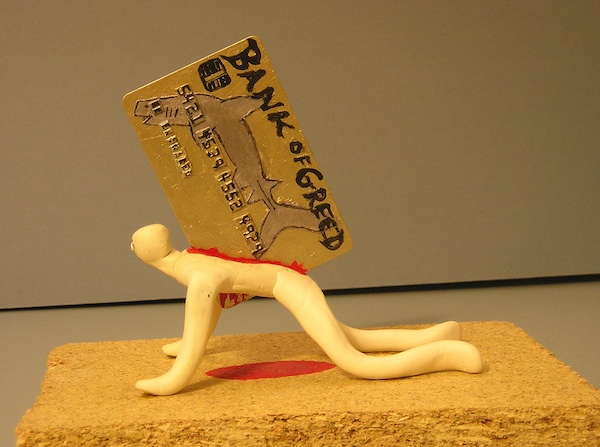
Albert Brenner: ‘Überizing; The Democratizaion of Usury’

When caught in a current, it is always prudent to swim with the current, but to the side – to exit. The great Banking Crisis has, once again, shown that simply swimming with, or against, the current is all for naught. The current of human greed is inexhaustible. Social responsibility is last on the list in the affairs of the unholy alliance between politics and finance. Profit is privatized whilst loss is socialized all with the unashamedly overt support of the democratically elected governments of the West (Iceland being the notable exception).

To be fair; said governments had to intervene to save the System from self-imploding. Quantitative easing saved the day, for today. But what about tomorrow? Giving a drunk more booze sure sooths the longing, but it cannot, be any and all means, cure the addiction.

Marxism tried to “cure” said addiction by fervently advocating for the abolition of private property (read private capital hoarding) thereby hoping to “cold-turkey” the all-too-human need to possess/own. This “cure” obviously failed… due to the imperatives of evolutionary pressures, the dictates of Natural Law and the moral precepts in/of Christianity.

As naively Progressivist as the above endeavour was and still is, in certain countries – the underlying motive to undermine said unholy alliance between politics and finance cannot be shunned outright. Fact is: the common wo/man always has to bear the burden when things go awry among these, hitherto, “powers-that-be”.

But what if modern technology has the potential to, at least, buffer the excesses of the System… to the benefit of the common man who, at the end of the day, actually sustains it? This author believes it is indeed possible to “exit” the System without (it) leading to the self-implosion (thereof).

All that is needed, is the “democratisation” of usury/banking. This is a real possibility, given the incredible advances of, especially, the IT Revolution. This revolution has, inter alia, opened up the incredible (liberating) potential of “non-mediation” – from age-old fixed structures, e.g. monopoly-capitalism.

The first example of “non-mediation” in the IT Age was Napster. This (free) file-sharing platform allowed users the liberty to download and compile their choice of music in a single data storage unit “burnt” CDs, back then. This “non-mediated” liberty to choose (your own music) led directly to the invention of the Apple iPod. And this, as we know, propelled Apple into the dizzying heights of profit unheard of before – a (current) quarterly turnover that equals the total yearly industrial output of Russia.

This process of “non-mediation” has rolled on relentlessly. It simply cannot be stopped. A new Age has dawned. A true revolution. Just last week, taxi drivers in France took to the barricades to protest against the cell-phone app called Über. This simple app directly threatens their livelihood insofar as it turns (every) common man, with a car (and time), into a taxi driver. In short; the monopoly on public transport taxi drivers had, has been broken via the process of “non-mediation”.

So why not apply the same principle to banking? Bankers have, for too long already, monopolised usury. Simply put; why not “Überize” banking especially given the extremely low interest rates offered by banks in the West nowadays?

Just imagine (theoretically) giving every common man the possibility to be a banker. Would that not be a sterling approach to “distribute” (the) wealth equally among those who actually create/d said wealth? Labour topping investment, this time round à la Piketty. Said private citizens could then, when vetted accordingly, truly be the banker. There would, obviously, be many “loan-sharking” pitfalls. But then; if properly regulated, it would certainly allow the common man to participate more directly in the financial system more than ever before!

It obvious that the common man does not have the funds/savings to act as the guarantor/financier of the 30-year mortgage plan of his/her neighbour But if (the) like-minded team up for the common purpose of taking social responsibility for the private financial decisions of the individual, this could be overcome without too much ado. It is simply a question of trust… among the like-minded.

It is indeed impossible to swim against the tide of human greed. But it is also not impossible to swim to the side, to the benefit of your neighbour who, at the end of the day, means you. Or do you want to be the sorry sucker who always picks up the tab every time the banker and his/her politician buddy profit whilst socialising loss… eternally at your expense?

I say NO!

Ergo, exit… by Überizing Usury.

China spoils Washington’s war against Venezuela

In the coming months China will lend Venezuela, which faces bankruptcy, ten billion dollars. These funds are part of a bilateral agreement. For China it’s a way to quench its energy needs, while the US continue the confrontation line with Venezuela.

Venezuela is under the threat of soverign default. In providing two five-billion dollar loans, China has become an important partner for the struggling country. The first part of the loan is the joint Chinese-Venezuelan Fund, and will be directed into major projects, CNBC reported. The agreement will be signed later this month. China extended the terms of the loan to five years, giving Venezuela more breathing room, as the terms are typically limited to three years.

The second part of the loan will be used in the oil industry. China will support investments in oil fields, intended to help Venezuelan oil company PDVSA increase production, the official said. 96 percent of Venezuela’s foreign exchange revenue comes from the export of raw materials.

The recent fall in oil prices is one contributor to Venezuela financial pressure. Interest rates on bonds have risen again. Venezuelan President Nicolás Maduro claimed the US is responsible for the fall in oil prices late last year. “Are you aware that an oil war rages?” said Maduro on Monday in a broadcast speech to businessmen. “This war has one goal – to destroy Russia.” In addition, it is also directed against Venezuela “to destroy our revolution and bring about a collapse of the economy.”

In March Obama called Venezuela a threat to the US national security. Domestically Venezuela is well under pressure. There were regularly scheduled demonstrations against the government of the country last year. In February 2015, a 14-year-old died in protests. Last week there were protests in Caracas again.

Venezuela is extremely lucrative for China’s investment interests. This is the country with the highest oil reserves in general, and China’s energy demand will increase with the increasing rural-urban migration in the coming years. China has already given Venezuela $45 billion in exchange for oil and fuel. With the new loans for Venezuela, China finds itself in opposition to the United States.

Translated from German

Source: http://deutsche-wirtschafts-nachrichten.de/

Russia offers Greece loans, gas discount

Russia may offer Greece a discount on gas deliveries and new loans when Greek Prime Minister Alexis Tsipras visits Moscow this week, the Kommersant business daily reported on Tuesday, citing one source in the Russian government.

A Kremlin spokesman said last week that Russian President Vladimir Putin and Tsipras planned to discuss economic ties and EU sanctions on Moscow when they meet for talks, which Kommersant said would take place on Thursday.

“We are ready to consider the issue of a gas price discount for Greece,” the newspaper said quoting an unnamed Russian government source.

Russia’s state-controlled producer Gazprom declined to comment. The Energy Ministry also declined to comment.

The source said that in exchange for the discount and some unspecified loans, Russia would want access to Greek assets. The source did not name any specific assets.

In recent weeks, the gas price charged by Gazprom has fallen, tracking lower oil prices. Gazprom said it wanted to acquire DEPA in 2013 but dropped its bid after failing to receive enough guarantees over DEPA’s financial position.

Source: Reuters

Soros meets with the President of Ukraine

Multibillion dollar loans don’t come without a few strings attached.

President Petro Poroshenko held a meeting with billionaire crony opportunist George Soros, at which Soros informed the head of state about his initiative to create a “strategic plan of reforms” for Ukraine.

“We set up a strategic consultative group for immediate reactions to challenges as they arise,” the press service of the Ukrainian president reported on Monday, citing Soros.

Source: economicpolicyjournal.com

US mortgage applications remain weak despite rising home prices

Fierce bidding wars for homes in the nation’s capital are slashing applications from borrowers interested in taking out a purchase mortgage, an industry group said Wednesday.

Around the country, rising mortgage rates over the past year have cut applications for loans to buy a home, with the latest weekly reading on a U.S. gauge from the Mortgage Bankers Association showing a 5% drop from the prior week (as seen in the chart). But in hot markets like Washington, where there’s a low supply of homesavailable for sale and borrowers  haven’t been put off by pricier loans, would-be mortgage applicants are still giving up on borrowing.

“Some lenders continue to report that they have pre-approved borrowers who have been unable to find a property given the tight inventory in certain markets,” said Mike Fratantoni, MBA’s chief economist.

Just how hot is D.C.’s market? More than one-quarter of homes sold in May closed above their list price, according to Redfin, a real estate firm. But that statistic pales in comparison to the scorching markets in San Jose and San Francisco, where almost 70% of homes sold above their asking price.

Elsewhere in the country, rising rates are taking a toll on loan applications from borrowers who have become priced out of the market. Plus, borrowers still face the extremely high standards that lenders erected in the wake of the financial crisis.

Source: WSJ