The US’ decision to beef up its military presence in southern Spain indicates that a new strategy towards Africa is well underway says Andrew Korybko.
Washington just clinched a deal with Madrid that will see it boosting its military footprint in the south of the country. According to the agreement, up to 2,200 Marines and possibly 40 military aircraft will be deployed within striking distance of all of West Africa, and this massive amount of firepower proves that the US is preparing its forces for engagement all across the continent in the years to come.
Its deployment along the African periphery in Spain complements the existing presence it has in Italy and Djibouti, to say nothing of its mobile naval capabilities, and this arrangement may actually be the most ‘efficient’ of AFRICOM’s speculated formations.
In the short term, it’s predicted that the US’ latest moves are in anticipation of an inevitable leadership transition that may soon take place in Algeria, while the constant, long-term interest is in controlling the transit of significant non-Russian gas supplies to the EU.
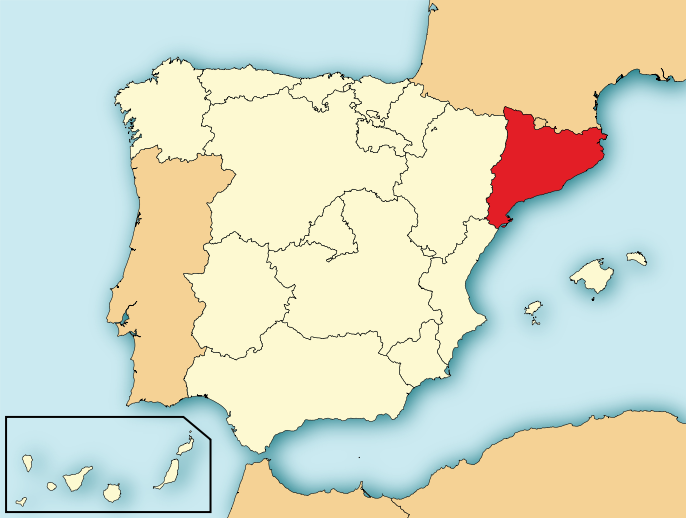
Spain’s leaders want US support against the Catalonian independence movement too. They fear that the independence of Catalonia could lead to a chain reaction of similar movements in Spain’s other regions.
AFRICOM is technically only a command and control center for US military operations in Africa, and due to advances in communication and transport technology, it doesn’t even have to be based in the continent itself. It’s currently headquartered in Germany.
US forces are predicted to operate as the storm troopers of unipolarity in Africa, but for prolonged occupation, the French are expected to shoulder the burden, which they’re already doing via their ground deployments in 10 African countries already (nearly a fifth of the continent’s total).
The US’ latest moves in Spain are likely aimed at ‘managing’ a forthcoming leadership transition in Algeria.
Aging President Abdelaziz Bouteflika suffered a stroke two years ago, and it’s not known who will succeed him if he dies in office. Bouteflika’s 15-year-long presidency has been a stabilizing factor in rebuilding Algeria since the decade-long Islamist-inspired civil war ended in 2002, and his death might make the country vulnerable to a Color Revolution, a jihadist uprising, and/or a destabilizing struggle between state security forces.
The chaos in Libya showed signs of seeping through to Algeria in January 2013 during the In Amenas hostage crisis. Terrorists took over a gas processing facility and killed 39 foreign hostages before being defeated by decisive government action.
Most important for the US is Algeria’s contribution to the EU’s gas supply, being the third-largest supplier to the bloc after Russia and Norway.
There’s also discussion of creating a Trans-Saharan Pipeline from gas-rich and under-processed Nigeria through Niger and Algeria to Europe, which would make the North African state the geo-energy ‘Ukraine’ of the Western EU. Because of this, the US must make sure that Algeria stays under Western influence and the pipeline routes are secured, hence the upcoming deployment of 2,200 Marines and 40 military aircraft within striking distance to ensure this.
The Spanish government has not specified what legal consequences Catalan leaders, poll workers or voters might face Sunday, when they go to vote. But Madrid has reportedly readied thousands of Civil Guard officers to travel to Catalonia this weekend.
Spain’s northeastern region of Catalonia vowed Tuesday to defy both the central government and the country’s highest court and proceed with a much-disputed weekend vote on whether to secede from Spain.
Hours earlier, Spain’s Constitutional Court ordered Catalonia to freeze its plans for an independence vote, scheduled for Sunday. It was the second time the court issued an order siding with Madrid, which considers any Catalan independence vote illegal.
But Catalan leaders said they would not back down.
“Everything is all set for Nov. 9,” Francesc Homs, a spokesman for the Catalan regional government, said at a news conference. “We are maintaining our participatory process. We couldn’t say this any clearer — and we’re doing so regardless of the consequences.
The presence of military convoys on the roads in Catalonia has been steady throughout the day.
Military convoys on the roads to Lleida and Zaragoza and also Panadella and Low Llobreta and Diagonal were noted, with several military helicopters flying sorties over certain Catalan regions.
The leader of Spain’s wealthy Catalonia region on Tuesday called off an independence vote but said an unofficial poll will take place next month to gauge secessionist sentiment.
Artur Mas was forced to cancel the Nov. 9 referendum and replace it with a symbolic one on the same day after Spain’s government challenged the referendum in the country’s Constitutional Court, which suspended the vote while it deliberates.
Separatists in northeastern Catalonia, which has 7.5 million people, have been trying for several years to hold a breakaway vote from Spain to carve out a new Mediterranean nation.
Secessionist sentiment surged during Spain’s economic stagnation and amid discontent at Spain’s refusal to give the region more autonomy and fiscal powers.
Polls show most Catalans support holding an independence referendum and around half favor ending centuries-old ties with Spain.
Mas insisted his regional government is not backtracking and still plans an official vote later, saying the symbolic vote will serve as a “preliminary” ballot.
“It means there will be polling stations open, with ballot boxes and ballots,” Mas said. “It will depend on the people for a strong enough participation to show that people here want to vote.”
The vote questions will be the same, asking residents if they think Catalonia should be a state, and, if so, whether it should be independent.
Madrid’s central government has said an independence vote would violate clauses in Spain’s constitution specifying that only the national government can call referendums on sovereignty and that all Spaniards must be allowed to vote.
Unlike last month’s independence referendum in Scotland, which ended with voters deciding to remain part of the United Kingdom, the vote that Catalonia separatists wanted to hold would have been nonbinding.
Spain’s Constitutional Court on Monday suspended an independence referendum called by Catalonia for November 9, although leaders of the rich northeastern region vowed to press ahead anyway with preparations for the vote.
The unanimous and expected decision by the court’s 12 judges came just hours after Spain’s central government asked it to declare the independence referendum illegal on the grounds that it breaches the country’s constitution.
The court said in a statement that it had accepted the appeal and had suspended the referendum while it considers the central government’s arguments. The court had up to five months to give its ruling although it can request an extension.
The head of the regional government of Catalonia, Artur Mas, signed a decree on Saturday calling for the referendum.
Since then a luminous clock on Barcelona’s historic Sant Jaume square has been ticking down the seconds to November 9 and television and radio stations in the region have aired ads informing the public of the vote.
Conservative Prime Minister Mariano Rajoy said he “deeply” regretted Mas’s move, saying it “divides Catalans, alienates them from Europe and the rest of Spain and seriously harms their welfare”.
Buoyed by mass street demonstrations, Mas has pushed ahead for a vote in defiance of Rajoy’s warnings.
“You cannot use the law to prevent people indefinitely from stating their opinion,” Mas said in a television interview on Sunday in anticipation of Monday’s appeal.
“Voting on November is the best thing for everyone because it will allow us and also the Spanish government to know what the Catalan people’s opinion is.”
The main opposition Socialist Party is calling for a constitutional reform instead of a vote to answer Catalan demands for greater autonomy.
The Socialists’ leader Pedro Sanchez on Monday said the referendum plan “deeply damages Spanish democracy”.
Fitch Ratings has chimed in also by placing the Autonomous Community of Catalonia’s (Catalonia) and Institut Catala de Finances’ (ICF) Long-term foreign and local currency Issuer Default Ratings (IDR) of ‘BBB-‘ on Rating Watch Negative (RWN).
Their Short-term foreign currency IDRs of ‘F3’ have also been placed on RWN. Catalonia’s EMTN programme and bond issues, rated ‘BBB-‘, were also placed on RWN.
The last scheduled review date for Fitch’s ratings of the Autonomous Community of Catalonia was on 25 July 2014 and the next review date for 2015 has not yet been set.
Leaders of the Flemish nationalists in Belgium, the Catalans in Spain and Italy’s Venetians said they still have momentum on their side, despite the ‘No’ vote in Scotland.
“Whether it was a ‘no’ or a ’yes’ vote, the main thing is that the process has started,” Gerolf Annemans, leader of the Vlaams Belang, or Flemish Interest party, said in an a phone interview. “You can’t say this is a clear vote for unity. The process of autonomy and national identity can’t be stopped.”
Separatists across Europe that had been energized by the Scottish nationalists’ push for independence were drawing breath today after voters opted to remain with the U.K. by about 10 percentage points. That leaves the Catalans as the most likely candidate to test EU leaders’ insistence that newly independent states will have to reapply for membership and face a period in the wilderness before reclaiming its full rights.
European Commission President Jose Manuel Barroso, Spanish Prime Minister Mariano Rajoy and German Foreign Minister Frank-Walter Steinmeier all welcomed the vote, which shores up the constitutional status quo in the 28-member bloc.
“I think this is a good decision for Scotland, Great Britain and Europe,” Steinmeier said in a statement.
Roger Albinyana, head of the foreign affairs department of the Catalan regional government, said in an interview with Bloomberg Television today that his movement is still determined to hold a referendum, despite the opposition of the national government in Madrid.
“There is a strong determination from the Catalan people,” Albinyana said. “We’ll do our best to hold that vote.”
Rajoy — who today said Scotland had avoided “grave social, economic, institutional, political consequences” of a split — has pledged to prevent Catalans voting on independence from Spain in a ballot Regional President Artur Mas has penciled in for November. The Catalan Parliament is set to approve the legal framework for the referendum today and Mas’s allies are urging him to defy the legal threats from the central government.
Mas today told reporters in Barcelona that Catalonia will push on with its independence referendum, and that a vote is the only way to resolve conflicts between Catalonia and the rest of Spain.
Gianluca Busato, who organized an unofficial referendum in March that called for independence of the Veneto region in northeast Italy, said economic arguments appeared to have won out in Scotland, the exact same reason why he said his region will eventually choose independence.
What the Catalans do regarding independence will likely have an impact on Spain’s Basques, who already have some autonomy.
The Basque region on the border between Spain and France has long sought independence. Around 150,000 Basques formed a 123km-long human chain on June 8 in a “Right to Decide” event.
The organizers of the Veneto vote said 2.36 million people voted in March, with 89 percent approving independence. Busato said Scotland’s experience shows the need for a more professionally prepared referendum next time.
“The oppressive fiscal transfers from Veneto to the rest of Italy are apparent for all to see,” Busato said in a phone interview. “For the Scottish, independence may have appeared more of a gamble.’
An independent Flanders with Brussels as its capital will be best for the Flemish people who represent 60 percent of the Belgium population, and provide 80 percent of its economy, Flemish MP Tom van Grieken told RT.
Following in the footsteps of Scotland, Veneto in Italy and Catalonia in Spain, and Belgium’s Flemish region may become the next to hold a referendum on independence. The Flanders area of northern Belgium has been claiming its own sovereignty for years, and if it succeeds, Belgium may be no more, along with its being the symbol of a united Europe.
The 2008 financial crisis has boosted separatism movements in Europe, with rich and developed regions in a number of countries starting to voice their discontent with policies from the capital, and the necessity to feed economically weak regions. However, for such Scotland, Catalonia and Flanders it is also a question rooted in the history of the formation of the countries they belong to.
Dutch-speaking Flanders and French-speaking Wallonia have always been rich and well-developed regions, connected to each other despite language and cultural differences. The artificial creation of the Belgian state put these nations into a difficult situation, forcing them to coexist with people they don’t feel any connections with. Meanwhile, Scotland’s independence vote has inspired the Flemish people with hope to finally create their own state.
RT: Why does your party Vlaams Belang (“Flemish Interest”) support independence of Flanders?
Tom van Grieken: We are the only party in Belgium who are for Flemish independence. We think Belgium is dead, it is from the beginning in 1830 an artificial state, where two different people are forced to live together. Although we are only 60 percent of the population of Belgium, we produce 80 percent of our economy. Independent Flanders with Brussels as its capital will be the best for the Flemish people.
RT: The world’s attention is now chained to the Scottish referendum. After this vote we expect Catalonia to follow the same path. If Flanders was to hold a referendum, what results do you foresee?
TG: The importance of holding a referendum – it’s not the result which is important. The public debate concerning becoming independent is also important. In my country there is almost no debate on public television about independence, although the population really wants it. For example, in Scotland whether it is “yes” or “no” vote when the referendum results are made public, they already have their victory simply by having a public debate about independence of the people.
RT: Is it mostly for political reasons that the Flemish people seek independence? Does Flanders want to take decisions on its own?
TG: Of course it’s not our main purpose. The economic part is also very important. Like I have already said, 60 percent of the population of Belgium is Dutch-speaking, Flemish-speaking and they produce 80 percent. Also there are differences between cultures – the Flemish culture is completely different [from] the French culture in the south. We also have different political views: [in] the south [people] are all socialists, social-democrats and the North Flemish part votes for the right and center-right. It would be the best democratic solution to split up Belgium.
RT: Do you think in case of “yes” vote Flanders, Catalonia and Veneto will be able to survive?
TG: Of course. Small nation-states can produce easier answers to the difficult questions we all face in Europe. Flanders will not be smaller than independent Ireland or Denmark, or Estonia, or Lithuania. We would be a full-grown nation-state in the heart of Europe.
RT: How do you see the development of the situation?
TG: I think it will be like in a marriage. At the moment we are always fighting in every discussion but we should divorce, split up and become good friends, good neighbors. I think it will be our first economic partner to work together with but it’s better to become good friends than stay together in a bad marriage.
RT: What are the reasons for a marriage to become bad? And what makes bad neighbors?
TG: What makes bad neighbors? Of course it’s not something among individuals. As you know, my country, Belgium, where I’m forced to live in, holds the world’s record for days without government because we don’t agree on anything. Every political discussion has an aspect which Flemish and Wallonia people disagree on. So it would be better not only for Flanders but also for my French friends in the south.
RT: Do you think a referendum is needed?
TG: Yes, of course. We are the only independence party in Belgium. I think referendum is a good thing because if you are afraid of the opinion of your people, then you are not ready to be a leader of your people. So I think we need also in Belgium a referendum concerning the Flemish independence.
The Spanish government is militarizing gearing up for violent protests against the EU that are expected to turn up before a hot autumn. Spain is now equipping the police for about one billion euros with new combat equipment. Violent protests in Spain since the crisis began almost a daily occurrence. Movements such as 25 de Mayo or the Indignados call Spaniards of all strata of the population to protest against the government on the streets. The police will always respond violently. They cover up their brutal responses by banning any video of police beatings making it a crime in itself. This is certainly illustrating the loss of freedom and any democratic process within Europe. The police scandals have only charged the atmosphere within the population and we may see this erupt into civil war as we move forward.
Goya’s painting of the brutal treatment of citizens during the Spanish Civil War is a reminder of what we could face in the aftermath of the militarization of Spain against its own citizens. Since June, the Spanish Interior Ministry has signed four contracts for the purchase of protective vests, shields and other riot gear. These weapon purchases are causing many to relive very bad memories in Spain. Spain has also bought water canons, a weapon that by the end of the Franco dictatorship was in continuous use. Opposition leader Antonio Trevin called the purchase therefore “a return to the times we would rather forget.” The Interior Ministry has responded merely justifying their rearming as necessary “because of the current social dynamics”, necessary, reports the Guardian.
The protests are mainly directed against the always new austerity measures, tax increases, the extremely high youth unemployment, homelessness following the bursting of the housing bubble, and also against a restrictive policy such as the recent bill to ban abortions. Then there is the movement to establish a referenda for the abolition of the monarchy. Then throw in the separatist movement as we see in Scotland where the Catalans are moving for their independence. There were protests against the recent visit of German Chancellor Angela Merkel that had to be violently dispersed by the government.
Spain is moving toward civil war. Even the human rights organization Amnesty International has expressed concern over the arming of the police. The police are there to protect the government – not the people. That is a dangerous position that sets the stage for civil war.
Catalan President Artur Mas has pledged to go ahead with the region’s independence vote, defying the Spanish Prime Minister in person. Madrid has branded the referendum as “illegal” and resolved to block the Catalan bid to separate from Spain.
Mas met with Spanish Prime Minister Mariano Rajoy on Wednesday in their first encounter in over a year.
“We have the determination and the political strength, but we would like to hold [the vote] in a legal manner and with the backing of the state,” said Mas following the meeting, referring to Scotland’s upcoming independence vote in September.
Mas said it was impossible to hold a legal consultation because Rajoy refused to budge on his stance the Catalan vote is a violation of Spanish sovereignty and therefore illegal.
“I thought that Rajoy was going to propose something concrete. I came prepared to listen, but there was no proposal,” said Mas, adding that he believed Madrid’s stance was more to do with politics than the actual legality of the independence vote.
Rajoy has been unmoving in his dialogue over the Catalan vote from the very beginning, and has resolved to block the referendum. Alicia Sanchez-Camacho, president of Rajoy’s party in Catalonia, said the vote would be a violation of Spanish law.
There has been growing resentment in the region that their taxes are being redistributing to other parts of the country and 45 percent of Catalans believe the region would be better off on its own, according to an April poll.
Catalonia is not the only region of Spain campaigning for independence. The long-rebellious Basque country has also called for a referendum to decide on their future in Spain. In late May, Basque lawmakers adopted a declaration of self-determination to follow on the footsteps of Catalonia.
Last month, at least 100,000 Basque citizens formed a human chain measuring 123 kilometers in solidarity with the Basque independence movement.
Spain’s Constitutional Court has ruled that a referendum in Catalonia on independence from the rest of the country would violate the law, saying that regions within Spain “cannot unilaterally call a referendum on self-determination.”
According to a summary of the ruling, any “right to decide” their future by Catalans has to be in accordance with Spain’s 1978 constitution, which stipulates Spanish unity.
The Constitutional Court ruled “unconstitutional and null” a declaration by the regional parliament in Barcelona which claimed that Catalonia has the right of self-determination.
Kingdom of Spain Constitutional Court of Justice Building (AFP Photo / Dominique Faget)Kingdom of Spain Constitutional Court of Justice Building (AFP Photo / Dominique Faget)
The fate of the region rests on the power struggle between Catalan President Artur Mas who had promised a referendum on independence from Spain on November 9 and the Spanish Prime Minister Mariano Rajoy who insists that such a vote would be illegal.
“No one can unilaterally deprive the entire Spanish people of the right to decide on their future,” Rajoy told the national parliament last month insisting that the referendum “can’t take place.”
Rajoy remains certain that Catalonia cannot be compared to Scotland’s aspiration of succession from the UK, because the Spanish written constitution, unlike British, rules out such a move.
But in Catalonia, March’s public opinion poll showed that 59.6 percent of the population want independence from the rest of Spain and want their region to become a “new state of Europe.”
Catalonia, an autonomous community with a population of 7.5 million is responsible for around one-fifth of the country’s GDP and one-quarter of its taxes. Public sentiment believes that the region will be much better off financially if they secede from Madrid.
The situation is aggravated by the economic crisis, which is forcing the Spanish government to adopt painful austerity policies.
In January the Catalan Parliament voted to send a petition to the national legislature seeking the power to hold the vote. That initiative is still in the process. If successful the referendum in Catalonia will be a month after a similar vote in Scotland, which is slated for September 2014.
From a node in the neoconservative network, a Fox News studio, Charles Krauthammer has complained about the eviction of the Ukrainian Navy from the city of Sevastopol, where it was headquartered. Not a word did the commentator say about the city’s location: Sevastopol is on the Crimean Peninsula. It would appear that the city now falls within Crimean jurisdiction – starting March 16, the day the people of Crimea voted to secede from Ukraine.
By most estimates, between 97 and 93 percent of Crimean voters said yes to a reunion with Russia. High too was voter turnout. McClatchy pegs it at 83 percent of registered voters in Crimea. BBC News was agreed, also reporting a ballot of “more than 80 percent.” Zerohedge.com counted a “paltry” 73 percent turnout, still “higher than every U.S. presidential election since 1900.”
As rocker Ted Nugent might say, the Russians and Crimeans are blood brothers. Nugent got into trouble for using this perfectly proper appellation to describe his affinity for a politician, of all people: Texas Republican gubernatorial hopeful Greg Abbott. Notwithstanding that in the land of the terminally stupid, linguistic flourish can land one in hot water – blood brother is a good, if colorful, turn of phrase that denotes fealty between like-minded people. Steeped in state-enforced multiculturalism, America’s deracinated, self-anointed cognoscenti have a hard time grasping the blood-brother connections between the people of Russia and Crimea.
For no apparent reason other than that it is pro-Russian, Americans have reflexively aligned themselves against the swell for secession in southern Ukraine. Separatist referenda in Kosovo, Catalonia, South Sudan and Scotland have been accepted without demur by a political and media establishment unprepared to countenance a similar referendum in Crimea.
Guided by the pack animals of politics and punditry who seldom fail to shed darkness on whatever topic they tackle, a nation that struggles to locate the disputed territories on the map has been convinced of the menace posed by Russia. According to a CNN poll, 69 percent of Americans say they see Russia as a threat. A Rasmussen Report poll indicated that “52 percent support U.S. diplomatic action against Russia over Crimea.”
Helping to drive American Russophobia is the implacable logic exemplified by Bill O’Reilly of “The Factor,” yet another node in the network mentioned. At the suggestion that there are similarities between Russian and American military bellicosity, the TV host foams at the mouth. Fulmination is followed not by argument, but by a form of ad hominem or psychologizing.
It is absolutely verboten on this popular and powerful show to compare Russia’s “excursion” into Ukraine to America’s naturally illicit and illegal occupations of Iraq, Afghanistan and Libya. In defense of their reflexive rejection of the reasonable, if inaccurate, comparison – for decades the U.S. has been far more aggressive than Russia in its forays abroad – Bill and his gang “argued” (on March 3) as follows:
President Vladimir Putin is a thug. That’s why his actions can’t be contrasted with the actions of “a good country” like the U.S. By “logical” extension, George Bush and Barack Obama are never to be fingered as thugs.
Why, Billy, some of you will inquire? Is it because these thugs are American? Precisely.
Next, Bill O’Reilly’s mind-reading gifts were galvanized to negate the juxtaposition of the actions on the ground of the Russian and American governments. Putin, it would appear, seeks the recrudescence of the Russian empire. On the other hand, the U.S., with a military presence in 148 countries and 900 bases worldwide, has neither sought nor achieved empire status.
Why, Billy, some of you will ask? Is it because the U.S. is a good country? You got it!
Be it in Belgium, Germany, Italy, Spain, Turkey, the United Kingdom, Japan, Bahrain, Djibouti, South Korea, Iraq, Kyrgyzstan, Afghanistan and Kuwait – even Aruba, Iceland, Indonesia, Kenya, Norway and Peru – wherever it plants its military boot, a “good country” is never an empire, only a force for good.
Me, O’Reilly would dismiss as “anti-American.” But what of former secretary of state Henry Kissinger? While Kissinger has condemned Russia’s annexation of Crimea, he excoriated “the demonization of Vladimir Putin.” This antipathy “is not a policy; it is an alibi for the absence of one.” “The United States needs to avoid treating Russia as an aberrant to be patiently taught rules of conduct established by Washington,” wrote the statesman in the Washington Post.
Is Henry Kissinger anti-American or simply smarter than some Americans?
At least Secretary of State John Kerry hung on to his sense of humor. “Unless you are the United States of America, you just don’t invade another country on phony pretext in order to assert your interests,” Kerry lectured the congenitally incurious David Gregory, of “Meet the Press.”
I ad-libbed. Except for the first eight words in quotation marks, Secretary Kerry did indeed say the foregoing. Given America’s military record, the missing words are implied.
The O’Reilly school of “thought” could – and does – counteract that Crimea’s vote to join Russia was tainted by fraud. This is certainly possible. Nevertheless, it is none of our business. Americans have their own tyrants to dethrone.
We’re supposed to be the freest people in the world, aren’t we? Is this claim not the moral basis for America’s we-know-best global meddling? But if we Americans are the freest people in the world, where’s our right to a referendum on, say, that “little” legislative “blip” called Obamacare? And if we’re so bleeding free, where’s our right to secede from D.C.?
Four separatist parties in Spain’s Catalonia looked set to win a majority in regional elections on Sunday, partial results showed, but the main one was on course to lose some seats, possibly undermining its bid to call an independence referendum.
With half of votes counted, the ruling Convergence and Union alliance, or CiU, was winning 48 seats in the 135-seat local parliament, well down from its current 62 seats.
The separatist Republican Left, or ERC, was winning 20 seats, with two other smaller separatist parties taking a total of 16 seats, giving the four parties 60 percent between them.
Regional President Artur Mas, of CiU, had campaigned on a pledge to hold a referendum on independence, in response to a resurgent separatist movement among Catalans who are frustrated with Spain in a deep economic crisis.
Opinion polls had forecast that CiU would retain 62 or more seats in the local Parliament and that all four separatist parties would have more than two-thirds of the seats. Neither of those projections was met as the results began to come in.
Without the psychological backing of a two-thirds majority, analysts have said, it may be hard for Mas to defy the constitution and the central government in Madrid and try to hold a referendum.
Turnout was very high in the election, 68 percent, 10 percentage point higher than in the previous vote two years ago.
With more people than Denmark and an economy almost as big as Portugal’s, Catalonia has its own language. Like Basques, Catalans see themselves as distinct from the rest of Spain.
Growing Catalan separatism is a huge challenge for Prime Minister Mariano Rajoy, who is trying to bring down painfully high borrowing costs by persuading investors of Spain’s fiscal and political stability.
Mas converted to separatism after huge street demonstrations in September.
Up until recently Mas was a moderate nationalist who had pushed Spain to give Catalonia more self-governing powers. He has followed the popular mood in converting to a more radical separatism, but it is not clear he can hold a referendum legally.
Many Catalans are angry that Rajoy has refused to negotiate a new tax deal with their largely self-governing region. Annually, an estimated 16 billion euros ($21 billion) in taxes paid in Catalonia, about 8 percent of its economic output, is not returned to the region.
Home to car factories and banks that generate one fifth of Spain’s economic wealth, and birthplace of surrealist painter Salvador Dali and architect Antoni Gaudi, the region also has one of the world’s most successful football clubs, FC Barcelona. – Reuters
Protesters clashed with police in Spain’s capital on Tuesday as the government prepares a new round of unpopular austerity measures for the 2013 budget that will be announced on Thursday.
Thousands gathered in Neptune plaza, just a few meters away from El Prado museum in central Madrid where they formed a human chain around parliament, surrounded by barricades, police trucks and more than 1,500 police in riot gear.
Police fired rubber bullets and beat protesters with truncheons, first as several protesters were trying to tear down barriers and later to clear the square. The police said at least 15 people had been arrested and at least 6 injured.
The protest, promoted over the Internet by different activist groups, was younger and more rowdy than recent marches called by labor unions. Protesters said they were fed up with cuts to public salaries and health and education.
“My annual salary has dropped by 8000 euros and if it falls much further I won’t be able to make ends meet,” said Luis Rodriguez, 36, a firefighter who joined the protest. He said he is considering leaving Spain to find a better quality of life.
With this year’s budget deficit target looking untenable, the conservative government is now looking at such things as cuts in inflation-linked pensions, taxes on stock transactions, “green taxes” on emissions or eliminating tax breaks.
The 2013 budget is the second one conservative Prime Minister Mariano Rajoy has had to pass since he took office in December. Spain must persuade its European partners that it can cut the budget shortfall by more than 60 billion euros by 2014.
Rajoy has already passed spending cuts and tax hikes worth slightly more than that over the next two years, but half-year figures show the 2012 deficit target slipping from view as tax income forecasts will not be hit due to economic contraction.
He said earlier this month the 2013 budget would cut spending further in all areas of government apart from pensions and borrowing costs.
Spain is at the centre of the euro zone debt crisis on concerns the government cannot control its finances and those of highly indebted regions, bitten by a second recession since 2009 which has put one in four workers out of a job.
Regional tension
On the regional front, Catalonia, which generates about 20 percent of the national output, announced on Tuesday it would hold early elections on November 25 after its call for more tax autonomy was rejected last week by Rajoy.
Political uncertainty in cash-strapped Catalonia, along with an announcement from southern region Andalucia it might seek a 4.9 billion euros credit line from the central government, will pile more pressure on Madrid to seek European aid.
Rajoy is holding back from applying for help, which would activate a European Central Bank bond-buying programme and bring down Spain’s punishing debt premiums.
With the threat of the plan alone reducing 10-year yields by around 2 percentage points, the cautious leader, known for keeping his cards close to his chest, is playing for time.
Rajoy says he is mulling the conditions of a bailout application, but suspicion that he may wait until after regional elections on October 21 pushed short-term yields higher at auction on Tuesday.
The government is also expected on Thursday or Friday to set a fresh timetable for economic reforms, seen as an attempt to pre-empt strict EU-imposed conditions for aid.
“Let us in, we want to evict you,” protesters chanted outside parliament. Evictions have soared in Spain as thousands of people have defaulted on bank loans.
Demonstrators said they were angry that the state has poured funds into crumbled banks while it is cutting social benefits.
“We’re protesting against the cuts. I’ve had to give up my apartment,” said Ondina, a 30-year-old fine arts graduate who is without a job. She said she can’t survive on an unemployment benefit of 260 euros ($340) a month.
Running out of options
Half-year deficit data indicate national accounts are already on a slope that will drive Spain into a bailout. The deficit to end-June stands at over 4.3 percent of gross domestic product, including transfers to bailed out banks, making meeting the 6.3 percent target by the end of the year almost impossible.
On Tuesday, the treasury ministry said the central government deficit to end-August had reached 4.77 percent of GDP, already above its year-end target of 4.5 percent of GDP.
“Its going to be difficult keeping the deficit to around 2 percent in the second half, when the first half was closer to 4 percent, especially since traditionally, the second half deficit is higher than the first,” said Juan Ignacio Conde-Ruiz, economist at Madrid’s Complutense University.
For 2012, the measures aim to reap savings of over 13 billion euros, but economists see the deficit missing the target by almost 1 percentage points implies further saving needs of up to 10 billion euros for this year alone.
Rajoy has been careful to highlight the importance of next year’s deficit target of 4.5 percent of GDP though any shortfall this year will weigh on 2013’s accounts. After slashing civil servants’ wages, raising value added tax and cutting health and education spending, Rajoy is running out of options. – Reuters
Showing support for Catalonian autonomy from Spain
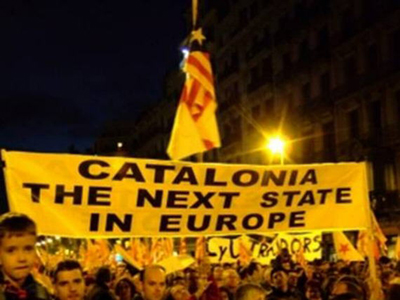
(Reuters) – Hundreds of thousands of Catalans took to the streets of Barcelona on Tuesday in an unprecedented show of mass support for autonomy from Madrid, blaming Spain’s economic crisis for dragging their wealthy region down.
Surging unemployment and financial disarray have stoked a fever of separatism in Catalonia, a comparatively prosperous part of Spain whose leaders say their wealth is being sucked dry by the central government.
Crowds waved red and yellow striped Catalan flags – one of the oldest still in use in Europe – and sang the Catalan anthem on a national day marking the conquest of Catalonia by Spain’s King Philip V in 1714 after a 13 month siege of Barcelona.
The central government said the crowd was 600,000 strong. Catalan police gave figures as high as 1.5 million.
Marchers said the sheer size of the crowd – swollen with people from around the region who descended on its capital in bright sunshine – would at last make Madrid hear their message.
“This is a blow for the government. People like me came from everywhere. I don’t think they were expecting something as big,” said 53-years-old Teresa Cabanes, who came from Santa Coloma de Gramanet, in the outskirts of Barcelona, to march.
“We feel that the central government is fooling with us. We Catalans are giving away a lot of money to Spain.”
They held up banners and signs saying “No to the Fourth Reich”, “No to Europe”, “Independence Now!” and “Catalonia: the New European State”.
The huge volume of people overwhelmed the mobile phone network, which shut down for hours under the strain. Marchers who had attended Catalan national day rallies for decades, including others that attracted hundreds of thousands, said this was the biggest they could recall.
The march ended after nightfall without any incident and no people were arrested, police said.
The show of anger and ethnic pride will play into the hands of regional authorities who are trying to force the central government to yield control over taxes raised in Catalonia.
Catalans speak a language similar to, but distinct from, the Castillian Spanish spoken in the rest of Spain. The region accounts for 15 percent of Spain’s population but 20 percent of its economy.
With Spain’s economy in freefall from the euro zone debt crisis, Catalans complain of paying billions of euros more in taxes than they receive back from Madrid, even as their regional government has been forced to fire workers and cut services.
The region’s president, Artur Mas, has suggested he could seek independence if he is not given more control over tax raised from Catalonia.
“If we cannot reach a financial agreement, the road to freedom for Catalonia is open,” he repeated on Tuesday. Mas did not attend the march but said he backed it in spirit.
URGENT BATTLE
The annual Diada holiday is typically commemorated with a fiesta in the Catalan capital with song, dance and a floral offering to Rafael Casanova, a hero of the siege.
But the outpouring on Tuesday was a sign that the economic crisis has transformed issues of cultural identity into a mainstream political movement bent on autonomy. A poll by the regional government in July showed for the first time that more than half of Catalonia’s population favors independence.
For Mas and his nationalist Convergence and Union party (CiU), that translates into demands for control over tax.
When Spain returned to democracy in the mid-1970s, regions such as Catalonia and the Basque Country saw a vibrant resurgence of their culture and languages that had been crushed during the dictatorship of Francisco Franco.
Catalonia has long sought more autonomy, though without a violent separatist movement like the Basque Country’s ETA.
Economists calculate Catalans pay at least 12 billion euros more in taxes per year to Madrid than they receive back for services like schools and hospitals. Many Catalans say the figure – difficult to calculate because of a complex system of transfers – is even higher, up to 16 billion.
“A lot of people who were not into independence are more and more into it now,” said Elvira Farre, a retired secretary from Barcelona. “They are being driven into it by their feelings but also by their wallets.”
Government worker Jauma Turra said: “It’s like a marriage you can’t put up with any more.”
The Madrid government took a dim view of what leaders there saw as Mas’s stirring up Catalans ahead of the march.
“Catalonia has serious deficit and employment problems and this is not the moment for messing around or disputes or controversy,” Prime Minister Mariano Rajoy of the conservative People’s Party said on Monday.
SUSPICION
Many Catalans are suspicious of what they see as the centralizing aims of the People’s Party.
Although Catalonia’s unemployment is somewhat lower than Spain’s as a whole – 22 percent instead of more than 24 percent – the region has suffered badly due to the Spanish debt crisis.
There are 700,000 jobless in Catalonia. The government cannot borrow from financial markets to pay bills because, like other Spanish regions, it saw its debt downgraded to junk.
Catalonia was among the first of Spain’s 17 autonomous regions to start making budget cuts to its public services in 2010 and cuts have grown deeper, with civil servant pay cuts causing a public backlash in recent months.
Despite his austerity drive, Mas has managed to deflect fury over his region’s economic problems onto the central government, saying if the tax system were set up differently Catalonia would not be in its quagmire.
He has proposed a “fiscal pact” that would give Catalonia its own tax authority. He is scheduled to meet Rajoy on Sept 20 to discuss it, but Rajoy is expected to reject it.
“It’s part of a political game that has been going on for years. The only difference is that the crisis has changed the stakes,” said Antonio Barroso, political analyst with Eurasia Group consulting firm.
Catalans were particularly galled when the central government raised the value-added tax across Spain from Sept 1, but said it would not pass the extra revenue to the regions.
Catalonia has already had to tap billions of euros in emergency central government funds this year to catch up on months of back payments to service providers.
Mas says he now needs another 5.7 billion euros to pay maturing debt, but the possibility that the central government would demand more say in local finances in exchange for the aid is adding to anger in the province.
If he meets the expected resistance from Rajoy on the fiscal pact, Mas is expected to call early elections to try to win an absolute majority in the regional parliament, where he currently governs through alliances with other parties. He could use such wider backing to press Madrid for more autonomy.
This website uses cookies to improve your experience. We'll assume you're ok with this, but you can opt-out if you wish. Cookie settingsACCEPT
Privacy & Cookies Policy
Privacy Overview
This website uses cookies to improve your experience while you navigate through the website. Out of these cookies, the cookies that are categorized as necessary are stored on your browser as they are essential for the working of basic functionalities of the website. We also use third-party cookies that help us analyze and understand how you use this website. These cookies will be stored in your browser only with your consent. You also have the option to opt-out of these cookies. But opting out of some of these cookies may have an effect on your browsing experience.
Necessary cookies are absolutely essential for the website to function properly. This category only includes cookies that ensures basic functionalities and security features of the website. These cookies do not store any personal information.
Any cookies that may not be particularly necessary for the website to function and is used specifically to collect user personal data via analytics, ads, other embedded contents are termed as non-necessary cookies. It is mandatory to procure user consent prior to running these cookies on your website.