The peoples of Europe are suppressed. Don’t fool yourself that living in the EU is good. It is not. The living standard of the average German has fallen in the last 15 years. The living standards of the Greeks, the Spanish and many others have been smashed. The EU is an instrument for the exploitation of the average people to the benefit of the few. And this is why Oligarchs want you to be in the EU: To institutionalize your suffering and exploitation.
For me, as a German with strong liberal views, it is hard to say this, but it is true: The hope for a better Europe today comes from the East.
If Ukraine goes to the West, it will go into the sunset of a declining part of the world.
If you go East, you will go into the sunrise of a rich and prosperous commonwealth.
With violence and anti-white racism rising in South Africa, Afrikaners need international support to survive. Our unique testimony of how a Western nation is being dominated by non-Westerners may just save the whole of our civilization!
It is now commonly accepted that Afrikaners and South African whites generally are in deep trouble. There are now two, no three, major black political parties who are trying to outbid one another in confiscating white-owned land, taxing us more, putting stricter racial quotas on our rugby and cricket teams, swamping the remaining white-majority schools with black pupils and making it harder for white students to gain entry to university. Even local taxes are used in an attempt to bankrupt many white-owned small businesses or family-owned farms.
All in all, the multicultural experiment is failing dismally in South Africa. Violence and mayhem are rising (70 000 of us killed since 1994), like corruption, environmental degradation and intolerance among South Africa’s linguistic and ethnic groups. Foreign Africans, like white farmers, are routinely killed and more often than not the police and the criminal justice system are turning a blind eye.
The city of Pretoria, with the Voortrekker Monument in the foreground
To many people overseas, South Africa is a lost cause, a sinking ship only worth abandoning. Yet, the very failure of our society presents a powerful argument against political correctness that may still save us and European civilization. It will take decades for Europe or North America to reach the state of advanced decay that South Africa finds itself in. We are ahead of the curve, as they say. We are the empirical proof that multiculturalism, affirmative action, the adulation of black people simply because they are black, lead straight to disaster!
But still, the skeptic may ask, why is it worth saving three or four million million whites in South Africa when the entire European/Western civilization is currently at risk? When support is needed to save France, Britain, the USA, from a programmed demise and takeover by other cultures, why bother about South Africa?
I accept that laying down our lives for most of the twentieth century in at least four wars fought for the Allies of for the West, does not count for much. But here are some persuasive reasons why you should support us now, in our final battle for survival. It is not a physical, but a spiritual battle, one of the will. We have many enemies and few friends… Yet we continue, against all odds, to resist being murdered, being acculturated, being assimilated!
Why the Afrikaner people is worth saving (and supporting)
Most of us come from Northern Europe which, for the last 300 years or so, ever since the Enlightenment, has produced some of the foremost breakthroughs in science, philosophy, art, music and literature. If it is worth saving Northern Europeans, it is worth saving us. In fact, we are a unique group of interbred Dutch, Germans, French and Scots who mostly speak a modernised Germanic dialect called Afrikaans. During the twentieth century we were united during a great national movement that was only brought down through foreign intervention, terror, intense propaganda, financial sanctions and more. Instead of getting a federal system and tolerance for ethnic diversity, we got Leninism and ethnic domination, even a slow genocide during which we are being killed one by one, family by family.
To many people, language is but a means of communication. Yet without Milton or the English Romantic poets, the English language would never have expressed a unique national identity, nor would German have acquired a high status without Goethe, Russian without Pushkin and Dostoevsky, etc. The astonishing aspect about our language, Afrikaans, is that, while evolving into a simplified grammar, its lexicon or vocabulary has remained more or less intact since the European Middle Ages, much more so than even the major European languages. We maintain a unique link with our distant past in Europe. There is some evidence that most of Northern Europe spoke dialects very similar to Afrikaans from 1300 to 1600 when Low German was the lingua franca of the Hanseatic League, a forerunner of the European Union which bound hundreds of cities together, from Russia to England and the Low Countries. This trade and seafarer’s tongue finally beached right here in South Africa in 1652. We nurtured and cared for this language which today, against the hostility of the state and global corporations who would like to see it disappear, remains a vehicle for cultural and scientific expression, for teaching anything from law to mathematics, from film to cooking, from information technology to accounting or high finance.
After more than three centuries in Africa, we have become hardy and strong. Is there any other country in the world where blacks have to impose racial quotas favouring themselves because they feel threatened by the sporting prowess of whites? Not to mention the most radical affirmative action programme on earth, in order to starve us economically, intellectually, even literally, so as to prevent us from producing food on our farms, like we have done since the 1650s!
The battle for South Africa is not over. One would have thought our fate was sealed in 1994 when Nelson Mandela became president of this country, after the dismal failure of the then Afrikaner leadership during the negotiations at Kempton Park. An avowed communist and co-conspirator of the East German Stasi, Joe Slovo, triumphed over them all. Yet, such is our resilience in the face of terror, farm murders, racial and language discrimination, economic and educational injustices, that after 20 years of very hostile government we are still here!
The unique contribution of Afrikaners to the future of Europe?
Just today I saw a French TV debate on Ce soir ou jamais! in which a Cameroonian author, Léonora Miano, told Elisabeth Lévy “not to be afraid of becoming a minority in France”. Lévy took the risk of articulating the apprehension of many French people in seeing their country changed culturally by immigration. With supreme arrogance, Miano told her bluntly that “this is what is called a mutation” and “it is going to happen”.
What wil life be like once the French are a minority in France, the Dutch a minority in the Netherlands, the Italians a minority in Italy, and so on? Well, they need look no further than South Africa to find the nightmarish answer. Once one becomes a minority under a non-Western majority, one is simply forced to undergo constant violence, debasement, humiliation and impoverishment through racial and ethnic quotas.
The testimony that we Afrikaners bring to the international debate on immigration, multiculturalism, race and ethnicity, may yet save Western and European civilization! Yet for that possibility to be realised, we ourselves need to survive.
We did not ask to be cast ashore in 1652, yet we have made the most of our opportunity by building the most successful country in Africa, a country where we are today cast as foreigners. We are denied access to the very institutions our forebears had founded while our names are removed from towns, streets and buildings, to bring home to us that we are the racial and cultural “other”. We are good enough to pay taxes but not to be counted as full citizens; a myriad of laws impose a fundamental inequality on us under the pretext of ensuring, precisely, “racial equality”.
In South Africa, as there will no doubt soon be all over the world, something caled “fair discrimination”, which is nothing other than anti-white racism.
If you believe our voice and unique testimony should be heard and that we do not deserve simply being killed or expelled from our own country, then we humbly ask you to support our struggle for dignity, equality and fair treatment by the black majority and their radical communist allies. For our long-term survival, like that of the Palestinians, only self-government will suffice.
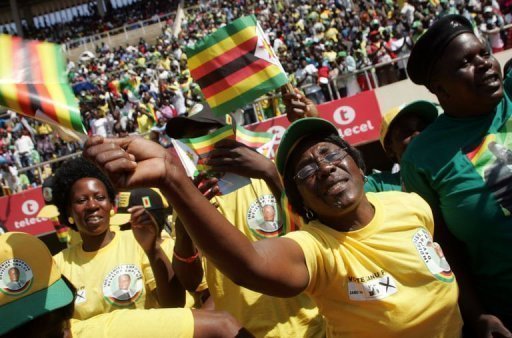
Flag-waving Mugabe supporters on 13 August 2013 in Harare (AFP file photo)
by Reagan Mashavave
Veteran Zimbabwean President Robert Mugabe hit out at “vile” Western critics as he was sworn in for another five-year term Thursday in a stadium packed with jubilant supporters.
Festooned in a sash, garland and medals, the 89-year-old dismissed accusations the July 31 election that returned him to power was rigged and vowed to rejuvenate the foreign-dominated banking and mining sectors.
Mugabe’s 33-year rule since Zimbabwe’s independence has been marked a drive to transfer foreign-owned and white-owned assets, including farms, to blacks.
“I promise you better conditions,” he told the 60,000 capacity crowd of supporters at a stadium in Harare.
“The mining sector will be the centrepiece of our economic recovery and growth. It should generate growth spurts across sector, reignite that economic miracle which must now happen.”
Mugabe’s inner circle has faced decades of international sanctions over rights abuses, and the veteran leader said he expected the punitive measures to continue.
“Most likely we shall remain under these sanctions for much longer.”
“We continue to look East,” Mugabe said lampooning, Western countries which have called into question the legitimacy of his election victory.
“We dismiss them as the vile ones whose moral turpitude we must mourn,” he said venting against Britain, Australia, Canada and the United States.
Former colonial power Britain called Thursday for an “independent investigation” into the conduct of the election, which Mugabe officially won by a landslide.
Unlike previous low-key investitures, Thursday’s event — replete with banners, flags and chants — carried strong echoes of Mugabe’s inauguration as prime minister of a newly independent Zimbabwe in 1980.
A no-show by many leaders from neighbouring countries — including President Jacob Zuma of regional power-broker South Africa — did little to dampen enthusiasm.
Neither did a boycott by opposition leader and former prime minister Morgan Tsvangirai, who insists the July 31 vote was stolen.
Mugabe was greeted in the stadium by thunderous cheers and whistling. On board a military truck he inspected assembled military personnel.
Gates to the Chinese-built stadium, the venue of Mugabe’s inauguration as president in 1987, opened shortly after dawn.
The day was declared a public holiday, helping boost attendance.
“Mr Mugabe, you are one of a kind,” sang a group of supporters slamming the sides of the minibus taking them to the stadium, while others waved fists as drivers honked their horns.
“It is a great day for Zimbabwe and the world will come to a standstill today,” said Alfred Tome, the Harare provincial administrator and spokesman for the organisers.
A concert will include artists from South Africa, Zambia and Jamaica –whose iconic singer Bob Marley played at Zimbabwe’s independence event.
Banners around the oval stadium carried messages praising African leaders and denouncing Western governments accused of meddling in Zimbabwe’s political affairs.
“Which African ever observed elections in Europe, America?” read one banner. “Africa has spoken, respect it’s voice,” said another.
The inauguration had been delayed after Tsvangirai challenged the poll results — which he denounced as “massive fraud” — in a petition to the Constitutional Court that was later withdrawn.
Among a series of complaints, Tsvangirai queried the suspiciously high number of voters who were turned away from polling stations in urban areas, which are considered opposition strongholds.
He also charged that his party’s supporters in rural areas were intimidated by Mugabe party backers into feigning illiteracy and voting in the presence of police and election officers.
The Constitutional Court confirmed Mugabe as president and declared the elections “free, fair and credible”, saying the results “reflected the free will of the people of Zimbabwe”.
‘Farewell event for Mugabe’
Eldred Masunungure, a political scientist from the University of Zimbabwe, said the event was at once Mugabe’s victory lap and his “last supper”.
“This inauguration is being projected as the crowning of a victory of a struggle for the past 13 years against big Western powers,” he said.
There is however also an “unintended meaning”, he said. “It can be read as a farewell event for Mugabe. It reminds one of Jesus’s Last Supper.”
The electoral commission declared Mugabe winner with 61 percent of the vote, against 34 percent for former prime minister Tsvangirai.
The vote ended a shaky power-sharing government formed by Mugabe and Tsvangirai four years ago to avoid a tip into all-out conflict following a bloody presidential run-off election in 2008.
Local observers judged the elections flawed and Western powers have raised serious doubts over the vote.
But regional groupings the Southern African Development Community and the African Union were less critical. – AFP
International unease mounted Sunday over the re-election of Africa’s oldest leader Robert Mugabe in polls denounced by Zimbabwe’s opposition as “stolen”.
Mugabe, 89, in power since 1980, trounced his long-standing rival Morgan Tsvangirai in Wednesday’s polls with 61 percent of the presidential vote while his party swept to a crushing parliamentary majority.
But 61-year-old Tsvangirai, leader of the Movement for Democratic Change (MDC) who has unsuccessfully tried to unseat Mugabe three times, condemned the vote as “fraudulent and stolen” and has vowed to challenge it.
Western powers, barred from sending full observer teams, voiced serious doubts about the polls following concerns over irregularities.
On Sunday, Germany said the election “casts a big shadow on the political and economic future of Zimbabwe”, while Australia called for new polls.
“Given our doubts about the results, Australia calls for a re-run of the elections based on a verified and agreed voters roll,” Foreign Minister Bob Carr said in a statement.
US Secretary of State John Kerry had Saturday described the election as “deeply flawed” and said Washington “does not believe that the results …today represent a credible expression of the will of the Zimbabwean people.”
British Foreign Secretary William Hague added his own “grave concerns” over the conduct of the vote in the former colony.
African and local observers raised concerns over the voters roll, the printing of extra ballot papers, and the turning away of voters at polling stations.
But with gentler assessments from the continent despite noting the flaws, President Jacob Zuma of powerful neighbour South Africa offered his “profound congratulations” to Mugabe on Sunday.
“President Zuma urges all political parties in Zimbabwe to accept the outcome of the elections as election observers reported it to be an expression of the will of the people,” a foreign ministry statement said.
The reaction in Zimbabwe’s Sunday press was starkly divided, with state-controlled newspaper The Herald proclaiming “President Mugabe romps to victory”, while the independent Daily News headlined, “It’s a Crisis”.
The vote marks the end of Mugabe and Tsvangirai’s tense compromise government, forced by bloodstained 2008 polls, that helped steer the isolated nation out of a protracted crisis.
In Harare’s oldest township Mbare on Sunday, several hundred Mugabe supporters carried a white coffin draped in an MDC flag, with a red knotted scarf placed on top with the inscription “RIP Morgan”.
“People are elated,” said one of the marchers, Tatenda Savanhu, 26, an economist.
“It’s really a moment of joy that the GNU (coalition government) is now gone that we are going into an era of ZANU-PF”.
— Finding a smoking gun may prove difficult —
Tsvangirai vowed to challenge the result in court and said the MDC would boycott government institutions.
“The fraudulent and stolen election has plunged Zimbabwe into a constitutional, political and economic crisis.”
Tsvangirai defended his 2008 decision to enter the uneasy pact with Mugabe, who has had him arrested, beaten and charged with treason, saying it had “rescued” Zimbabwe after years of meltdown.
But Mugabe’s ZANU-PF party says there is no need for the MDC in the new government.
“We have received over 60 percent of the vote, we have two-thirds majority, why would we want to bring someone else on board?” State Security Minister Sydney Sekeramayi told AFP.
The MDC now has until Saturday to present evidence of fraud to the constitutional court, but finding a smoking gun may prove difficult. The inauguration is expected within 48 hours of the court’s decision.
Tsvangirai said he would submit a dossier of “all irregularities and all the illegalities” to the influential 15-member Southern African Development Community (SADC) and called for an urgent summit.
The European Union, which had been moving toward easing long-standing sanctions, has also expressed concern.
But Emmerson Mnangagwa, defence minister and a key Mugabe lieutenant, argued that the result was a game-changer.
“The West will now have to climb down, they must find a ladder and climb down… A democratic election has taken place in Zimbabwe,” he told AFP.
The SADC, which engineered the power-sharing government, said the vote was “free and peaceful”.
But top SADC election observer Bernard Membe noted: “We did not say it was fair … we didn’t want to jump to a conclusion.”
The poll’s credibility was further tarnished by the resignation of one of the nine official electoral commissioners over “the manner” in which the polls “were proclaimed and conducted”.
But Harare based political analyst Blessing Vava said Western concerns meant little with African guarantors having given the polls the nod.
“The issue of Zimbabwe is over and done with,” Vava said.
The criticism will also be of little concern to Mugabe, he said.
“He will not care much with what the West will say, this is the reason why they were not invited to observe elections in the first place.” – AFP
This website uses cookies to improve your experience. We'll assume you're ok with this, but you can opt-out if you wish. Cookie settingsACCEPT
Privacy & Cookies Policy
Privacy Overview
This website uses cookies to improve your experience while you navigate through the website. Out of these cookies, the cookies that are categorized as necessary are stored on your browser as they are essential for the working of basic functionalities of the website. We also use third-party cookies that help us analyze and understand how you use this website. These cookies will be stored in your browser only with your consent. You also have the option to opt-out of these cookies. But opting out of some of these cookies may have an effect on your browsing experience.
Necessary cookies are absolutely essential for the website to function properly. This category only includes cookies that ensures basic functionalities and security features of the website. These cookies do not store any personal information.
Any cookies that may not be particularly necessary for the website to function and is used specifically to collect user personal data via analytics, ads, other embedded contents are termed as non-necessary cookies. It is mandatory to procure user consent prior to running these cookies on your website.