Mugabe’s inauguration ‘a victory against big Western powers’

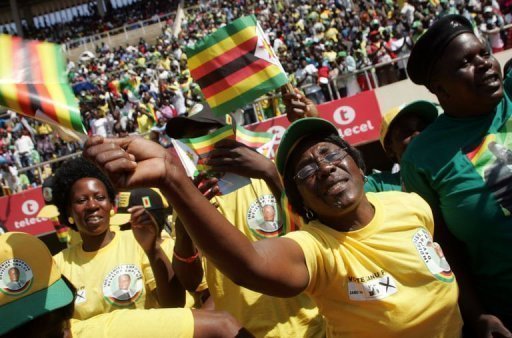
Flag-waving Mugabe supporters on 13 August 2013 in Harare (AFP file photo)

by Reagan Mashavave

Veteran Zimbabwean President Robert Mugabe hit out at “vile” Western critics as he was sworn in for another five-year term Thursday in a stadium packed with jubilant supporters.

Festooned in a sash, garland and medals, the 89-year-old dismissed accusations the July 31 election that returned him to power was rigged and vowed to rejuvenate the foreign-dominated banking and mining sectors.

Mugabe’s 33-year rule since Zimbabwe’s independence has been marked a drive to transfer foreign-owned and white-owned assets, including farms, to blacks.

“I promise you better conditions,” he told the 60,000 capacity crowd of supporters at a stadium in Harare.

“The mining sector will be the centrepiece of our economic recovery and growth. It should generate growth spurts across sector, reignite that economic miracle which must now happen.”

Mugabe’s inner circle has faced decades of international sanctions over rights abuses, and the veteran leader said he expected the punitive measures to continue.

“Most likely we shall remain under these sanctions for much longer.”

“We continue to look East,” Mugabe said lampooning, Western countries which have called into question the legitimacy of his election victory.

“We dismiss them as the vile ones whose moral turpitude we must mourn,” he said venting against Britain, Australia, Canada and the United States.

Former colonial power Britain called Thursday for an “independent investigation” into the conduct of the election, which Mugabe officially won by a landslide.

Unlike previous low-key investitures, Thursday’s event — replete with banners, flags and chants — carried strong echoes of Mugabe’s inauguration as prime minister of a newly independent Zimbabwe in 1980.

A no-show by many leaders from neighbouring countries — including President Jacob Zuma of regional power-broker South Africa — did little to dampen enthusiasm.

Neither did a boycott by opposition leader and former prime minister Morgan Tsvangirai, who insists the July 31 vote was stolen.

Mugabe was greeted in the stadium by thunderous cheers and whistling. On board a military truck he inspected assembled military personnel.

Gates to the Chinese-built stadium, the venue of Mugabe’s inauguration as president in 1987, opened shortly after dawn.

The day was declared a public holiday, helping boost attendance.

“Mr Mugabe, you are one of a kind,” sang a group of supporters slamming the sides of the minibus taking them to the stadium, while others waved fists as drivers honked their horns.

“It is a great day for Zimbabwe and the world will come to a standstill today,” said Alfred Tome, the Harare provincial administrator and spokesman for the organisers.

A concert will include artists from South Africa, Zambia and Jamaica –whose iconic singer Bob Marley played at Zimbabwe’s independence event.

Banners around the oval stadium carried messages praising African leaders and denouncing Western governments accused of meddling in Zimbabwe’s political affairs.

“Which African ever observed elections in Europe, America?” read one banner. “Africa has spoken, respect it’s voice,” said another.

The inauguration had been delayed after Tsvangirai challenged the poll results — which he denounced as “massive fraud” — in a petition to the Constitutional Court that was later withdrawn.

Among a series of complaints, Tsvangirai queried the suspiciously high number of voters who were turned away from polling stations in urban areas, which are considered opposition strongholds.

He also charged that his party’s supporters in rural areas were intimidated by Mugabe party backers into feigning illiteracy and voting in the presence of police and election officers.

The Constitutional Court confirmed Mugabe as president and declared the elections “free, fair and credible”, saying the results “reflected the free will of the people of Zimbabwe”.

‘Farewell event for Mugabe’

Eldred Masunungure, a political scientist from the University of Zimbabwe, said the event was at once Mugabe’s victory lap and his “last supper”.

“This inauguration is being projected as the crowning of a victory of a struggle for the past 13 years against big Western powers,” he said.

There is however also an “unintended meaning”, he said. “It can be read as a farewell event for Mugabe. It reminds one of Jesus’s Last Supper.”

The electoral commission declared Mugabe winner with 61 percent of the vote, against 34 percent for former prime minister Tsvangirai.

The vote ended a shaky power-sharing government formed by Mugabe and Tsvangirai four years ago to avoid a tip into all-out conflict following a bloody presidential run-off election in 2008.

Local observers judged the elections flawed and Western powers have raised serious doubts over the vote.

But regional groupings the Southern African Development Community and the African Union were less critical. – AFP
Mugabe to be sworn in on Thursday

Waiting for indigenization

Robert Mugabe will be sworn in on Thursday, beginning a fresh five-year mandate as Zimbabwe’s president following a disputed election, his spokesperson said Sunday.

“It is now this Thursday,” George Charamba told AFP on the sidelines of a summit of southern African leaders in Malawi.

On Friday Mugabe’s main challenger, opposition leader Morgan Tsvangirai, withdrew a legal challenge to the election result, claiming the courts would not be fair.

That removed the last hurdle to 89-year-old Mugabe’s inauguration for a seventh term.

Mugabe, Africa’s oldest leader, first took the reins of a newly independent Zimbabwe in 1980 as prime minister. He became president following a constitutional amendment in 1987.

Southern African leaders attending the summit had earlier endorsed the result of the election that extended his 33-year rule, congratulating him for holding peaceful elections.

Asked whether regional leaders would attend the swearing-in, Charamba said that “everybody will be invited”. – AFP

Pimping the culture

by Ilana Mercer

The marketplace doesn’t adjudicate the quality of art or pop culture – it does no more than offer an aggregate snapshot of the trillions of subjective preferences acted upon by consumers. That snapshot, in 2013, tells us that when it comes to “Bread and Circuses,” Rome and its provinces wallow in the same lowbrow popular culture.

Incidentally, to judge the quality of a cultural product is not to begrudge the preferences of the people who purchase it. It is simply to apply timeless, objective standards in assessing these products.

In its salient features, the Commander In Chief’s Ball resembles the annual White House Correspondents’ Association Dinner. There, some of the most pretentious, worthless people in the country – in politics, journalism and entertainment – convene to revel in their ability to petition and curry favor with one another, usually to the detriment of the people, whether the latter know it or not.

By and large, when it comes to entertainment, the people and the elites are on the same empty page – most of the musicians whose products they patronize, or with whom they fraternize, can’t read music, much less play it.

“Grammy and Academy Award winner” Jennifer Hudson, to whose primal screams the president and first lady attempted to dance, doesn’t sing; she screams. Voice coaches once considered the Hudson brand of “vocal wobble” a deficiency in technique and talent. But then, “Why be a musician, when you can be a success?” Such cacophony currently plays to full houses. It is to their credit that the First Couple smoothed the noise over with some smooth moves.

“We all know Beyoncé can sing,” came the response from inaugural organizers to the rumors that the singing sensation lip-synched to “The Star Spangled Banner.” Beyoncé is another performer who distinguishes herself with an obscene bump-and-grind routine and a din of discordant, jarring yelps.

Order lIana Mercer’s brilliant polemical work, “Into the Cannibal’s Pot: Lessons for America from Post-Apartheid South Africa”

We know not definitively whether Beyoncé moved her mouth to a prerecorded version of the national anthem, but much like babies banging on a play-play piano, the nation is preoccupied with the matter.

We do know this: As a studio musician close to home has explained to me, the T&A line-up at the Inaugural and Commander In Chief’s Balls would be reduced to embarrassing grunts, out-of-tune yelling and bedroom whispers, if not for the magic of Auto-Tune, which is the “holy grail of recording.” Auto-Tune “corrects intonation problems in vocals or solo instruments, in real time, without distortion or artifacts.”

Auto-Tune technology is what makes a cast of vain ventriloquists like Katy Perry and Glee what it is.

More sounds that curdled the air were those of Alicia Keys pounding on the piano keys.

“Obama’s on Fire. Obama’s on Fire,” the smirking Ms. Keys chanted tunelessly over and over again. The tradition of a praise singer or a tribal poet laureate still flourishes in Africa. But the tribal poet, unlike Keys, is a splendid performing artist. I know. I’ve seen him in my native South Africa convey the glory of the African savanna – even bring to life moribund leaders – with mesmerizing words and movement.

To sing well, you need a finely tuned instrument and musicality. An example of such an instrument is Carly Simon’s voice in this live performance of “That’s The Way I Always Heard It Should Be – 1972.” Hers is an evocative and nuanced voice. As to the lyrics, you’d have to be both literate and complex to write as evocatively.

To counter the assault on the ears popularized even further by the current White House, do lend an ear to the opera group “Seven,” singing the National Anthem at the Republican National Convention in Tampa, Fla., Aug. 30, 2012.

However, the National Anthem – the words to which were written in the aftermath of the Battle against the British, at Fort McHenry, Sept. 14, 1814 – is not much of an antidote to the ugliness of the Inaugural soiree.

So here are the sounds of “Seven” singing “Joyful, Joyful We Adore Thee,” set to Ludwig van Beethoven’s “Ode to Joy.” Enjoy! (This rendition has garnered only 173 YouTube views.)

I’d rather listen to the dodecaphony of 12-tone music than sit through the guttural battle cries emitted by today’s performers.