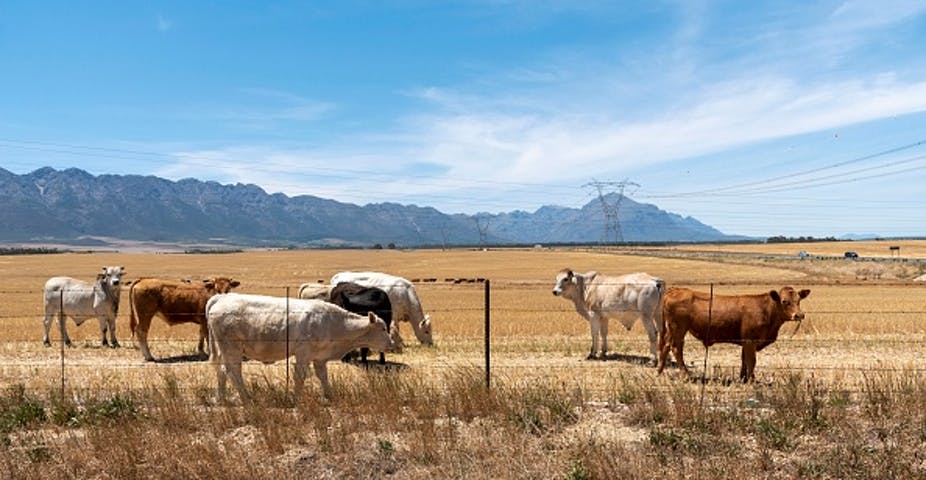
Small towns are collapsing across South Africa. How it’s starting to affect farming

Wandile Sihlobo, University of the Witwatersrand

Farming and agribusiness play a crucial role in sustaining the economies of small towns and rural areas. There is a lot of evidence of this in the economic literature and in the popular media. This dependency has its inherent risks.

International literature tends to focus on the devastation of small towns in times of drought or when farming lobby groups argue for particular policies. In South Africa, a different pattern has emerged. This is when municipalities fail to provide basic services to their communities and businesses. These services include water and sanitation, electricity, roads and technological infrastructure.

South Africa has a three-tier system of governance. National government sets national economic development policy and drives the search for investment by both domestic and international investors. Provincial government plays a big role too in searching for investment and executing government’s policies and programmes. The most successful province has been the Western Cape, which has achieved the status of the country’s technology hub. But where the investors are located within a province depends on municipalities, specifically how well run they are.

South African municipalities are in deep trouble. For many years households and residents have felt the impact. They have resorted increasingly to mounting protests across the country. But lately, there is growing evidence that governance and service delivery failures are also directly affecting the functioning and efficiencies of farming and agribusinesses in small towns.

A case in point is the recent decision by the food and beverages group Clover to move its cheese production from Lichtenburg, a town in the North West province of South Africa, to an existing plant outside Durban in KwaZulu-Natal due to “ongoing poor service delivery”.

Lichtenburg is part of the country’s maize producing triangle. Three provinces – Free State, Mpumalanga, North West – account for 84% of the country’s maize production, according to latest estimates of the 2020/21 season.

State of collapse

South Africa’s finance minister, Tito Mboweni, recently painted a gloomy picture of the state of municipalities in the country. There are about 278 municipalities in South Africa. Mboweni said that 163 municipalities were in financial distress, 40 were battling to deliver basic services, and 102 had adopted budgets for 2021/22 that they cannot fund.

A growing number are also failing to collect revenue from residents and businesses for electricity, water and property taxes.

Mboweni added:

And, for the first time in our democracy, the national executive has been ordered by a high court to constitutionally intervene in the affairs of a municipality owing to
a financial and service delivery failure.

Municipalities in rural areas and small towns are worst off. A recent study by the Tshwane University of Technology researchers stated that

the level of service delivery in rural communities is less compared to urban areas, and there is no sign of improvement.

Consequences

The multiplier effects of Clover’s decision to relocate are likely to be large. The closure of the firm in such a small town is likely to have a number of negative spillover effects across the local economy.

The company, according to official statements from the government, provided 380 permanent jobs and 40 temporary jobs. It also employs 20 general workers and 20 truck drivers and cleaners.

In addition, the plant gave farmers market access for their produce, and a range of businesses bought and sold products from the company. The income from these activities would have supported many other businesses in the community.

Clover is not the first major company to decry poor municipal services. There’s the long running case of Astral Foods, a poultry producer that also supplies animal feed, and the Lekwa Municipality. Astral has lost millions of rands in production because of failures by the municipality in the Mpumalanga province to provide its poultry plant with water and electricity.

These two cases illustrate how efficiency and economic sustainability of agribusinesses depend on delivery of basic services. Without them, levels of investment in the businesses will shrink in such towns. Importantly, this may affect the sustainability of agribusinesses as some might incur more costs as they try themselves to provide the services that were supposed to be provided by local governments.

The farmers face a similar challenge, directly and indirectly. The agribusiness provides a range of solutions and market access to local farmers. If agribusinesses’ sustainability is threatened, farmers suffer too. More directly, poor roads, unreliable electricity supply and water supply directly affect the profitability and sustainability of farming operations.

Importantly, these are all entities that provide job opportunities to the least skilled South Africans and indirectly sustain the communities around small towns.

The way forward

President Cyril Ramaphosa set out an economic reform and recovery agenda for the country in October 2020. In it he identified agriculture and agro-processing (food security) as one of the drivers of economic growth and job creation, especially in small towns.

But a vibrant agriculture and agribusiness won’t develop if poor service delivery by municipalities continues.

There are some basic practical interventions the government could make. These include ensuring that a municipality has competent management, financial officers, civil and electrical engineers, as well as competent political leadership.

The Financial and Fiscal Commission, an independent constitutional advisory body on financial fiscal matters in the country, recently argued municipalities should look closely at their wage bills. This would ensure that salaries didn’t crowd out money for critical service delivery functions. These include waste removal, waste management, sewerage systems, roads and water provision.

These improvements need to happen simultaneously and not before or after agriculture revitalisation, which is supported by the government’s Agricultural and Agro-processing Master Plans. These seek to expand and grow South Africa’s agriculture and agro-processing.

But a healthy farming sector rests on towns that are functional and that have the basics in place.

This is a challenge that the South African government should face head-on.The Conversation

Wandile Sihlobo, Visiting Research Fellow, Wits School of Governance, University of the Witwatersrand

This article is republished from The Conversation under a Creative Commons license. Read the original article.
Kenya is banking on water

Around the world people use bank machines to access cash: but in the Kenyan capital’s crowded slums, people now use similar machines to access an even more basic requirement — clean water.

In a bid to boost access to clean water, four water dispensing machines have been installed in Nairobi slums that operate like cash machines — with customers able to buy affordable water using smart cards.

It has cut costs dramatically, and is helping improve health, residents say.

“It’s pure and good for cooking, and above all it is affordable,” said Peter Ngui, who runs a small street restaurant.

“I used to get water from far away, but this water system is closer to my place of work.”

Previously people living in Nairobi’s cramped slums struggled to get clean water cheaply.

Without water pipes or plumbing in the tin-hut districts, residents resorted to buying water from sellers who dragged handcarts loaded with jerry cans or oil drums into the narrow streets.

That water was often dirty, sometimes taken illegally from broken pipes.

But the new machines, installed by the government-run Nairobi Water and Sewerage Company (NWSC), allow people to purchase water directly — and far more cheaply — than before.

Residents load money onto the water smart cards at a nearby kiosk or via payments sent on a mobile phone — a common system of payment in Kenya, which pioneered the sending of cash via phones — then tapping into the machine how many litres they want to buy.

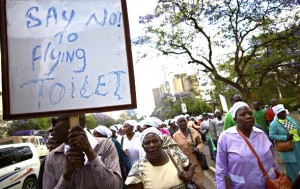
Kenya’s slums earned a grim reputation for “flying toilets” — when people defecate into plastic bags due to a lack of other facilities, which are then hurled somewhere else into the shanty town.

Source: AFP

Lesotho’s opposition leader flees country

Lesotho’s opposition leader has fled the country for the second time in a year, claiming that he was at risk of assassination after being voted out of power.

Thomas Thabane, the former prime minister, travelled to Botswana on Tuesday night in the latest twist to a year of political turmoil for the mountainous country that is entirely surrounded by South Africa.

“I ordered an investigation which confirmed that there were indeed plans to kill me,” he told AFP by telephone.

“Soon after I was given this report, I fled the country fearing for my life. I am still in Botswana.”

The Lesotho police said they could not confirm the threat against Thabane, but that they would investigate.

Thabane suspended parliament in June last year to avoid a motion that would have seen him ousted from power after the previous fragile coalition government fell apart.

In August, soldiers attacked police headquarters, looting weapons and killing one officer.

Thabane described the violence as an opposition-backed coup attempt and fled to South Africa, though both his political opponents and the military denied any bid to seize power.

A regionally-brokered snap election in February brought a new coalition government to power, headed by Thabane’s predecessor, Pakalitha Mosisili.

Lesotho is seen as strategically important to South Africa as it provides 90 percent of the water to Johannesburg city.

Source: AFP

No water at OR Tambo

There was no water supply at Africa’s biggest airport, OR Tambo International Airport in Johannesburg, on Friday morning due to water pipe connection problems, the Airports Company of SA said.

“This problem has affected one section of the airport, flights are not affected at all. The functioning of toilets has as a result been affected,” said Acsa spokesman Collen Naidoo.

The airport management had to shut down the water supply to enable engineers to fix the problem, he said.

Travellers complained about unavailability of water at the airport on social media.

Some complained that most restaurants did not have beverages such as coffee available due to water shortage.

Naidoo said the situation was temporary and would be fixed very soon.

Source: ANA

Whites only to pay for water soon?

Talks are under way to stop providing 6000litres of water a month free to residents deemed able to pay for all the water they consume.

Since 2001 the government has been allocating free basic water to white and black consumers indiscriminately.

But this might come to an end if proposals on the table are made law.

For an average household with a monthly water bill of R919, factoring in the cost of the 6kl into the equation – at the lowest tariff category – will add about R150 to the bill.

William Moraka, director of water services at the SA Local Government Association, confirmed yesterday that talks on the issue had begun.

Salga’s proposal is that the net increase per household would depend on how tariffs are to be structured.

White ratepayers will probably be punished anew.

Middle East headed for water crisis

The Middle East is headed towards a water shortage crisis, as NASA satellites show that reserves the size of the Dead Sea have been depleted in just seven years, largely due to well-drilling.

Newly-obtained results show that 144 cubic kilometres of freshwater – a volume nearly equivalent to that of the Dead Sea or Lake Tahoe – had been removed from the ground in the area that encompasses Turkey, Iran, Iraq and Syria between 2003 and 2009.

“That’s enough water to meet the needs of tens of millions to more than a hundred million people in the region each year, depending on regional water use standards and availability,” said Jay Famiglietti, the UC Irvine professor who led the team who made the findings, which are due to be published on Friday in Water Resources Reasearch magazine.

While 40 percent of the decline is in the soil and surface water, the decrease in groundwater, caused by human actions, is responsible for 90 cubic kilometers of the shortfall.

“Satellite data shows an alarming rate of decrease in total water storage in the Tigris and Euphrates river basins, which currently have the second fastest rate of groundwater storage loss on Earth, after India,” said Famiglietti.

The study was made possible by the US space agency’s Gravity Recovery and Climate Experiment (GRACE) satellites. The two identical vessels measure miniscule changes in the planet’s gravity through the variations in distance between them as they circle the Earth, their positions influenced by the varying mass of the water reserves.

The research team said the depletion was caused by poor water management, combined with unfavorable climate conditions.

Iraqi women carry non-potable water back home through a sand storm in the outskirts of Basra. (Reuters / Yannis Behrakis)

A devastating 2007 drought in the area not only caused depletions of surface water, which have still not been compensated, but also forced Iraqi authorities to order the drilling of more than 1,000 water wells. The actual number of wells drilled is likely to be much higher, as official statistics in the region are often patchy.

“That decline in stream flow put a lot of pressure on northern Iraq,” said Kate Voss, another study author. “Both the UN and anecdotal reports from area residents note that once stream flow declined, this northern region of Iraq had to switch to groundwater.”

At the time, the country was at the height of a deadly sectarian conflict.

“In an already fragile social, economic and political environment, this did not help the situation,” said Voss.

Iraqi children scramble for water at a collection point, overseen by British troops from the Black Watch and the Desert Rats, in Basra in southern Iraq. (Reuters / STR)

Last year’s authoritative Global Water Security report, produced by US intelligence agencies, marked the Middle East, naturally the driest region in the world alongside North Africa, as the area most vulnerable to water shortages, saying the situation was exacerbated by a lack of legal agreements and political instability.

“They just do not have that much water to begin with, and they’re in a part of the world that will be experiencing less rainfall with climate change,” Famiglietti said. “Those dry areas are getting dryer. Demand for freshwater continues to rise, and the region does not coordinate its water management because of different interpretations of international laws.”

Turkey, whose territory houses the headwaters of the region’s two major rivers, Tigris and Euphrates, enjoys a strained relationship with Syria and Iraq, the countries further downstream, and has systematically diverted water for its irrigation, which is frequently inefficient (throughout the Middle East).

Meanwhile, the World Bank predicts that water demand in the region will rise by 60 percent by 2045.

Groundwater has made up the shortage so far but it is being extracted at much faster rates than it is replaced.

“Groundwater is like your savings account,” said Matt Rodell, another study author. “It’s okay to draw it down when you need it, but if it’s not replenished, eventually it will be gone.”

Fracking will pollute water, causing cancer

Artist's impression of the fracking process

KwaZulu-Natal – SA’s top water research body has warned the government to think carefully about the serious risk of water pollution from cancer-causing chemicals and radioactive compounds from future underground “fracking” operations across huge swathes of the country.

A new report by the state-funded Water Research Commission says shale gas rock-fracturing (fracking) will not only happen in remote sections of the Karoo. In fact, the government had already issued fracking exploration permits in six of the nine provinces, including a massive chunk of southern KwaZulu-Natal stretching almost as far north as Pietermaritzburg.

The scientists note that future fracking, at depths 4km below the earth’s surface, could be over a much wider area of the country – including most of the high-lying areas south of latitude 29°C in KZN (a line which starts at Mtunzini in the east and stretches inland past Estcourt towards Bloemfontein and Kimberley).

The report also identifies a number of risks to human health, water and the natural environment from fracking wells. These risks included:

– Widespread pollution of groundwater, rivers and lakes with dozens of cancer-causing fracking compounds and other “highly toxic” pollutants such as benzene, hydrochloric acid and isopropanol.

– Accidental release of underground uranium and other radioactive elements into the water and soil.

– Underground mini-earthquakes, cave-ins and land subsidence.

– Privatisation of parks and other state land where the public is excluded from fracking land and gas fields for safety reasons.

– Above-ground air pollution from methane and other shale gas wells.

– Lower property values.

However, water pollution is the main emphasis of the 84-page Water Research Commission report by Gideon Steyl (University of the Free State chemistry department), Gerrit van Tonder (University of the Free State Institute for Groundwater Studies) and Luc Chevallier (Council for Geoscience).

The scientists note that gas-drilling companies in the US have been trying to hide the toxic nature of many fracking chemicals.

However, the commission cites a report from the US House of Representatives last year which identified at least 29 commonly used fracking chemicals that were known or probable cancer-causing agents, or were regulated as hazardous to drinking water and air.

These chemicals are mixed with water and pumped underground at very high pressure to fracture and crack the rock formations to release buried pockets of methane and other gas formed millions of years ago from rotting mounds of mud, vegetation, algae and other organic matter.

Some chemicals included benzene (a known cancer-causing chemical) along with a variety of acids and petroleum products.

A study by the University of Buffalo in the US last year also raised concern about the possible release of underground uranium and other radioactive compounds when rocks are cracked up with hydrochloric acid.

Another US study published last year showed that the methane gas level in underground drinking water was generally 17 times higher in fracking areas compared with well water where no fracking took place.

However, Steyl and his colleagues voiced dismay over the difficulty in tracking down truly unbiased international studies on the impacts of fracking, since most were done by industry and private interests.

Even official US government reports claiming no damage to public health or the environment stood in contradiction to numerous adverse reports by US citizens and the US Environmental Protection Agency.

The commission researchers note that a single fracking event in a single well used the same amount of water needed to irrigate eight to 10ha of maize during a growing season.

Every time a well was fracked, large volumes of chemicals were added to the water-pressure mixture. Although chemicals only made up between 0.5 and 2 percent of the mixture, the volume of hazardous chemicals in a single fracking event could total between 34 000 and 136 000 litres.

Even if just 1 percent of dangerous fracking chemicals leaked out of the concrete well drillings during a single fracking, Steyl estimated that 490 litres of hazardous chemicals could contaminate underground water. This could pose “serious hazards” to the environment and to underground water drunk by people and livestock.

Despite these concerns, the scientists appear to recognise that fracking is a fait accompli and they have listed a set of 10 recommendations to limit harm. They include compulsory “full disclosure” of every chemical used. Any fracking well should be at least 10km away from residential areas to reduce chemical exposure risks.

All drilling records should be freely available to the public, and a thorough baseline study should be done to measure pre-fracking quality of water, soil and air by an “unbiased” body such as a university.

Legal action should also be taken against any drilling company after a first offence. They should be forced to clean up damage, and be banned from future fracking in SA. However, even in the US, there were fewer than 10 inspectors to monitor more than 3 500 fracking wells in Pennsylvania. – The Mercury

Eskom, ANC government causing water crisis, says Greenpeace

JOHANNESBURG, June 25 2012 — A water crisis is looming in South Africa, communities are at risk of losing access to water, and coal is right in the middle of it, according to a report released by Greenpeace today. This latest briefing is a stark reminder to the SA government to start pushing Eskom to substantially invest in renewable energy.

South Africa is projected to experience a 17% gap between water supply and demand by 2030, but new mega coal-fired power stations (Medupi and Kusile) are being built by the national utility Eskom without a clear view of what the water impacts are likely to be.

According to Melita Steele, climate and energy campaigner for Greenpeace Africa: “The truth is that in the face of looming electricity price hikes, and a R13.2 billion net profit recorded by Eskom this year, local communities in coal areas may lose their water rights to make way for mines, to help feed Eskom’s coal addiction.”

The briefing entitled: ‘The Eskom factor: Power politics and the electricity sector in South Africa'[1] tries to identify what the real story is behind Eskom’s decisions, outlining Eskom’s role in South Africa, its evolution as a state-owned company, and its current status as an influential player in South African politics [2]. This is combined with an independently commissioned feature story ‘Coal’s hidden water cost to South Africa’ [3], written by award-winning journalist, Yolandi Groenewald.

“Eskom is the only ‘strategic’ water user under the National Water Act, which means that the Department of Water Affairs has to provide it with water, come hell or high water. The problem is that in one day, Eskom uses enough water to grow almost a million kilograms of maize, due to its reliance on coal. If there were a drought, water might have to be taken away from other users. But Medupi and Kusile will push up Eskom’s water usage considerably in the next decade. The impact of new coal-fired power stations on a future water crisis hasn’t been adequately taken into account”, continued Steele.

“South Africa’s current electricity system is geared to supply energy-intensive industries, and building new coal-fired power stations to ‘keep the lights on’ means catering to big business, at the expense of the 12.3 million South Africans without access to electricity. Making profits for a privileged few, while the people of South Africa pay the price.”

“It is time to hold Eskom and the South African government accountable for the decisions being made today, which will affect all of our futures. South Africa’s continued reliance on coal goes to the heart of whether we can keep our taps running with clean water. Greenpeace calls on Eskom to stop building new coal-fired power stations, and instead invest in the substantial rollout of large-scale and decentralised renewable energy projects to allow for a just transition away from coal: creating jobs, ensuring universal energy access, and avoiding a water crisis exacerbated by catastrophic climate change. In the face of South Africa’s already severe water and electricity crises, the government’s inaction is irresponsible”, Steele concluded.