Small towns are collapsing across South Africa. How it’s starting to affect farming

Wandile Sihlobo, University of the Witwatersrand

Farming and agribusiness play a crucial role in sustaining the economies of small towns and rural areas. There is a lot of evidence of this in the economic literature and in the popular media. This dependency has its inherent risks.

International literature tends to focus on the devastation of small towns in times of drought or when farming lobby groups argue for particular policies. In South Africa, a different pattern has emerged. This is when municipalities fail to provide basic services to their communities and businesses. These services include water and sanitation, electricity, roads and technological infrastructure.

South Africa has a three-tier system of governance. National government sets national economic development policy and drives the search for investment by both domestic and international investors. Provincial government plays a big role too in searching for investment and executing government’s policies and programmes. The most successful province has been the Western Cape, which has achieved the status of the country’s technology hub. But where the investors are located within a province depends on municipalities, specifically how well run they are.

South African municipalities are in deep trouble. For many years households and residents have felt the impact. They have resorted increasingly to mounting protests across the country. But lately, there is growing evidence that governance and service delivery failures are also directly affecting the functioning and efficiencies of farming and agribusinesses in small towns.

A case in point is the recent decision by the food and beverages group Clover to move its cheese production from Lichtenburg, a town in the North West province of South Africa, to an existing plant outside Durban in KwaZulu-Natal due to “ongoing poor service delivery”.

Lichtenburg is part of the country’s maize producing triangle. Three provinces – Free State, Mpumalanga, North West – account for 84% of the country’s maize production, according to latest estimates of the 2020/21 season.

State of collapse

South Africa’s finance minister, Tito Mboweni, recently painted a gloomy picture of the state of municipalities in the country. There are about 278 municipalities in South Africa. Mboweni said that 163 municipalities were in financial distress, 40 were battling to deliver basic services, and 102 had adopted budgets for 2021/22 that they cannot fund.

A growing number are also failing to collect revenue from residents and businesses for electricity, water and property taxes.

Mboweni added:

And, for the first time in our democracy, the national executive has been ordered by a high court to constitutionally intervene in the affairs of a municipality owing to
a financial and service delivery failure.

Municipalities in rural areas and small towns are worst off. A recent study by the Tshwane University of Technology researchers stated that

the level of service delivery in rural communities is less compared to urban areas, and there is no sign of improvement.

Consequences

The multiplier effects of Clover’s decision to relocate are likely to be large. The closure of the firm in such a small town is likely to have a number of negative spillover effects across the local economy.

The company, according to official statements from the government, provided 380 permanent jobs and 40 temporary jobs. It also employs 20 general workers and 20 truck drivers and cleaners.

In addition, the plant gave farmers market access for their produce, and a range of businesses bought and sold products from the company. The income from these activities would have supported many other businesses in the community.

Clover is not the first major company to decry poor municipal services. There’s the long running case of Astral Foods, a poultry producer that also supplies animal feed, and the Lekwa Municipality. Astral has lost millions of rands in production because of failures by the municipality in the Mpumalanga province to provide its poultry plant with water and electricity.

These two cases illustrate how efficiency and economic sustainability of agribusinesses depend on delivery of basic services. Without them, levels of investment in the businesses will shrink in such towns. Importantly, this may affect the sustainability of agribusinesses as some might incur more costs as they try themselves to provide the services that were supposed to be provided by local governments.

The farmers face a similar challenge, directly and indirectly. The agribusiness provides a range of solutions and market access to local farmers. If agribusinesses’ sustainability is threatened, farmers suffer too. More directly, poor roads, unreliable electricity supply and water supply directly affect the profitability and sustainability of farming operations.

Importantly, these are all entities that provide job opportunities to the least skilled South Africans and indirectly sustain the communities around small towns.

The way forward

President Cyril Ramaphosa set out an economic reform and recovery agenda for the country in October 2020. In it he identified agriculture and agro-processing (food security) as one of the drivers of economic growth and job creation, especially in small towns.

But a vibrant agriculture and agribusiness won’t develop if poor service delivery by municipalities continues.

There are some basic practical interventions the government could make. These include ensuring that a municipality has competent management, financial officers, civil and electrical engineers, as well as competent political leadership.

The Financial and Fiscal Commission, an independent constitutional advisory body on financial fiscal matters in the country, recently argued municipalities should look closely at their wage bills. This would ensure that salaries didn’t crowd out money for critical service delivery functions. These include waste removal, waste management, sewerage systems, roads and water provision.

These improvements need to happen simultaneously and not before or after agriculture revitalisation, which is supported by the government’s Agricultural and Agro-processing Master Plans. These seek to expand and grow South Africa’s agriculture and agro-processing.

But a healthy farming sector rests on towns that are functional and that have the basics in place.

This is a challenge that the South African government should face head-on.The Conversation

Wandile Sihlobo, Visiting Research Fellow, Wits School of Governance, University of the Witwatersrand

This article is republished from The Conversation under a Creative Commons license. Read the original article.
Littering in South Africa is the expression of wider selfish – and costly — culture

Roger Southall, University of the Witwatersrand

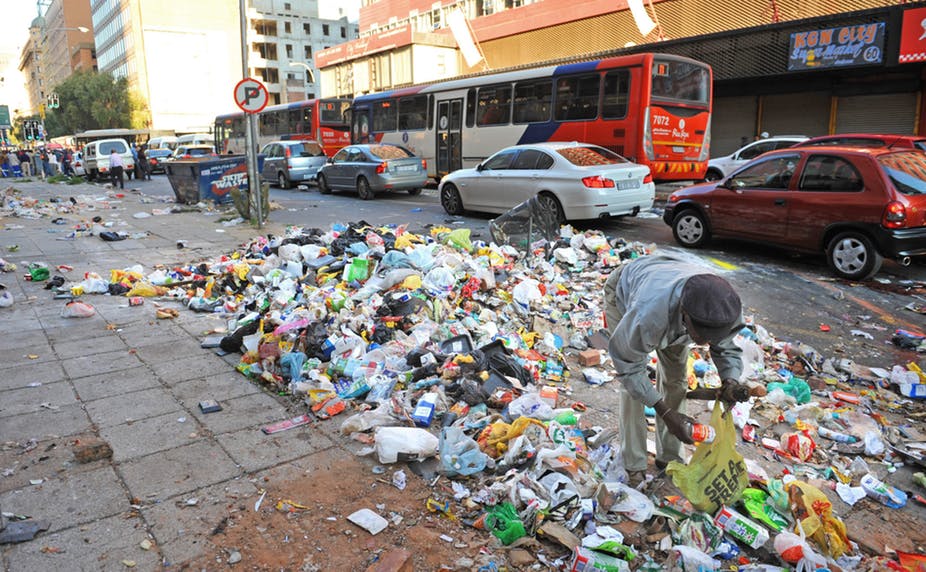
It is common when municipal workers go on strike in South Africa to resort to upturning garbage cans and strewing litter around city centres. Their message is clear: we may be at the bottom of the social heap, and you may think we are human trash, but by God, society needs us, and if you don’t listen to us and give us a living wage, we’ll make you pay for it.

Trashing a city is more than a demand for a better wage. Often, it’s also an expression of rage against employer arrogance or unaccountability, and a demand for basic respect. Such tactics are manifestly expressions of class struggle and class power, workers resorting to their most effective weapon. While they are unlikely, in extremis, to be able to confront the armed might of the state, they may well be able to make city managers and the general population wilt in the face of the stink and mess of uncollected garbage.

Yet such actions are indicative of a discordant society, and a culture of littering can tell us a lot about a society’s ethos.

Littering is an act of individual or group disposal of waste at the public expense in terms, not only of the cost of public collection, but also at worst, of public health, and always in terms of public enjoyment of the environment. It prioritises the private interest over the public, and places the burden of collection or consequences of litter on the collective.

Doubtless too, it is expressive of class, income, status and power. It is no accident that in most – if not all countries – better-off residential areas are likely to be freer of litter than worse off localities. They have more public clout and more private resources.

Littering tells us a great deal about community spirit. It is surely no accident that the Scandinavian countries, which regularly top the World Happiness Index, are relatively litter free. Their governments have long prioritised the collective interest and there is less social inequality than in similarly industrialised nations.

Industrialised countries such as Britain and the US are rich, but they’ve embraced austerity and encouraged rampant consumerism, making them sadly notorious for being far more publicly dirty, as captured by Kenneth Galbraith’s (1958) critique of “Private Affluence and Public Squalor”. South Africa has similarly developed a culture of externalising private costs onto the public, a culture of not caring about the environment which has been emblematic of the country’s mining industry for more than a century.

Public interest

South Africa is a country still deeply divided along lines of race, class, and geography in which there may be a public, but a limited sense of “public interest”. It’s a country where the needs of the better off were historically always prioritised over those of the poor.

For example, the expansion of the road system was accompanied by the massive expansion of white suburbia from the 1960s, where tellingly, pedestrians – many of them black domestic workers going to and from work – were denied pavements and left to walk in the road. Because the white inhabitants of suburbia were ratepayers, and because they employed domestic labour to tend to their verges, they enjoyed a generally litter free environment. The scholarship is not available to tell us about the state of litter and waste in the townships at that time, but we may guess it was distressingly different.

Johannesburg Mayor Herman Mashaba, second from left, joins the city’s Are Sebetseng (Let’s work) cleaning campaign.
Enoch Lehung

Today, the South African environment is pockmarked by the detritus of mass consumption. The culture of takeaway culture is also the culture of throwaway, and if there is no litter bin available, or if it’s full, too bad. It’s just easier to dump. So, what if it adds to the mess? Does anyone really care about the one more bottle or can lying on the ground?

There are worries, as there should be, that the appalling littering along South Africa’s highways and the litter to be found even in many of South Africa’s beauty spots, is a threat to our tourist industry, and that in turn, means fewer jobs (let alone less general enjoyment). Yet the problems resulting from poor disposal of waste run far deeper.

Yes, the fast food industry and the supermarket chains, which have a fetish for unnecessary packaging, have much to answer for. But the externalisation of production costs onto to the public is hard-wired into South African industry.

South Africa is a country whose industrial origins lie in mining, and mining systematically produces massive waste and pollution which often has hugely detrimental effects on the environment and public health. This culture continues today, sadly encouraged by lax governmental environmental supervision and excessive concern for profits, investment and private gain.

“Littering” by individuals is merely the expression of a far wider selfish – and publicly, costly – culture.

Addressing the issue

There are no great mysteries about how to address the issue of litter. What is needed first is the political will. This in turn requires the recognition of the importance of the problem.

There is more at stake than what many people might consider to be merely a middle class distaste for littering and general physical untidiness. Indeed, any presumption that middle class people have a greater dislike of litter than working class people or the poor needs itself to be questioned. After all, poor people bear the brunt of the problem. Where there is litter, there is filth, and where there is filth, there is disease.

Political will must be backed up by public resources, and all the paraphernalia of waste collection – from collection lorries, appropriate waste sites and disposal mechanisms, and litter bins. So much is obvious. Yet what is also required is far greater effort by government and ordinary citizens to curb the waste encouraged by excess packaging.

South Africa’s recycling industries – providers of thousands of jobs in the informal sector – need to be backed up by greater requirements imposed on retailers to provide collection points for plastic, cans, bottles and so on. The lack of effort by municipalities to encourage recycling by requiring householders to sort their waste into categories is scandalous, especially in middle class, high consumption areas where this would be easy to implement.

Legislation to curb use of plastic is spreading around the world, and South Africa should not want to be left behind.

A cleaner environment, cleaner air, cleaner towns and cities, needs to be placed firmly on the public agenda.The Conversation

Roger Southall, Professor of Sociology, University of the Witwatersrand

This article is republished from The Conversation under a Creative Commons license. Read the original article.

Blacks are confused and they require help: But what help?

by Johann Theron

Blacks themselves give a lot of clues as to what they want or need, especially when they think some politically correct answer is not required. Very few would venture to actually admit to wrong-doing such as the infamous Pallo Jordan of the South African revolutionary movement ANC (African National Congress), or as the American lawyer Michael Smith pointed out – black Americans would rather believe a cellmate than their own lawyer.

Lately a black South African twitter account tweeted that “they (blacks) do not want to be civilized” – something I would actually believe given their extremely limited and limiting continued tribal and communist education. Then quite surprisingly the South African Moeketsi Masola was published saying that he is both “ashamed to be black and a man”. Stories abound here in South Africa of “black diamonds” – a term denoting black people in senior corporate positions they were never qualified for – which (still) allow those white-run corporations to compete for lucrative government tenders. As long as they have a “scorecard” showing black management and ownership, they can still do business with an anti-white government.

The South African government itself is of course virtually 100% black except for a few important positions such as the Department of Trade and Industry Minister which manages the very influential state-owned enterprises of which there are thousands – with more to come. Then you also get the arrogant side where a “shortage” of money is simply downplayed by the possibility of selling “more bonds” to finance an unsustainable welfare state despite not purporting to be “welfare oriented”. South Africa proposes to be a constitutional state similar to America that actually functions like a socialist/Marxist regime behind the “black” curtain. Apparently 40% of parliamentarians are communist (of the old type) and I will not go into the percentage of councillors in municipalities that are illiterate. Municipal finances are in such disarry that something like 90% of South African municipalities get qualified audits.

Black people, especially in South Africa, agree that they cannot manage the country, but they continue nonetheless! They agree to be token appointments, but continue nonetheless. Recently Matome Letsoalo published an article with the title “African Leaders: Heroes or desperate house negroes?” The term house negro is of American origin (I believe) and he actually describes the President of South Africa (Jacob Zuma who incidentally has zero qualifications beyond primary or elementary school) as such a person or from that “horde”. That he asks how Obama can promote peace while causing war at the same time is perhaps a different discussion because it may have unpalatable answers such as to get rid of those same “hordes”.

That there is an inferiority complex in black people is assured – the question is how does one help these people? – not all of them though – because some are quite self-respecting and self-disciplined. But there are many others that cry for help. Since politics won’t help and neither will religion, the controlling elements in black people’s lives are tribalism and unionism. The interesting thing in South Africa is that unionism (something the anointed future SA President is well aware of) sits on the same side of the table as the government (as an alliance). In fact he appears to be intimately involved in the Marikana shooting where 34 miners died in a hail of police fire because he was most likely a black-diamond Lonmin shareholder.

The last “proper” vestige of influence on the crying masses therefore remains a single concept, i.e. tribal leadership. Unfortunately these “traditional leaders” are making things worse by claiming land they never possessed and monies they did not work for. The kind of land and funds that would have benefitted the individual crying black citizen immensely. But then that requires real (literate) black leadership heroes, maybe even somebody like Prince Buthelezi – not the Malema populist type.