‘Nigga’ used 500 000 times daily on Twitter

This season, the US National Football League is attempting the impossible: banning the n-word within the chalk-lined borders of its purview.

As with the previous attempts, the NFL’s “zero tolerance” policy — which gives referees leeway to issue a 15-yard penalty for a first offense and ejection for a second — comes with good intentions: to establish a field of play free of the most racially charged word in American history.

The policy, though, was widely criticized as being heavy-handed and out of touch. As the league wrestled with the issue, a team of Washington Post journalists examined the history of this singular American word, its spread through popular culture and its place in the vernacular today.

But like the others, it is almost certainly doomed to fail; to be ignored, at best — or mocked and flouted, at worst.

If there is one thing certain about the modern n-word, it is that it defies black-and-white interpretations and hard-and-fast rules.

The word is too essential as an urban slang term to be placed in a casket and buried, as NAACP delegates attempted to do in a 2007 mock “funeral” for the word.

It is too ingrained in youth culture to be eliminated from city streets, as the New York City Council attempted with a symbolic resolution banning the word the same year. And more than likely, it will prove too complex and nuanced to be policed by football referees wielding yellow flags and penalties. Never mind the troublesome optics of a group of mostly white NFL executives dictating the language rules of a majority-black player pool.

If anything, in 2014, it is the very notion of banning the n-word that appears dead and fit for burial. It was a long and noble fight, waged largely — but not exclusively — by an older generation for which the word is inseparable from the brutality into which it was born. If there is still a meaningful n-word debate left to have, it is over context, ownership and the degree to which it should be tethered to its awful history — or set free from it.

A word that is used 500,000 times a day on Twitter — as “nigga” is, according to search data on the social media analytics Web site Topsy.com — is almost by definition beyond banning. By comparison, “bro” and “dude” — two of the terms with which the n-word is synonymous to many people younger than 35 — are used 300,000 and 200,000 times, respectively. For many of this generation, the word is tossed around unthinkingly, no more impactful than a comma.

“It’s such a regular part of my vernacular. It’s a word I use every day,” said comedian/actor Tehran Von Ghasri, a 34-year-old D.C. native of African American and Iranian American heritage. “I’m a ‘nigga’ addict.”

But any larger exploration of this subject leads to the inevitable conclusion that it isn’t just the NFL that has an n-word problem. It’s all of America.

Source: Washington Post
‘Racism is everywhere’: Minneapolis police chief

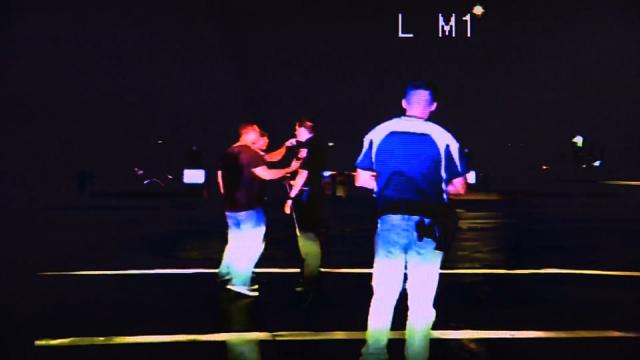
The scene in Green Bay where police officers Brian Thole and Shawn Powell used the 'N word'
The scene in Green Bay where police officers Brian Thole and Shawn Powell used the ‘N word’

The Minneapolis Police Department has been under the microscope after two separate incidences of officer-involved altercations laced with racial slurs came to light. Now, the former police chief is speaking out.

The videos out of Green Bay, Wis., and Apple Valley, Minn., have rocked the department and city leaders. In both, off-duty officers can be seen and heard as they fight and use racial epithets in heated altercations.

“It makes the department look bad,” said Tim Dolan, former police chief for the Minneapolis Police Department. “It makes the profession look bad.”

Dolan found the behavior so troubling, he penned a letter to the editor of the Star Tribune over the weekend. In it, he wrote, “As I often told officers in the past, there will be days when you will be less proud of putting on the uniform of the Minneapolis Police Department.”

“The recent incidents reported should embarrass and concern anyone who has worn a uniform,” he continued.

Dolan led the department for six years. Last year, he retired and passed the baton to Janee Harteau.

“I used to say the job was easy except for personnel issues,” Dolan recalled. “Personnel issues are the toughest to deal with, especially with race involved.”

When asked whether there is a problem with racism within the department, Dolan replied: “Racism is everywhere.”

“People say there isn’t racism,” he said. “They are not living in reality.”

The cases have sparked outrage in every corner of the city, particularly in neighborhoods where the majority of residents are African American.

“As a member of the community — the last couple years, I began trusting police here,” Darrel Young told FOX 9 News. “To see that… it was a hard to swallow.”

While Harteau cannot comment on specific individuals and punishments, she made it clear she was “appalled” by what she saw in the videos appearing on the local news. She has insisted that there is no place for racism or discrimination in the department and has vowed to reach out to cultural and faith leaders in the community, including Bishop Richard Howell, in an effort to rebuild trust.

“I think the time for conversation is now,” Howell said. “Let’s not let this thing get out of hand.”

On Sunday, the Minneapolis Police Federation also signaled its interest in being a part of the solution, with the union president releasing a statement that echoed Harteau’s sentiments after illustrated a desire to be included in discussions with community leaders.

“On behalf of our 850 members, we agree 100% with Chief Janee Harteau that each and every officer in MPD has taken an oath of office and is required to live by the Law Enforcement Code of Ethics. We take that oath and the code very seriously,” Lt. John Delmonico wrote. “The overwhelming majority of MPD officers work hard every day to earn the public’s respect and trust. We must impartially enforce the law without discriminating against any citizen based on their race, sexual orientation, religion or national origin. There is no place in MPD for racist and bigoted officers.”

Dolan said while it is tough to weed out the “bad apples,” he believes union cooperation will be crucial going forward.

“The union can make some concessions which might help in terms of how far you can control off-duty behavior,” Dolan said. “They do play an important role.” – KMSP-TV