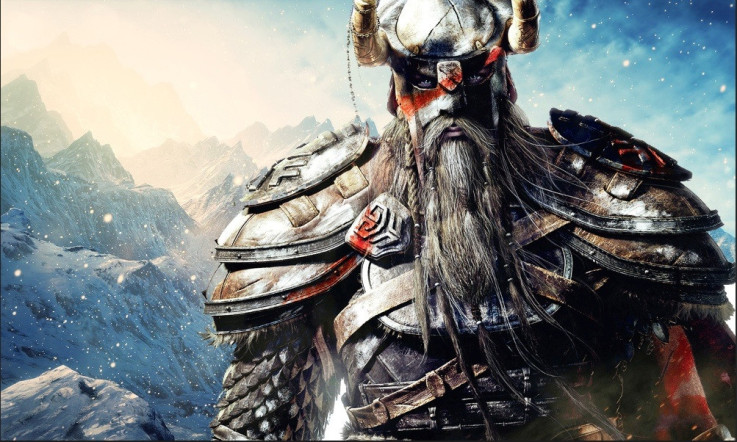
Mediaeval video games ‘legitimize white supremacy’ and nationalism – academic

“The Middle Ages is a space where white supremecy is legitimised. The maintenance of white privilege. The gamer community use ‘historical facts’ to legitimise this kind of literacy,” said British Ph.D. candidate Victoria Cooper recently. Mediaeval representations in video games was the focus of Victoria Cooper’s paper, Playing Politics: Exploring Nationalism and Conservatism in Fantasy Video Games, which was given earlier this month at the International Medieval Congress.  Part of the session,The Use and Abuse of the Middle Ages in the Modern World, IV: Nationalism and Identity, it examined the ways in which medieval imagery and history are often hijacked by far-right political groups and nationalist organisations to legitimise their historical narratives.

Victoria Cooper
Victoria Cooper

Cooper, a PhD candidate at the University of Leeds, used player assessments of the Middle Ages, marketing, and player forums as the backbone of her research. Forums, in particular, are good resources for player observation because conversations here spring up organically and aren’t censored. When Cooper was speaking to players, she was careful to never brings up the Middle Ages to see if they brought it up themselves. The result? Most players do.

What did these unchecked conversations reveal? The games don’t inspire a specific kind of nationalism with another country per se, but they do harken to “the mediaeval’ which becomes it’s own space, and has its own nationalistic quality where real heritage is superimposed upon a fictional world.

Cooper notes that the medieval world is often exploited by right wing groups, such as the British National Party (BNP). They used the symbol of Excalibur to promote “Englishness”, since, according to legend, Excalibur is the sword that confers the rightful kingship of England. There is even an online shop profiting from this perceived sense of English nationalism that declares, “Excalibur: the number 1 patriotic goods store”. However, it appears that the BNP is no longer affiliated with the shop and Excalibur has taken great pains to extricate itself from the association by posting a large disclaimer on their front page stating, “Excalibur has no affiliation or ties to any political party. All merchandise sold on Excalibur belongs to Excalibur and any profits made from such merchandise stays with Excalibur.”

Groups like the BNP in England often attempt to tie a mediaeval past to their nationalism by framing it with shirts like, “White and Proud”, or “Anglo Saxon”, as a form of identity politics.

#GamerGate

Cooper recalled the infamous “#GamerGate” – the 2014 scandal that erupted in the gaming world when several prominent women challenged the status quo of the community. The women received rape, violence and death threats. They (and their supporters) were also “doxed”; a tactic whereby private information, like a home address, phone number, place of work and personal details are made public in an effort to silence and publicly shame the person.

Cooper noted that the gaming community has traditionally had horrible reactions towards academic inspection of games because players want to maintain them as apolitical and are resistant to changing the status quo. The predominantly white, male players of Gamergate insisted that representations of the games should be divorced from modern politics.

However forcefully players maintain their arguments, many gamers continue to map their identity, heritage, and ancestry onto these games. They claim to be apolitical, yet in the same breath, refuse to acknowledge the politics behind these games. According to Cooper, they subscribe to the popular idea of the Middle Ages as ‘gritty, white, male, and powerful’. They cling to the notion that women didn’t fight in the Middle Ages, fiercely stating this as ‘as fact’, and steadfastly refusing to allow women agency in warrior roles.

Unfortunately for gamers, the tide is turning and the inspection of their identities is happening whether they like it or not, and will continue to gain momentum. Games like Skyrim, and The Elder Scrolls are only the tip of the iceberg. What Gamergate tried to shut down, instead, opened a Pandora’s Box that can never be closed. Academics, like Cooper, will continue to challenge, examine and illustrate the ways these groups misappropriate mediaeval history. – mediavalists.net


War on white Christians gaining in the US

The culture war against Christianity is picking up speed, says Patrick Buchanan.

Last week came word Saint Louis University will remove a heroic-sized statue of Father Pierre-Jean De Smet S.J. from the front of Fusz Hall, where it has stood for 60 years.

The statue depicts De Smet holding aloft a crucifix as he ministers to two American Indians, one of whom is kneeling.

Historically, the statue is accurate. Father De Smet, “Blackrobe,” as he was known, was a 19th-century missionary to Indian tribes who converted thousands. A friend of Sitting Bull, he spent his last years in St. Louis.

And as the mission of this Jesuit university is, presumably, to instruct the Catholic young in their faith and send them out into the world to bring the good news of Jesus Christ as Lord and savior to nonbelievers, what exactly is the problem here?

According to SLU Assistant Vice President for Communications Clayton Berry, “some faculty and staff … raised questions about whether the sculpture is culturally sensitive.” Senior Ryan McKinley is more specific: “The statue of De Smet depicts a history of colonialism, imperialism, racism and of Christian and white supremacy.”

The faculty and staff are ashamed of the truth for which Saint Louis University was supposed to stand.

The SLU president should have been honest with the iconoclasts. SLU is a Catholic university that welcomes students and faculty not of the faith. Instead, they try to hide who they are.

Apartheid is alive and well in Australia

John Pilger
John Pilger

In the late 1960s, I was given an usual assignment by the London Daily Mirror’s editor in chief, Hugh Cudlipp. I was to return to my homeland, Australia, and “discover what lies behind the sunny face”. The Mirror had been an indefatigable campaigner against apartheid in South Africa, where I had reported from behind the “sunny face”. As an Australian, I had been welcomed into this bastion of white supremacy. “We admire you Aussies,” people would say. “You know how to deal with your blacks.”

I was offended, of course, but I also knew that only the Indian Ocean separated the racial attitudes of the two colonial nations. What I was not aware of was how the similarity caused such suffering among the original people of my own country. Growing up, my school books had made clear, to quote one historian: “We are civilised, and they are not”. I remember how a few talented Aboriginal Rugby League players were allowed their glory as long as they never mentioned their people. Eddie Gilbert, the great Aboriginal cricketer, the man who bowled Don Bradman for a duck, was to be prevented from playing again. That was not untypical.

In 1969, I flew to Alice Springs in the red heart of Australia and met Charlie Perkins. At a time when Aboriginal people were not even counted in the census — unlike the sheep — Charlie was only the second Aborigine to get a university degree. He had made good use of this distinction by leading “freedom rides” into racially segregated towns in the outback of New South Wales. He got the idea from the freedom riders who went into the Deep South of the United States.

We hired an old Ford, picked up Charlie’s mother Hetti, an elder of the Aranda people, and headed for what Charlie described as ”hell”. This was Jay Creek, a “native reserve”, where hundreds of Aboriginal people were corralled in conditions I had seen in Africa and India. One outside tap trickled brown; there was no sanitation; the food, or “rations”, was starch and sugar. The children had stick-thin legs and the distended bellies of malnutrition.

What struck me was the number of grieving mothers and grandmothers – bereft at the theft of children by the police and “welfare” authorities who, for years, had taken away those infants with lighter skin. The policy was “assimilation”. Today, this has changed only in name and rationale.

The boys would end up working on white-run farms, the girls as servants in middle-class homes. This was undeclared slave labour. They were known as the Stolen Generation. Hetti Perkins told me that when Charlie was an infant she had kept him tied to her back, and would hide whenever she heard the hoofs of the police horses. “They didn’t get him,” she said, with pride.

In 2008, Prime Minister Kevin Rudd apologised for this crime against humanity. Older Aboriginal people were grateful; they believed that Australia’s first people — the most enduring human presence on earth — might finally receive the justice and recognition they had been denied for 220 years.

What few of them heard was the postscript to Rudd’s apology. “I want to be blunt about this,” he said. “There will be no compensation.” That 100,000 people deeply wronged and scarred by vicious racism – the product of a form of the eugenics movement with its links to fascism — would be given no opportunity to materially restore their lives was shocking, though not surprising. Most governments in Canberra, conservative or Labor, have insinuated that the First Australians are to blame for their suffering and poverty.

When the Labor government in the 1980s promised “full restitution” and land rights, the powerful mining lobby went on the attack, spending millions campaigning on the theme that “the blacks” would “take over your beaches and barbies”. The government capitulated, even though the lie was farcical; Aboriginal people comprise barely three per cent of the Australian population.

Today, Aboriginal children are again being stolen from their families. The bureaucratic words are “removed” for “child protection”. By July 2012, there were 13,299 Aboriginal children in institutions or handed over to white families. Today, the theft of these children is now higher than at any time during the last century. I have interviewed numerous specialists in child care who regard this as a second stolen generation. “Many of the kids never see their mothers and communities again,” Olga Havnen, the author of a report for the Northern Territory government, told me. “In the Northern Territory, $80 million was spent on surveillance and removing kids, and less than $500,000 on supporting these impoverished families. Families are often given no warning and have no idea where their children are being taken. The reason given is neglect — which means poverty. This is destroying Aboriginal culture and is racist. If apartheid South Africa had done this, there would have been an uproar.”

In the town of Wilcannia, New South Wales, the life expectancy of Aborigines is 37 – lower than the Central African Republic, perhaps the poorest country on earth, currently racked by civil war. Wilcannia’s other distinction is that the Cuban government runs a literacy programme there, teaching young Aboriginal children to read and write. This is what the Cubans are famous for – in the world’s poorest countries. Australia is one of the world’s richest countries.

I filmed similar conditions 28 years ago when I made my first film about indigenous Australia, The Secret Country. Vince Forrester, an Aboriginal elder I interviewed then, appears in my new film, Utopia. He guided me through a house in Mutitjulu where 32 people lived, mostly children, many of them suffering from otitis media, an infectious, entirely preventable disease that impairs hearing and speech. “Seventy per cent of the children in this house are partially deaf,” he said. Turning straight to my camera, he said, “Australians, this is what we call an abuse of human rights.”

The majority of Australians are rarely confronted with their nation’s dirtiest secret. In 2009, the respected United Nations Special Rapporteur, Professor James Anaya, witnessed similar conditions and described government “intervention” policies as racist. The then Minister for Indigenous Health, Tony Abbott, told him to “get a life” and stop listening to “the victim brigade”. Abbott is now the prime minister of Australia.

In Western Australia, minerals are being dug up from Aboriginal land and shipped to China for a profit of a billion dollars a week. In this, the richest, “booming” state, the prisons bulge with stricken Aboriginal people, including juveniles whose mothers stand at the prison gates, pleading for their release. The incarceration of black Australians here is eight times that of black South Africans during the last decade of apartheid.

When Nelson Mandela was buried this week, his struggle against apartheid was duly celebrated in Australia, though the irony was missing. Apartheid was defeated largely by a global campaign from which the South African regime never recovered. Similar opprobrium has seldom found its mark in Australia, principally because the Aboriginal population is so small and Australian governments have been successful in dividing and co-opting a disparate leadership with gestures and vacuous promises. That may well be changing. A resistance is growing, yet again, in the Aboriginal heartland, especially among the young. Unlike the US, Canada and New Zealand, which have made treaties with their first people, Australia has offered gestures often wrapped in the law. However, in the 21st century the outside world is starting to pay attention. The specter of Mandela’s South Africa is a warning.

This article first appeared in the London Daily Mirror.

Fighting white supremacy with a hat

Looking ridiculous
Looking ridiculous

A defiant Julius Malema has unveiled radical draft policies that seek to turn South Africa into a socialist country in the mould of Cuba and Venezuela.

Malema insists that his Economic Freedom Fighters (EFF)stand a good chance of toppling the ANC, and that they are the only credible alternative to the ruling party.

Addressing the media at Constitution Hill in Johannesburg on Thursday, Malema said the expropriation of land without compensation and the nationalisation of the mines and other key sectors of the economy are central to his organisation’s policy.

Malema also introduced some new members, including former ANC Youth League North West chairperson Papiki Baboile, former youth league spokesperson Floyd Shivambu and former Umkhonto weSizwe (MK) cadre Mpho Ramakatsa.

MK has just celebrated the raid on Liliesleaf Farm, where Mandela and his Communist buddies were holed up.

Promising to lead service delivery protests, the expelled ANC Youth League president said his party would contest elections on a socialist ticket and “non-negotiable principles”.

The broad movement would also fight “white supremacy”, restore the dignity of blacks and “make it warm” outside the ANC.

This included the expropriation of land without compensation, the nationalisation of banks and mines without compensation, as well as the fight against imperialism and white monopoly capital.

He promised to build a coalition of like-minded parties, civil society movements, church leaders and trade unions to take over South Africa.

Malema unveiled the Economic Freedom Fighters’ (EFF) interim national and provincial leaderships, led by himself and national co-ordinator Mpho Ramakatsa, known as the “central command team”.

The national leadership includes actor Fana Mokoena and businessman Kenny Kunene.

Controversial millionaire Kenny Kunene, has, in just a few short days, rebranded himself from playboy big spender to serious politician.

Kunene, better known as South Africa’s King of Bling and for eating sushi off semi-naked models, is now going biblical, comparing himself to Saul, who saw the error of his ways on the road to Damascus, and changed his name to Paul.

Kunene joined Julius Malema’s Economic Freedom Fighters, declared his political will, and vowed to leave his old ways behind – including bathtubs of Champagne and his usual bevy of at least 15 beautiful women who made up his modern-day harem.

He said this week the women understood.

To go with his more serious image, Kunene has changed his Twitter handle from @zarsushiking to the more respectable @Kenny-T-Kunene. Whereas the Sushi King would tweet about parties and women, Kenny-T is quoting Plato and Tupac Shakur interchangeably.

The official launch of the EFF comes three years after Malema visited his idol, late Venezuelan president and socialist leader Hugo Chavez, to learn about nationalisation.

Insisting he was prepared to suffer the consequences, Malema said he would be guided by the Freedom Charter rather than “your liberal constitution” in his push for social justice and redress.

He dismissed the constitution as the “product of negotiations and compromises” rather than the will of the people.

Malema reiterated that the EFF would not collaborate with the DA because “our enemy number one is white monopoly capital, and it’s supported by the DA”.

Malema said while his movement’s policies would be decided by the national assembly to be held in Soweto at the end of the month, draft policies included the expropriation of land; nationalisation; free education, health care and housing; cracking down on corruption; as well as industrialisation and the introduction of minimum wages to close the gap between rich and poor.

“We are going to be a government-in-waiting. We will take over South Africa and will usher in the demands of our people. We will fight against white supremacy and for the restoration of black African dignity. Our people should feel comfortable again that this is their soil,” Malema maintained.

He added that white South Africans should be prepared to share land and wealth because, not being prepared to share, “you are going to be forced to share”.

Malema insisted that not even the seizure of his own properties and assets would deter him. “Let them take everything else. They will take the last thing, and then what?”

He said anyone found guilty of corruption would never lead any of the EFF’s structures.

Ramakatsa said the ANC’s time was up because the ruling party had failed to deliver beyond political freedom.

He dismissed claims that Malema was too compromised to lead a party, given the corruption charges he faced. He said “comrade Julius is not guilty until found guilty by a court of law”. It was surprising that the state had charged Malema for corruption but left those he had been accused of corrupting, he added.- IOL