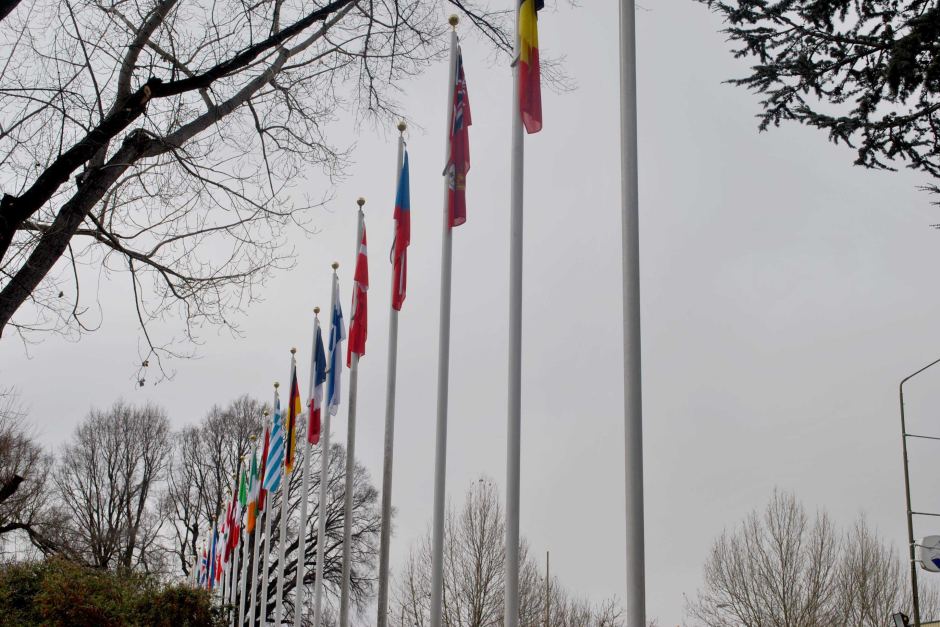
ANC ambassador in Australia tries to have old SA flag removed from Cooma

The Cooma-Monaro Shire Mayor has defended a decision to continue flying the former South African flag at Cooma in south east New South Wales.

The flag is part of the historic Avenue of Flags along the town’s main street, which was put up to represent the nationalities of workers involved in building the Snowy Mountains Scheme.

The flag’s presence has been the subject of controversy in recent years, with some ex-pats calling for the old flag to be replaced with the current one.

The South African High Commission has been in discussions with the Cooma-Monaro Shire Council over the issue, and the council has now decided to fly South Africa’s present day flag in a separate location near the town’s Centennial Park.

But Mayor Dean Lynch said there was still no need to take down the former South African flag.

“They’re historic flags; this is nothing about politics,” he said.

“They’re the flags that people lived, worked and died under while the Snowy scheme was being built.”

South African High Commissioner Sibusiso Ndebele said he raised concerns with the council after seeing a report online that referred to “some sort of honouring of the apartheid flag” in the town.

“We wanted to check up [with the council] because the Australian Government had taken a position that … they supported the creation of a democracy, so Australia can’t be seen to be supporting the old,” Mr Ndebele said.

“That’s how I understood it until we had discussions with Mayor Dean Lynch last Friday.

“He took us to lunch and explained they have got this historical flag avenue that represents the countries that built the hydro electric power in the late 50s.

“We are arranging now on our national day to put up a flag which will take pride of place there at Cooma of the South African flag as it exists now alongside with other flags.”

Cr Lynch said the old South African flag was not the only one in the town that had “negative” political associations.

“We fly a number of historic flags, one of them being Yugoslav flag which of course was another oppressive regime,” he said.

“But also there’s other old flags there – the old Canadian flag, the old American flag minus the star.

“Those flags are the flags of the day and that’s just history.” – Australian Broadcasting Corporation

Religious leaders must rehabilitate criminals: South African minister

Prisoner with white ribbon

Religious leaders should do more to rehabilitate criminals, because this was not the sole responsibility of the correctional services department, Correctional Services Minister Sibusiso Ndebele said on Sunday.

“We call upon religious leaders to play a more active role in our concerted efforts to heal victims of crime, and rehabilitate offenders so that they return to society as better human beings,” he said.

“Corrections is not the sole responsibility of the department of correctional services. Corrections is a societal responsibility.”

On Friday, Ndebele met religious leaders and officials at the East London Correctional Centre.

“As government, we will not win the battle against crime and re-offending if victims of crime, and the religious community, are not at the centre of the justice system,” he said in a statement on Sunday.

“The religious community can encourage moral regeneration, coupled with basic values and cultures; be more prominent with its role in rehabilitation…. We cannot allow a situation where the poor are being punished because of their lack of money.”

He said religious leaders should play a major role reintegrating convicted criminals into society, and providing social and economic assistance to the families of people serving time in prison.

Ndebele said there was a church in every community and it was time for them to play their part.

“We all have a duty to play in the eradication poverty. We must perform charitable deeds as Buddhism, Christianity, Judaism, Islam and indigenous cultures dictate,” he said.

“Like slavery and apartheid, poverty is not natural. It is man-made and it can be overcome and eradicated by the actions of human beings.”

Research showed a correlation between a lack of education, poverty and crime, he said.

To reduce re-offending, the department had made education compulsory, he said.

“Education breeds confidence. Confidence breeds hope. Hope breeds peace,” Ndebele said.

“The hand that previously held an okapi, to harm others, must be transformed into a hand of a tailor, carpenter, builder and writer. We are, indeed, humbled to see offenders taking pride and working hard….”

He said his department was putting the victims of crime at the “core of the justice system” and their pain did not go away until the offenders were sentenced.

“I have no doubt in my mind that the religious community is best positioned to play a decisive role in setting right the hearts, minds, and souls of South Africans. As long as we do not make moral regeneration a central theme of our conduct, we will find ourselves having progressed one step forward, and regressed 10 steps backward,” he said. – Sapa

Corrupt police chief Jackie Selebi released on medical parole

Pretoria – Corruption-convicted former police commissioner Jackie Selebi will be released from prison on Friday, Correctional Services Minister Sibusiso Ndebele announced in Pretoria.

“Mr Selebi will be going home today [Friday],” he told a media briefing in Pretoria.

“The department has limited capacity to provide for palliative care needed by some offenders,” said Ndebele.

Palliative care meant he would be kept comfortable until his death, as there was no hope of him recovering.

Dialysis

An 11-member medical parole advisory board met on June 20 and recommended the release of six offenders, including Selebi, who needed dialysis for kidney failure.

Three of them had since died, said Ndebele.

Selebi was the president of Interpol at the time of the investigation into claims that he received money from convicted drug trafficker and police informer Glenn Agliotti.

He was convicted of corruption on July 2, 2010, and handed a 15-year jail sentence.

Selebi appealed against the corruption conviction in the Supreme Court of Appeal. His appeal was denied.

In December 2011, he collapsed at home in Waterkloof, Pretoria, while watching the judgment on television.

The appeal outcome meant he had to begin his 15-year jail sentence for corruption. It was decided he would stay in Pretoria Central prison’s medical wing indefinitely.

At the time he had not instructed his medical team to apply for medical parole. Selebi had also been trained to administer his own treatment. He suffered from diabetes and kidney disease. – Sapa