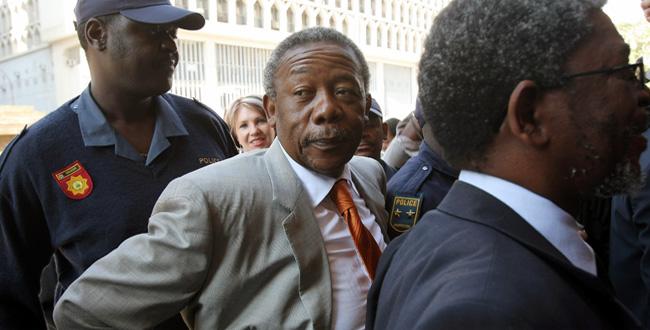
ANC-lawyer tries to keep terminally ill Derby-Lewis in jail

Justice Minister Michael Masutha acted in accordance with the law when he denied terminally-ill Clive Derby-Lewis parole, the High Court in Pretoria heard on Monday.

“We submit that the decision by the first respondent [Justice Minister Michael Masutha] was a rational decision taken in accordance with the law in consistency with the requirements of the controlling legislation,” advocate Marumo Moerane SC, representing Masutha, told Judge Selby Baqwa.

Moerane was responding to an urgent motion launched by Derby-Lewis, who is seeking release on medical parole.

The lawyer said Masutha’s decision should not be reviewed or set aside through the judicial process.

“It is common cause the applicant is suffering from a terminal disease that is lung cancer which is inoperable with marginal response to concurrent chemotherapy and radiotherapy,” said Moerane.

“We submit that however there is no failure of chemotherapy or radiotherapy. There is just marginal response.”
Among other reasons for denying parole, Moerane said Masutha was of the view that Derby-Lewis had not shown remorse “for his heinous act”.

Baqwa then asked Moerane to explain how Derby-Lewis’s repeated apologies could be discounted.

“At what stage does one say a person has been remorseful? He [Derby-Lewis] has said so and that is as much as he can say. On what basis does the minister discount the expressions put in front of him,” said Baqwa.

Moerane responded: “The first respondent was not satisfied that the applicant has shown remorse for the crime committed by him. The first respondent was accordingly not satisfied that the requirement in the [Correctional Services] Act was met for purposes of placement on medical parole”.

“Our broad submission is that the applicant was just paying lip service to remorse. To use a colloquilism, they say talk is cheap. The proof of the pudding is in the eating.”

Earlier on Monday, Derby-Lewis’s representative advocate Roelof du Plessis narrated his dying client’s condition.

“The recommendation of the medical parole advisory board refers to a stage 3b cancer of the right lung with probable or inconclusive spread to the left adrenal glands, is inoperable and there is marginal response to concurrent chemo and radiotherapy with poor prognostic features,” said Du Plessis.

“The medical aid parole advisory board took into consideration the age and gender of the patient because men die earlier than women currently, my lord. They took into consideration the history of the tumour and co-mobilities, hypertension, congestive cardiac failure, prostate cancer which is in remission, skin cancer and on the basis of that they eventually recommended medical parole.”

Derby-Lewis is currently serving a life sentence for his role in the assassination of SA Communist Party (SACP) leader Chris Hani in April 1993 and has repeatedly been denied parole.

“This case is about a terminally-ill man who wants to die among his family and friends,” said Du Plessis.
Du Plessis argued that Masutha should have implemented the recommendation of the board and released Derby-Lewis.

In January, Masutha had announced that there were several problems with a medical parole bid by Derby-Lewis.

“There is nothing to suggest that Mr Derby-Lewis’ condition is such that he is rendered physically incapacitated as a result of injury, disease or illness so as to severely limit daily activity or self-care,” Masutha said at the time.

Masutha told reporters in January that the medical parole board had recommended that Derby-Lewis be released.

“In making my decision [to decline parole] I took into account the applicable legislation, recommendations made by the board as well as the submission made by Mrs Hani and the SACP,” the minister said at the time.

Masutha said the parole board indicated that Derby-Lewis suffered from stage three b cancer of the lung.

“This finding and recommendation appears to be oblivious of the fact that in the Act, read with relevant regulations, it is an inmate with malignant cancer stage four with metastasis, being inoperable or with both radiotherapy and chemotherapy failure that qualifies,” he had said.

“The rationale of the board’s conclusion in this regard is, on the face of it, difficult for me to comprehend.”

Hani’s widow Limpho sat attentively in court, a row ahead of Derby-Lewis’ wife Gaye.

The matter continues on Tuesday.

Source: ANA

Presumed racist until proven guilty

manfredBy Manfred Delport.

The core principles in any justice system should be equality before the law and the impartiality of the justice system. As we have repeatedly seen in South Africa since 1994, this ideal of equality and impartiality is an absolute joke in the Mandelatopian justice system. If you are politically connected, you are much more equal than other mere mortals.

The most well-known example of this gross inequality in terms of justice is Schabir Shaik. Having been found guilty of fraud and corruption involving the president, JZ783, Shaik spent only a few months in jail, and most of these in hospital. He was then released on so-called medical parole, only to be photographed while enjoying his “terminal disease” on the golf course. On the other hand, people like Clive Derby-Lewis still languish in jail, years after he should have been released on medical parole, given that Derby-Lewis really actually has cancer. Unlike Derby-Lewis, the merry golfer is simply suffering from the terminal disease called life.

There is however a much more egregious set of double standards that exist in the Mandelatopian “justice” system. These double standards pertain to the grossly unequal treatment of whites and blacks whenever there is any incident of an interracial nature, and the prejudice that whites suffer.

Example 1: Two white students allegedly run over a black pedestrian in Bloemfontein. Predictably, the mainstream media immediately descend into an orgy of rabid, self-righteous rage, and waste no time whatsoever in hysterically labelling this as a so-called racist incident. Within days, the Human Rights Commission (HRC) announces that it too will investigate this incident.

Note the immediate assumption and prejudice, which is repeated time and again whenever blacks and whites are involved in an incident where the alleged wrongdoer is white: Racism is immediately the presumed motive of the white, no matter if there is any proof whatsoever to support this assumption.

Example 2: A black lawyer shoots a white motorcyclist in a road rage incident in Randburg. The lawyer claims the shooting was in self-defence, but this is patently absurd, given that the cowardly Randburg Backshooter shot his victim in the back, as his victim was walking away. Being a so-called lawyer, the Randburg Backshooter should surely realize that no impartial judge would ever accept self-defence as a justification for his crime in these circumstances. However, no news report labels this as a racist incident. The HRC’s silence is deafening, and there is no hint of any HRC investigation.

In contrast to the automatic assumption of a racist motive when whites are involved, there is clearly no automatic assumption of a racist motive on behalf of the Randburg Backshooter, even though he shot his victim in the back and clearly committed murder, and a cowardly murder at that. He is not prejudiced by the automatic assumption of a racist motive on his behalf, but alleged white perpetrators do suffer this prejudice.

I can, of course, quote hundreds if not thousands of cases in which black attackers viciously target whites during brutal farm invasions, hijackings, rapes and tortures, including incidents during home invasions in the suburbs. It is very, very seldom that the mainstream media would call these incidents racist, even though it is difficult to see why the brutal torture and murder of elderly whites by violent black farm attackers can be anything but the most shocking incidents of racist hate crimes.

Why is this? Why are whites involved in interracial incidents prejudiced in the media and the courts by automatically labelled as racists, and even investigated for so-called racism, while the same very seldom happens to blacks involved in crimes or attacks against whites?

It seems to me that whites are being treated unequally by both the justice system and the mainstream media. Any misstep on behalf of a white towards a black is automatically assumed to have racism as an aggravating factor or indeed its motive, whereas the reverse is not true. Because of this automatic assumption, the white perpetrator, if found guilty, would have his sentence aggravated because of the assumption, as well as the hysterical accusations of racism by the loony-left media, whereas black attackers of whites do not suffer the same fate.

The hysterical accusations of racism by the mainstream media, as well as the involvement of organizations such as the HRC, make a mockery of any fairness and impartiality towards alleged white perpetrators. Whites are subject to double jeopardy in the Mandelatopian justice system, because of the immediate additional of charges of racism in any incident involving somebody from another racial group.

Selebi out shopping in Pretoria in chauffered BMW

Jackie Selebi during one of his court appearances

Former police chief and convicted criminal Jackie Selebi, who was released on medical parole in 2012 in a reportedly critically ill state, was photographed shopping in Pretoria, Beeld reported on Monday.

He was chauffeured in his luxury BMW 6-series to a shopping centre in Monument Park to buy the Sunday papers.

Selebi spoke to a few shoppers before he bought his newspaper.

He walked without any assistance, and, according to Beeld, seemed to be in good health.

When reporters phoned him a few hours later to enquire about his health, he said he felt a little better and he hoped his condition would improve further.

Selebi said his illness kept him at home and prevented him from driving.

The medical parole board on July 20 2012 decided that Selebi could be released because he was suffering from irreversible kidney failure, high blood pressure and diabetes.

His sudden decline into ill health surprised independent doctors, who said that kidney failure was normally a disease with slow progression.

At the time of his release on medical parole, Correctional Services Minister Sibusiso Ndebele said Selebi was being sent home because his department had limited capacity to provide care for terminally ill patients.

Selebi was sentenced to 15 years’ imprisonment on August 3, 2010 for taking bribes from convicted drug dealer Glenn Agliotti.

He collapsed at his house in December 2011 after his final appeal failed.

Selebi’s comfortable release from prison contrasts sharply with the case of white prisoner and former Conservative Party MP Clive Derby-Lewis who has done 20 years of his sentence already. Although Derby-Lewis has been officially recommended for both medical and ordinary parole, the minister of correctional services refuses to release him. – Sapa/praag

Corrupt police chief Jackie Selebi released on medical parole

Pretoria – Corruption-convicted former police commissioner Jackie Selebi will be released from prison on Friday, Correctional Services Minister Sibusiso Ndebele announced in Pretoria.

“Mr Selebi will be going home today [Friday],” he told a media briefing in Pretoria.

“The department has limited capacity to provide for palliative care needed by some offenders,” said Ndebele.

Palliative care meant he would be kept comfortable until his death, as there was no hope of him recovering.

Dialysis

An 11-member medical parole advisory board met on June 20 and recommended the release of six offenders, including Selebi, who needed dialysis for kidney failure.

Three of them had since died, said Ndebele.

Selebi was the president of Interpol at the time of the investigation into claims that he received money from convicted drug trafficker and police informer Glenn Agliotti.

He was convicted of corruption on July 2, 2010, and handed a 15-year jail sentence.

Selebi appealed against the corruption conviction in the Supreme Court of Appeal. His appeal was denied.

In December 2011, he collapsed at home in Waterkloof, Pretoria, while watching the judgment on television.

The appeal outcome meant he had to begin his 15-year jail sentence for corruption. It was decided he would stay in Pretoria Central prison’s medical wing indefinitely.

At the time he had not instructed his medical team to apply for medical parole. Selebi had also been trained to administer his own treatment. He suffered from diabetes and kidney disease. – Sapa