Clinton plays the race card

Hillary Clinton closed a three-day campaign fundraising swing through Texas and New Mexico on Thursday with a rare public appearance at Texas Southern University in Houston to play the race card on voting rights.

She took no questions and spoke with no reporters, but angrily complained that Texas voters can present their concealed-carry gun permits as a voter ID, but not their college student identification cards.

Clinton was received with wild applause at the historically black college, but organizers arranged the 8,100-seat basketball arena so that three-quarters of the seats were roped off and empty.

They added rows of chairs on the floor, but 15-foot-tall blue curtains draped all around blocked the view of entire sections of empty seats, leaving the impression that Clinton couldn’t fill the room.

The university didn’t provide a crowd count, but an arena security official estimated that there were 2,200 in attendance. Clinton spoke for 31 minutes with the aid of a teleprompter, alleging that ‘hundreds of thousands of registered voters in Texas’ are being disenfranchised by a conspiracy of conservatives who want to freeze out black voters.

And elsewhere, she said, in the Carolinas, election officials have changed the location and open hours of polling places in order to flummox poor and minority voters.

Clinton also complained that state and local officials in southern states have crusaded against early voting plans, same-day voter registration, and pre-registration systems that target 16- and 17-year-olds in high schools.

Changes to voting laws in the South came fast and furious after a 2013 Supreme Court decision that revoked key provisions in the Voting Rights Act.

That law’s ‘special protections,’ as Clinton put it, had forced southern states with histories of discrimination to get permission from the federal government before putting new election laws in place.

Texas moved to amend its voting laws just hours after the decision to end that system was handed down.

Texas Southern, a historically black university, honored Clinton with a public service award named for the late Rep. Barbara Jordan, the first black female member of Congress from the Deep South.

‘She was a staunch advocate for the Voting Rights Act, which had helped make it possible for her to be elected,’ Clinton said Thursday, lamenting that the federal law’s ‘heart has been ripped out’ by America’s most senior jurists.

In the wake of that decision, Clinton said Thursday, Americans have seen a torrent of ‘new laws that make it harder than ever to vote.’

She warned against ‘a sweeping effort to disempower and disenfranchise people of color, and young people and poor people from one end of this country to the other.’

Minority communities’ feelings of being especially challenged on Election Day, she said, ‘just didn’t happen by accident. And it is just wrong.’

Americans support voter ID laws, the measures Clinton railed hardest against, by large margins.

In deep-red Texas, according to a University of Texas poll in late 2014, support runs at 3-to-1.

Orlando Watson, the Republican National Committee’s communications director for black media, fired a broadside at her following the speech.

‘Hillary Clinton’s rhetoric is misleading and divisive,’ Watson said. ‘In reality, the vast majority of Americans – including minority voters – support commonsense measures to prevent voter fraud.’

‘Clinton’s shameless attacks ignore the fact her Democrat-led home state of New York does not allow early voting while dozens of Republican-led states do. Her exploitation of this issue only underscores why voters find her dishonest and untrustworthy.’

It was also revealed that Clinton’s charity accepted a substantial donation from an anti-gay African church which has likened homosexuals to the Devil.

The 2016 Presidential candidate took money for her sprawling health nonprofit from the Cameroon Baptist Convention whose official policy is that being gay ‘contradicts God’s purpose for human sexuality’.

The devout Christian organization has in the past compared being gay to committing incest and human trafficking. Its leaders have also railed against US attempts to promote gay rights in Cameroon.

Despite this, the Cameroon Baptist Convention Health Board gave between $1million and $10million between 2010 and this year, according to the latest list of donors from the Clinton Health Access Initiative.

Source: Daily Mail
Texas bloodbath may be start of all-out gang war

Predictably, experts see the hand of the Hells Angels behind Sunday’s Waco bloodbath. They say the Angels have been encouraging the Cossacks to challenge the Bandidos’ control of Texas. On Sunday, the Cossacks were helped by another gang, the Scimitars.

US experts fear that this may well be the beginning of an all-out war between highly organized crime syndicates – with the potential of going global.

The massacre in Waco had all the signs of a proxy war. It basically pitted the Bandidos against the Cossacks. But the latter group is supported by the Hells Angels, a biker gang with branches in Europe, Canada and Australia, and the archenemy of the Bandidos.

The real war will likely be fought between these two organizations. Control of Texas might be the immediate spoils, but the world might see other battlegrounds, as well.

The shootout in Waco was just the latest clash in a long history of rivalry. The Bandidos are generally considered the world’s second-largest biker gang, behind the popularly better known Hells Angels, with as many as 2500 members in 13 countries, according to the US authorities.

The Hells Angels were founded in 1948 in California and entertain more than 400 chapters in 50 countries, according to the organization’s own count.

Other gangs are the Outlaws, the Pagans, the Warlocks and the Mongols.

The Bandidos began in 1966 in Texas, almost 20 years after the Hells Angels, but the two gangs soon became bitter rivals. Named in honor of the Mexican bandits who refused to live by anyone’s rules but their own, the Bandidos began recruiting their first members out of biker bars in various Texan cities.

The Mongols have a big Lebanese Muslim contingent in Germany and the Middle East, too.

Looking at mugshots from Texas, some may think that these are “white” bikers and some of the Mongols are. Some even display the double lightning bolt tattoos, Nazi insignia based on runes.

But there is a tremendous amount of anti-white racism present. Although Hispanics do not frown upon white Norman Spanish, they avidly support racial mixing.

These mixed-race gangs fight against the white power gangs in the US and in Europe. Naked hatred based on “cultural differences”, actually racial differences, are pretty big deals for these gangs.

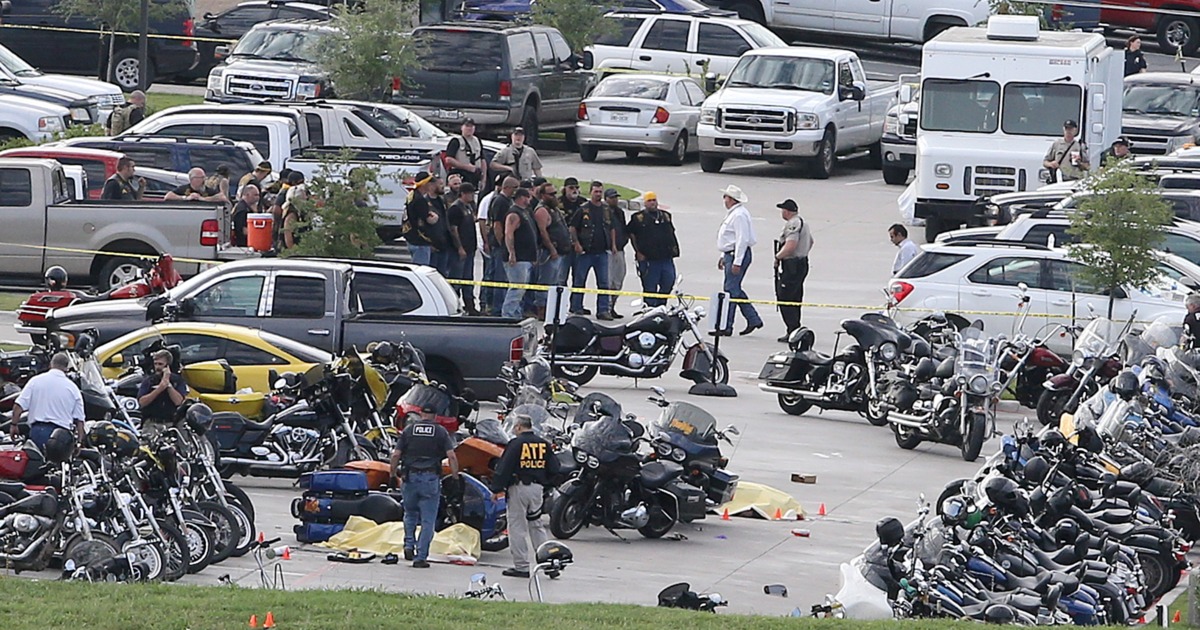
By the time the carnage was over, bodies were scattered across the tarmac in what one witness described as a war zone. Nine bikers were dead and 18 wounded, some critically. Police surrounded the rest and arrested 170, who face organised-crime charges.

There were claims on Monday night that one gang was ambushed by the other to settle a turf war over who becomes the king of the roads in Texas.

As local police braced themselves on Tuesday for more bloodshed, anti-white sentiments were gaining with policemen calling white gangs “domestic terrorists”.

In a memo dated May 1, the Texas Department of Public Safety (DPS) cautioned authorities about increasing violence between the Bandidos and the Cossacks, Dallas TV station WFAA reported.

The DPS Joint Information Center bulletin said the tension could stem from Cossacks refusing to pay Bandidos dues for operating in Texas and for wearing a patch on their vest that claimed Texas as their turf without the Bandidos’ approval.

ISIS posts warning after Garland attack

The terrorist group ISIS says they will murder Pamela Geller and kill anyone who shields her.

The terrorists also say they have 71 fighters in 15 different states and they 23 have signed up already for missions like the failed Sunday attack in Garland, Texas.

The attack by the Islamic State in America is only the beginning of our efforts to establish a wiliyah in the heart of our enemy. Our aim was the khanzeer Pamela Geller and to show her that we don’t care what land she hides in or what sky shields her; we will send all our Lions to achieve her slaughter. This will heal the hearts of our brothers and disperse the ones behind her. To those who protect her: this will be your only warning of housing this woman and her circus show. Everyone who houses her events, gives her a platform to spill her filth are legitimate targets. We have been watching closely who was present at this event and the shooter of our brothers. We knew that the target was protected. Our intention was to show how easy we give our lives for the Sake of Allah.

We have 71 trained soldiers in 15 different states ready at our word to attack any target we desire. Out of the 71 trained soldiers 23 have signed up for missions like Sunday, We are increasing in number bithnillah. Of the 15 states, 5 we will name… Virginia, Maryland, Illinois, California, and Michigan. The disbelievers who shot our brothers think that you killed someone untrained, nay, they gave you their bodies in plain view because we were watching.

The next six months will be interesting, To our Amir Al Mu’mineen make dua for us and continue your reign, May Allah enoble your face.

The threat was posted by Abu Al Ameriki.

‘Exclusively for white people’ stickers appear in Texas

Employees at several Austin businesses have found stickers saying “exclusively for white people” placed on their windows, sparking an investigation into their origin and condemnation from the mayor.

Mayor Steve Adler said the stickers discovered Wednesday morning were “an appalling and offensive display of ignorance in our city.”

The stickers also say “Maximum of 5 colored customers / colored BOH staff accepted,” apparently referring to the “back of house” operations at a restaurant. They featured a city of Austin logo and claimed to be “sponsored by the City of Austin Contemporary Partition and Restoration Program,” though no such program exists. The city has said the use of its logo was unauthorized.

Austin is one of the fastest-growing cities in the U.S. and is confronting increasing questions about economic and racial segregation as real estate prices skyrocket around its urban core.

Raul Alvarez, board president for the East Austin Conservancy, said the stickers are likely in response to gentrification in the area on Austin’s east side.

“I certainly share the concerns about the history and culture and affordability that’s being lost because of the rapid development, but our organization tends to focus on what it is we can do to preserve what makes East Austin unique and not focus on strategies that divide the community,” he told the Austin American-Statesman newspaper.

“I don’t really understand the message behind it,” said April Jensen, who is African-American. “All types of customers come in here.”

Bryce Bencivengo, spokesman for the city of Austin, tells the San Antonio Express-News that city officials along with the Austin police are investigating the stickers’ origin.

Nelson Linder, president of Austin NAACP, called the stickers “absolutely stupid.”

“Don’t put signs like that on people’s doors because you want to bring attention to your plight,” he said.

Texas Rep governor nominated two pro-affirmative action regents at UT

The two people nominated by Gov. Greg Abbott to join the Board of Regents of the University of Texas System support affirmative action.

On Thursday, Abbott nominated Sara Martinez Tucker of Laredo, head of an education nonprofit and a former U.S. undersecretary of education, as well as David Beck, a prominent Houston attorney and a founding member of the Texas Coalition for Excellence in Higher Education, a group formed to oppose education reform proposals put forward by the conservative Texas Public Policy Foundation and to defend the university’s president, Bill Powers, from criticism.

Martinez Tucker and Beck signed their names to a friend-of-the-court brief filed in a 2013 case before the U.S. Supreme Court regarding affirmative action known as Fisher v. UT. The brief argued in favor of affirmative action at UT, and the list of signers reads like an invite list to a Powers’ Christmas party.

As attorney general, Abbott represented UT in the early stages of the litigation but dropped out in 2012, apparently at Powers’ request. There was speculation at the time Abbott didn’t want to have to explain his defense of affirmative action during a run for governor.

Abbott also nominated Stephen Hicks, another friend of Powers, to serve another term on the board.

The nominees must still be confirmed by the state Senate, which is now run by Lt. Gov. Dan Patrick, who has called for investigations into UT’s admissions practices.

The pro-Powers nominations come as little surprise, as Abbott sat on an investigation into the UT Law School foundation for nearly two years. When Deputy Attorney General John Scott produced a highly critical report, the Attorney General’s office withheld it until the 11th hour — Dec. 31 of last year.

Affirmative actions policies at the University of Texas have been the subject of two major Supreme Court decisions. – watchdog.org

Texans ban fracking in its birthplace

Voters approved a ban on hydraulic fracturing in the north Texas town of Denton on Tuesday, making it the first city in the Lone Star State to outlaw the oil and gas extraction technique behind the U.S. energy boom.

The vote in the city of 123,000 was highly symbolic because hydraulic fracturing, better known as fracking, is widely used in Texas, the top crude producer in the United States.

“Denton, Texas is where hydraulic fracturing was invented,” said Bruce Baizel, Earthworks energy program director. “If this place in the heart of the oil and gas industry can’t live with fracking, then who can?”

Green groups said the result served as a wake-up call to the industry.

Groups like Frack Free Denton won even though they were outspent by a margin of 10 to one, according to organizers and local media reports.

The Texas Oil & Gas Association, the state’s energy lobby, on Wednesday quickly filed for an injunction.

“A ban on hydraulic fracturing is inconsistent with state law,” Thomas Phillips, a former head of the Supreme Court of Texas who now represents the trade group, said.

In a frack job, a mix of pressurized water, sand and chemicals is used to unlock hydrocarbons from rock. Operators claim it is safe but many environmental groups oppose the practice – calling it wasteful, polluting, dirty and noisy.

Fracking was pioneered at the Barnett shale formation where Denton is located. Exxon Mobil’s XTO unit honed its shale expertise in the natural gas-rich Barnett. Most of the crude output in Texas comes, however, from the growing Eagle Ford and Permian fields to the south and west.

The Denton referendum pitted oil and gas operators and mineral rights owners against residents who say their homes and lives are being encroached on by work that can be noisy, soak up scarce water supplies and overwhelm roads with heavy truck traffic.

“It’s essentially a ban on all drilling,” said Ed Ireland, executive director of the Barnett Shale Energy Education Council, a group aligned with producers. “No one would try to drill a well if they can’t frack it.”

Source: Reuters


End of the road for affirmative action on US campuses?

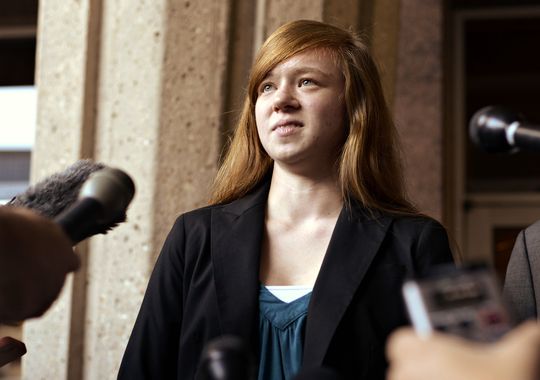
Abigail Fisher outside the Supreme Court

After more than 60 years, is the end of the road near for affirmative action in college admissions?

The idea of using race to help determine who gets a seat in public colleges has been under fire for decades. Eight states have essentially banned the practice, and a Michigan case pending before the U.S. Supreme Court could prompt others to do the same.

College officials nationwide got a wake-up call last June from the high court, which set a high bar for using race as part of a complex admissions program in Texas. Many observers say the combined weight of the two cases could finally push state universities to find another way to promote diversity.

“All the trends are pointing against the continued use of race in admissions,” says Richard Kahlenberg of the Washington, D.C.-based Century Foundation, a liberal think tank. Kahlenberg has for years advocated using family income,not race, as a way to ensure that public K-12 schools and colleges have a diverse student body.

A year after hearing Fisher, the justices last October heard arguments in a case from Michigan, where a 2006 state constitutional amendment banned racial preferences in public university admissions. Seven other states — California, Florida, Washington, Arizona, Nebraska, Oklahoma and New Hampshire — do the same, and about 29% of students live in states where affirmative action is banned, Kahlenberg estimates.

Michigan Attorney General Bill Schuette says the state’s position was summed up well by Chief Justice John Roberts, who said the best way to stop racial discrimination “is to stop discriminating on the basis of race.”

“Our constitution requires equal treatment in college admissions, which is an expression by 58% of Michigan voters in 2006 that says it is fundamentally wrong to treat people differently based on race or the color of their skin,” Schuette says. “It’s just wrong.”

A July 2013 study by Georgetown University scholars Anthony Carnevale and Jeff Strohl found that in 2009, white students were more “over-represented” among the USA’s 468 most selective colleges than they had been in 1995. From 1995 to 2009, the nationwide share of young people ages 18-24 who were white dropped 6 percentage points, from 68% to 62%. But whites’ share of freshman slots at the USA’s most elite colleges dropped just 2 points during that same period, from 77% to 75%.

Another study, by Orfield’s Civil Rights Project, found that 15 years after California’s ban on racial preferences went into effect, increased competition has dropped the share of black in-state high school graduates admitted to UCLA from 47.6% of applicants to 13.7%; the percentage of Latino students admitted dropped from 54.9% of applicants to 14.8%. The percentage of white students admitted also dropped, but not as sharply.

Kahlenberg says the string of affirmative action cases has pushed universities to find alternative ways to create diverse freshman classes. He notes that Texas’ 10% rule has resulted in higher levels of black and Latino representation. Other state systems have gotten similar results by eliminating preferences for children of alumni and bolstering financial aid, among other measures. These strategies have led to more racially and economically diverse classes “in a way the Supreme Court can’t touch,” he says. “I think that’s the future of affirmative action.”

Recent surveys have found that Americans don’t like using race in admissions, Kahlenberg says, “but on the other hand, Americans don’t want to see universities and American higher education re-segregated.”

A decision in the Michigan case, Schuette v. Coalition to Defend Affirmative Action, is expected this spring. If a majority of eight justices rule in Michigan’s favor (Elena Kagan, a former solicitor general, recused herself), it could prompt opponents of affirmative action in other states to push for similar bans.

But if the ban is overturned, states such as California again could weigh race in college admissions — and not a moment too soon, Orfield says. Admissions pressures there have become “very intense.” He notes that UCLA alone last year received nearly 100,000 applications. “It’s a big state, it’s growing … and we haven’t been growing the higher education system.” – USA Today

Contributing: Richard Wolf

Texans have ‘secession fever’

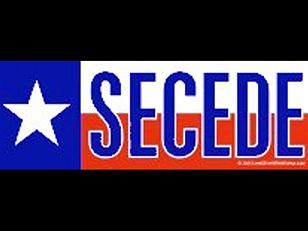
Move over, “Everything is bigger in Texas.” The Lone Star state has a new favorite bumper sticker and it’s a simple one-worder: “Secede.” Yes, it appears that “secession fever,” as some columnists are calling it, has taken over the red-leaning state following the post-election petitions — and sales of the stickers are just one sign. Among others, a perennial GOP candidate named Larry Scott Kilgore has announced he’s running for governor and will legally change his name to Larry SECEDE Kilgore — yes, with “secede” in all-caps. His web page also declares, “Secession! All other issues can be dealt with later.”

Meanwhile former Florida governor Jeb Bush met Monday with a group of his former staffers at the J. W. Marriott hotel on Pennsylvania Avenue, just steps from the White House. Bush, a potential 2016 presidential contender, spent an hour in the hotel’s Cannon room, reminiscing and entertaining questions about his political future.

In an interview with NRO, Bush did not rule out a presidential run. “I am here to catch up with folks and promote education reform,” he said, smiling.

When asked again whether he will issue a Sherman-type statement about his future, Bush remained coy. “We have an alumni group that I like keeping in touch with,” he said. “I’m here to focus on educational reform, and that’s what I’m going to tell people.”

Neil Newhouse, Mitt Romney’s campaign pollster, was at the meeting, as were several veteran Florida operatives.

On Tuesday, Bush will host a national summit on education reform. Education secretary Arne Duncan, former secretary of state Condoleezza Rice, and Indiana governor Mitch Daniels will speak at the event.

Will Jeb be the man to stay in the Union? -msn.com/nationalreview