Greek government arrests Golden Dawn leader and MPs

Nikos Michaloliakos, the leader of Golden Dawn
Arrested: Nikos Michaloliakos, the leader of Golden Dawn

by Hélène COLLIOPOULOU

Greek police on Saturday swooped on the Golden Dawn party, arresting its leadership and hunting for dozens of members across the country in a crackdown sparked by the murder of a leftist musician.

The arrests came a day after Golden Dawn threatened to pull its lawmakers out of parliament, a move that could spark a political crisis in the recession-hit country.

The party urged its followers to demonstrate against what it called an “illegal decision” on Saturday and by late morning several hundred faithful had gathered in front police headquarters in Athens.

In dawn raids, Greek anti-terror police arrested party leader Nikos Michaloliakos along with party spokesman and MP Ilias Kassidiairis, two other lawmakers and a dozen party members, police said.

The charges against them ranged from belonging to a “criminal organisation” to murder and assault, according to a source in the justice ministry.

The police sweep came after the country’s supreme court, which has been charged with investigating the group, issued arrest warrants for some 30 members.

Golden Dawn has faced a crackdown after a self-confessed neo-Nazi fatally stabbed popular hip-hop musician Pavlos Fyssas, 34, on September 18, a killing that sparked nationwide protests.

The party currently has 18 lawmakers in parliament and prior to the murder was the third most popular political grouping in the country.

“This government is determined not to allow the descendants of the Nazis to poison our social life, to commit crimes, terrorise and undermine the foundations of the country that gave birth to democracy,” Prime Minister Antonis Samaras warned in a televised address a day after the killing.

Golden Dawn leader Michaloliakos has threatened to pull the group’s deputies out of parliament, a move that would prompt by-elections in 15 regions around the country.

“We will exhaust any means within our legal constitutional rights to defend our political honour,” Michaloliakos told reporters late on Thursday.

“If the country enters a cycle of instability, it is those who demonise Golden Dawn who will be responsible, not (us),” he said.

By-elections could hurt Samaras’s coalition government, which has a slim majority of 155 MPs in the 300-seat parliament, and could cast into doubt Greece’s ability to fulfil its obligations to creditors on multi-billion-euro bailouts.

Samaras’s conservative party is neck-and-neck in the polls with the radical leftist Syriza party that opposes Greece’s EU-IMF austerity bailout, and a strong showing by Syriza in by-elections could lead to the government’s fall.

Formerly on the fringe of Greek politics, Golden Dawn’s popularity has skyrocketed as it tapped into widespread anger over unpopular reforms in a country that is currently slogging through its sixth year of recession and where unemployment among the youth stands at a staggering 60 percent.

It went from 19,000 votes a few years ago to over 426,000 in June 2012 elections after pledging to “scour the country” clean of illegal immigrants.

The party, whose leader has denied the Holocaust, has sent black-clad squads to smash market stalls owned by migrants, held torch-lit rallies lambasting political opponents as “traitors” and “thieves”, and organised food donations exclusively for ethnic Greeks.

It has also been blamed for a series of brutal attacks on migrants and political opponents, though it strenuously denies any responsibility and claims to be the victim of slander.

This year, the party has consistently polled at over 10 percent, with its approval ratings even higher in the 18-44 age group, making them the country’s third-strongest political force.

Although the hip-hop artist’s murder has led to a dip in those ratings, analysts warn that the party’s popularity will make any efforts to outlaw it difficult and politically dangerous.

“The constitution makes no provision for the dissolution of a parliamentary group, even it there is proof that it is a criminal organisation,” Dimitris Christopoulos, an associate professor of law at Athens’ Panteion University, told AFP this week. – AFP

Thousands protest against right-wing party in Athens

Supporters of Golden Dawn in Greece

Thousands of Greeks took to the streets of Athens to protest against far-right extremism on Thursday, a day after police and demonstrators clashed in cities across the country following the murder of an anti-fascist singer.

Around 4,000 people marched in the capital’s western Keratsini district, where Wednesday’s murder occurred, carrying banners that said “stop fascism” and “no pasaran” (“they shall not pass”), an AFP reporter saw.

The protesters, mostly trade union members, shouted slogans including “out with fascists” and “workers do not fear threats”.

Greece has been rocked by unrest since popular hip hop artist Pavlos Fyssas, who wrote music under the nickname Killah P, was stabbed to death early on Wednesday by 45-year-old truck driver George Roupakias, who has allegedly confessed to police and is said to be a supporter of the neo-Nazi Golden Dawn party.

Thousands of Greeks took to the streets in anti-fascist marches in cities across the country on Wednesday. Scuffles broke out in some areas, with police firing tear gas at groups of demonstrators in Athens, the northern city of Thessaloniki and the western city of Patras.

Golden Dawn has denied links with the killer, but pictures have surfaced of Roupakias participating in party activities, and reports said members of his family worked for the organisation.

In a televised address earlier on Thursday, Greek Prime Minister Antonis Samaras vowed to rein in the Golden Dawn party.

“This government is determined not to allow the descendants of the Nazis to poison our social life, to commit crimes, terrorise and undermine the foundations of the country that gave birth to democracy,” he said.

Experts have argued that current legislation would make it difficult to slap an outright ban on Golden Dawn, but government spokesman Simos Kedikoglou said steps will be taken to expose the group’s “criminal” acts and isolate it. – AFP

Greek political parties try to solve crisis around state TV closure

Thousands of demonstrators gather outside the Greek public television and radio broadcaster ERT headquarters in Athens, June 11, 2013.

Greece’s governing coalition parties are to meet for a second time in three days to try and end a political crisis triggered by the closure of state broadcaster ERT.

Conservative Prime Minister Antonis Samaras will hold talks later Wednesday with coalition partners — the Socialist Pasok and Democratic Left parties — who have opposed his decision to switch of ERT’s signal and fire all its 2,700 employees.

The dispute has raised the threat of a snap general election in crisis-hit Greece, just one year after the last general election. But most analysts have argued that politicians are unlikely to gamble on the country’s vital bailout program given that opinion polls suggest no party would emerge the outright winner.

Shares on the Athens Stock Exchange were broadly unchanged Wednesday, as markets in Europe drifted.

Pasok spokeswoman Fofi Gennimata demanded that the government switch ERT’s signal back on, in compliance with a high court decision this week.

But conservatives insist the public broadcaster will remain off the air until a more efficient state TV and radio network is set up.

“It’s fairly simple. A mistake has been made and it must be corrected,” Gennimata told private Vima FM radio. “It requires bravery to correct a mistake. But that is necessary. It’s not acceptable for an elected government to fail to comply with a high court order.”

Gennimata denied reports that senior members of her party were seeking Samaras’ replacement as prime minister.

Fired ERT employees have continued unauthorized broadcasts since the broadcaster’s June 11 closure, streamed mostly online and on disused analog frequencies, and have even expanded regional TV and radio programming this week.

Journalist and other media unions on Wednesday filed a law suit against Greece’s finance and media ministers, accusing them of violating the high court ruling.

ERT was axed as international pressure is growing on the bailed out country to fire public servants and speed up long-term cost cutting reforms aimed at making the country’s budget and national debt sustainable.

Samaras has described ERT as an organization under excessive union control that could not be reformed without closure. Opponents counter that ERT’s problems stem from decades of political interference in programming and hiring decisions.

Greece’s two largest labor unions are planning to stage a protest rally outside ERT headquarters, a building 10 kilometers (6 miles) north of central Athens that remains occupied by laid off broadcast workers for a ninth day. Protests in other Greek cities and towns are also planned to start at 6:00 p.m. (1500GMT), to coincide with Samaras’ coalition talks. – AP

Greek lawmakers pass austerity bill as Athens burns

Greece riots
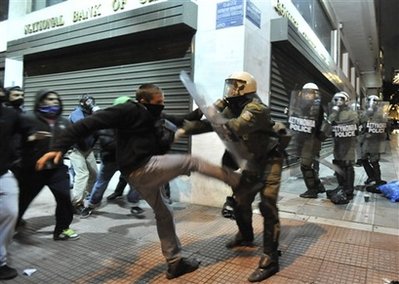
Clashes between police and rioters in Athens

Greece’s parliament approved a deeply unpopular austerity bill Monday to secure a second EU/IMF bailout and avoid national bankruptcy, as buildings burned across central Athens and violence spread around the country.

Cinemas, cafes, shops and banks were set ablaze in central Athens and black-masked protesters fought riot police outside parliament before lawmakers voted on the package that demands deep pay, pension and job cuts — the price of a 130 billion euro ($172 billion) bailout needed to keep the country afloat.

State television reported the violence spread to the tourist islands of Corfu and Crete, the northern city of Thessaloniki and towns in central Greece. Police said 150 shops were looted in the capital and 34 buildings set ablaze.

Altogether 199 of the 300 lawmakers backed the bill, but 43 deputies from the two parties in the government of Prime Minister Lucas Papademos, the socialists and conservatives, rebelled by voting against It. They were immediately expelled by their parties.

Asian shares and the euro gained modestly Monday, relieved by the Greek parliament’s passage of austerity measures that put the country a step closer to securing a much-needed bailout fund and avoiding a messy default.

MSCI’s broadest index of Asia Pacific shares outside Japan edged up as much as 0.3 percent on the news.

The rebellion and street violence foreshadowed the problems the Greek government faces in implementing the cuts, which include a 22 percent reduction in the minimum wage — a package critics say condemns the economy to an ever-deeper downward spiral.

Papademos, a technocrat brought in to get a grip on the crisis, denounced the worst breakdown of order since 2008, when violence gripped Greece for weeks after police shot a 15-year-old schoolboy.

“Vandalism, violence and destruction have no place in a democratic country and won’t be tolerated,” he told parliament as it prepared to vote.

“SHORT-TERM SACRIFICES”

But he admitted that imposing the austerity on a nation that has already endured several years of cuts would be tough.

“The full, timely and effective implementation of the program won’t be easy. We are fully aware that the economic program means short-term sacrifices for the Greek people,” Papademos said.

Greece needs the international funds before March 20 to meet debt repayments of 14.5 billion euros, or suffer a chaotic default which could shake the entire euro zone.

Outside parliament chaos reigned. A Reuters photographer saw buildings in Athens engulfed in flames and huge plumes of smoke rose in the night sky.

“We are facing destruction. Our country, our home, has become ripe for burning, the center of Athens is in flames. We cannot allow populism to burn our country down,” conservative lawmaker Costis Hatzidakis told parliament.

The air in Syntagma Square outside parliament was thick with teargas as riot police fought running battles with youths who smashed marble balustrades and hurled stones and petrol bombs.

Terrified Greeks and tourists fled the rock-strewn streets and the clouds of stinging gas, cramming into hotel lobbies for shelter as lines of riot police struggled to contain the mayhem.

State NET television reported that trouble had also broken out in Heraklion, capital of Crete, as well as the towns of Volos and Agrinio in central Greece.

On the streets of Athens many businesses were ablaze, including the neo-classical home to the Attikon cinema dating from 1870 and a building housing the Asty, an underground cinema used by the Gestapo as a torture chamber during World War Two.

NO GOOD CHOICES

The EU and IMF say they have had enough of broken promises and that the funds will be released only with the clear commitment of Greek political leaders that they will implement the reforms whoever wins an election potentially in April.

Euro zone paymaster Germany ratcheted up the pressure on Sunday. “The promises from Greece aren’t enough for us any more,” German Finance Minister Wolfgang Schaeuble said in an interview published in Welt am Sonntag newspaper.

“Greece needs to do its own homework to become competitive, whether that happens in conjunction with a new rescue program or by another route that we actually don’t want to take.”

When asked if that other route meant Greece quitting the euro zone, Schaeuble said: “That is all in the hands of the Greeks themselves. But even in the event (Greece leaves the euro zone), which almost no one assumes will happen, they will still remain part of Europe.”

The bill sets out 3.3 billion euros ($4.35 billion) of extra budget cuts for this year alone.

It also provides for a bond swap to ease Greece’s debt burden by cutting the real value of private-sector investors’ bond holdings by some 70 percent. Greece would have missed a February 17 deadline to offer a debt “haircut” to private bondholders if the vote had not been passed.

Many Greeks believe their living standards are collapsing already and the new measures will deepen their misery.

“Enough is enough!” said 89-year-old Manolis Glezos, one of Greece’s most famous leftists and a national hero. “They have no idea what an uprising by the Greek people means. And the Greek people, regardless of ideology, have risen.”

Glezos is a national hero for sneaking up the Acropolis at night in 1941 and tearing down a Nazi flag from under the noses of the German occupiers, raising the morale of Athens residents. – Reuters