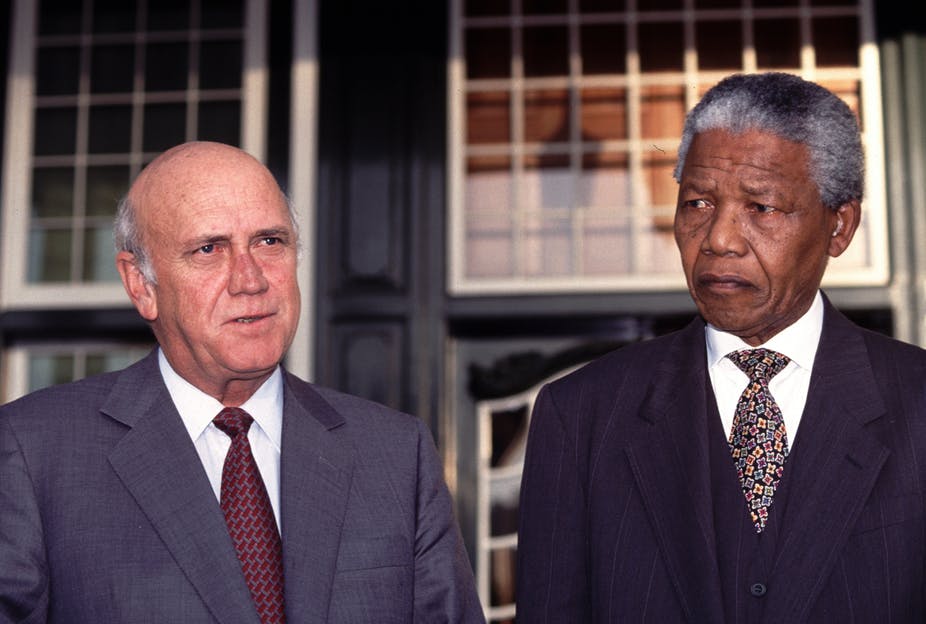
Archive documents reveal the US and UK’s role in getting the ANC into power

Sue Onslow, School of Advanced Study and Martin Plaut, School of Advanced Study

It is a quarter of a century since the end of apartheid in South Africa. But it’s easy to forget how complex, difficult and violent the birth of full democracy really was. This was particularly true in KwaZulu-Natal, where battles between the African National Congress (ANC) and the mainly Zulu Inkatha Freedom Party (IFP) claimed the lives of as many as 20,000 in the decade between 1984 and 1994.

In the three months before the first elections in April 1994 an estimated 1 000 people were killed. The British and Americans were becoming increasingly concerned. The conflict between Inkatha and the ANC was just one crisis: another was developing with far right white extremists, who were threatening to resort to violence.

The US Central Intelligence Agency (CIA) reported that there was an:

eight in 10 chance that violence will surge immediately before and during the election, when emotions are at their highest.

The agency also warned of the threat of a right wing coup, although it considered this “unlikely”. (This CIA report is available in hard copy only.)

As the situation grew increasingly tense, Britain’s Prime Minister John Major and the US’s President Bill Clinton became personally involved. Their interventions are shown in documents just released by the UK National Archives.
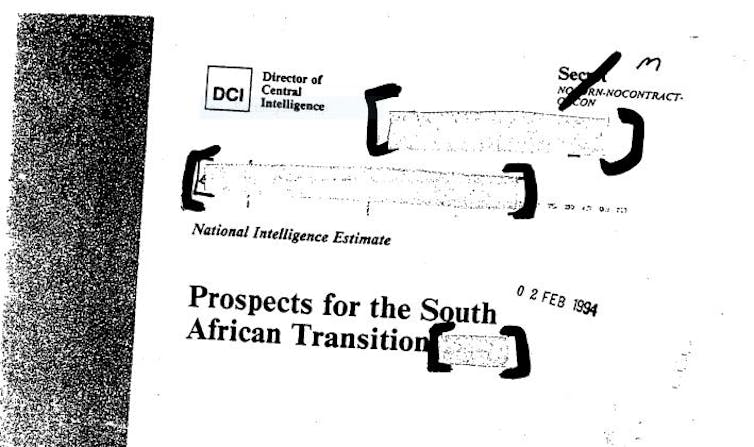
The cover page of the CIA document.
Author provided

The documents reveal just what a close-run thing the first truly democratic election was, and how much time and effort Britain and the USA spent ensuring that the voting went ahead.

Desperate times

Prime Minister Major took a phone call from Nelson Mandela on 22 February, in which the ANC leader described the situation as “very difficult.” Major briefed Mandela on a meeting between the British ambassador and the Inkatha leader, Mangosuthu Buthelezi. He gave Mandela a full account of the conversation, which he warmly welcomed.

On 24 February there is the first indication of a joint Anglo-American mediation effort to resolve the crisis. This arose during planning for a visit to Washington by Major three days later.

Our starting point is that the situation has now deteriorated to the point where it seems very unlikely that left to themselves the South Africans will reach an agreement that will enable to participate in the elections. The consequences are likely to be very serious.

The British suggested that Major and Clinton might “offer their joint help to the transition process”.

The following day – having held discussions with Mandela, Buthelezi and President Frederik de Klerk – the British ambassador in Pretoria, Sir Anthony Reeve, was able to report that all three were prepared to go along with the Anglo-American initiative, although with some reservations. The ambassador concluded:

These responses do, I think, give us the green light to consult the Americans in detail on our thinking.

The proposal was discussed between Mandela and Buthelezi at a meeting on March 1 and both leaders agreed to “explore” the possibility of international mediation. Lord Carrington, who had negotiated the end of Rhodesia and its transition to Zimbabwe in 1980, was on a lecture tour of South Africa. He was approached by the ANC’s Thabo Mbeki who asked whether he might act as one of a panel of mediators.

Others suggested were US Secretary of State Henry Kissinger and former Tanzanian head of state Julius Nyerere.

There followed intensive discussions between London and Washington, over how such mediation might work; indeed, Carrington and Kissinger travelled to South Africa. In the end a failure to agree on the terms of reference for the mediators, and South African government fears that the elections might be delayed, put paid to the plan.

It has been claimed the crisis – the most immediate was that Buthelezi was threatening to boycott the poll – was resolved by surprising last minute mediation by Kenyan Professor, Washington Okumu. Other Commonwealth envoys who had excellent contacts with both the ANC leadership and Buthelezi, including the late Ghanaian diplomat Moses Anafu, doubt this, arguing that forces that led Buthelezi into the election were much bigger.

Indeed, Buthelezi’s brinkmanship had ensured key constitutional concessions. Okumu’s intervention seems then a face-saving device for the IFP leader. A joint statement was agreed between Mandela, Buthelezi and de Klerk on 19 April, which allowed the election to take place just a week later (April 26-28).

Close-run thing

It had been a close-run thing and South Africa’s first truly democratic election almost came to grief. But there were two more potential obstacles.

In the tense run-up to polling day, a report on the role of the apartheid state in stoking internal tension and violence was published. The Commission of Inquiry Regarding the Prevention of Public Violence and Intimidation, led by Justice Richard Goldstone had been established in 1991: its report was published on 21 April 1994. Judge Goldstone’s investigations revealed that sections of the South African Police had armed Inkatha, and pointed to attempts by senior police officers to subvert the work of his enquiry.

The charges were explosive and for a while the judge and his family were clearly at risk from white extremists. With de Klerk’s support and the knowledge of Mandela, Goldstone, his wife and a “key witness” (a former South African police officer) asked whether they might come to Britain. John Major agreed, and they were given temporary asylum and a safe house.

The second obstacle was the South African government’s clandestine chemical and biological weapons programme, known as “Project Coast.” The British Foreign Secretary, Douglas Hurd, contacted Washington about the possibility of issuing a formal public protest unless President de Klerk publicly admitted his government’s involvement in the use of these weapons against ANC and Namibian prisoners.

The British had apparently intervened to prevent the proliferation of these weapons to other rogue states or terrorist groups. On April 11 the US and British ambassadors delivered their protest to President de Klerk – which apparently did the trick. There was an agreement that all the chemical and biological systems would be destroyed and one of the key South African experts, Wouter Basson, who had travelled to Libya on several occasions, was subsequently prosecuted.

Political triumph

The April 1994 election proved to be a watershed for South Africa. In technical terms, the election was a fiasco, but it was a political triumph, according to the Commonwealth’s leading election official, Carl Dundass. Inkatha’s surprising victory in Natal-KwaZulu strongly suggest Natal “horsetrading” involved overturning an actual ANC victory to manage anticipated post-election violence.

Despite all the violence, tension and drama the election ended apartheid and allowed Major to phone Mandela with his congratulations – a highly satisfactory conclusion to an intense period of international diplomacy.The Conversation

Sue Onslow, Reader, Institute of Commonwealth Studies, School of Advanced Study and Martin Plaut, Senior Research Fellow, Horn of Africa and Southern Africa, Institute of Commonwealth Studies, School of Advanced Study

This article is republished from The Conversation under a Creative Commons license. Read the original article.

Ilana Mercer: Trump The Party Pooper Should Triangulate

Working people warm to Donald Trump. He appeals to a good segment of real Americans. The circle jerk of power brokers that is American media, however, lacks the depth and understanding to grasp the fellow-feeling Trump engenders in his fans.

THE MEDIA STRUMPETS

Amid sneers about Trump’s “crazy, entertaining, simplistic talk,” the none-too bright Joan Walsh, Salon editor-in-chief, proclaimed (MSNBC): “I look at those people and I feel sad. That is really such a low common denominator. They’re all Republicans … they really don’t have a firm grasp on reality.”

For failing to foresee Trump’s staying power, smarmy Michael Smerconish (CNN) scolded himself adoringly. He was what “Mr. Trump would call ‘a loser.’” Smerconish’s admission was a way of copping to his superiority. From such vertiginous intellectual heights, Smerconish was incapable of fathoming the atavistic instincts elicited by the candidate. Nevertheless, the broadcaster “quadrupled down.” The country would be delivered from Donald by Mexican drug lord El Chapo, who’d scare Trump away.

Campbell Brown, another banal bloviator, ventured that Trump resonates with a fringe and was fast approaching a time when he would, like Herman Cain and Michele Bachmann, “max-out the craziness” quotient.

Trump supporters were simply enamored of his vibe, said a dismissive Ellis Henican.

As derisive, another Fox News commentator spoke about the “meat and potatoes” for which Trump cheerleaders hanker. I suspect he meant “red meat.”

National Journal’s Ronald Brownstein divined his own taxonomy of the Republican Beast: the “upscale Republicans and the blue-collar Republicans.” The group of toothless rube-hicks Brownstein places in Trump’s camp.

Pollster Frank Luntz provides his own brand of asphyxiating agitprop: The little people want to elect someone they’d have a beer with.

A British late night anchor—a CNN hire!—offered this non sequitur: Trump painting himself as anti-establishment and, at the same time, owning hotels: this was a contradiction. In the mind of this asinine liberal, only a Smelly Rally like “Occupy Wall Street” instantiates the stuff of rebellion and individualism. (Never mind that the Occupy Crowds were walking ads for the bounty business provides. The clothes they wore, the devices they used to transmit their sub-intelligent message; the food they bought cheaply at the corner stand to sustain their efforts—these were all produced, or brought to market by the invisible hand of the despised John Galts and the derided working people.)

I know not what exactly the oracular Krauthammer said to anger Trump, but it was worth it: “Charles Krauthammer is a totally overrated person … I’ve never met him … He’s a totally overrated guy, doesn’t know what he’s doing. He was totally in favor of the war in Iraq. He wanted to go into Iraq and he wanted to stay there forever. These are totally overrated people.”

Even media mogul Rupert Murdoch moved in on Trump, calling him an embarrassment to his friends and to the country.

Inadvertently, one media strumpet came close to coming clean about the serial failures of analysis among her kind. Wonkette, or Wonkette Emerita, aka Ana Marie Cox, spoke of “the superfluousness of the media’s predictions and its inability to perform the service of making sense of events.” Like Smerconish, Cox is hoping against hope that the little people are having fun at her expense and “are in some way in on the joke” that is Trump.

POLITICAL POWER VS. ECONOMIC POWER

To understand why his campaign has legs, it is necessary to grasp the difference between The Donald and The Career Politician. Why so? Because although his supporters can ill-articulate these differences, they live them and feel them viscerally. Their reaction to Mr. Trump is informed by a sense of Trump the private citizen, the businessman, the anti-politician. As such, they grasp that Trump’s reality, incentives and motives sharply diverge from those of the professional politician. His reasons for doing what he’s doing are different.

Differently put: A successful politician and a successful businessman represent two solitudes, never the twain shall meet—except when the capitalist must curry favor with the politician so as to further his business interests, a reality brought about by corrupt politics. Trump’s donations to both parties fit a pattern forced by the regulatory state, whereby, in order to keep doing business, business is compelled to buy-off politicians.

“What, then, is the difference between economic power and political power?”

Capitalism.org supplies a succinct reply: “The difference between political and economic power is the difference between plunder and production, between punishment and reward, between destruction and trade. Plunder, punishment, and destruction belong to the political realm; production, reward, and trade belong to the economic realm.”

By definition, a professional politician is opportunistic and parasitic. For his survival, he must feed off his hosts. To convince the host to let him hook on and drain his lifeblood, the political hookworm must persuade enough of them to believe his deception. The energies of this political confidence trickster are thus focused on gaining voter confidence by promising what will never be delivered and what is impossible to deliver.

The methods of politics, encapsulated in the title of broadcaster Mark Levin’s latest book, are deceit and plunder, in that order. (And no, Mr. Levin, electing a conservative will not transform this modus operandi.) The machinery of politics is coercion and force. If elected, a politician gains power over those who did not support him as well as over those who supported him. Once in power, and backed by police power, he revels in the right to legislate and regulate vast areas in the lives of people.

Conversely, to succeed, a man in the private economy must deliver on his promises. If he doesn’t fulfill his promises, he loses his shirt. He goes belly up.

Whereas success in politics depends on intellectual deceit and economic plunder; success in the private economy indicates that an individual has delivered on his promises: he has provided goods and services people want, built buildings and resorts they inhabit and frequent, provided his investors with a return on their investment.

And he has done so using the peaceful, voluntary means of free-market capitalism. He has not passed an individual mandate to compel any and all to patronize his buildings, businesses or buy his products.

Flawed though he most certainly is—Donald Trump belongs to the category of Americans who wield economic power.

Trump has had moral and business failings aplenty. He has taken risks for which he has paid with his capital and good name. (He certainly owes recompense to the Scottish farmers of Aberdeenshire, whose lives he upended with his development.) Not given to the contemplative life, Trump is a pragmatist. He has waded into some very polluted waters. But he swims. He doesn’t drown.

To that people relate.

RAPING REALITY WITH POLITICAL THEORY

For his credibility, the politician cloaks himself in the raiment of political theory, cobbled up by liberal academics. Theory that controverts reality is his stock-in-trade. And so the politician, Democrat and Republican, will conjure “ideas”—delusional ideation really—that flout reason, the nature of man, and the natural laws of justice and economics. People, however, are smart. They sense the discrepancy between contrived political theory and reality; between conceptual frameworks that do not reflect reality, but rape it.

Examples:

The macroeconomics parroted by Democrats and Republicans dictate that economic recessions and depressions must be cured by increasing the availability of easy credit so that more spending can take place. People know this is bogus. They know they cannot “deficit” spend themselves into prosperity. Why, then, would the “country” manage to disregard the immutable laws of economics?

From the safety and comfort of rarefied zip codes, open-border theorists tutor the little people in the positive economic effects of, say, high population density on productivity and economic growth. But regular folks don’t have to travel to Cairo or Karachi to discover that this urban theory is an urban myth.

The same sort of thing happens in the hearts and minds of ordinary working men and women when Trump says Crimea is Europe’s problem. Yes, let a regional power like Germany police that neighborhood.

Or, when Trump reveals that he pays as little tax as he can. “I hate what our country does with our taxes.” A noble sentiment, because true.

Libertarian theorist Wendy McElroy explains why certain verities are second-nature: “The more basic the political issue or principle, the more likely it is to be understood by most people and to appeal to their interests.”

For example, despite pronouncements from up high that “the common man should not be allowed to judge the law” because he lacks intellectual sophistication, “the trial by jury lauded by Lysander Spooner was meant to place community opinion as a safeguard between the individual and the State. As Spooner explained, ‘The trial by jury is a trial by the country – that is, by the people – as distinguished from a trial by the government … The object … is to guard against every species of oppression by the government.’”

PARTY POOPER

That Trump is no “GOP loyalist” hardly disqualifies him from representing the Republican base, which the GOP habitually misrepresents. Given the GOP’s record; a failure to swear fealty to the Republican Party is an award-worthy failing.

On the topic of awards, James Webb, the decorated Marine who served as Ronald Reagan’s secretary of the navy is no GOP loyalist, either. Webb, indisputably the last salt-of-the-earth Democrat, is considering a bid for president as a … Democrat.

Trump would do well to triangulate, à la Bill Clinton, and place the talented Mr. Webb on the Trump ticket. Then, make immigration a central theme in the campaign, advance a principled, major, pro-black policy by speaking to the legalization or decriminalizing of drug use and sale—and Trump will have secured the vote of blacks, white southern Democrats and other Reagan Democrats. Like no other, drug legalization is a proxy black issue, worthy of the endorsement of the “Black Lives Matter” movement.

A ticket sporting two Alpha Males, moreover, is likely to infuriate the Alpha females of media (including those with the Y chromosome).

NOBLESSE OBLIGE

In an interview with NBC, Trump explained the difference between the politicians running and a businessman like himself: He has a lot to lose. They have nothing to lose.

As a longtime observer and analyst writing in opposition to the state and the political process, I find the specter of the anti-politician—the rugged, unrefined, cowboy individualist—fascinating, certainly worthy of tracking, and quintessentially American.

Among America’s great industrialists and capitalists there has always been a long history of noblesse oblige—the notion that wealth, power and prestige carry responsibilities. Public service to the American Founders meant that men put their own fortunes and sacred honor on the line. Their lives too.

**
Ilana Mercer is a paleolibertarian writer, based in the U.S. She is a fellow at the Jerusalem Institute for Market Studies. Her latest book is “Into the Cannibal’s Pot: Lessons For America From Post-Apartheid South Africa.” Her website is www.IlanaMercer.com. Follow her on Twitter. “Friend” her on Facebook.

Bill Clinton on SA visit

Chelsea and Bill
Chelsea and Bill

Former US president Bill Clinton and daughter Chelsea will on Tuesday visit the Ubuntu Education Centre in Zwide in Port Elizabeth, one of the Clinton Global Initiative commitment sites.

The centre was opened in 2010 as part of the initiative. It is the culmination of the efforts of the Ubuntu Education Fund, which has become one of South Africa’s largest Non-Governmental Organisations (NGO) since it was founded in 1999.

The fund reaches 40 000 children and has fund-raising offices in New York and London.

South Africa is the last stop of an African tour by the former president and his daughter to four countries where Clinton Foundation projects are located.

Bill Clinton is visited former President Nelson Mandela at his home at Qunu in the Eastern Cape last year. The two former presidents  met on the eve of Madiba’s 94th birthday.

Clinton was trying to get more support for a charity he helped start that provides training for impoverished South African school children in the hope that they can carve out a better future for themselves.

Clinton visits Mandela

Former US president Bill Clinton paid former president Nelson Mandela a visit on Tuesday at his home in the Eastern Cape village of Qunu.

A statement from the Clinton Foundation said last week that Clinton would visit Qunu on Tuesday, to attend the opening of a container library at the No-Moscow Primary School.

It was unclear whether he would be attending Mandela’s birthday celebrations on Wednesday.

His visit was part of a round-trip of the African continent.

Qunu was besieged by the media ahead of Mandela Day.

Close friends and family were seen being smuggled into Mandela’s home by convoys of vehicles.

Photographers positioned themselves outside the entrance to the home, and attempted to follow exiting vehicles in hopes of confirming whoever had visited Mandela.

Several people thought Mandela would have attended his cousin Morris Mandela’s funeral last Sunday.

Mourners were told he could not make it because of the cold winter weather.

“He is old, he could not have come to the funeral and on Sunday it was very cold,” said Mzwakhe Mandela, Morris’s son.

The guest list for Wednesday’s lunch with Mandela has been closely guarded. Only key employees and local caterers are allowed entry into the homestead.

Inside the Mandela yard, a South African flag was seen hanging high. It is known among villagers that when the flag is up, Mandela is home and is feeling “sound and well”.

Across the N2 highway from Mandela’s house is the home of Silumko Mandela, a close family relative.

He said he had been bothered since last week by the media making enquiries, but was used to them.

“Look, those guys come here often, but at one time the chief in the village told us to be kind to visitors, so we are. The journalists are here to record the history of our own son, uMadiba Omhle [the great Madiba],” he said.

Silumko said he was waiting for a call from Chief Mandla Mandela, the former president’s grandson, to tell him about tomorrow’s proceedings.

“By now, we would usually be knowing what is happening tomorrow, but I do think Mandla has been too busy. Since his arrival, there have been number of things in the family,” said Silumko.

About a kilometre from Mandela’s house, events are underway at the Nelson Mandela Museum.

On Tuesday, the focus was on legacies and the state of archives in honour of Nelson Mandela.

Reverend Frank Chikane and African National Congress chairwoman Baleka Mbete were scheduled to give speeches on Tuesday morning, said museum spokeswoman Nokuzola Tetani. – Sapa