War criminal Blair, corrupt Europeans spared in arms inquiry

An arms deal critic has said that Tony Blair should have been summoned to testify at the Seriti commission.

Former British prime minister  and war criminal Tony Blair should have been summoned to testify at the Seriti commission of inquiry, arms deal critic Terry Crawford-Browne said on Monday.

“Judge Seriti will recall that in August 2012 I requested that the former British prime minister Tony Blair be subpoenaed to testify about the bribes and pressure he exerted on behalf of BAE Systems,” he told the inquiry in Pretoria.

“Regrettably, the chairman ruled that it was premature to subpoena Mr Blair, the man who is widely regarded internationally as a war criminal.”

He said the opportunity of investigating the role of the British arms manufacturer and the Bank of England “in the destabilisation of resource-rich Asian and African countries” was lost. “Not only is Mr Blair remembered for his lies in 2003 about Iraqi weapons of mass destruction, but he is now closely associated with the wars both in the Democratic Republic of Congo and Palestine,” Crawford-Browne wrote in his affidavit.

President Jacob Zuma established the inquiry, chaired by Judge Willie Seriti, to probe alleged corruption when government acquired, among other hardware, 26 Gripen fighter aircraft and 24 Hawk lead-in fighter trainer aircraft for the air force, and frigates and submarines for the navy. Crawford-Browne said the Sunday Times report of September 28, about bribes allegedly paid to Zuma, highlighted the abuse of state institutions. “Although it may not have been illegal in 1998/99 in Britain or Germany to bribe foreigners, it has long been illegal in South Africa to receive bribes,” he said.

The finance minister at the time of the arms deal, Trevor Manuel, should have investigated the alleged bribery and corruption. “Instead, and in gross abuse of those responsibilities, Mr Manuel actively engaged in cover-up of corruption and fraud associated with the arms deal,” Crawford-Browne said. He said the allegations in the Sunday Times, though not new, confirmed the malevolent roles of European governments in fostering corruption in countries such as South Africa.

Crawford-Browne said in 2012 Swedish TV4 exposed the role of newly elected prime minister Stefan Lofven in facilitating payments of R30-million to ANC MPs. The money was allegedly laundered via Swedish trade unions as funding for an industrial training school. “Mr Lofven in 1998 was the international officer for the Swedish Chemical Workers Union and the bribes were alleged to be laundered via Sanco [the South African National Civic Organisation] and Moses Mayekiso.

“This illustrates the extent of corruption in the international arms trade even in squeaky clean Sweden,” Crawford-Browne said. Mayekiso is a former ANC and Congress of the People member who was the Workers and Socialist Party’s presidential candidate. He served as the inaugural secretary general of the National Union of Metalworkers of SA and was among the first leaders of Sanco. Last month, the Sunday Times newspaper detailed allegations that in 2000, Zuma accepted a R500 000-a-year bribe from Ajay Sooklal, a “fixer” for French Arms company Thales.

Zuma apparently signalled his acceptance of the bribe by remarking during a meeting with Alain Thetard, the then-head of Thales’s South African subsidiary Thint, that “I see the Eiffel Tower lights are shining today”.

Thint is one of the companies linked to the country’s arms-deal controversy. In 1997 Thint was awarded a multibillion-rand contract to equip four new navy frigates with combat suites. The claims alleged in the Sunday Times emerged from transcripts a confidential arbitration hearing between Sooklal and Thales over a fee dispute. The presidency said there was “nothing new in the allegations”.

Source: Sapa
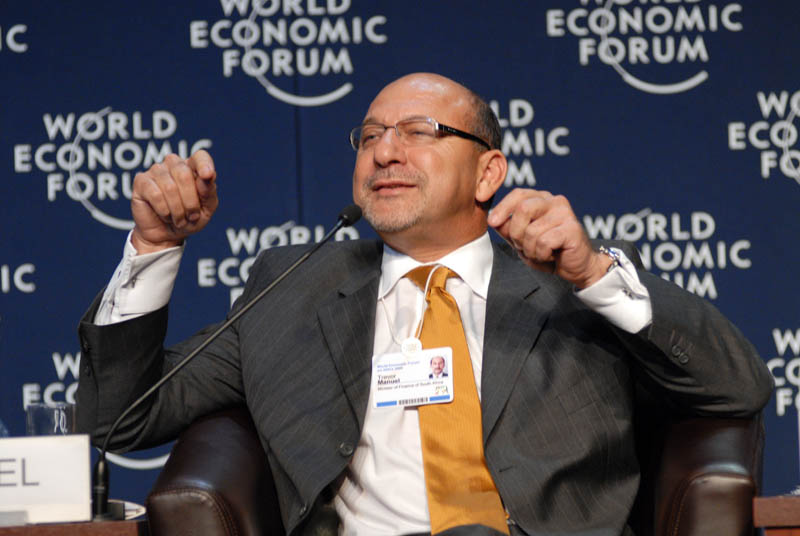
Everyone must be a Mandela: Trevor Manuel

Trevor Manuel
Trevor Manuel

Every person must remember the contribution former president Nelson Mandela has made to the country, Minister in the Presidency Trevor Manuel said on Thursday.

“I think that is what is important to remember,” he said in Johannesburg.

“We must carry forward his legacy… Everyone has to be a Nelson Mandela.”

Whatever Madiba had worked to achieve, including democracy, was a success.

Manuel said Mandela’s physical presence was only one part of it.

“We… understand that his physical presence is only one part of it… his spiritual presence [must] live on,” he said.

The elderly statesman, 94, is in a critical condition in a Pretoria hospital, where he was admitted with a recurring lung infection on June 8. – Sapa

President Zuma’s comments regarding the impact of apartheid on South Africa’s present problems

FW de KlerkIn comments that he made to mark the 20th anniversary of Chris Hani’s assassination, President Zuma alluded to the recent debate regarding the impact of apartheid on the current problems confronting South Africa.

He said that “to suggest we cannot blame apartheid for what is happening in our country now, I think is a mistake, to say the least. We don’t need to indicate what it is apartheid did. The fact that the country is two in one – you go to any city, there is a beautiful part and squatters on the other side – this is not the making of democracy and we can’t stop blaming those who caused it.”

“While wanting to see change happening fast in every corner of the country, we are under no illusion that South Africa will automatically and comprehensively change in only 20 years. That is impossible. The legacy of apartheid runs too deep and too far back for the democratic administration to reverse it in so short a period.”

President Zuma’s remarks were a repetition of what has become a central refrain in ANC communication: that the legacy of the past – i.e. apartheid or “colonialism of a special kind” – is responsible for the triple crisis of inequality, unemployment and poverty. The remarks are usually accompanied by simplistic comparisons between whites who live in the “beautiful part” and blacks who live “on the other side.”

We are all the products of our past – and there can be no doubt that apartheid created serious distortions in the normal development process that black South Africans would otherwise have experienced. However, the roots of inequality and poverty are far more complex than that. They include, in particular, lack of access to decent education, employment and effective government services – all factors that have been within the sphere of government policy since 1994.

The inequality that characterised our society in 1994 may certainly be ascribed to the complex legacies of the past. However, the fact that, 19 years later, we are an even more unequal society is the consequence of the failure of government policy. Unacceptable levels of inequality have their roots – among other things – in:

  • the dismal performance of our education system caused overwhelmingly by government mismanagement and the depredations of SADTU;
  • the fact that almost 40% of black South Africans are unemployed – primarily as a result of rigid labour policies; policies and attitudes that discourage foreign and domestic investment and the refusal of COSATU to countenance competition in freer labour markets;
  • the inability of government to deliver decent services – which is attested to by service delivery protests throughout the country almost on a daily basis; and
  • the implementation of inappropriate policies to promote equality – which have greatly benefited the top 10% of the black population – but which have done nothing for the bottom 60%.

Attempts to blame these failures on “apartheid” will simply divert government and public attention from the urgent need to implement the kind of realistic solutions called for in the National Development Plan. They also serve intentionally or unintentionally to stir up racial animosities that we simply cannot afford. When President Zuma says that “we cannot  stop blaming those who caused it”, he is playing the very dangerous game of making whites the racial scapegoats for the manifest failures of his own government.

The reality is that many of the beautiful parts to which President Zuma refers are now increasingly inhabited by the emerging black elite and middle class. In 1995 whites accounted for 69% of those in the top earnings decile. By 2007 their share had diminished to 43%. By now it will be even smaller. The nature of the squatter camps is also changing: several are now inhabited by impoverished whites. The country may be “two in one” as President Zuma observes but they can no longer be simplistically characterised as ‘rich white’ and ‘poor black’.

Clearly we South Africans need to engage one another in frank discussions about the legacy of the past, the challenges of the present and  our vision for the future.

ISSUED BY THE FW DE KLERK FOUNDATION

CAPE TOWN, 12 APRIL 2013

Zuma, Manuel – ‘no quarrel over apartheid’

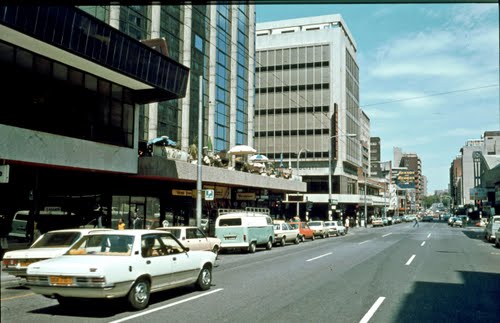
Legacy of apartheid... Johannesburg in the 1980s.

There is no contradiction between what President Jacob Zuma and Minister in the Presidency Trevor Manuel have said about the legacy of apartheid, the presidency said on Thursday.

“Stating that the apartheid legacy and impact still exists and will linger on for a long time does not mean that the president is saying that public servants should use it to excuse laziness and incompetence,” spokesman Mac Maharaj said in a statement.

“The point President Zuma made is that it is impossible to reverse the legacy of apartheid in only 20 years.”

During a wreath-laying ceremony to commemorate the 20 years since SA Communist Party leader Chris Hani was killed, Zuma commented on the statement that the government should stop blaming apartheid for its faults.

“To suggest we cannot blame apartheid for what is happening in our country now, I think is a mistake, to say the least,” he said, in an apparent reference to the comments made by Manuel.

“We don’t need to indicate what it is apartheid did. The fact that the country is two in one — you go to any city, there is a beautiful part and squatters on the other side — this is not the making of democracy and we can’t stop blaming those who caused it,” said Zuma.

Speaking to reporters on the sideline of a government leadership summit last week, Manuel said the government should take responsibility for its actions when it came to service delivery.

“We [the government] should no longer say it’s apartheid’s fault.

“We should get up every morning and recognise we have responsibility. There is no longer the Botha regime looking over our shoulder. We are responsible ourselves.”

Addressing public servants at the summit earlier, Manuel said the government had run out of excuses and had failed the people of South Africa repeatedly in terms of service delivery.

“We cannot continue to blame apartheid for our failings as a state,” he said in speech prepared for delivery.

“We cannot plead ignorance or inexperience. For almost two decades, the public has been patient in the face of mediocre services. The time for change, for ruthless focus on implementation has come.”

SACP deputy general secretary Jeremy Cronin reportedly said on Thursday that Manuel’s comments were taken out of context.

Cronin said Manuel’s remarks were intended to encourage civil servants to be proactive in delivering services.

During the wreath-laying, Zuma said: “While wanting to see change happening fast in every corner of the country, we are under no illusion that South Africa will automatically and comprehensively change in only 20 years. That is impossible.”

However, Zuma said as leaders of public servants, the government had to work harder, faster and more efficiently to ensure true freedom reached the poor and working class in a shorter time.

Maharaj said Manuel had also emphasised this.

“The impact of 300 years of apartheid and colonialism will be felt for many years to come, and since 1994 government has been working to reverse it. However, stating this fact, does not excuse laziness and inefficiency,” Maharaj said.

Opposition parties seemed to agree with Manuel’s comments that the government needed to take responsibility.

The Democratic Alliance said even though the material legacy of apartheid lived on, the slow rate of delivery could not be blamed on apartheid but on the government.

“The truth is that government has not delivered on these objectives fast enough,” DA national spokesman Mmusi Maimane said in a statement.

“Too many people still suffer from apartheid’s material legacy.”

He said Zuma should take responsibility for this and focus on improving service delivery so that the country could combat the evil legacy of apartheid.

United Democratic Movement leader Bantu Holomisa said although apartheid would be an important reminder of what not to do, the time was over for the ANC-led government to blame its failures on apartheid.

“Government has to take full responsibility for its failures and scandals such as the dysfunctional education system, the crumbling infrastructure, Sarafina II, the arms deal, the oilgate and Nkandlagate scandals, the [Andries] Tatane and Marikana incidents as well as the Central African Republic fiasco, among others,” he said. – Sapa