 by Ilana Mercer
[followbutton username=’IlanaMercer’ count=’true’ lang=’en’ theme=’light’]
Like Ilana Mercer’s Facebook page
Why would a consummate narcissist snap a “selfie” of himself at the funeral of Nelson Mandela?
How was it that a random gesticulator—and a very cool, creative guy, if you ask me—officiated as a sign-language interpreter at the Mandela memorial?
What could possibly have driven the handshake between dictator numero uno (the uncrowned king of the killer drones) and dictator No. 2 (Raul Castro)?
These are some of the weighty—evidently inexplicable—questions with which mainstream media are currently preoccupied in their ongoing Mandela monomania.
My homeland South-Africa is a dominant-party state where might makes right. However, due to the same malfunctioning media’s remedial revisionism, a “Rambo Nation” has been marketed to the world as the mythical “Rainbow Nation.”
To the American media, mining Mandela’s legacy has meant repeating the man’s fortune-cookie profundities and warmed-over wisdom.
RT TV, however—“Cross Talk,” in particular—has endeavored to dig deeper into the deceased leader’s legacy. The price I paid this week for smashing RT’s “Cross-Talk” set, so to speak, was this:
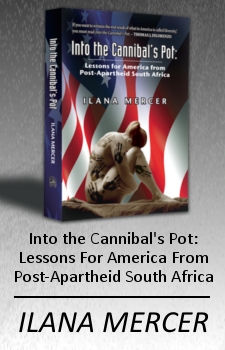
Despite twice providing producers with the necessary biographical details, my authorship of “Into the Cannibal’s Pot: Lessons for America from Post-Apartheid South Africa,” chronicling “The Heart of Darkness” that is Mandela’s South Africa, was kept under-wraps. Concealed as well was my WND affiliation. (Having no make-up is plenty punishment to any woman, however, the duty to bear Christian witness trumped vanity.) The other panelists you are about to watch—Mandela hagiographers both—had their credentials, affiliations, and yet-to-be-published books advertised.
When truth is smuggled onto television, it is rationed.
Since praag.org has never rationed the truth, what follows is an excerpt from the book that dare not speak its name on Russia Today, much less on American Big Media.
“Mandela, Mbeki, And Mugabe Sitting In A Baobab Tree K-I-S-S-I-N-G” is the title of Chapter 4 in “Into the Cannibal’s Pot: Lessons for America from Post-Apartheid South Africa.” It analyzes the significance of the unqualified support Mandela and his predecessors have lent to the Zimbabwean dictator Robert Mugabe over the decades. The chapter includes a historic corrective to the glitterati-created myth that is Mandela:
THE CHE GUEVARA OF AFRICA
To some extent, Mandela’s legend has been nourished—even created—by sentimental Westerners. The measure of the man whom Oprah Winfrey and supermodel Naomi Campbell have taken to calling “Madiba”—Mandela’s African honorific; Winfrey and Campbell’s African affectation—has been determined by the soggy sentimentality of our MTV-coated culture. “Madiba’s” TV smile has won out over his political philosophy, founded as it is on energetic income redistribution in the neo-Marxist tradition, on “land reform” in the same tradition, and on ethnic animosity toward the Afrikaner.
Guru and gadfly, sage and showman, Nelson Rolihlahla Mandela is not the focus of this monograph. Boatloads of biographical stuffing can be found in the odes penned to the man. Concentrating on Mandela, moreover, in a narrative about South Africa today would be like focusing on Jimmy Carter in an account of America of 2010. Going against the trend of hagiography as we are, it must be conceded that, notwithstanding Mandela’s agreement with the “racial socialism” currently contributing to the destruction of South Africa, his present role in his country’s Zimbabwefication is more symbolic—symbolic such as his belated, tokenistic condemnation of Mugabe to an intellectually meaty crowd of “moody models, desperate divas and priapic ex-Presidents,” who convened to celebrate Nelson’s ninetieth. The focus of our attention is, then, not the aging leader but his legacy, the ANC. Or “The Scourge of the ANC,” to quote the title of the polemical essay by Dan Roodt.
The patrician Mandela certainly deserves the sobriquets heaped on him by the distinguished liberal historian Hermann Giliomee: “He had an imposing bearing and a physical presence, together with gravitas and charisma. He also had that rare, intangible quality best described by Seamus Heaney as ‘great transmission of grace.’” Undeniably and uniquely, Mandela combined “the style of a tribal chief and that of an instinctive democratic leader, accompanied by old-world courtesy.” But there’s more to Mandela than meets the proverbial eye.
Cut to the year 1992. The occasion was immortalized on YouTube in 2006. Mandela’s fist is clenched in a black power salute. Flanking him are members of the South African Communist Party, African National Congress leaders, and the ANC’s terrorist arm, the Umkhonto we Sizwe (MK), which Mandela led. The sweet sounds of the MK anthem mask the ditty’s murderous words:
Go safely mkhonto
Mkonto we Sizwe
We the members of the Umkhonto have pledged ourselves to kill them—kill the whites
The catchy chorus is repeated many times and finally sealed with the responsorial, “Amandla!” (“Power”); followed by “Awethu” (“to the People”). Mandela’s genial countenance is at odds with the blood-curdling hymn he is mouthing. The “kill the whites” rallying cry still inspires enthusiasm at funerals and at political gatherings across South Africa, and has been, in practice, a soundtrack for the epic murder campaign currently being waged—however seldom it is acknowledged—against the country’s Boers. This is a side of the revered leader the world seldom sees. Or, rather, has chosen to ignore. Indeed, it appears impossible to persuade the charmed circles of the West that their idol (Mandela) had a bloodthirsty side, that his country (South Africa) is far from a political idyll, and that these facts might conceivably be important in assessing him.
Thanks to the foreign press, an elusive aura has always surrounded Mandela. At the time of his capture in 1962 and trial in 1963 for terrorism, he was described as though in possession of Scarlet-Pimpernel-like qualities—materializing and dematerializing mysteriously for his spectacular cameos. The reality of his arrest and capture were, however, decidedly more prosaic. (At the time, the writer’s father had briefly sheltered the children of two Jewish fugitives involved with the ANC’s operations. The family home was ransacked, and the infant Ilana’s mattress shredded by the South African Police.) About the myth of Mandela as a disciplined freedom fighter, the Pittsburgh Tribune-Review writes wryly:
[A]s a newly qualified attorney [Mandela] was known as a big spending ladies’ man rather than as a focused political activist. To the horror of his African National Congress (ANC) colleagues, he even fancied becoming a professional boxer, so some of the ANC sighed with relief when he went to jail.
Nor was the ANC very good at terrorism—it certainly had nothing on the ascetic, self-sacrificing Salafis who man al-Qaeda. “Without East European expertise and logistics, not to forget Swedish money, [the ANC] would never have managed to make and transport a single bomb across the South African border,” avers Roodt. There was certainly precious little that would have dampened Joseph Lelyveld’s enthusiasm for “The Struggle.” But when the former (aforementioned) New York Times editor went looking for his exiled ANC heroes all over Africa, he found nothing but monosyllabic, apathetic, oft-inebriated men whom he desperately tried to rouse with revolutionary rhetoric.
In any event, the sainted Mandela was caught plotting sabotage and conspiring to overthrow the government. “Mandela … freely admitted at his trial, ‘I do not deny that I planned sabotage. I planned it as a result of a calm and sober assessment of the political situation.’” Confirms Giliomee: “Under the leadership of Nelson Mandela, the armed wing of the ANC, Umkhonto we Sizwe, embarked on a low-key campaign of sabotage.” For that he was incarcerated for life. In 1967, the U.S. had similarly incarcerated the Black Panther’s Huey Newton for committing murder and other “revolutionary” acts against “racist” America. The FBI under J. Edgar Hoover proceeded to hunt down his compatriots who were plotting sabotage and assassination. Were they wrong too? The South African government later offered to release Mandela if he foreswore violence. Mandela—heroically, as The New York Times saw it—refused to do any such thing; so he sat. At the time, the Pentagon had classified the ANC as a terrorist organization. Amnesty International concurred, in a manner; it never recognized Mandela as a prisoner of conscience due to his commitment to violence. In 2002, “ANC member Tokyo Sexwale …, was refused a visa to the United States as a result of his terrorist past.”
Mandela has not always embodied the “great transmission of grace.” The man who causes the Clintons, rocker Bono, Barbra Streisand, Richard Branson, and even Queen Beatrix of the Netherlands to fall about themselves, was rather ungracious to George W. Bush. In 2003, Bush had conferred on Mandela the nation’s highest civilian honor, the Medal of Freedom. Mandela greedily accepted the honor, but responded rudely by calling America “a power with a president who has no foresight and cannot think properly,” and “is now wanting to plunge the world into a holocaust … If there is a country that has committed unspeakable atrocities in the world, it is the United States of America. They don’t care for human beings.” If the then eighty-five-year-old Mandela was referring to the invasion of Iraq, he must have forgotten in his dotage that he had invaded Lesotho in 1998. Pot. Kettle. Black.
Rebranding Socialism
History is being extremely kind to “Madiba.” Since he came to power in 1994, approximately 300,000 people have been murdered. The “Umkhonto we Sizwe” rallying cry is, indubitably, emblematic of the murderous reality that is the democratic South Africa. For having chosen not to implement the ANC’s radical agenda from the 1950s, Mandela incurred the contempt of oddball socialist scribes like the Canadian Naomi Klein. Were Ms. Klein—the author of No Logo: Taking Aim at the Brand Bullies—more discerning, she’d have credited Mandela for brilliantly rebranding socialism.
His crafty Third-Way politics aside, Mandela has nevertheless remained as committed as his political predecessors to race-based social planning.
An important element of our policy,” he said at the fiftieth ANC Conference, on December 16, 1997, “is the deracialisation of the economy to ensure that … in its ownership and management, this economy increasingly reflects the racial composition of our society … The situation cannot be sustained in which the future of humanity is surrendered to the so-called free market, with government denied the right to intervene … The evolution of the capitalist system in our country put on the highest pedestal the promotion of the material interests of the white minority.
Wrong, “Madiba.” If anything, capitalism undermined the country’s caste system; and capitalists had consistently defied apartheid’s race-based laws because of their “material interests.” Why, the “biggest industrial upheaval in South Africa’s history,” the miner’s strike of 1922, erupted because “the Chamber of Mines announced plans to extend the use of black labor. By 1920 the gold mines employed over twenty-one thousand whites … and nearly one hundred and eighty thousand blacks.” White miners were vastly more expensive than black miners, and not much more productive.
One of the mining chiefs, Sir Lionel Phillips, stated flatly that the wages paid to European miners put the economic existence of the mines in jeopardy. … Production costs were rising so the mining houses, entirely English owned and with no great sympathy for their increasingly Afrikaner workforce, proposed to abandon existing agreements with the white unions and open up for black workers…jobs previously reserved for whites.
A small war ensued. Bigotry led to bloodshed and martial law was declared. Although a defining event in the annals of South African labor, the General Strike exemplified the way South African capitalists worked against apartheid to maximize self-interest. Mandela clearly looks at business through the wrong end of a telescope.
Problematic too is Mandela’s Orwellian use of the world “deracialisation,” when what he was in fact describing and prescribing is racialization—a coerced state of affairs whereby the economy is forced, by hook or by crook, to reflect the country’s racial composition. Duly, the father of the Rainbow Nation also fathered the Employment Equity Act. It has seen the ANC assume partial ownership over business. Mandela’s comrade-in-arms, the late Joe Slovo, once dilated on the nature of ownership in the New South Africa. In an interview with a liberal newsman, this ANC and Communist Party leader suggested an alternative to nationalization which he dubbed ‘socialization.’” With a wink and a nod Slovo explained how the state would—and has since begun to—assume control of the economy “without ownership”:
The state could pass a law to give control without ownership—it can just do it. It can say the state has the right to take the following decisions in Anglo American [the great mining company]. You can have regulations and legislation like that, without ownership.
All of which is under way in South Africa. Mandela, moreover, has provided the intellectual seed-capital for this catastrophic “racial socialism.” (And who can forget how, in September of 1991, “Mr. Mandela threatened South African business with nationalization of mines and financial institutions unless business [came] up with an alternative option for the redistribution of wealth”?)
If the values that have guided Mandela’s governance can be discounted, then it is indeed possible to credit him with facilitating transition without revolution in South Africa. Unlike Mugabe, Mandela did not appoint himself Leader for Life, and has been the only head of state on the Continent to have ceded power voluntarily after a term in office. If not aping Africa’s ruling rogues is an achievement, then so be it.
Granted, Mandela has also attempted to mediate peace around Africa. But, “not long after he was released from prison,” notes The New Republic’s assistant editor James Kirchick, “Mr. Mandela began cavorting with the likes of Fidel Castro (‘Long live Comrade Fidel Castro!’ he said at a 1991 rally in Havana), Moammar Gaddafi (whom he visited in 1997, greeting the Libyan dictator as ‘my brother leader’), and Yasser Arafat (‘a comrade in arms’).” One has to wonder, though, why Mr. Kirchick feigns surprise at—and feels betrayed by—Mandela’s dalliances. Mandela and the ANC had never concealed that they were as tight as thieves with communists and terrorist regimes—Castro, Gaddafi, Arafat, North Korea and Iran’s cankered Khameneis. Nevertheless, and at the time, public intellectuals such as Mr. Kirchick thought nothing of delivering South Africa into the hands of professed radical Marxist terrorists. Any one suggesting such folly to the wise Margaret Thatcher risked taking a handbagging. The Iron Lady ventured that grooming the ANC as South Africa’s government-in-waiting was tantamount to “living in cloud-cuckoo land.”
In The Afrikaners, Giliomee also commends Mandela for his insight into Afrikaner nationalism. Mandela, Giliomee contends, considers Afrikaner nationalism “a legitimate indigenous movement, which, like African nationalism, had fought British colonialism.” This is unpersuasive. Forensic evidence against this romanticized view is still being recovered from the dying Afrikaner body politic. Judging by the ANC-led charge against the country’s Afrikaner history and heroes—landmarks and learning institutions—Mandela’s keen understanding of the Afrikaner was not transmitted to the political party he created. Of late, local and international establishment press has showered Mr. Mandela with more praise for serving as the mighty Springboks’ mascot.
The Springboks are the South African national rugby team, and the reigning world champions. Not that you’d guess it from the film “Invictus,” Clint Eastwood’s “over-reverent biopic,” but Mandela has never raised his authoritative voice against the ANC’s plans to force this traditionally Afrikaner game to become racially representative. Conversely, the absence of pale faces among the “Bafana Bafana,” South Africa’s equally celebrated national soccer team, has failed to similarly awaken the leader’s central-planning impulses. Has Mandela piped up about the ANC’s unremitting attacks on Afrikaans as the language of instruction in Afrikaner schools and universities? Or about the systematic culling of the white farming community? Has that paragon of virtue, Mandela, called publicly for a stop to these pogroms? Cancelled a birthday bash with “the hollow international jet set”—“ex-presidents, vacuous and egomaniacal politicians, starlets, coke-addled fashion models, intellectually challenged and morally strained musicians”? Called for a day of prayer instead (oops; he’s an ex-communist)? No, no, and no again.
Bit by barbaric bit, South Africa is being dismantled by official racial socialism, obscene levels of crime—organized and disorganized—AIDS, corruption, and an accreting kleptocracy. In response, people are “packing for Perth,” or as Mandela would say, the “traitors” pack for Perth. The South African Institute of Race Relations (SAIRR) was suitably dismayed to discover that close to one million whites had already left the country; the white population shrank from 5,215,000 in 1995 to 4,374,000 in 2005 (nearly one-fifth of this demographic).
Chief among the reasons cited for the exodus are violent crime and affirmative action. Alas, as the flight from crime gathered steam, the government stopped collecting the necessary emigration statistics. (Correlation is not causation, but …) The same strategy was initially adopted to combat out-of-control crime: suppress the statistics. The exact numbers are, therefore, unknown. What is known is that most émigrés are skilled white men. Also on record is Mandela’s message to them: He has accused whites of betraying him and of being “traitors” and “cowards.” Had “Madiba” wrestled with these defining issues, perhaps he’d be deserving of the monstrous statues raised in his honor. These too are in the socialist realist aesthetic tradition.
SALUTING THE ALPHA MALE
Back to the original question: Why have the leaders of the most powerful country on the continent (Mandela and Mbeki) succored the leader of the most corrupt (Mugabe)? The luminaries of Western café society were not the only ones to have given Mugabe a pass. So did blacks. “When Mugabe slaughtered 20,000 black people in southern Zimbabwe in 1983,” observes columnist Andrew Kenny, “nobody outside Zimbabwe, including the ANC, paid it the slightest attention. Nor did they care when, after 2000, he drove thousands of black farm workers out of their livelihoods and committed countless atrocities against his black population. But when he killed a dozen white farmers and pushed others off their farms, it caused tremendous excitement.”
When he socked it to Whitey, Mugabe cemented his status as hero to black activists and their white sycophants in South Africa, the US and England. “Whenever there is a South African radio phone-in programme [sic] on Zimbabwe, white South Africans and black Zimbabweans denounce Mugabe, and black South Africans applaud him. Therefore, one theory goes, Mbeki could not afford to criticise [sic] Mugabe,” who is revered, never reviled, by South African blacks.
Left-liberal journalist John Pilger and classical liberal columnist Andrew Kenny concur: bar Zimbabweans, blacks across Africa and beyond have a soft spot for Mugabe. While issuing the obligatory denunciations of the despot, Pilger makes clear that Mugabe is merely a cog in the real “silent war on Africa,” waged as it is by bourgeois, neo-colonial businessmen and their brokers in western governments. From his comfy perch in England, this Hugo Chávez supporter preaches against colonialism and capitalism. Writing in the Mail & Guardian Online, Pilger untangled the mystery of Mbeki and Mugabe’s cozy relationship: “When Robert Mugabe attended the ceremony to mark Thabo Mbeki’s second term as President of South Africa, the black crowd gave Zimbabwe’s dictator a standing ovation.” This is a “symbolic expression of appreciation for an African leader who, many poor blacks think, has given those greedy whites a long-delayed and just comeuppance.”
South Africa’s strongmen are saluting their Alpha Male Mugabe by implementing a slow-motion version of his program. One only need look at the present in Zimbabwe “if you want to see the future of South Africa,” ventures Kenny. When Mugabe took power in 1980, there were about 300,000 whites in Zimbabwe. Pursuant to the purges conducted by the leader and his people, fewer than 20,000 whites remain. Of these, only 200 are farmers, five percent of the total eight years ago.” Although most farmland in South Africa is still owned by whites, the government intends to change the landowner’s landscape by 2014. “Having so far acquired land on a ‘willing buyer, willing seller’ basis, officials have signaled that large-scale expropriations are on the cards.”
In South Africa, the main instrument of transformation is Black Economic Empowerment (BEE). This requires whites to hand over big chunks of the ownership of companies to blacks and to surrender top jobs to them. Almost all the blacks so enriched belong to a small elite connected to the ANC. BEE is already happening to mines, banks and factories. In other words, a peaceful Mugabe-like program is already in progress in South Africa. Except that it’s not so peaceful. South Africans are dying in droves, a reality the affable Mandela, the imperious Mbeki, and their successor Zuma have accepted without piety and pity.
Excerpted from “Into the Cannibal’s Pot: Lessons for America from Post-Apartheid South Africa” (pages 140-151, 2011). End-notes have been removed for fluidity.
[followbutton username=’IlanaMercer’ count=’true’ lang=’en’ theme=’light’]
Like Ilana Mercer’s Facebook page


