At this point of time, a barrel of oil costs $60, showing some signs of improvement from its previous value of below $50 back in March. Yet, full recovery of oil seems very unlikely, and people wonder whether fossil fuels will last that much longer as our primary source of power. Research indicates that oil demand will peak at 2030, while others believe another oil crisis could happen again in the future, with permanent damages as a consequence
Slowing rates of consumption have led to the closure of oil and gas rotaries in the United States. But many still see the fossil fuel industry as a lucrative investment as they pour capital into Iraq’s oil-rich fields in Rumaila and spend their funds on exploration programs throughout Africa, particularly in Namibia where around 60 petroleum exploration licenses have already been issued to local and foreign investors. Others have joined the race for renewable energy as the prices of solar and wind power continues to decrease. South Africa have taken a different route to address the slump in commodities, as they believe that shale gas exploration in the Karoo region could help survive the economy.
In the last 12 months, 36 mining rights have been granted with the hope to create around 6,000 jobs, as explained by Mineral Resources Minister Ngoako Ramatlhodi. The nation’s budding shale industry may soon have a new program starting up within the next several weeks, should the government approve new regulations on shale exploration in Karoo.
It’s been said that the semi-desert area holds up to 400 trillion cubic feet of shale gas, and passing these new rules will mitigate the current energy shortages. Environmentalists fear that extraction would damage the water supply of surrounding communities, which is why it’s of the utmost importance that extractors conduct all the appropriate assessments and work with local communities to minimize disturbances.
Prior to Western-led sanctions against Iran, South Africa had been the leading importer for Iran’s crude oil and the ninth in the world, which was reported by the Tasnim News Agency earlier this month. If the sanctions are ever lifted, South Africa are prepared to cooperate with Iran once again to boost each other’s economies, given the amount of potential in shale gas.
South Africa’s industrial policy will focus on platinum group metal (PGM) beneficiation, oil and gas from shale and neighbouring countries like Mozambique, and the manufacture of electric cars, Trade and Industry Minister Rob Davies said on Thursday.
These key areas will be the focus for the next three years, he said at the launch of the seventh edition of the plan in Johannesburg, adding that such industrialisation was key to driving economic growth. He said South Africa aimed to achieve 5 percent growth by 2019.
Davies the mineral beneficiation plan for PGMs would be for use in fuel cell technology and for the manufacture of catalytic converters which are mostly used in European vehicles that have to comply with strict emission controls.
In the 84 quarters to the end of 2014, growth of 5 percent had been achieved in 16 of these quarters, he said. This growth was driven by high commodity prices and by consumption, which was import intensive.
But he added that times were changing, with demand for commodities from China falling as quantitative easing ceases and slows consumer demand.
Another major energy deal with Russia shows China is eager to develop overland energy supply lines that reduce its dependence on vulnerable sea lanes
China and Russia will seal an agreement later this year on piped gas from Western Siberia, China’s foreign minister said on Sunday, a deal that will continue Russia’s economic shift towards Asia and away from Western Europe.
Russia’s split with the west over Ukraine has pushed it closer to China, which is eager to develop overland energy supply lines that reduce its dependence on vulnerable sea lanes. China has taken a carefully neutral stance on the Ukraine conflict, while more broadly expressing its support for Russia.
The relationship between the two on-again, off-again Cold War allies is “mature and stable,” Chinese foreign minister Wang Yi told a press conference on Sunday. “There is enormous internal impetus and room for expansion.”
Much of that expansion will be in oil, gas and nuclear energy co-operation, he added. “We will fully begin construction of the eastern gas line and sign a co-operation agreement for the western line,” he said.
During a visit to Beijing in November, Russian president Vladimir Putin reached a preliminary agreement for Gazprom, the Kremlin-controlled energy group, to supply China’s state oil company CNPC with 30bn cubic metres of gas per year from the Altai region of western Siberia. However, most of the details — including the price of the gas — are still to be worked out.
Beijing expects the deal to be finalised later this year, leading to a pipeline that will, for the first time, allow Russia to choose between exporting gas to Asia or to Europe.
Russia has also made a commitment to sell gas from its far east to China, but gas from that area of Siberia can only be sold economically to Asia. In a $400bn agreement signed during Mr Putin’s visit to Shanghai in May, Russia agreed to sell up to 38bn cubic metres a year to China.
Chinese and Russian leaders officially inaugurated construction of the Power of Siberia pipeline in September last year, but little work can be done during the harsh Siberian winter. The two sides have also disagreed over financing for the massive projects, with Russia strapped for cash amid sanctions imposed by the West. To sweeten the deal for China, Russia has offered Chinese oil firms the chance to invest directly in its upstream operations. Russia’s deputy premier Arkardy Dvorkovich said at an investment forum last month that there are no longer political barriers to China controlling strategic assets.
Increased economic ties with Russia, particularly the Russian Far East, fall under the broader One Belt, One Road strategy of increasing exports and investment in Central Asia, Mr Wang said.
China wants to create a new Silk Road economic belt that roughly retraces trade networks active at the height of China’s presence in Central Asia, during the Han dynasty 2,000 years ago, as well as a 21st-century maritime Silk Road that revisits the greatest extent of its sea power during the early Ming dynasty.
Rising investment in Central Asia, Southeast Asia, South Asia and Africa would allow China to export its surplus capacity in steel, rail and other industries, an overhang that is increasingly weighing on its domestic economy.
An added attraction for energy-hungry China is the creation of overland rail, road and pipe networks, which it views as more defensible than easily blockaded sea routes including the Suez Canal and the narrow Strait of Malacca.
On the outskirts of the village of Shishkovo under the snow and rain rusts the expensive equipment: four residential trailers for employees, diesel substation and equipment for conducting seismic surveys. Judging by the labels this equipment was certified in the U.S., and now it is in possession of the people of Donbass.
Local residents recall that this was a temporary base of geologists from Ukrgazdobicha. The residents of the Shishkovo witnessed the beginning of the work.
“This equipment was brought at a time when in June the Ukrainian tanks came from Metallist and started shelling the city. As we suppose, Kiev authorities planned a quick capture of South-East, Donbass in particular, for further extraction of shale gas,” explains a local resident Vladimir.
“They were from Western Ukraine. Geo-research. They were saying something about gas, said there is shale gas here. First there were two vehicles, then 10 -12. There was a lot,” says a resident.
Earlier the field was divided into squares, here the expert gasman conducted seismic studies and measurements and were preparing to install a rig.
Local mechanics and welders were not hired, because many of the them spoke out against the extraction of shale gas.
The residents of Shishkovo were not notified of the purpose of the camp. The camp was staffed mainly with residents of Western Ukraine, which is revealed by the documents left behind : “Ivano-Frankovsk, Cherkassy, Poltava region, Zhitomir region.” The documents also mention both gas and oil research.
According to the paperwork for 2013 found onsite, similar bases were also located in villages Shevchenko, Raigorodka and Gerasimovka.
As the local residents say, the research continued until the Ukrainian national guard had left. Along with tanks and howitzers the Ukrainian soldiers also took part of the seismic equipment, but in the rush they did not have the time to gather everything.
This abandoned base can be observed well from the Ukrainian side of the frontline. Just over this field, a mile from the abandoned base is the town of Schastye, which is under the complete control of the Ukrainian army. Even now, in the midst of a ceasefire it is not safe to be here. Locals say that during evening hours the Ukrainian Armed forces and volunteer battalions begin to fire at each other.
Royal Dutch Shell pushed SA on Wednesday to decide on its application, now nearly four years old, to explore for shale gas in the Karoo, a pristine semi-desert that may contain some of the world’s largest reserves.
Shell’s application in early 2011 for an exploration licence in the Karoo, which the US Energy Information Administration says may hold up to 390-trillion cubic feet of technically recoverable reserves, caused an uproar from farmers and green groups, and an 18-month moratorium on the issuing of permits.
A year ago, several ministers — including then-mining minister Susan Shabangu — suggested hydraulic fracturing, or fracking, exploration licences were about to be issued but none has been forthcoming.
The mining ministry has failed to clarify reasons for the delay, either to Reuters or Shell.
“Why it is taking so long is a conundrum that we are trying to figure out,” Shell SA chairman Bonang Mohale told a news conference.
“We were hoping that by now we would have at least started the exploration process.”
With energy firms chasing large natural gas finds in places such as Mozambique, Brazil and China, SA could ill-afford to carry on delaying much longer, he added.
“Capital is moving,” he said. “My guess is that we are probably months away, not years away, from the issuing of exploration rights.”
The US estimates give SA the world’s eighth-biggest shale reserves, with nearly two-thirds the deposits estimated in the US.
Shell says it is committed to investing $200m in gas exploration in the area, which lies at the underdeveloped heart of Africa’s most advanced economy.
A Shell-commissioned study by Cape Town-based consultancy Econometrix suggests extracting 50-trillion cubic feet of gas would add $20bn, or 0.5%, of gross domestic product annually for 25 years to an economy that has always been a major energy importer.
The study also suggests it would create 700,000 jobs, a major draw for a government trying and failing to come up with answers to persistent 25% unemployment.
Opponents of shale gas fracking say the government has failed to introduce a suitably robust regulatory framework to prevent damage to the delicate environment, ecosystems and water supplies of the Karoo.
The spokeswoman for the mining ministry did not respond to requests for comment.
US and EU sanctions against Moscow are in danger of turning round and biting the west by constraining global oil supply and pushing up prices in coming years, the former chief executive of BP has warned.
Tony Hayward said that cutting off capital markets from Russia’s energy groups, which would eventually lead to less investment in Russian oil production, was likely to damage long-term supply. He said the US shale boom had obscured the growing risks to the world’s supply picture, but its effect would wear off, leaving the global economy dangerously exposed to potential disruptions in the flow of oil.
His comments came as the US and Europe expanded sanctions against Russia on Friday with the US adding Gazprom, Europe’s leading energy provider, and Lukoil, the privately owned oil group, to the list of companies deprived of US goods, technology and services for deepwater, Arctic offshore and shale projects. EU and US sanctions have also imposed restrictions on financing for some state-owned Russian energy companies.
“The world has been lulled into a false sense of security because of what’s going on in the US,” Mr Hayward said in an interview with the Financial Times, referring to the shale boom that has driven a 60 per cent increase in US crude output since 2008. But he asked: “When US supply peaks, where will the new supply come from?”
As output from mature basins such as the North Sea and Alaska’s North Slope declines, the world had been banking on new barrels from places such as Canada, Iraq and Russia. But the latter’s future production from untapped resources in the Arctic and the vast shale reserves of Siberia are under threat because of sanctions, Mr Hayward said.
“Because of financial sanctions, the big gorillas are going to start cutting their activities,” he said.
Mr Hayward, who runs oil explorer Genel Energy and is chairman of commodities group Glencore, also expressed doubt about projections for a big increase in oil production from Iraq. He said current circumstances meant the country would struggle to reach targets to double production by 2020.
The advance of Isis militants in northern Iraq has coincided with political instability in other big oil-producing countries such as Libya. But the barrels lost through post-Arab Spring unrest have been matched by new supply from North America. Without that additional supply, the world would be facing an oil price of $150 a barrel, according to Mr Hayward.
Brent crude has fallen from about $108 per barrel at the start of the year to about $97 today.
Russian intelligence agencies are covertly funding and working with European environmental groups to campaign against fracking and maintain EU dependence on Russian gas, the head of Nato has claimed.
Answering questions after a speech in London, Anders Fogh Rasmussen, Nato secretary-general, said improving European energy security was of the “utmost importance” and accused Moscow of “blackmail” in its dealings with Europe.
“I have met allies who can report that Russia, as part of their sophisticated information and disinformation operations, engaged actively with so-called non-governmental organisations – environmental organisations working against shale gas – to maintain European dependence on imported Russian gas,” Mr Rasmussen, former Danish prime minister, told an audience at Chatham House, the international affairs think-tank.
Mr Rasmussen did not detail the nature of his suspicions about Russian involvement with environmental groups.
The 28-nation EU bloc depends on Russia for about a third of its oil and gas needs.
Shale gas enthusiasts want curb the EU’s high dependence on Russian imports.
A Nato official, speaking on condition of anonymity, told the Financial Times that “some allies worry that Russia could try to obstruct possible projects on shale gas exploration in Europe in order to maintain Europe’s reliance on Russian gas.”
Royal Dutch Shell last year struck a production-sharing agreement to develop the Yuzuvska field, which spans 8,000 square kilometres in and around Donetsk.
Denis Pushilin, from the Donetsk People’s Republic organised rallies against shale gas exploration in Donetsk. In May, Mr Pushilin said the Donetsk People’s Republic had banned the extraction of shale gas in territory it controlled in eastern Ukraine.
Protests against fracking have been held in Bulgaria and Romania but green groups in both countries have angrily rejected charges that they are puppets and dismiss the idea of Russia’s influence as a conspiracy theory.
Romania’s president, Traian Basescu, suggested that Russia was playing a role in trying to thwart Chevron’s shale gas development near the village of Pungesti.
Environmentalists reject the charges and accuse the Romanian police of acting as a private security force for Chevron.
Demonstrators have vented their outrage about the danger that shale development would pose to drinking water and geological faults.
High principles dominate the rhetoric on freedom-loving Ukraine, writes JP Sottile. But more mundane realities – like the interests of US oil corporations and Ukraine’s vast shale gas capacity – are part of the volatile equation.
In Ukraine, Chevron’s deal continues a long tradition of intermarriage between ‘national’ and corporate interests under the guise of national security.
Everybody’s got an opinion about the ‘showdown’ with Russia.
Some say it’s about freedom and the right to self-determination. Some say it’s about standing up to aggression and halting a dictator’s march.
Some say it’s about the future of everything-from Syria to North Korea to Iran’s nuclear program – and, according to Sen. Lindsey Graham, it all stems from Obama’s failure to kill the people who killed Americans at Benghazi.
But the most-revealing voice in the chorus is Condi Rice. She penned a tension-filled op-ed on Ukraine for the Washington Post – the newspaper of broken records.
Her nostalgic, “Baby, It’s a Cold War Outside” ditty on the “Ukrainian Problem” came just two days after a Teflon-coated Henry Kissinger opined about the “art of establishing priorities” in his own Ukraine-themed op-ed for the Post.
Why should we care about Condi?
As the world learned through painful experience, Condi Rice, much like Henry Kissinger, was all about establishing priorities. But now that she’s out of power, why should anyone waste any time considering Ms. Rice’s opinion about anything, much less about the ‘crisis’ in Ukraine?
Why? Because it’s telling. Like most American Exceptionalists, her bluster and posturing can be reverse-engineered to find the banal truth about US foreign policy.
For example, her steadfast belief that Ukraine “should not be a pawn in a great-power conflict but rather an independent nation” might have something to do with Chevron’s 50-year lease to develop Ukraine’s shale gas reserves.
It’s the gas, stupid
When that lease was signed on November 5, 2013, it stoked Russian fears about losing its influence on, and a major gas market in, a former satellite.
It also came on the eve of the much-disputed trade deal with the European Union that, once abandoned due to Russian pressure, led to the toppling of Ukraine’s government.
Reuters characterized Ukraine’s “$10 billion shale gas production-sharing agreement with US Chevron” as “another step in a drive for more energy independence from Russia.”
Of course, Ms. Rice knows something about driving for more energy. She sat on Chevron’s board of directors for ten years before resigning to become President Bush’s National Security Adviser in January of 2001.
She was such a titanic figure at Chevron and so beloved by their corporate captains that they even named a 129,000-ton oil tanker ‘Condoleezza Rice’. Do people name tankers after people? People do!
But four months after leaving Chevron, they “quietly renamed” the tanker, apparently sensitive to the implication that she might prioritize their interests in places like Kazakhstan (a de facto dictatorship never targeted by American Exceptionalists) or the Caspian Sea (where Chevron is heavily invested) or Afghanistan (where they’ve long sought a pipeline from the Caspian region to the Indian Ocean).
Corporate Interests Abroad
In the case of Ukraine, Chevron’s deal continues a long tradition of intermarriage between ‘national’ and corporate interests under the guise of national security.
As the International Business Times stated immediately after the deal, “Chevron’s agreement with Ukraine was supported by the US as part of its national security strategy to help reduce Russia’s hold on Europe and Kiev.”
As quoted in the article, US Ambassador Geoffrey Pyatt said, “I’m very determined to cooperate with the Ukrainian government in strengthening Ukraine’s energy independence.”
That “cooperation” is couched in the language of “independence” – but it’s actually about shifting to financial interdependence with powerful, American corporate interests. It’s not about freedom or self-determination or human rights.
It’s about the ‘Open Door’.
Since the US proposed the Open Door Policy in China at the end of the 19th Century, American ‘soft imperialism’ has exploited resource opportunities for American corporate interests in dozens of ‘friendly’regimes – their commitment to freedom notwithstanding.
We have been there before
Whether it was oil in Iran, bananas in Guatemala or sugar-cane in Cuba, any move to close the door on US business interests has traditionally been met with dire warnings about the dangers of isolationism and specious claims about America’s national interests – which, oddly enough, always seem to be located in another country.
Throughout the Cold War, those ‘endangered’ national interests inspired CIA hijinks around the world. US foreign policymakers supported regime change in places like Chile (calling Dr. Kissinger) and around Central America.
And they doled out generous foreign aid packages to a motley crew of anti-communist ‘strongmen’. If push came to shove, the US military might even get involved.
Since the end of the Cold War, US policy has been kicking open doors around the world and particularly around the edges of the former Soviet Union. Expansion of NATO and US involvement in the former ‘Soviet Stans’ around Afghanistan extended a semi-circle of US military might around Russia.
A declaration of economic war
And the Ukrainian energy independence trumpeted by Ambassador Pyatt amounted to a declaration of economic warfare on Russia’s oil and gas-based economy. Like Condi Rice before him, Ambassador Pyatt’s well-established priority is to ensure that well-connected businesses get in on the ground floor.
Once on the ground floor, they need insurance – either from local clients or from a neighborhood patrol by US forces. Perhaps that’s why Ms. Rice used her Ukraine op-ed as an opportunity to advocate leaving a permanent military force in Afghanistan.
She doesn’t want to hear “talk of withdrawal from Afghanistan whether the security situation warrants it or not.” For her, nothing less than 10,000 troops will do. Otherwise, the US is “not serious about helping to stabilize that country.”
Freedom, liberty, justice … and hydrocarbons
Yet, one wonders if she – like all the professional hand-wringers, truculent think tankers, and once and future policymakers who’ve grandstanded on the showdown with Russia – isn’t quietly more concerned about something more basic than freedom, liberty and justice for all.
Perhaps the former Secretary of State, former Chevron big-wig and former oil tanker is more concerned with the ability of Chevron to realize its Turkmenistan-Afghanistan-Pakistan-India (TAPI) pipeline dream.
Her old cohorts practicing soft imperialism at the US State Department have certainly been doing their part to help Chevron score that lucrative contract.
The banal truth is that America’s long-standing policy is to help people anywhere and everywhere when those people just so happen to be living on or near valuable resources.
Unless, of course, it’s Bahrain, Nigeria, Kazakhstan or anywhere else repressive and corrupt governments are already interdependent upon US corporate interests.
South African petrochemicals group Sasol Ltd is keen to invest in a domestic shale industry once it gets off the ground, its chief executive said, in a potential challenge to oil major Royal Dutch Shell.
South Africa’s cabinet proposed new regulations to govern exploration for shale gas late last year after it lifted a 2012 moratorium on the activity in the central Karoo region.
Fracking in the region might tap what is believed to be some of the world’s biggest reserves of the energy source and the government wants to develop an industry that it sees as a potential game-changer in Africa’s largest economy.
“I am very excited because of the technologies we can bring to the table. We’ve got shale gas upstream experience in British Columbia,” Sasol Chief Executive David Constable said on Monday.
“We want to get involved and participate and monetize that gas in country with gas to liquid, gas to power, gas to chemicals,” he said after the group posted a 26 percent rise in half-year earnings.
Shell has applied for an exploration licence and once all of the new regulations are in place it is expected to be near the front of the line.
Constable said Sasol wanted to take part. “We are really interested in what is going in the Shell block and would love to farm in or take a piece of it. Shell is issuing profit warnings and pulling back capex right now,” he said.
Shell said in January that it planned to cut capital spending to $37 billion this year from $46 billion in 2013, following a profit warning.
Shell was not immediately available to comment on Monday.
Constable said the government should take Shell’s strategy into account.
South Africa’s Public Investment Corporation (PIC), which is Sasol’s biggest shareholder with a 13 percent stake in the company and manages 1.4 trillion rand ($130.3 billion) in civil servant retirement funds, has also said it wants a big slice of the shale pie.
Fracking involves pumping pressurised water, chemicals and sand underground to release gas trapped in shale formations and the prospect of it occurring in the semi-arid and sparsely-populated Karoo region, known for its big skies and scenery, has raised concerns anong conservationists.
Constable said Sasol’s experience in British Columbia would enable the company to carry out the process “in an environmentally friendly fashion.”
Ukraine signed a $10 billion shale gas production-sharing agreement with U.S. Chevron on Tuesday, another step in a drive for more energy independence from Russia.
The deal to develop its western Olesska field followed a similar shale gas agreement with Royal Dutch Shell in January and boosts Ukraine’s leadership at a time of fraught relations with Moscow over gas supplies.
“The agreements with Shell and Chevron … will enable us to have full sufficiency in gas by 2020 and, under an optimistic scenario, even enable us to export energy,” President Viktor Yanukovich told investors shortly before the signing.
The highest end of expectations for Olesska’s potential reserves would match around three years of European Union gas demand, but similarly sunny hopes for shale reserves in neighboring Poland have been very sharply downsized.
Some of the most drought-ravaged areas of the US are also heavily targeted for oil and gas development using hydraulic fracturing – a practice that exacerbates water shortages – according to a new report.
Three-quarters of the nearly 40,000 oil and gas wells drilled in the US since 2011 were located in areas of the country facing water scarcity, according to research by the Ceres investor network. Over half of those new wells were in areas experiencing drought conditions.
Hydraulic fracturing, or fracking, in those wells required the use of 97 billion gallons of water, Ceres found.
“Hydraulic fracturing is increasing competitive pressures for water in some of the country’s most water-stressed and drought-ridden regions,” said Mindy Lubber, president of the Ceres green investors’ network.
Lubber warned that the fracking boom across the US puts the industry on a “collision course” with other water users.
Fracking is the highly controversial process of injecting water, sand, and various chemicals into layers of rock, in hopes of releasing oil and gas deep underground. Fracking in a single well can take millions of gallons of freshwater. Much of the drilling has occurred in areas mired in multi-year droughts.
Half of the 97 billion gallons of water used since 2011 for fracking have gone to wells in Texas, a state in the midst of a severe, years-long drought. Meanwhile, oil and gas production through fracking is on track to double in the state over the next five years, the Guardian reported.
The report also found that rural communities in the Lone Star State are being hit hard by the fracking bonanza occurring especially in the Eagle Ford Shale in south Texas.
“Shale producers are having significant impacts at the county level, especially in smaller rural counties with limited water infrastructure capacity,” the report said. “With water use requirements for shale producers in the Eagle Ford already high and expected to double in the coming 10 years, these rural counties can expect severe water stress challenges in the years ahead.”
Levels of vital aquifers that serve local communities near Eagle Ford have dropped by up to 300 feet in the last few years.
Many small communities in areas of heavy fracking in Texas are in dire need of water, as supplies have run out in some places or will dry up soon in others. The Texas Commission on Environmental Quality says 29 communities across the state could run out of water in 90 days, and that many reservoirs in west Texas are at around 25 percent capacity.
In December, the San Antonio Express-News found that fracking was using more water than previously thought. The newspaper reported that in 2012, the industry used around 43,770 acre-feet of water in 3,522 Eagle Ford fracking wells – about the same usage of 153,000 San Antonio households.
“The oil and gas boom is requiring more water than we have,” Hugh Fitzsimons, a Dimmit County rancher and a director of the Wintergarden Groundwater Conservation District, told the Express-News. “Period.”
A separate study published this week found that the industry does a very poor job recycling fracking water in Texas. Researchers at the University of Texas’ Bureau of Economic Geology found that 92 percent of water used in 2011 to frack Barnett Shale in north central Texas was “consumed,” and not recycled. Only about five percent of all water used for fracking in that area has been reused or recycled in the “past few years.”
Other states do not fare well in the Ceres report, either. In Colorado, 97 percent of wells were in areas strapped for water, as demand for fracking water in the state is expected to double to six billion gallons – twice the annual use of the city of Boulder – by 2015.
In California, 96 percent of new wells were located in areas where competition for water is high. A drought emergency for the entire state – which has traditionally dealt with water-sharing and access problems – was declared last month.
The report found similar high percentages of wells built in other states – such as New Mexico, Utah and Wyoming – where water shortages exist.
“It’s a wake-up call,” said Prof. James Famiglietti, a hydrologist at the University of California, Irvine, according to the Guardian. “We understand as a country that we need more energy but it is time to have a conversation about what impacts there are, and do our best to try to minimize any damage.”
Two industry groups signed a Memorandum of Understanding stating that their members will minimize the impact of onshore oil and gas development in the UK on the country’s water resources.The memorandum accompanies a report released by Water UK. The report concludes that ”where water is in short supply there may not be enough available from public water supplies or the environment to meet the requirements for hydraulic fracturing.”While the aim of the mutual agreement was to give the public greater confidence and reassurance that everything will be done to minimize the effects on water resources and the environment during fracking, some organizations are speaking out against agreement.
“Water is a key concern for people in areas where drilling is proposed, particularly among farmers, who’re worried for their livestock,” said Greenpeace energy spokesperson Anna Jones. ”A voluntary agreement between Water UK and its major new client is unlikely to alleviate these concerns.
Under the memorandum, members of Water UK and UK Onshore Operators Group pledge to work together to identify and resolve risks around water or wastewater including:
Baseline monitoring requirements to assess impacts of onshore oil and gas development on the quality and quantity of local water resources.
Plans relating to site water management, especially water reuse, to improve understanding of local impacts.
Onshore oil and gas company development plans, including scenarios for expansion of exploration and development within a local area and what this means for short and long-term demand for water at specific locations.
The expected volumes and chemical and biological composition of waste water as well as preferred disposal routes.
“This agreement acknowledges that fracking will impact and affect the UK’s water resources and environment,” Jones said. But she also warns, “you will never regulate away the risks of fracking.”
The UK is not the only nation feeling a strain on water resources from the fracking boom. In the U.S. record temperatures this summer led to water shortages and drought in states like Texas and Colorado.
According to an AP analysis, the vast majority of counties in these states have fracking operations. In October, a report was released showing that the volumes of water used for fracking in the Marcellus Shale states of West Virginia and Pennsylvania are putting a major strain on freshwater reserves.
“The desperate search for shale gas and oil mustn’t be allowed to cause water shortages for critical public purposes,” said Tony Bosworth, a campaigner.
“Fracking is not the solution to our energy problems—it won’t lead to cheaper energy bills,” Bosworth said. “The government should pull the plug on its dash for dirty shale gas and develop Britain’s plentiful renewable power potential.” – wakingtimes.com
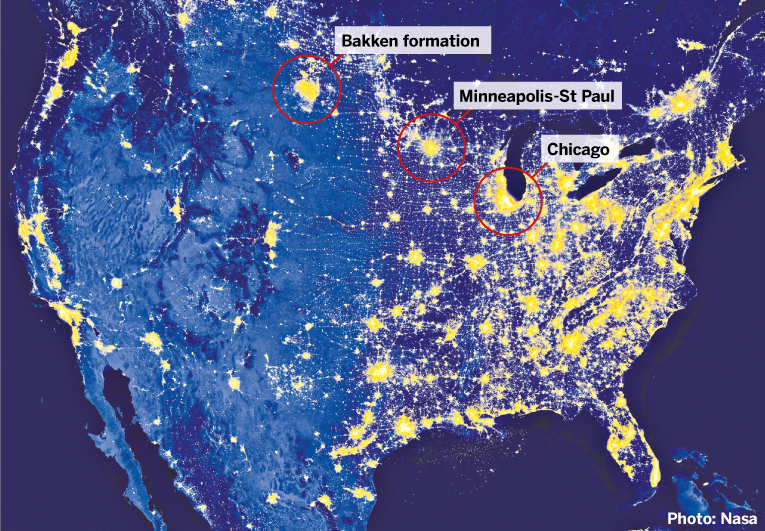
Oil companies at the heart of the US shale oil boom are burning off enough gas to power all the homes in Chicago and Washington combined in a practice causing growing concern about the waste of resources and damage to the environment.
The volume of unwanted gas being flared off in North Dakota, the state leading the shale revolution transforming the outlook for US energy, rose about 50 per cent last year. The surge at the state’s Bakken formation is being replicated in other shale regions with the Texas state regulator issuing 1,963 permits to flare in 2012, more than six times the number of 306 in 2010.
The rapid increase has made the US one of the world’s worst countries for gas flaring. The volume of gas flared in the US has tripled in just five years, according to World Bank estimates and is now fifth highest in the world, behind Russia, Nigeria, Iran and Iraq.
The flaring is a result, in large part, of the low price of natural gas in North America, which can make it uneconomic to build pipelines and tanks to handle the gas released by oil production. Flaring is often the safest way to dispose of it.
The lights of the flares burning in the Bakken and Texas’ Eagle Ford shale fields can clearly be seen in night-time satellite photography.
Flaring has been attracting attention from investors and environmental campaigners because of the waste of gas and its consequences for greenhouse gas emissions, local air pollution and disturbance to nearby communities.
Flaring in North Dakota increases by about 20 per cent the greenhouse gas emissions resulting from the state’s oil production, refining and transport, compared with the US average, according to Financial Times analysis of official data.
Investors managing a total of $500bn last year wrote to oil companies including ExxonMobil, Chevron, Statoiland US independents urging them to do more to cut their flaring. They warned that “excessive flaring, because of its impact on air quality and climate change, poses significant risks for the companies involved.”
Since then, flaring in the US and concerns over it have only increased.
The North Dakota legislature is considering a bill to encourage flaring reduction through tax breaks. The state is also pushing producers to use gas to power drilling rigs.
Fuel is usually found in unattractive places. Geologists discovered the biggest oil and natural gas reserves in the deserts of the Middle East and beneath the permafrost of Siberia. Countries in temperate Central Europe, on the other hand, have only modest reserves. One of them lies some 5,000 meters (16,000 feet) beneath the surface in Rotenburg/Wümme, an administrative district in the northwestern German state of Lower Saxony.
Using a method known as “fracking,” Germany could exploit domestic sources to meet its natural gas needs for 20 years. But safety worries have prompted government authorities to refrain from granting the permits that companies need to use the controversial technique.
ExxonMobil, which operates a well called “Bötersen Z11” uses “induced hydraulic fracturing,” or “fracking” for short.
ExxonMobil plans to inject about 350,000 liters (92,500 gallons) of water, mixed with a cocktail of chemicals, into the well under high pressure. The liquid is supposed to penetrate into the rock at the bottom of the pipe and trigger a long-term loosening effect. Hair-line fractures will create a network of tiny channels from which natural gas can escape for at least 15 years, according to ExxonMobil estimates.
But what ExxonMobil still lacks is official permission to do this. The state mining agency has been sitting on the company’s application for the last year, hesitant to move forward with its approval.
“Unfortunately, fracking has become a scary word,” says Dieter Sieber, a mining engineer and fracking expert at ExxonMobil. A cart decorated with pamphlets from a local citizens’ initiative is parked at the entrance to the drilling site. The group aims to “protect God’s creation,” and one of its signs proclaims: “Stop Fracking!”
The public reservations and protests are coming at a surprisingly late point. As a method to increase the yields of hydrocarbon deposits, fracking has been in use for almost 50 years. In Germany, it has been instrumental in preventing domestic natural gas production from drying up altogether. Very few Germans are aware that, until the 1980s, almost a quarter of the natural gas being burned in Germany came from domestic sources. Although it’s still about 12 percent today, that number is declining by about 1 percent a year.
The deposits that have already been discovered are almost exhausted. About 300 wells have been fracked in Germany since the 1960s. Without imports, more than three-quarters of which come from Russia, Norway and the Netherlands, Germany would soon find itself without natural gas — if there weren’t another alternative, that is.
In May, Germany’s Federal Institute for Geosciences and Natural Resources (BGR) published a study concluding that there are up to 2.3 trillion cubic meters (81 trillion cubic feet) of technically recoverable natural gas under German soil, primarily in the northern state of Lower Saxony and the western state of North Rhine-Westphalia. This would amount to more than 20 times Germany’s annual consumption of natural gas.
The reserves are in deposits that are described as “unconventional,” consisting of shale and coal formations, which are the primary “source rocks” of hydrocarbons. They were long considered unexploitable because they are substantially denser than “conventional” deposits found in more porous sandstone. The coveted fuel simply doesn’t flow out of shale formations — which is where fracking comes in.
Fracking is now proving to be a key technology for extracting oil and gas from shale formations. In Germany, the natural gas reserves that could be exploited in this manner would have “the potential to make up for declines in production in recent years,” explains geophysicist Dieter Franke, a geophysicist who heads the BGR’s oil and gas geology department. In light of the sheer magnitude of proven reserves, this could be seen as a conservative estimate.
Since the mid-1990s, Americans have been far more aggressive and active when it comes to fracking. Geologists estimate that — after China and, presumably, Russia — the United States has the third-largest shale natural gas reserves on Earth, or about 20 times as much as Germany. The United States is exploiting these reserves on a large scale and even hopes to use fracking to end its dependence on gas imports.
Now the United States is also taking a similar approach with shale oil. Thanks to fracking, the Midwestern state of North Dakota already produces more than half a million barrels of oil from the Bakken shale formation. As a result, this year, the state surpassed Alaska in oil production for the first time. According to a forecast by the Organization of Petroleum Exporting Countries (OPEC), oil-tanker traffic to North America could very well be eliminated by 2035.
In contrast to the United States, which once met its own oil requirements and is now enthusiastic about returning to this status, government agencies in Europe are tentative. France, which is assumed to have the largest unconventional gas reserves in Western Europe, has yet to issue a single fracking permit. German authorities have only permitted isolated test fracking. The last fracking operation in German bedrock was conducted in late July 2011 — also by ExxonMobil — at the “Buchhorst T12” site, a conventional gas deposit in Bundsandstein, a type of colored sandstone that lies below large parts of Western and Central Europe.
Horror stories from the United States, an El Dorado for companies engaged in fracking, have discredited the technology. A documentary film about the practice showed a fireball emerging from a faucet, a result of the presence of methane in drinking water. People are starting to realize that pumping 13 million liters of chemical-laced water into a hole can have unpleasant consequences.
This website uses cookies to improve your experience. We'll assume you're ok with this, but you can opt-out if you wish. Cookie settingsACCEPT
Privacy & Cookies Policy
Privacy Overview
This website uses cookies to improve your experience while you navigate through the website. Out of these cookies, the cookies that are categorized as necessary are stored on your browser as they are essential for the working of basic functionalities of the website. We also use third-party cookies that help us analyze and understand how you use this website. These cookies will be stored in your browser only with your consent. You also have the option to opt-out of these cookies. But opting out of some of these cookies may have an effect on your browsing experience.
Necessary cookies are absolutely essential for the website to function properly. This category only includes cookies that ensures basic functionalities and security features of the website. These cookies do not store any personal information.
Any cookies that may not be particularly necessary for the website to function and is used specifically to collect user personal data via analytics, ads, other embedded contents are termed as non-necessary cookies. It is mandatory to procure user consent prior to running these cookies on your website.