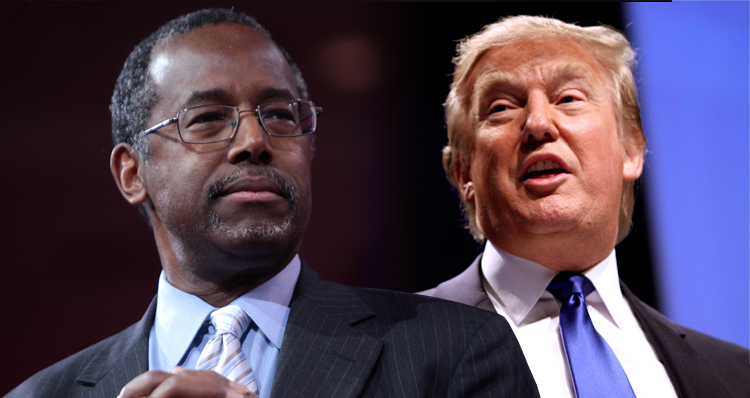
Trump, Carson have Republican Jewish establishment worried

Longtime GOP Jewish donors and activists look on in dismay as the two presidential hopefuls lead the polls

The Republican Jewish establishment is watching the surge of political outsiders — like Donald Trump and Ben Carson — in the presidential primaries with dismay.

“It’s like we have a conference call every morning, and we ask, ‘What can we do to screw ourselves up today?’” said Fred Zeidman, a longtime fundraiser for Republican presidential candidates.

Zeidman’s exasperation pervades the Jewish Republican world: A party that has, in recent years, established a cozy relationship with Jewish conservatives seems to be careening — at least since the presidential race began.

Donald Trump, the billionaire reality show star, has lobbed rhetorical bombs at Hispanics, women and GOP rivals, and promised to deport 11 million illegal immigrants. Ben Carson, the retired world-famous neurosurgeon, said this weekend that a Muslim can’t be president.

“This election is proving that nobody really knows anything, including me,” said Seth Mandel, the Op-Ed editor of the New York Post.

It’s a disorienting experience for longtime Republican Jewish donors and activists, who have made inroads into the party’s establishment over the last two decades, and who have been at the forefront of advocacy for tolerance and pluralism within the party.

“The tone of what they’re saying, we get painted as a party of intolerance,” said Zeidman, who practices law in the Houston area and backs Bush’s candidacy.

The anti-immigrant rhetoric especially infuriates Zeidman, a past chairman of the US Holocaust Memorial Council, who was driving near his home during his phone interview with JTA.

“I think half the people I’m looking at doing roadwork in 100-degree heat are not legal — and they are working their tuchus off,” he said.

Mandel said online that white supremacist backing for Trump — who has suggested immigrants from Mexico are predominantly criminals — has been unsettling. “That will always make Jews uncomfortable, that’s why there’s so much pushback” among some Jewish conservatives against the Trump candidacy.

Tevi Troy, a deputy health secretary in the President George W. Bush administration who is not yet backing a candidate, said one plus that’s emerging from the debates is that the entire range of candidates — insiders and outsiders alike — are pro-Israel and have embraced the party’s skepticism of the Iran nuclear deal.

Contrast that with previous Republican primary seasons, when disruptive outsiders were cool on Israel – notably in the 1990s, when Pat Buchanan ran twice, Troy said.

“Fortunately, the outsiders this time, just about all are exceedingly pro-Israel and that’s a good thing,” he said.

Still, he noted, for a constituency that has cultivated the Republican establishment, the emergence of outsiders is discomfiting.

The Republican Jewish Coalition’s board is a who’s who of the party’s most generous givers — most famously Sheldon Adelson, the Las Vegas casino magnate.

Adelson has yet to come out for a candidate, the conventional wisdom being that he is waiting in order to avoid a repeat of 2012, when his bankrolling of long-shot Newt Gingrich ended up weakening the eventual nominee, Mitt Romney. But one of Adelson’s top allies, Mort Klein of the Zionist Organization of America, recently expressed concern over Trump’s behavior and lead in the polls.

“Trump is making many of us very nervous,” Klein told Talking Points Memo, speaking after Trump derided the black Carson’s skills as a physician. (Carson is a world-famous neurosurgeon.) “He doesn’t have the temperament to be president. I mean, really, to lash out at Carson as a talented doctor? You don’t know what you’re talking about.”

Source: Times of Israel

Will the US Follow South Africa Down the Path of White Decline?

by Dan Roodt

In the aftermath of President Obama’s victory, the Wall Street Journal described the GOP as the WOP, the White Old Party. Indeed, the Republican Party finds itself in a demographic death spiral as youth, single women, blacks, Hispanics, and Asians overwhelmingly vote Democrat.

In fact, the Democratic Party could become the American version of South Africa’s ANC as immigration and high non-white birth rates ensure a steady stream of Democratic voters eager for “change” or even South African-style “transformation:” the ANC’s term for racial revolution and ever tighter anti-white measures.
The latest proposal is for all charities, such as orphanages or soup kitchens to lose their non-profit status if they serve any whites at all. It would mean that charitable organizations could serve only blacks and that whites would not be allowed to help each other in any organized way, even to alleviate poverty or care for orphaned white children.

In the United States, such extreme anti-white measures are probably unthinkable today, but as recently as the early 1980s the idea of a black president in South Africa was deemed equally unthinkable. Even Prime Minister Margaret Thatcher’s spokesman Bernard Ingham said at the time: “Anyone who thinks the ANC will form the government of South Africa is living in cloud cuckoo-land.”

In the 1960s, so-called apartheid South Africa was still considered such a desirable place to live that 500,000 Britons emigrated there, fleeing socialist Britain.

The question therefore arises: how could South Africa, once seen as a leading Western power more or less on par with Canada or Australia, collapse so quickly to become “just another African country?” And what lessons can white Americans draw from our tragic demise, as they ponder the outcome of a Presidential election in which the evidence of a demographic turn for the worse is clear for all to see?

Ilana Mercer’s book, Into The Cannibal’s Pot: Lessons for America from Post-Apartheid South Africa went some way towards portraying the horrors and mayhem of whites living under a hostile black government, but the underlying causes of South Africa’s spectacular collapse still need explanation.

A century ago, South African whites still enjoyed demographic parity with blacks and were a majority in most towns and cities. In 1950, demographers sympathetic to the National Party shocked everyone at a Stellenbosch University conference by stating that the black population could grow from 8 million to 20 million by 2000. This prediction seemed so outlandish no one believed it. The recent census confirmed that blacks now represent 40 million, far overshooting the “nightmare scenario” of 1950.

South African whites feared communism more than anything else, but American racial ideologies such as affirmative action and so-called BEE (“black economic empowerment—our version of minority procurement) are doing vastly more damage to them. At least under communism the Bolshoi ballet still functioned and the Soviet Union still had a space program. The pursuit of diversity and multiculturalism in South Africa has, however, led to across the board decline; some small towns regularly suffer water and electricity shortages.

In my opinion, America’s future will not resemble its past, but will look more like today’s South Africa. As the number of whites declines, loss of power will follow, leading to aggressive legislation pushing whites out of jobs and most positions of power.

Many whites will emigrate or move to the remaining red states, just as South Africa’s whites have emigrated since 1994. But ultimately there will be no place to go as the global demographic decline of whites means that even European countries suffer the same fate of dispossession.

Demography is destiny, as Auguste Comte said. There is a mysterious process whereby whites react to racial domination not by rioting or claiming special privileges as other races do, but by working harder, having even fewer children, and quarrelling among themselves. We see this happening in South Africa, in Western Europe and, of course, in America where white Republicans and Democrats are like two dogs fighting over a bone, while a third is about to run away with it and leave them with nothing.

The Republican Party is poised to adopt the attitude of South Africa’s liberal opposition party, the Democratic Alliance, which has forsaken its core white support and practices affirmative action in its own ranks. There are three women on its election posters: one white, one colored or mixed-race, and one black, at once expressing the party’s diversity and its disdain for the white male.

Jared Taylor asks that the Republican Party be loyal to its electorate and become the unabashed champion of white interests. Again, the history of South Africa is instructive. British Prime Minister Harold McMillan made a famous speech in the South African parliament  on February 3, 1960 in which he warned us that “the wind of change is blowing through the African continent” and that ultimately we would have to surrender power to the nonwhite majority. Our brilliant leader, Hendrik Verwoerd, promptly replied in an unprepared speech that “the tendency in Africa for nations to become independent, and at the same time to do justice to all, does not only mean being just to the black man of Africa, but also being just to the white man of Africa.”

Verwoerd’s slogan of “justice for the white man too” was rejected by most of the Western world. Lest we forget, the rank and file of the Republican Party rebelled against Ronald Reagan’s veto and passed sanctions against South Africa on Sept. 29, 1986.

Since that time, the U.S. has consistently pursued an anti-white foreign policy. In Southern Africa it supported black Marxist movements such as the African National Congress (ANC) and the South West African Peoples Organization (SWAPO). In Europe, it has called for a large Muslim state, Turkey, to be included in the European Union. Would the American elite ever adopt a pro-white policy domestically while pursuing the opposite of such a policy externally?

There are three forces that are likely to determine the Republican Party’s position on white interests. The first is the wishes of its own electorate; the second is the corporate sector that funds the party, and the third is the mainstream media. America’s large corporations support affirmative action and diversity, while the media support multiculturalism. The GOP will follow their bidding and betray its voters.

Like the whites of the former Rhodesia, South West Africa, and South Africa, Republicans will embark on a forlorn search for conservative allies “of color” whom non-white voters will reject as “traitors.” Even if a black woman such as Condoleezza Rice could be fielded as the next Republican presidential candidate, it is doubtful whether many blacks or Hispanics would vote for her.

Pat Buchanan and others have already chronicled “the death of the West,” but we need to understand the laws of this process, because it follows a pattern of false hopes, interspersed with successive betrayals by white leaders. The final days of the Roman Empire followed the same fatal chain of events.

The crisis is far deeper than most Americans realize. South Africa went from being a powerful, Western country to capitulation in just ten years: from 1980 to 1990. President Barack Obama has already started to fire some of his best generals, just like F.W. de Klerk purged his army of all pro-white generals prior to surrendering to the ANC.

I fear that white Americans take false comfort in “still being the majority.” They do not realize how quickly they will lose that status as global demographics change, and immigration to the US accelerates. South Africa is now being overrun by immigrants from sub-Saharan Africa. But America too will become a haven for African immigrants as the population of our continent doubles from the current one billion to two billion within the next 30 or 40 years.

It could even be that Africa’s burgeoning population poses a far greater demographic risk to Americans than Mexicans. Unprecedented technological change, especially in communications, has put immigration information at the disposal of Africans in even the remotest villages.
American whites could become a minority much sooner than they think. That has been our experience in South Africa; people appreciate the enormity of the changes only after it is too late.

Some white Americans may clamor for self-determination, and the South may want to secede again. However, any breakaway group will find itself in the political wilderness, without media support and fighting the forces of demography and history.

We need to form a global network to keep America from falling into the hands of anti-white zealots. We should constantly compare notes on successes and failures, taking heart from every advance. The United States is such a military and economic power that the battle now taking shape within its borders could well determine the fate of the West. If the United States goes the way of South Africa, whites everywhere will be in danger.

Whites’ ‘waning influence’ among US electorate

President Barack Obama’s election victory exposed tectonic demographic shifts in American society that are reordering the U.S. political landscape.

The 2012 presidential election likely will be remembered as marking the end of long-standing coalitions, as voters regroup in cultural, ethnic and economic patterns that challenge both parties—but especially Republicans.

Older voters and white working-class voters, once core elements of the Democratic Party, have drifted into the Republican column. Rural and small-town voters, whose grandparents backed the New Deal, now fill the swath of the U.S. that leans reliably GOP.

But in cities and dynamic suburbs, a rapidly growing force of Latinos, Asian-Americans, African-Americans and higher-income whites emerged this week as the strength of Mr. Obama’s winning Democratic coalition.

“The Democrats now own a coalition of emerging metro areas where the whites and minorities live together, and where they vote Democratic,” said Robert Lang, a demographer who directs the Brookings Mountain West, a research center at the University of Nevada, Las Vegas.

In northern Virginia’s Fairfax County, for example, Democratic Rep. Gerry Connolly represents a district where 20 years ago, he said, 3% of residents were born outside the U.S. Now, it is nearly 30%, with the majority Asian immigrants.

What County-by-County Results Tell Us About the Election

The most detailed results from the 2012 election show the voting patterns for each county in the country. Changes from the previous election give us an idea of what geographic and demographic trends are impacting national politics.

Mr. Obama won big there Tuesday, helping him to tally the once reliably Republican state of Virginia for the second straight general election.

Similar shifts throughout the U.S. help explain how Mr. Obama was returned to the White House on support from young people, minorities, women and upscale whites, a coalition virtually identical to the one that carried him to victory four years ago.

Some political analysts thought that coalition came together only because of the historic nature of Mr. Obama’s 2008 victory and wouldn’t prove durable. That belief didn’t hold up this week.

The question now is whether Mr. Obama and other members of his party can solidify this coalition into a foundation of the Democratic Party.

Republicans said their party won a smashing victory in congressional elections just two years ago, when they took control of the House of Representatives, illustrating that there is no clear claim for either party.

Decision Day in America

Voters headed to the polls Tuesday in a presidential contest defined by its intensity and razor-thin margins.

The 2010 election, they said, shows that even with modest inroads among Latino and Asian-American voters, the GOP can build a solid majority on the foundation of its strong white support. Republicans enjoy historically high levels of control over governorships and state legislatures, which they say shows the party’s potential if it can improve its message to minorities.

In any case, both Democrats and Republicans see new contours of a split electorate.

Twenty years after supporting former President Bill Clinton, a majority of white voters have returned to where they were during the Reagan administration, firmly planted in the Republican camp. Nearly six in 10 white voters told exit pollsters Tuesday that they sided with Republicans, up from 40% during Mr. Clinton’s 1992 presidential victory.

More striking is the GOP’s loose grip on minority voters: just 29% of Latinos, 25% of Asians and 8% of African-Americans said Tuesday they identified with the Republican Party.

The trend has strengthened the Democrats’ hold in cities and extended a new reach into once-white suburbs now filling with successful Asian and South Asian immigrants, as well as Hispanics.

Mr. Obama scored a big win, for example, in Denver’s Arapahoe County, a bedroom community of family farms and high-tech firms. The county, in turn, helped propel Mr. Obama to victory for the second time in Colorado, formerly a Republican-leaning state.

The presidential election also cast a spotlight on a generational shift under way.

Senior citizens, who swung to the Democrats during the Medicare and Social Security fights of the 1990s, have swerved to Republicans. Close to six in 10 seniors backed Republican presidential candidate Mitt Romney, according to exit polls Tuesday, up from the 51% of the group siding with Sen. John McCain in 2008.

The split by age reached even deeper: A majority of voters age 40 and older sided with Mr. Romney. The majority of every younger age group voted for Mr. Obama, according to exit polls.

When former President George H.W. Bush, Mr. Reagan and Mr. Clinton won their respective elections, they won among all ages. But no Republican presidential candidate has won a majority of voters under age 30 since Mr. Bush in 1988.

Polls earlier this year showed cooling interest among young voters in the Obama re-election campaign. But turnout among voters ages 18 to 29, in fact, eclipsed the 2008 election, with nearly 60% siding with the president.

The robust turnout by younger voters boosted Democrats nearly as much as the strong showing among Latinos.

image

Concerns grew Wednesday among some Republicans that the party’s base will be hobbled in national elections if it becomes too old, too rural and too white. “What worries me is that the GOP is about to become the WOP—the White Old Party,” said Norm Coleman, a former Minnesota senator.

Nothing casts more fear in the GOP than estrangement with the swelling U.S. Hispanic population, which now accounts for 10% of the electorate.

During the 1970s and 1980s, Republican presidential candidates routinely received a third or more of the Latino vote. Former President George W. Bush garnered just over 40% in 2004. That share has since plummeted amid sometimes harsh debate over legislation to deal with millions of illegal immigrants, mostly from Mexico, living in the U.S.

Mr. Romney got 29% of the Hispanic vote Tuesday, the lowest share since Sen. Bob Dole ran for president in 1996.

“The party has hit a new floor,” said Al Cardenas, the head of the American Conservative Union and former chairman of the Florida Republican Party. “The reality is we face a very big, very important shifting demographic in the country, and we saw how it played out in Colorado, Florida, Nevada and Virginia.”

Mr. Obama beat Mr. Romney among Latinos by 58% to 40% in Florida; 87% to 10% in Colorado; 80% to 17% in Nevada; and 66% to 31% in Virginia, according to an ImpreMedia/Latino Decisions poll.

“Texas probably has a huge potential to trend Democratic if the Democratic Party engages the electorate there,” said Matt Barreto, co-founder of the Latino Decisions polling firm.

The Romney campaign devoted attention to Asian voters, particularly in northern Virginia. Exit polls showed the Asian vote expanding to 3% of the total U.S. electorate—an all-time high—with 75% of those votes cast for Mr. Obama. – WSJ