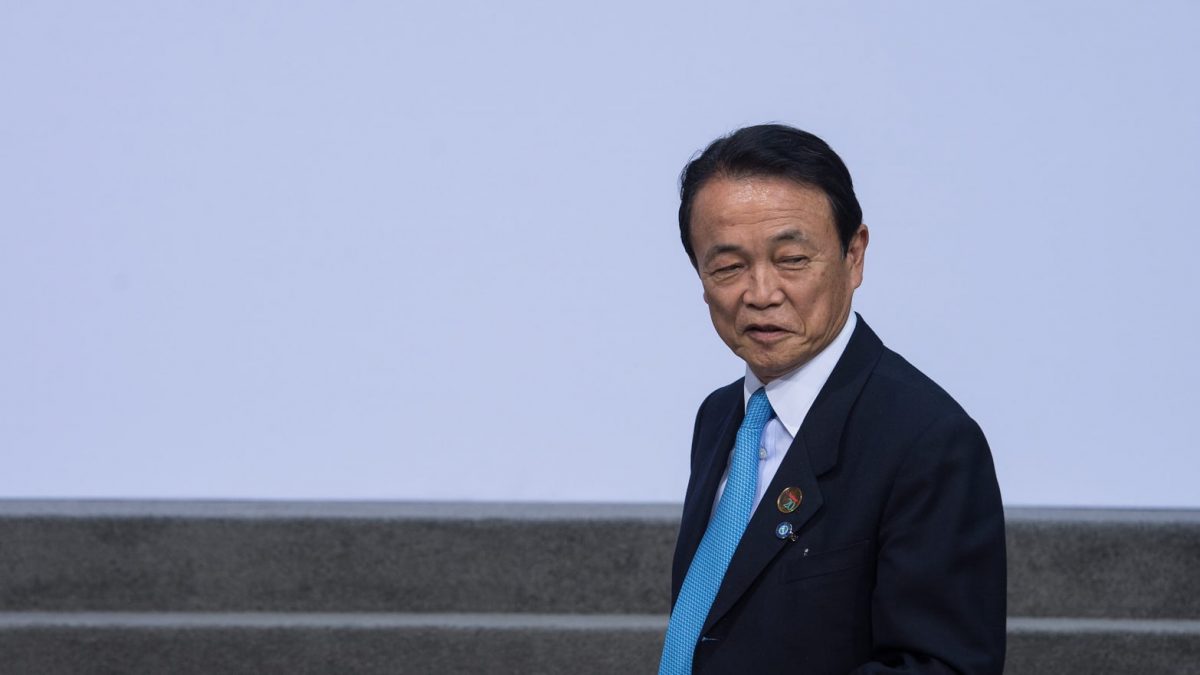
Japan’s success against the coronavirus without enforcing a strict lockdown is due to the citizens’ “cultural standard” that is different from other nations, Finance Minister Taro Aso said, drawing criticism from the public that the comments were inappropriate.
“Other countries have called me up and asked me if we’re the only ones with some drug against the virus or something,” Aso said on Thursday in response to a question from a lawmaker on Japan’s reputation of successfully containing the pandemic. “When I tell them ‘our country’s cultural standard levels are different to yours,’ they’re left speechless. That’s the simplest way to put an end to the questions.”
Despite the lack of harsh measures, Japan suffered far fewer coronavirus infections than any of its Group of Seven peers, with about 7 deaths per million, a track record that Aso noted in his comments. Japan isn’t an exception though in Asia, with Taiwan and South Korea reporting lower mortality rates. —Bloomberg
The revenue outlook could dim even more if markets react adversely to an awaited announcement by the US Federal Reserve, Finance Minister Pravin Gordhan warned on Tuesday.
“In respect of the revenue outlook in relation to the current economic growth that we are experiencing,… we are today facing more difficulties than anticipated.
“[This is] partly because of the very uncertain and volatile environment that we are experiencing globally, which could become worse when the chairman of the Federal Reserve of the US addresses us,” Gordhan told the National Assembly during debate on the 2013 Appropriation Bill.
Federal Reserve chairman Ben Bernanke is expected to indicate on Wednesday whether the US central bank will taper off its massive quantitative easing programme, which was designed to boost the recovery of the US economy.
“It is likely that if the markets don’t like what he is saying, or interpret what he is saying in a particular way, that could introduce shockwaves very similar to what we experienced about two weeks ago in the financial markets around the world, so prepare ourselves for that.
“All these uncertainties actually introduce uncertainty around the revenue picture,” Gordhan said.
Two weeks ago, the rand fell to a four-year low against the dollar. The US currency has strengthened in recent weeks, raising expectations that the Federal Reserve might start retreating from its bond-buying stimulus programme.
The bill putting into effect Gordhan’s R1.1 trillion 2013 budget was passed after often acrimonious debate, with opposition parties criticising the performance of one department after another and refusing to support the budget allocations for many.
Rising on the finance ministry’s budget, Democratic Alliance finance spokesman Tim Harris said it was not legitimate to blame the volatility of the rand and South Africa’s bleak growth outlook on quantitative easing.
Harris said the DA would vote for the department’s budget this year, but threatened not to do so in future if Gordhan were to bow to pressure from the ANC’s left-wing allies on fiscal policy.
Gordhan dismissed the criticism on finance policy as electioneering.
“As we get closer to elections, the temptation for fabrication becomes quite strong,” he said.
“The ANC, for the past 19 years, has led this country extremely well in terms of the fiscal management of this country…. There is no piece of fact that anybody can produce anywhere in South Africa that can accuse the ANC of being profligate, of being irresponsible, of not responding timeously to the events around us.
“We can’t be subjecting our public to the DA model of neo-liberalism and laissez-faire, which they want to cast upon South Africa.”
All opposition parties refused to support the presidency budget, in effect turning this vote into one of no confidence in President Jacob Zuma, with DA parliamentary leader Lindiwe Mazibuko saying South Africa could not afford another term of “leadership failure”.
Congress of the People leader Mosiuoa Lekota said he would not vote for the state security budget in protest against the Protection of State Information Bill which is awaiting the president’s signature.
Lekota said former president Nelson Mandela would never have signed the bill because it was a setback for freedom of speech. – Sapa
This website uses cookies to improve your experience. We'll assume you're ok with this, but you can opt-out if you wish. Cookie settingsACCEPT
Privacy & Cookies Policy
Privacy Overview
This website uses cookies to improve your experience while you navigate through the website. Out of these cookies, the cookies that are categorized as necessary are stored on your browser as they are essential for the working of basic functionalities of the website. We also use third-party cookies that help us analyze and understand how you use this website. These cookies will be stored in your browser only with your consent. You also have the option to opt-out of these cookies. But opting out of some of these cookies may have an effect on your browsing experience.
Necessary cookies are absolutely essential for the website to function properly. This category only includes cookies that ensures basic functionalities and security features of the website. These cookies do not store any personal information.
Any cookies that may not be particularly necessary for the website to function and is used specifically to collect user personal data via analytics, ads, other embedded contents are termed as non-necessary cookies. It is mandatory to procure user consent prior to running these cookies on your website.