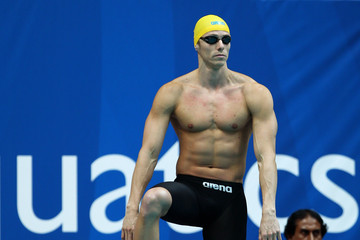
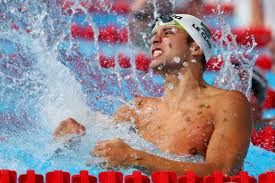
South Africa’s Cameron van der Burgh set a world record for the men’s 50 metres breaststroke in the qualifying heats at the world swimming championships in Kazan, Russia on Tuesday.
The defending champion’s time of 26.62 seconds broke his previous mark of 26.67 seconds, set at the world championships in Rome in 2009.
Team South Africa continues to fly the flag in FINA’s Swiming World Cup events.
After bagging 6 medals in the Eindhoven event last week, Roland Schoeman and Chad le Clos opened South Africa’s account with gold medals in Berlin, the German leg of the competition. South Africa’s veteran Schoeman got proceedings underway in fine style. The 33-year old, who claimed gold in the 50 metres breast stroke in the Eindhoven event last week, followed that up with another gold winning performance. With a time of 25, 65 seconds, Schoeman edged out Italy’s Fabio Scozolli.
Chad le Clos, the new superstar in world swimming, followed up on Schoeman’s triumph with yet another gold in his favourite event, the 200 meters butterfly. As is his habit, Le Clos started the race conservatively, but maintained his position with the leaders. Le Clos eventually charged to victory in a time of one minute, 49, 90 seconds.
Myles Brown became Team South Africa’s third medallist on the opening day of the competition. Brown claimed bronze in the men’s 400 meters Freestyle. The dynamic duo of Schoeman and le Clos ended the night in Berlin with another two pieces of silverware. In an exact replica of the event in Eindhoven, the pair claimed first and third places in the men’s 50 meter butterfly.
“After winning the 200m, people were saying that the time was not fast. So I just wanted to prove to everyone that I could win the 100 and do a fast time,” Le Clos said.
Le Clos, who had earlier in the competition won the 200m butterfly, was only fifth at the turn, but won in a time of 51.06, beating Hungarian Laszlo Cszeh by 0.39 seconds.
Poland’s Konrad Czerniak won the bronze In winning his second and South Africa’s fifth medal in the Palau Sant Jrodi in Barcelona, the 21-year-old broke his own South African record, which stood at 51.44.
Le Clos, who famously beat American superstar Michael Phelps in the 200m butterfly Olympic final last year and also won silver in the 100m, admitted that he had been nervous before the race.
“I was so worried last night, I did not get a lot of sleep in and I was really nervous this morning,” he said.
“But when I woke up half past three in the afternoon, I felt much more relaxed. The closer I got to the race, the more relaxed and confident I became and I thought that I really had a good chance of winning it.”
Le Clos said he was very happy that big names like Ryan Lochte were competing in the race. “The bigger the names, the bigger the hype is and it is good for the sport,” he said.
“Once the race starts, it makes no difference who is racing against me, I just want to win.”
He said winning the 100m felt different than winning the 200m. “This one is very special,” said Le Clos.
“Ryan Lochte came in and he really wanted to win. That gave the race extra flavour, I think it was one of the biggest races of the night.
“The crowd just would not keep quiet and I went: ‘Chad, don’t jump into the pool,’ and then I was getting nervous and I thought that it was time to get going.”
He said that when he came out, he still felt strong. “I am not even tired now, I feel like going again.” – Sapa
Michael Phelps has always talked about changing the sport of swimming. He certainly made it more exciting by collecting more Olympic medals than any other athlete in history. But where does the sport go now that its most visible star is retiring?
Swimming doesn’t have an established worldwide circuit, so the biggest chance its athletes have to be in the spotlight is at the games. Some top competitors feel it’s time to capitalize on the window of opportunity Phelps’ success and the games created.
“It is hard for swimmers, just because it’s every four years and we only really get one time to shine,” Phelps’ American rival Ryan Lochte told The Associated Press. “(A full-time circuit) is what we need if we want to make the sport bigger than what it is or what it was.”
In between Olympics and the biannual world championships, swimmers compete in a hodgepodge of international events such as the Pan Pacific championships, Asian Games, Pan American Games, Asian championships, European championships and Commonwealth Games.
“The calendar is so full that it’s impossible for coaches to understand how to accommodate the preparation, priorities and obligations of the athletes,” Cornel Marculescu, the executive director of swimming governing body FINA, said Monday.
The closest thing swimming has to an international regular season is the World Cup series – eight meets over six weeks starting in October with stops in Dubai, Doha, Stockholm, Moscow, Berlin, Beijing, Tokyo and Singapore.
The circuit pales in comparison to winter sport World Cups like the one in Alpine skiing, or even the Diamond League in athletics. It’s held in short-course venues that are half the size of Olympic pools, often failing to draw the top athletes.
During last year’s series, Phelps competed in just two World Cups, while Lochte has never been to one. Americans usually prefer to compete in USA Swimming’s Grand Prix series, but even in those events they’re not necessarily racing to win.
At a Grand Prix meet in Charlotte, North Carolina, in May, backstroker Nick Thoman swam with a beard, Phelps had a scruffy face and an unshaven body, while Lochte competed in a skimpy brief. Not exactly what you saw in London, where sleek, shaven swimmers competed in the latest compression racing suits.
Why so much disregard for these meets? Because swimming is a training-based sport, and for many countries the Olympics are all that really matters.
“Swimming is not cycling or tennis where you go from one circuit to another. It takes a long time to prepare for a very short moment and that’s the nature of the sport,” Australia head coach Leigh Nugent said.
More high-level competition could change the way athletes approach training. Many Olympic swimmers train nonstop for two, three or four years leading up to a games, with daily workouts of up to 10 miles (15 kilometers). That may turn out to be rewarding for the very best, but most of the nearly 1,000 swimmers who compete at an Olympics go home without a medal.
There’s also a worry that more racing won’t produce the routine record-breaking swims that an event like the Olympics does, because it’s impossible to train to reach that level of performance all the time.
“I say you just appreciate great racing. It doesn’t necessarily have to be a world record,” said American breaststroker Eric Shanteau, a cancer survivor who won a gold medal with the U.S. 4×100-meter medley relay squad. “It’s more about following the story of any one of us. It’s pretty interesting to see how we train and how we race during those years, not just how we race at the Olympics.”
Sponsorship plays a role, too. Current prize money at World Cup meets is just $1,000 for race winners, $500 for second place and $250 for third. Overall points leaders for men and women over the course of the series win prizes of $100,000 each.
Cameron van der Burgh of South Africa, who set a world record to win the 100 breaststroke at these games, suggested allowing swimmers to wear personal sponsors – even non-swimming brands – on their caps. That’s not allowed right now, but such sponsorship is common in other sports, such as skiing, where athletes sport logos on their headgear.
“Most sponsors come and go, ‘We would love to sponsor you, but how are we going to get the (exposure)?'” he said. “You can’t say, ‘OK when I hit the wall and win and they take my photo I’ll put your logo on my cap.’ That’s what’s stopping people.”
Total prize money for the U.S.-based Grand Prix series this year was about $20,000, although USA Swimming plans to multiply that by five or six times for the next edition.
“There’s kind of this sweet spot between having enough money to attract good athletes and from our financial team perspective of not having so much money involved that the top athletes are chasing the money at the expense of their training,” USA Swimming executive director Chuck Wielgus said. “The ultimate goal is the performance at the Olympics and everything works backward from there.”
Coaches met with FINA on Sunday to discuss possible changes to the World Cup.
While the World Cup is now based exclusively in Europe, the Middle East and Asia, not too long ago there were also stops in New York and Sydney. One of the problems for swimming organizers is finding pools with enough seating to host big events. In the U.S., Olympic trials, which draw thousands of spectators, are held in a temporary pool.
“The World Cup circuit is not a bad thing,” Swimming Canada CEO and coach Pierre Lafontaine said. “We have to figure out a way to make it more exciting, maybe a regional approach to meets and the winners of the regional go up to super series and so forth.”
Still, USA Swimming is content with its Grand Prix series, and doesn’t show any interest in the World Cup.
How about a drastic move like linking World Cup results to Olympic or world championship qualifying? That would certainly spice up the series.
“We sure hope not,” Wielgus said. “Part of our swimming culture in the United States is that we want to have the opportunity to select our Olympic team based on trials, not over a series of meets. … We’ll fight very hard to protect our right to do that.” – AP
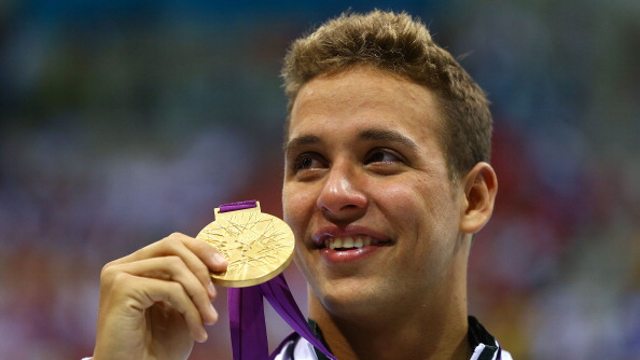
Chad le Clos with his gold medal, not good for South Africa's image as a "black" country
While white South African swimmers, Cameron van den Burgh and Chad Le Clos, have won gold medals at the Olympic games in London, complaints that “Team SA” is “too white” have surfaced. In a country where affirmative action requires black majorities everywhere, even racial quotas for sports teams, the sight of two young white men winning gold medals have jarred local sensibilities.
On Twitter, one member of the black elite tweeted “Whites will be hugged by the likes of @Sentletse @Mabine_Seabe @khayadlanga because of that Gold. #2012London I’ll wait for Caster’s Bronze”. Caster refers to Caster Semenya, the black female 800m athlete whose career has been marred by a controversy about her gender.
Whereas white faces are almost never shown in leadership positions on state TV, many of the black presenters for the Olympic games have enthused about “our gold medals” won by the the two white swimmers.
Sapa reports that former ANC Youth League president Julius Malema has defended the racial make-up of the SA Olympic team after suggestions that it was too white.
Malema was asked about the team during an interview with British Sky News on Tuesday.
The Sky News interviewer said: “It did strike me that there weren’t many black faces in the group for a black majority country.”
Malema said the team members were chosen because they were qualified.
“We think that we’re a non-racial country and all South Africans who have qualified to make Team SA should carry the flag proudly, and we support them,” he said.
“It’s not [any] more about the issue of colour.”
Malema said there was still a problem with poor communities not having access to sport. Sport Minister Fikile Mbalula was working to resolve this.
“It’s quite a serious challenge, but we’re still very proud of our Team SA,” Malema said.
This website uses cookies to improve your experience. We'll assume you're ok with this, but you can opt-out if you wish. Cookie settingsACCEPT
Privacy & Cookies Policy
Privacy Overview
This website uses cookies to improve your experience while you navigate through the website. Out of these cookies, the cookies that are categorized as necessary are stored on your browser as they are essential for the working of basic functionalities of the website. We also use third-party cookies that help us analyze and understand how you use this website. These cookies will be stored in your browser only with your consent. You also have the option to opt-out of these cookies. But opting out of some of these cookies may have an effect on your browsing experience.
Necessary cookies are absolutely essential for the website to function properly. This category only includes cookies that ensures basic functionalities and security features of the website. These cookies do not store any personal information.
Any cookies that may not be particularly necessary for the website to function and is used specifically to collect user personal data via analytics, ads, other embedded contents are termed as non-necessary cookies. It is mandatory to procure user consent prior to running these cookies on your website.